 Before we go in, I should warn you that Isa might jump out from somewhere. Act surprised. She'll leave you alone after that. 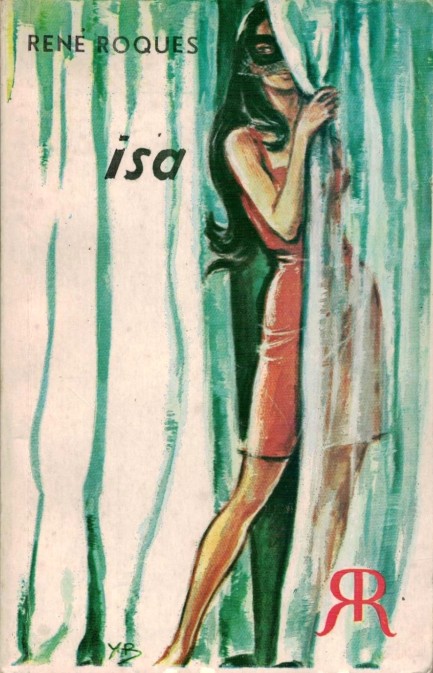
Above: a cover for the 1953 adventure Isa, written by René Roques and published by his Paris-based company Éditions R.R. Their cover art was often by Jef de Wulf, but this one is signed YB. We have no idea who that is, nor have we ever seen his or her work elsewhere, but it's an interesting effort. R.R. produced attractive covers even in collaboration with obscure artists, so some of the credit for their consistency probably goes to the company's art director—René Roques himself. Click his keywords below to see more.
 She's a rare example of prey that's more dangerous than her predators. 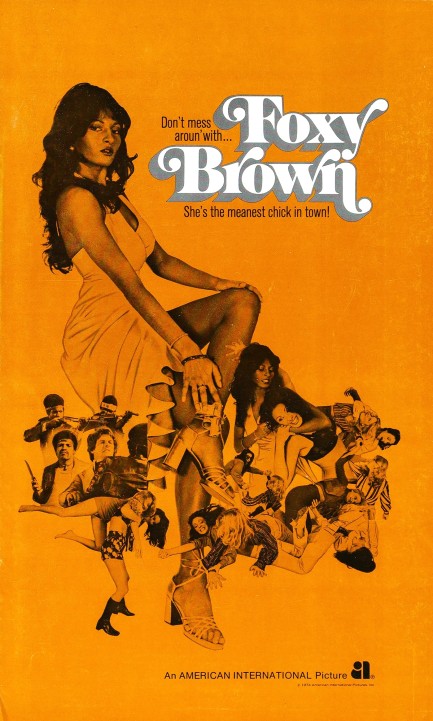 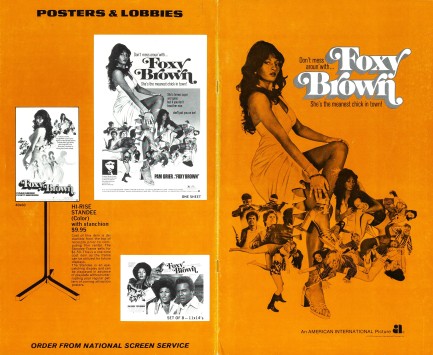
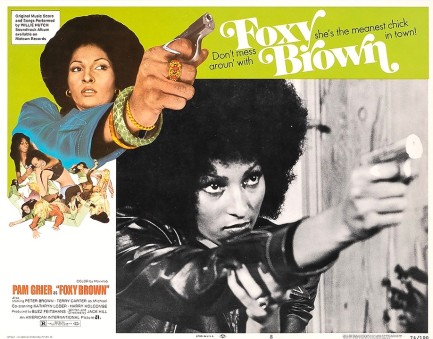
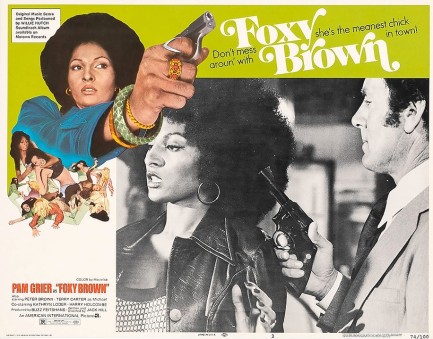
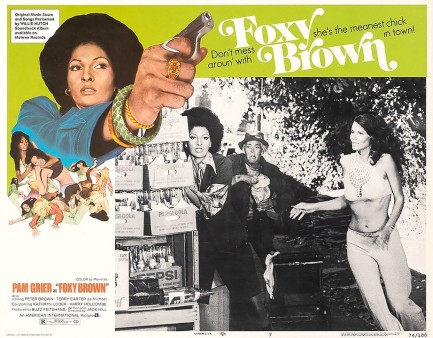
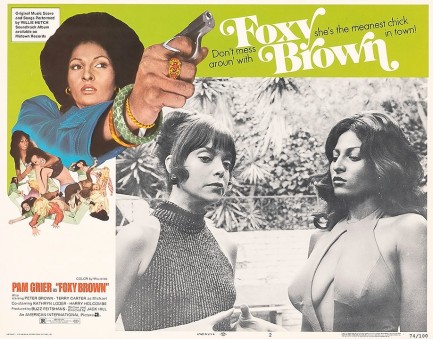
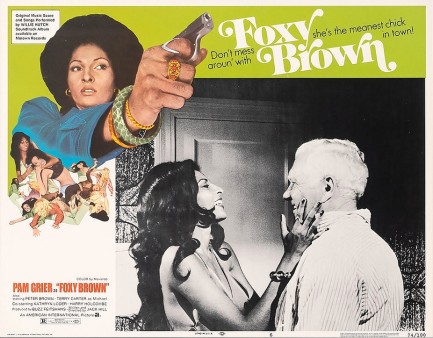
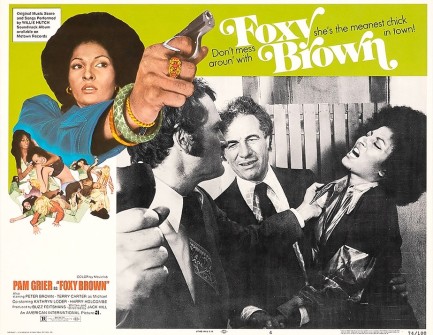
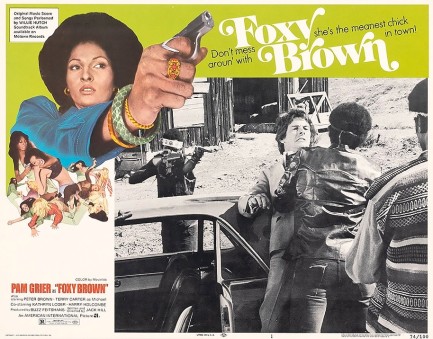
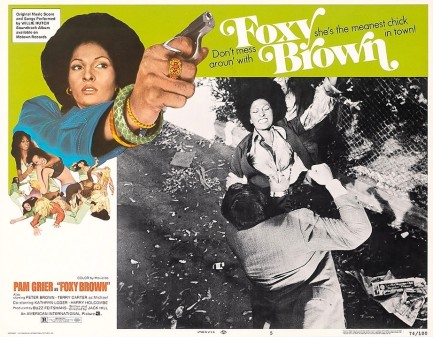
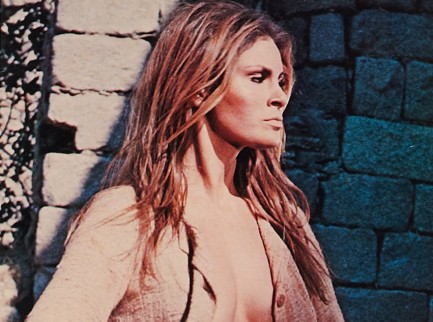
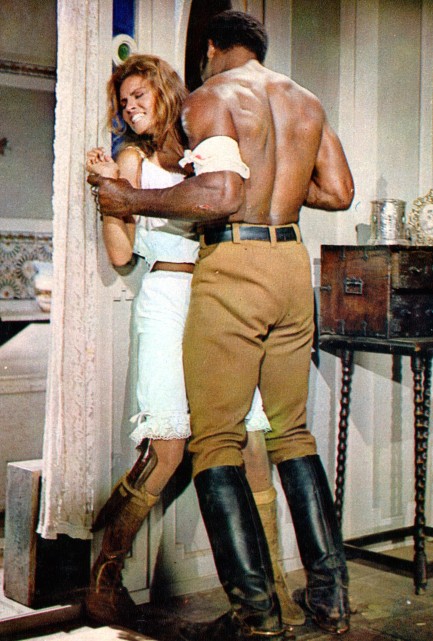
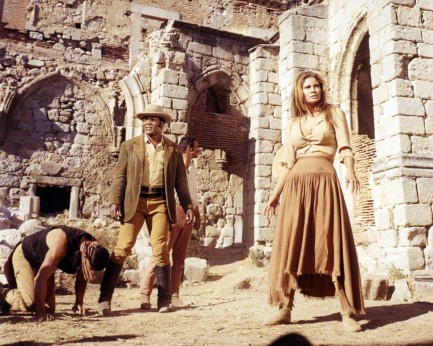
Above is a fun pressbook cover for the legendary Pam Grier's classic action movie Foxy Brown, a tangled tale of drug dealers, crooked cops, loan sharks, and narcs, which premiered in the U.S. today in 1974. When pressed against the wall Grier gets just as vicious as her screen foes. She even sets one guy on fire and runs another over—with a plane. There are no holds barred in blaxploitation cinema.
Below we also have various lobby cards from the film. These are interesting because they're made from production photos that you don't typically see online. It's too bad Grier's blaxploitation/action phase was short, because she was good in the films, even when the films weren't good enough for her. But every artist seeks to hone their craft, so we imagine she got tired of such roles. That's okay—her output, though limited, is always fun to re-watch.
As a side note, the hazards of blogging during the unethical digital age are amply illustrated here. Users on both Alamy and Getty attempt to assert copyright on these items, but movie promos are made for non-copyright holders to publicize the works depicted, and despite claims to the contrary individuals can't hold copyright on them. There are probably hundreds or thousands of these reproductions out there, all individually possessed, so a specific person claiming copyright is nonsensical on the face of it. Only the issuing studio holds copyright.
Even so, we occasionally get threatening e-mails from digital photo resellers. They're AI generated and automatically sent, which means they'll only increase in number as time goes by. We have a form e-mail we send back demanding proof of copyright. We never get a reply to it. Shockingly. We'll say this though—one day corporate greed will kill the blogging culture the same way it's killed most everything else. But that day isn't today. Read what we thought about Foxy Brown here.
 Relax, honey. They must be from that boat with the skull flag. I bet they're spring breakers on a booze cruise. 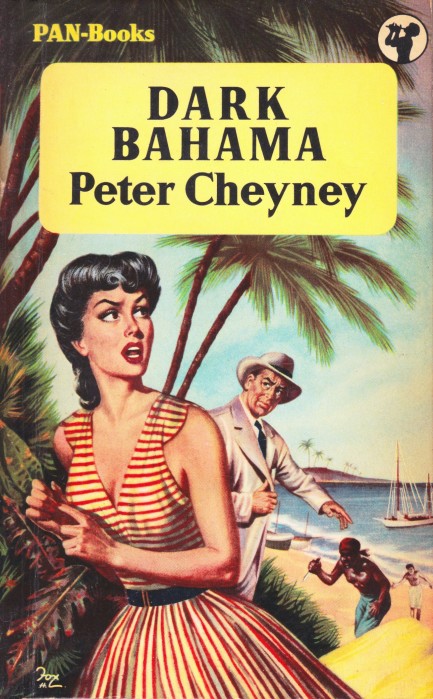
The 1960 Fontana edition of Peter Cheyney's Dark Bahama, with its unlucky man being mauled by a shark, is one of the craziest mid-century paperback covers you'll see. By contrast, the earlier 1957 edition above from Pan Books goes a bit more traditional. It was painted by Henry Fox, easily recognizable thanks to his unique signature at lower left. The book is unique too. Feel free to read the earlier write-up to find out how.
 And fired last. Which is ideally how you want these things to go. 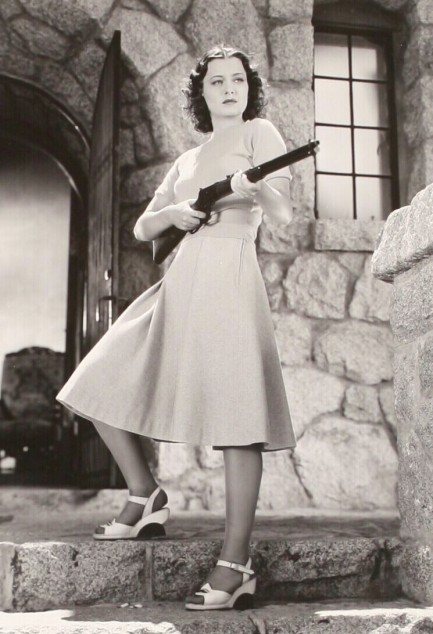
The above photo of U.S. actress Ellen Drew was made when she was filming her 1940 western Texas Rangers Ride Again, which is a surprise, because she's isn't dressed Old West style, with her leg-exposing skirt and open toed shoes. We guess even cowgirls get the blues—when it comes to wearing those hoop skirts and corsets. This is Drew's third femme fatale appearance. You can see the other two here and here.
 Gloria Grahame is a bad mamma scamma. 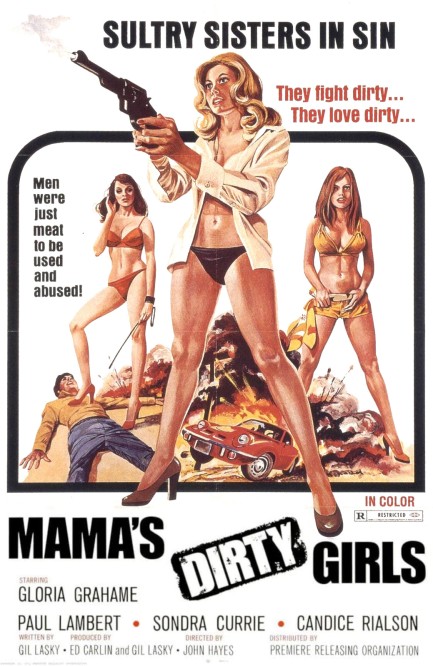
We had to watch Mama's Dirty Girls, not because it's a 1970's grindhouse movie (though that helped), but because none other than 1950s femme fatale Gloria Grahame got snared in this low budget affair. Sometimes the bills simply need to be paid. Or maybe she thought the script was dynamite. Either way, she gets top billing in this drive-in quality drama that premiered today in 1974, which tells the story of a scam artist mother and her three daughters who are honeytrap serial killers dispatching men for their money.
When Grahame gets another rich man on the hook, she foolishly poses as a well-to-do widow without realizing that her target is likewise seeking to kill someone for their money. This twist is ironic, and the mutual murder attempts that follow can be read as black comedy if you peer deeply between the lines, but in our opinion Mama's Dirty Girls doesn't have enough brainpower to be satire. Grahame probably wished it were, though—then she'd have had an excuse for starring in it. Sadly, it's just an amusingly bad movie. Everyone is terrible in it—even Grahame. And there isn't near enough eroticism to save it.
But you may want to watch it anyway. The cast is beautiful, particularly Currie, and there's an interesting value-added co-star too. Fifteen minutes into the movie's running time you'll see an actress that'll make you go, “Who is that?” You'll be reacting to the radiant beauty of bit player Annika Di Lorenzo, née Marjorie Lee Thoreson, who was a Penthouse centerfold in 1973 and later carved out a career in b-cinema. Besides Mama's Dirty Girls she appeared in such films as 1974's Act of Vengeance and The Centerfold Girls, 1980's Dressed To Kill, and 1979's big budget porn epic Caligula.
She later sued Penthouse publisher Bob Guccione, claiming that he forced her to have sex with business associates, and tricked her into the infamous Caligula orgy. She won a $4 million punitive judgement, but lost it in an appeal. Guccione took revenge by publishing a lesbian pictorial of Di Lorenzo. Afterward, she stepped away from the limelight, but in 2011 hit newspapers again when she washed up dead on Camp Pendleton Beach in San Diego under baffling circumstances. Police suggested suicide, but her family contended that it was foul play, possibly perpetrated by someone from the military base. In the end, her case was closed as unsolved, and today remains another Hollywood mystery.    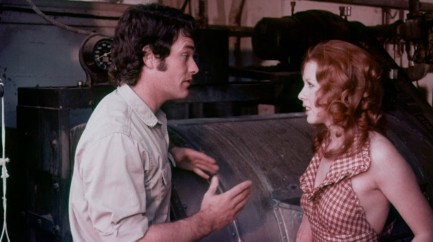      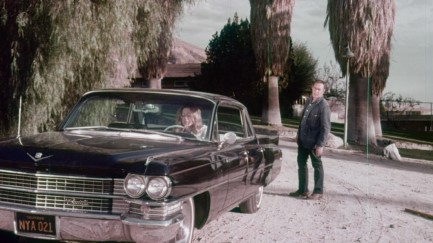   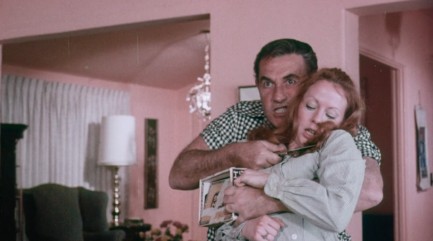 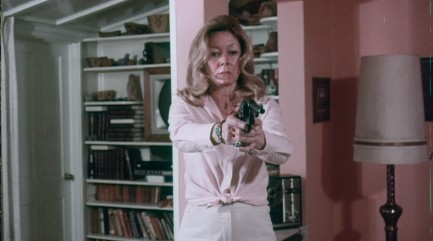 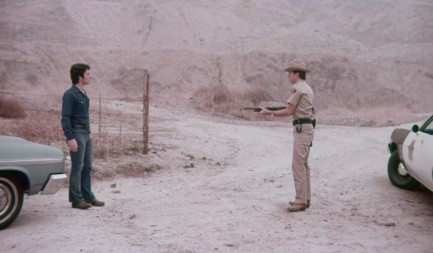
 If you jump without looking you might get swept away. 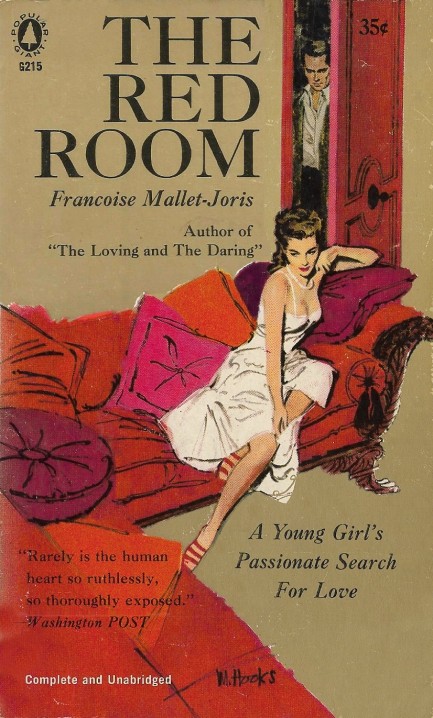
The book you see above, a 1958 Popular Library edition of The Red Room by Belgian author Françoise Mallet-Joris, was picked up for us by a friend who thought he was buying a pulp novel. He was attracted by the cover, and it's indeed fine work, from the skilled brush (and possibly ink quill and charcoal pencil) of Mitchell Hooks. As for the novel, it was originally published in 1955 as La chambre rouge and was a sequel to 1951's Le rempart des Béguines.
When someone buys us a book we always read it out of appreciation and respect, even romance novels, and in reading The Red Room we were reminded once again of the skill gap between literary and crime fiction. There are obviously excellent, transcendent crime writers (and literary fiction that misses the mark), but Mallet-Joris—even translated—spins evocative phrases as deftly as a weaver with a loom. Like this one:
The presence of winter—vulgar winter, befurred and jangling her crystal adornments—was scarcely felt in the small white and gold drawing room.
Isn't that nice? It's not Hammett describing a gangster popping off shots in a crowded bar, but it's still fun to read. The tale is a coming of age breast-beater set in Gers, France in which the main character, eighteen-year-old Hélène Noris decides to steal the dashing young film director her hated stepmother Tamara has earmarked for extra-marital games. That actually sounds kind of pulp, doesn't it? Well, just wait.
At some point it becomes clear that Hélène had been Tamara's young lover (probably this is the central plot of the previous book). Tamara and Hélène had been carrying on, but in order to secure for herself a stable existence Tamara decided to marry Hélène's father. Thus, The Red Room charts Hélène as she impulsively steals her stepmother's crush, only to find herself getting in too deep with someone who's more experienced and decisive than any man she's known.
Needless to say, that plot sounds like some of the sleaze novels we highlight here, which would make you wonder, in terms of public perception, at which point the lowbrow becomes highbrow. And the easy answer to that is: when you can write like Mallet-Joris and critics adore you. Overall, The Red Room is probably a little too genteel and interiorized for most pulp readers, but we liked it. Consider that less a recommendation than an acknowledgment of talent.
 
 That's a tempting invitation, but the hospital has a very strict code of ethics. So we'll have to do it at your place. 
Above: a Harry Barton cover for Stuart Friedman's 1960 sleazer The Way We Love, an “unconventional novels of manners and morals in a modern hospital.” Uh huh. We bet we know what's unconventional about it. Something of note here: the cover for Friedman's 1962 effort The Surgeons is a near-duplicate of this, but painted by Harry Schaare. We wonder if that's chance, or if Monarch's art director influenced the final product. Curious. We have a lot more medical covers in the website. See a small portion of them here, here, here, here, here, and here.
 All you need is one part Reiko and you'll be completely intoxicated. 
Above is another look at Reiko Ike perched on a Kyoto bartop from a 1972 promo series that appeared in the Japanese magazine Heibon Punch. As we mentioned, the location was used in her action movie Sukeban gerira. We'll try to get around to posting more shots from the series at some point. In the meantime, you can see the previous photo here.
 Thank you very much. Next I'd like to massacre a song by Joan Baez. 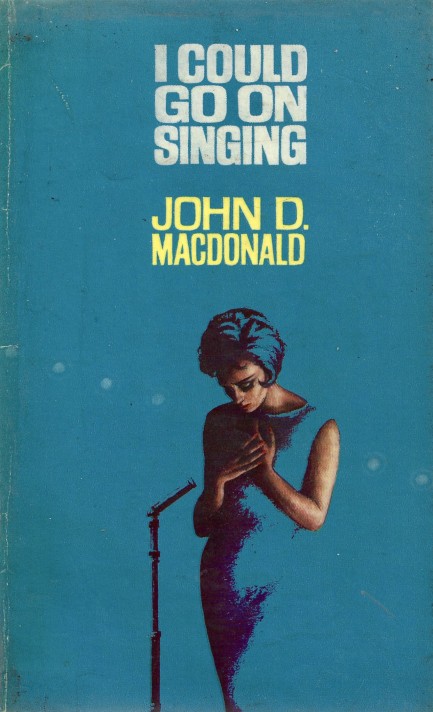
Since we took a look at Barbara Walton's cover work recently we thought we'd circle back to her with an effort for John D. MacDonald's I Could Go On Singing, originally published in 1963 with this Robert Hale Ltd. hardback coming in ’64. This is very different, very minimalist work from Walton compared to what we showed you last time, but it just demonstrates her broad range. It's different work for pop fiction icon MacDonald too, as it was a novelization for a 1963 movie of the same name. Hey, whatever pays the bills. We didn't read it, but we gather that he managed to put his unique stamp on it.
|
 |

The headlines that mattered yesteryear.
1986—Otto Preminger Dies
Austro–Hungarian film director Otto Preminger, who directed such eternal classics as Laura, Anatomy of a Murder, Carmen Jones, The Man with the Golden Arm, and Stalag 17, and for his efforts earned a star on Hollywood's Walk of Fame, dies in New York City, aged 80, from cancer and Alzheimer's disease. 1998—James Earl Ray Dies
The convicted assassin of American civil rights leader Martin Luther King, Jr., petty criminal James Earl Ray, dies in prison of hepatitis aged 70, protesting his innocence as he had for decades. Members of the King family who supported Ray's fight to clear his name believed the U.S. Government had been involved in Dr. King's killing, but with Ray's death such questions became moot. 1912—Pravda Is Founded
The newspaper Pravda, or Truth, known as the voice of the Communist Party of the Soviet Union, begins publication in Saint Petersburg. It is one of the country's leading newspapers until 1991, when it is closed down by decree of then-President Boris Yeltsin. A number of other Pravdas appear afterward, including an internet site and a tabloid. 1983—Hitler's Diaries Found
The German magazine Der Stern claims that Adolf Hitler's diaries had been found in wreckage in East Germany. The magazine had paid 10 million German marks for the sixty small books, plus a volume about Rudolf Hess's flight to the United Kingdom, covering the period from 1932 to 1945. But the diaries are subsequently revealed to be fakes written by Konrad Kujau, a notorious Stuttgart forger. Both he and Stern journalist Gerd Heidemann go to trial in 1985 and are each sentenced to 42 months in prison. 1918—The Red Baron Is Shot Down
German WWI fighter ace Manfred von Richthofen, better known as The Red Baron, sustains a fatal wound while flying over Vaux sur Somme in France. Von Richthofen, shot through the heart, manages a hasty emergency landing before dying in the cockpit of his plane. His last word, according to one witness, is "Kaputt." The Red Baron was the most successful flying ace during the war, having shot down at least 80 enemy airplanes. 1964—Satellite Spreads Radioactivity
An American-made Transit satellite, which had been designed to track submarines, fails to reach orbit after launch and disperses its highly radioactive two pound plutonium power source over a wide area as it breaks up re-entering the atmosphere.
|

|
|
It's easy. We have an uploader that makes it a snap. Use it to submit your art, text, header, and subhead. Your post can be funny, serious, or anything in between, as long as it's vintage pulp. You'll get a byline and experience the fleeting pride of free authorship. We'll edit your post for typos, but the rest is up to you. Click here to give us your best shot.

|
|