| Hollywoodland | Apr 25 2016 |

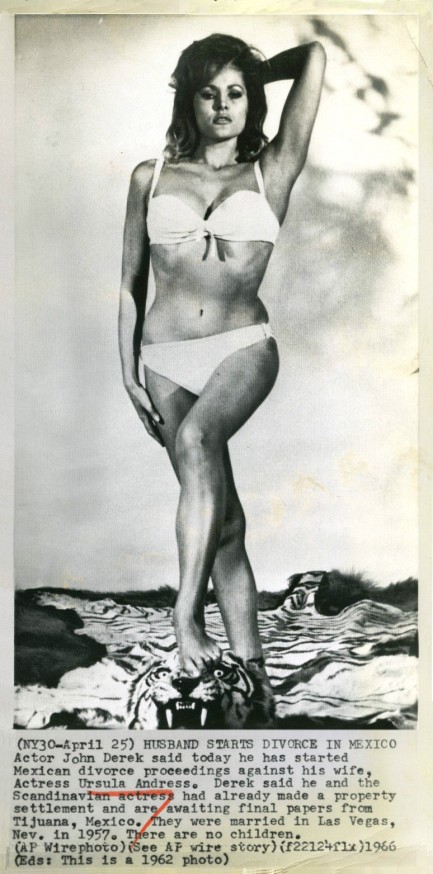
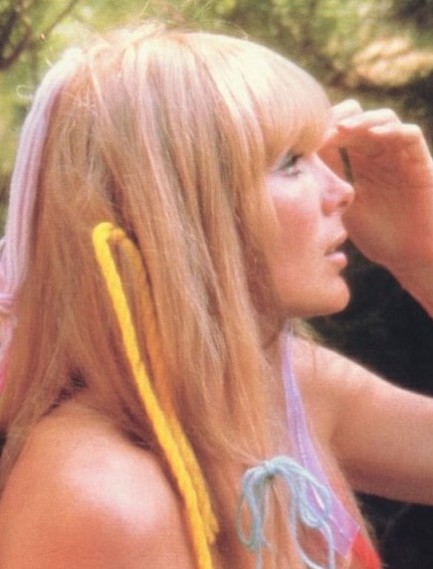
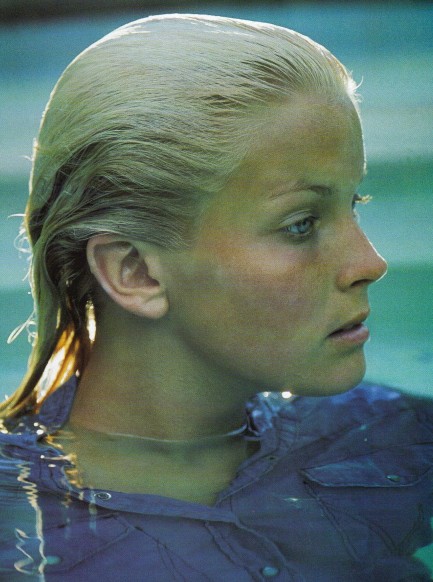
If you've never seen one, this is what an AP wire photo looked like back in 1966. The text at the bottom gives newspaper editors the identity of the subject and some basic facts. No identity needed here—this is Ursula Andress, and the photo is the one widely used when newspapers reported that her husband John Derek was filing for divorce in Tijuana, Mexico. This made us smile because the basic idea here was to show that Derek was out of his mind. Perhaps, however he had already established a pattern of moving on to younger, equally beautiful women. He was first married to Pati Behrs, but divorced her when he met nineteen-year-old Andress. She was thirty when they divorced and he moved on to twenty-three-year-old Linda Evans. And Evans was thirty-two when Derek tossed her over for sixteen-year-old Mary Collins, who you know better as Bo Derek. Andress, Evans, and Collins could have been sisters, and in fact they looked quite a bit like John Derek too (see below). But in Bo he had found not just another doppleganger, but an ingénue willing to star in the poorly made sexually oriented films he liked to direct. These included Fantasies (when Bo was sixteen), the almost competent Bolero, Ghosts Can't Do It, and Tarzan, the Ape Man. Bo and John John Derek stayed together until John died, a span of twenty-two years, so it seems wife number four cured him of his habit of trading for younger models. Just an interesting Hollywood factoid to enliven your Monday.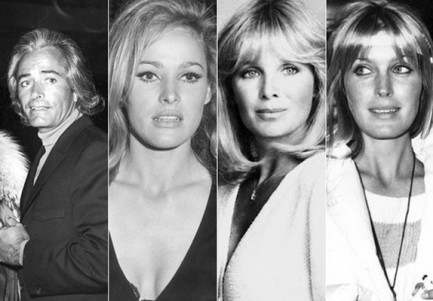


| Vintage Pulp | Apr 24 2011 |

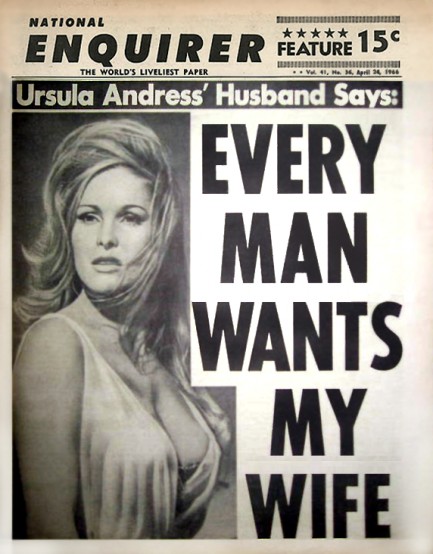
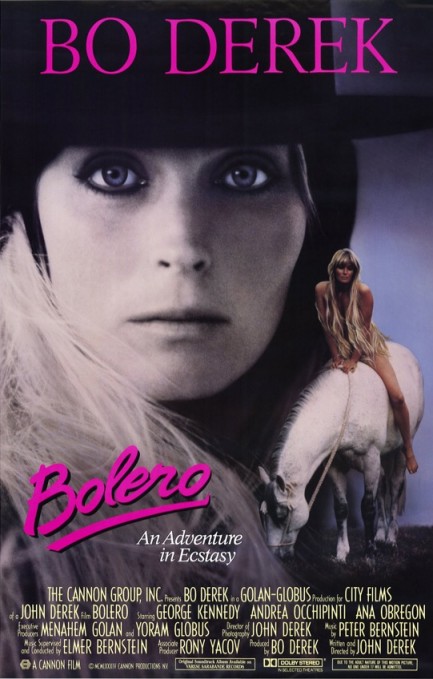
Here’s an interesting National Enquirer cover from today in 1966, with a scrunched Ursula Andress and a quote from her husband John Derek, who never actually had a problem sharing her, or for that matter any of his spouses—at least artistically. He shot and published nude series of second wife Andress, third wife Linda Evans, and fourth wife Bo Derek, and directed Derek in the softcore bomb Bolero, which contained a sex scene that had filmgoers asking at the time if maybe Bo and her partner went beyond mere acting. John Derek is actually worthy of a separate discussion sometime, so maybe we’ll get back to him. He was also eerily consistent—Andress, Evans and Derek are virtually clones of one another. See below.

| Vintage Pulp | Jul 14 2010 |

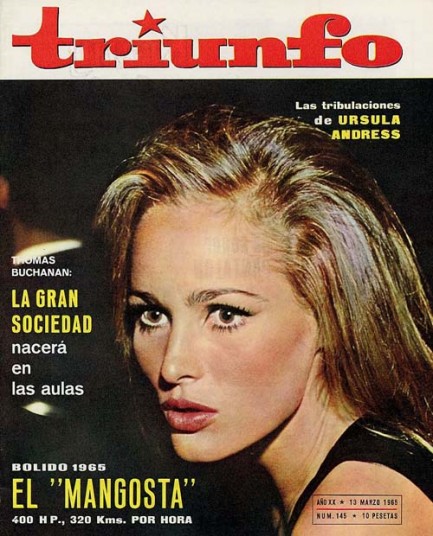
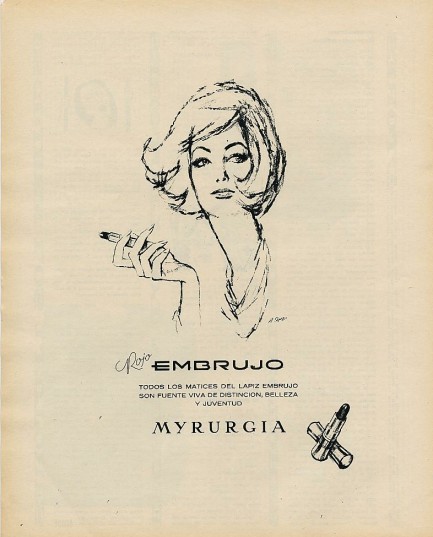
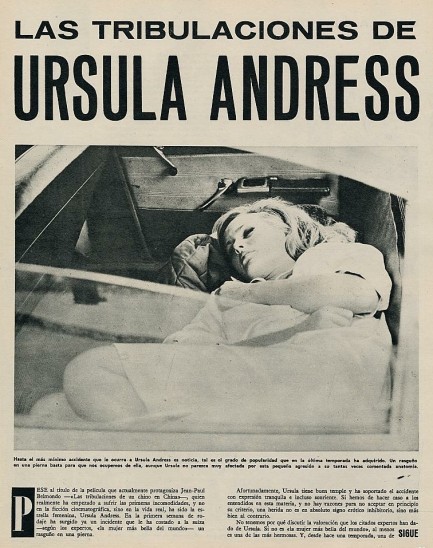
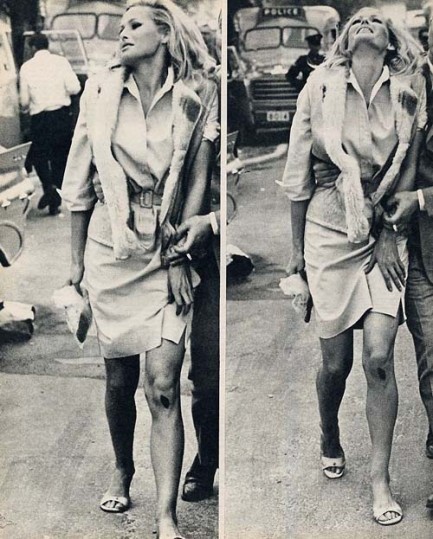
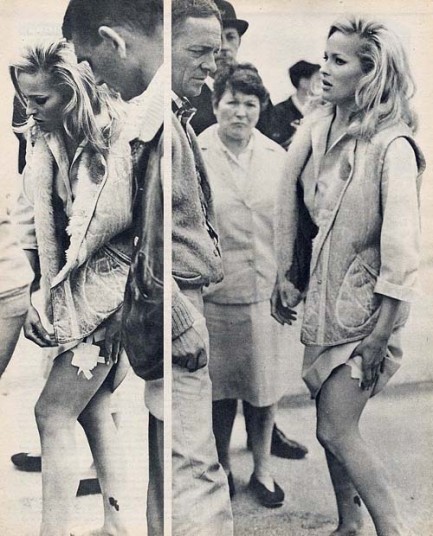

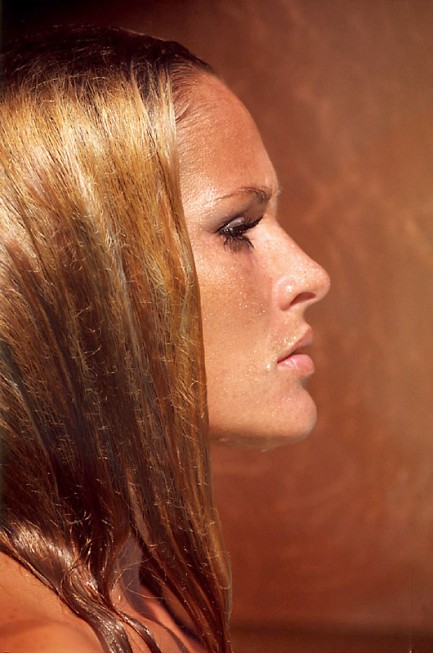
Above are the cover and several interior pages from Spain’s Triunfo, with Swiss actress Ursula Andress, who according to the magazine was the most beautiful woman in the world. Andress was starring opposite Jean-Paul Belmondo in the French action adventure Les tribulations d’une Chinois in Chine, based on Jules Verne’s Tribulations of a Chinaman in China, and released in the U.S. as Up to His Ears. The article discusses among other things how Andress injured herself during the first week of the physically demanding shoot, and you can see a scab on her knee and calf, as well as a bandage on her thigh. While she perhaps didn’t have a gazelle’s grace, she did seem to possess a siren’s allure—her rumored affair with Belmondo supposedly ruined her marriage to John Derek, and this may not have been her first affair. However, it seems possible that the marriage failed for reasons other than fidelity, since John Derek did not seem to be a possessive husband (if his willingness to share his fourth wife Bo is any indication). Anyway, not be overlooked is Pamela Tiffin, who appears in the centerfold. We’ll have more on Tiffin later.

| Modern Pulp | Aug 31 2009 |

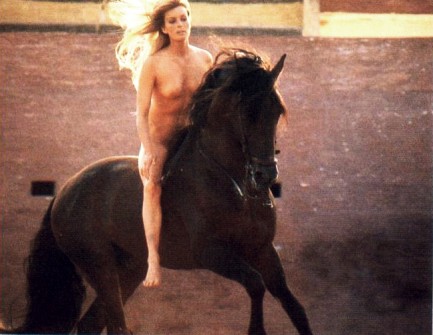
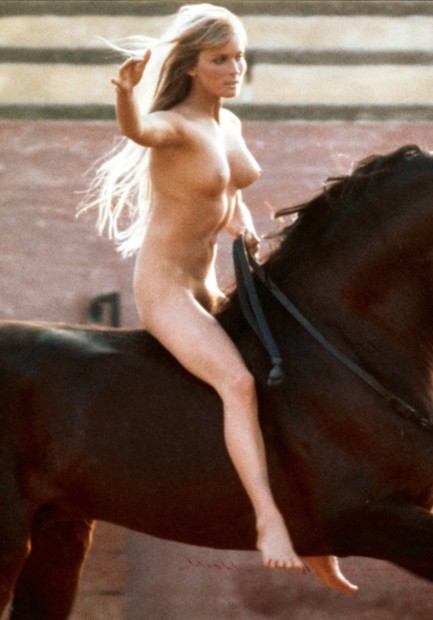

| Vintage Pulp | Mar 25 2009 |

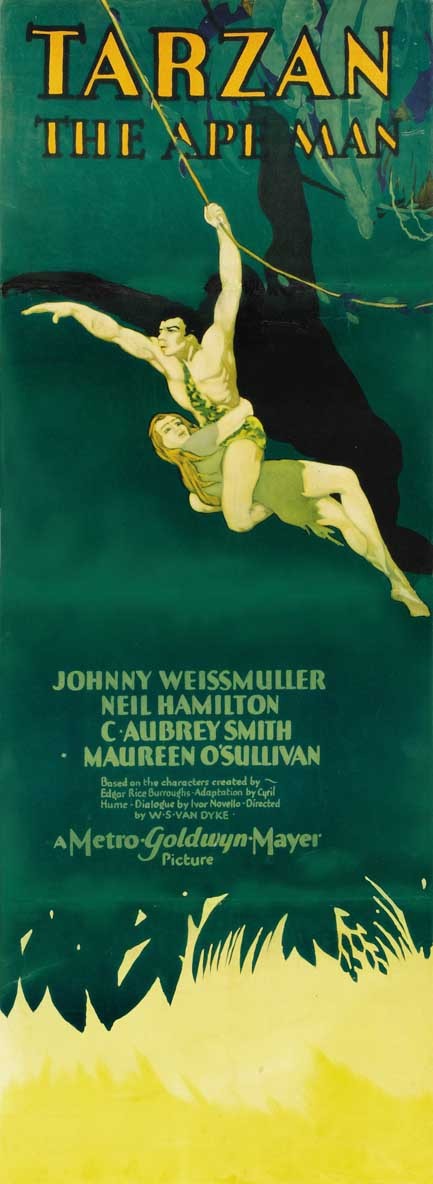
This is one of the most beautiful posters we’ve ever seen. Based on the fiction of Edgar Rice Burroughs, Tarzan the Ape Man was the first offering in a film and television franchise that has been sixty-plus years running. It has taken forms as diverse as Bo Derek’s teasingly awful 1981 softcore remake, Jock Mahoney’s 1962 potboiler Tarzan Goes to India, and Casper Van Diem’s 1998 career-killer Tarzan and the Lost City. None of these would have been possible without the original Tarzan, and that film worked for one reason—Romanian-born hunk Johnny Weissmuller. He was not an actor trying to fit the role of a superman, but a superman trying to fit the role of an actor. He was a six foot three inch Olympic swimmer who won 67 world and 52 national titles, and whose physicality radiated from the movie screen. Men wanted to be him, and women wanted to ride his vine. Tarzan the Ape Man premiered in the U.S. today in 1934.