John Travolta sets the recording straight. 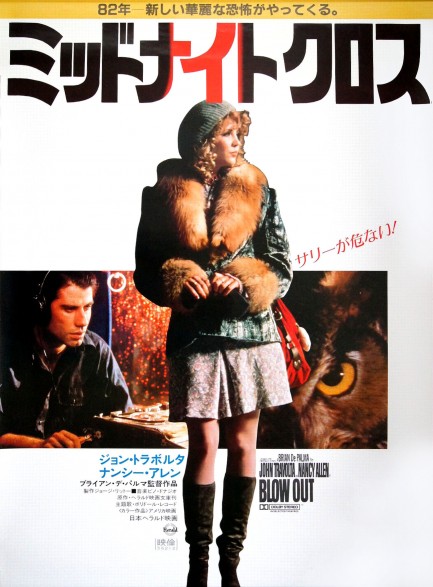
Above is a Japanese poster for Brian De Palma's 1981 thriller Blow Out, his update of the classic British thriller Blowup. In the latter film a photographer thinks he's accidentally shot a photo of a murder, and in Blow Out a movie sound man thinks he's accidentally recorded one. And indeed he has, a political assassination actually, which brings highly connected villains out of the woodwork to engineer a cover-up. The movie stars John Travolta in his hunk incarnation, pouting his way through the twists and turns of the mystery, along with Nancy Allen as his shakedown artist sidekick. De Palma's movies often underwhelm upon release but usually age well. This is a good example. Audiences were cool toward Blow Out but it's a solid, giallo influenced thriller, wrapped in Kennedyesque conspiracy. It premiered in the U.S. in the summer of 1981 and reached Japan today in 1982 with the title ミッドナイトクロス, or Middonaito kurosu, which means “midnight cross.” 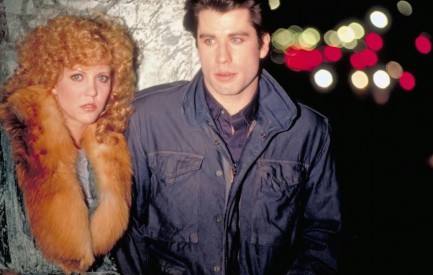 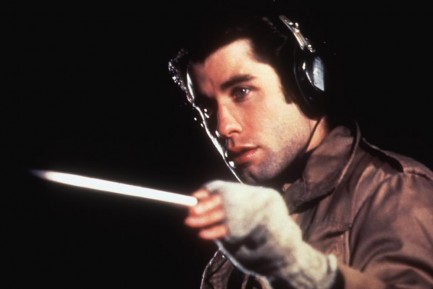 
 Pacino arrives in Korea in a hail of bullets. 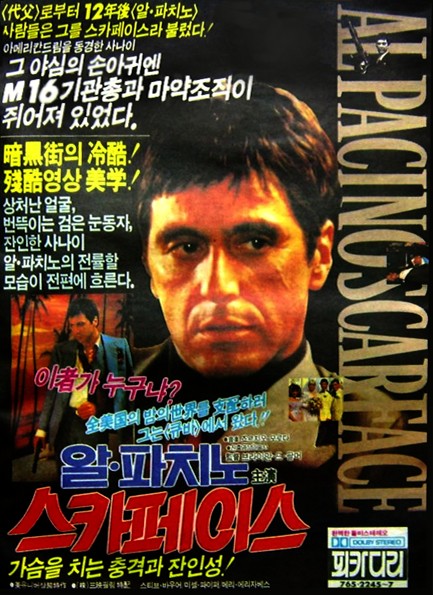
Something completely different today, this is a South Korean poster for the 1983 Brian De Palma thriller Scarface, which didn’t open there until December 1984. We have no idea what all that info packed on the poster says. Maybe something about how this is the most violence to hit Korean shores since the end of the war. The image, by the way, is not a nice clean scan, but rather a digital photo shot through a store window. It looks pretty good, though, no? Anyway, we have others and maybe we’ll share those later.
 I want the world, chico, and everything in it. 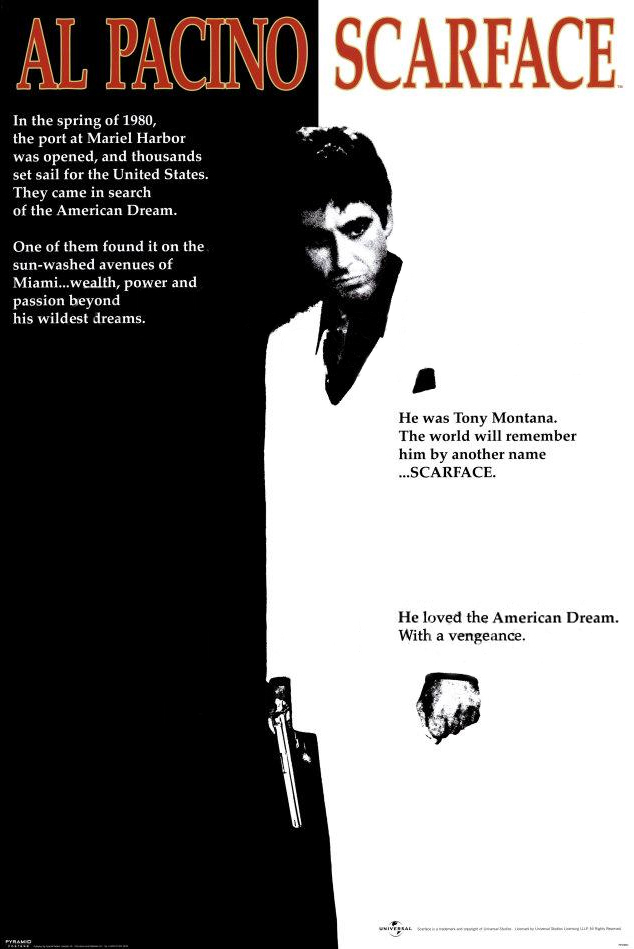
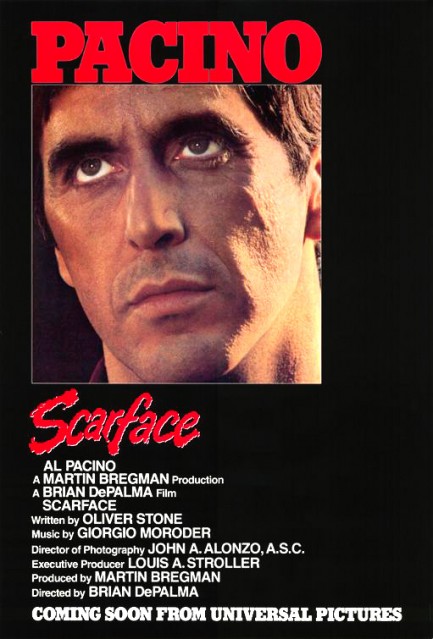
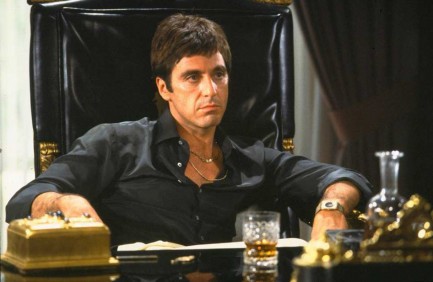
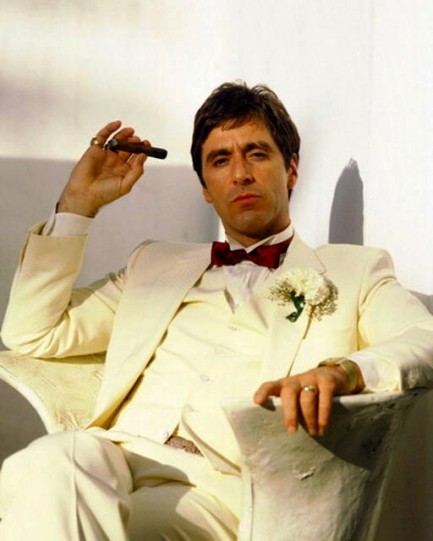
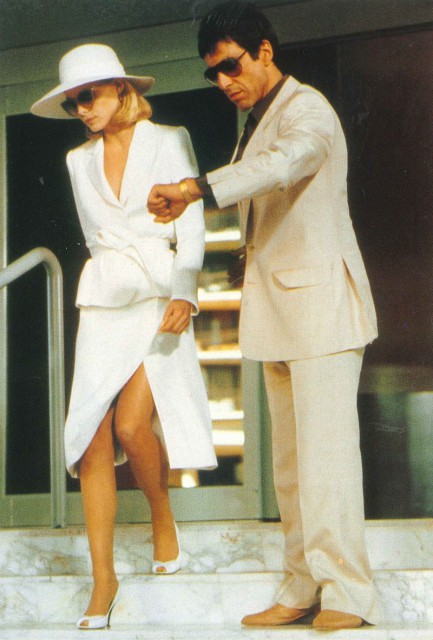
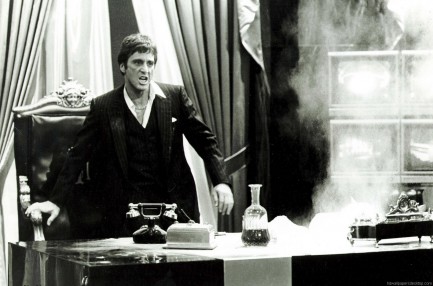
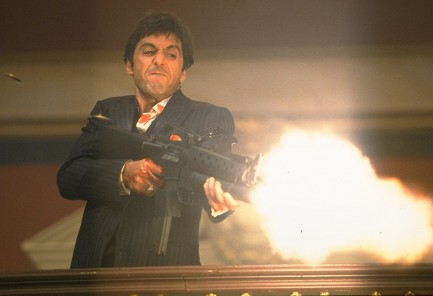
It was called Scarface, but it had nothing to do with Howard Hawks’ 1932 classic. No, this version was a big, beautiful, transgressive mess cooked up by Oliver Stone, directed by Brian de Palma, and brought to life by Al Pacino, with an icy assist from Michelle Pfieffer. You couldn’t take your eyes off it, even during the gut-wrenching chainsaw scene. When this post-gangster epic ended in a storm of cordite, coke dust, sparks, and blood spray, you realized you’d barely breathed during the final ten minutes. Many critics panned it, yet it established its own cinematic cult and, we think it’s fair to say, will remain relevant for a very long time. Even its promo art is among the most iconic in film history. We've posted one above, and two lesser-known versions below. Scarface premiered today in 1983.
|
 |

The headlines that mattered yesteryear.
1967—First Space Program Casualty Occurs
Soviet cosmonaut Vladimir Komarov dies in Soyuz 1 when, during re-entry into Earth's atmosphere after more than ten successful orbits, the capsule's main parachute fails to deploy properly, and the backup chute becomes entangled in the first. The capsule's descent is slowed, but it still hits the ground at about 90 mph, at which point it bursts into flames. Komarov is the first human to die during a space mission. 1986—Otto Preminger Dies
Austro–Hungarian film director Otto Preminger, who directed such eternal classics as Laura, Anatomy of a Murder, Carmen Jones, The Man with the Golden Arm, and Stalag 17, and for his efforts earned a star on Hollywood's Walk of Fame, dies in New York City, aged 80, from cancer and Alzheimer's disease. 1998—James Earl Ray Dies
The convicted assassin of American civil rights leader Martin Luther King, Jr., petty criminal James Earl Ray, dies in prison of hepatitis aged 70, protesting his innocence as he had for decades. Members of the King family who supported Ray's fight to clear his name believed the U.S. Government had been involved in Dr. King's killing, but with Ray's death such questions became moot. 1912—Pravda Is Founded
The newspaper Pravda, or Truth, known as the voice of the Communist Party of the Soviet Union, begins publication in Saint Petersburg. It is one of the country's leading newspapers until 1991, when it is closed down by decree of then-President Boris Yeltsin. A number of other Pravdas appear afterward, including an internet site and a tabloid. 1983—Hitler's Diaries Found
The German magazine Der Stern claims that Adolf Hitler's diaries had been found in wreckage in East Germany. The magazine had paid 10 million German marks for the sixty small books, plus a volume about Rudolf Hess's flight to the United Kingdom, covering the period from 1932 to 1945. But the diaries are subsequently revealed to be fakes written by Konrad Kujau, a notorious Stuttgart forger. Both he and Stern journalist Gerd Heidemann go to trial in 1985 and are each sentenced to 42 months in prison.
|

|
|
It's easy. We have an uploader that makes it a snap. Use it to submit your art, text, header, and subhead. Your post can be funny, serious, or anything in between, as long as it's vintage pulp. You'll get a byline and experience the fleeting pride of free authorship. We'll edit your post for typos, but the rest is up to you. Click here to give us your best shot.
|
|