| The Naked City | Nov 23 2010 |

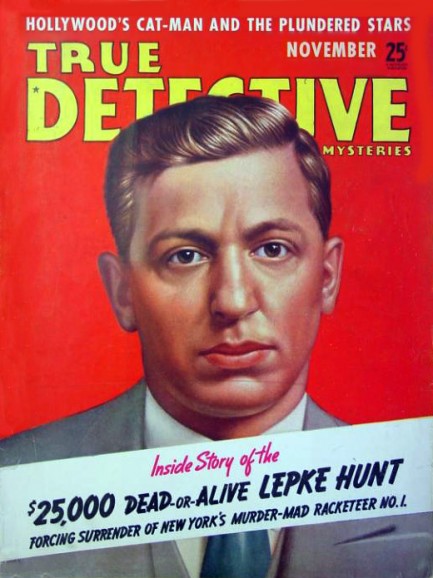
This True Detective from November 1939 features a cover painting of mobster Louis “Lepke” Buchalter, whose flight from authorities had taken him from the U.S. to Mexico, and then to Costa Rica, Puerto Rico and Cuba, and across the ocean to England, France and Germany. Buchalter had begun his career in organized crime by shaking down pushcart operators in Brooklyn, and had risen through the ranks of the criminal-controlled fur industry by doing every type of dirt imaginable, from issuing threatening phone calls to garment union activists to throwing acid in a competitor’s face. Eventually he was running a criminal empire that stretched to both coasts, and was acting as head of the infamous assassination squad Murder, Inc.
In 1936 Buchalter went into hiding after he became aware that criminal charges were being prepared against him. Not long after he dropped out of sight, he was indicted for smuggling an estimated $10 million in heroin into the U.S. from Hong Kong. The FBI printed a million posters and displayed them in every post office, police station, and federal building in America. All this attention was a problem for U.S. mob bosses, and so with characteristic unsentimentality, they decided Buchalter had to surrender. Convincing him was not difficult. While he undoubtedly had the flair and intelligence to dodge the feds indefinitely, living in another country away from the old neighborhood and away from the hundreds of underlings who respected him was not his style. Buchalter was a mobster through-and-through. To him, an anonymous existence, even in a tropical paradise or cosmopolitan foreign capitol, was little different from being in prison.
Buchalter’s associates got word to him that if he came back to the U.S. he would be able to surrender personally to J. Edgar Hoover. Surrendering to the Feds meant he would not face a more serious group of charges brought by Manhattan D.A. Thomas Dewey. But it was wishful thinking. The federal charges were rapidly followed by Dewey’s charges and Buchalter earned a fourteen-year jolt in the pen. His legal team hoped to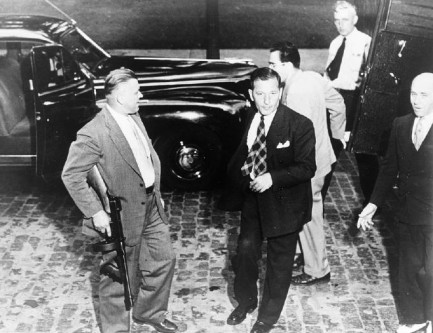 have the sentence reduced via appeals and procedural maneuvers, but when a snitch fingered Buchalter for ordering the murder of a candy store owner named Joe Rosen, he was tried for the killing, convicted, and sentenced to execution. By some estimates Buchalter had been responsible for a thousand murders as head of Murder, Inc., but all it took was one to seal his fate. Louis "Lepke" Buchalter was electrocuted in Sing Sing prison's famous "Old Sparky" electric chair on March 4, 1944, perhaps while realizing life on a beach in Costa Rica hadn’t been so bad after all.