Vintage Pulp May 7 2011
MEN OF ACTION
Fortune favors the bold.

Above, four issues of the weekly pulp magazine Argosy from 1937 through 1940 with three covers from Rudolph Belarski and one from Marshall Frantz, plus early fiction from L. Ron Hubbard. These all came courtesy of our friends over at National Road Books, whose store you can visit via the little linkee here. 

diggfacebookstumbledelicious

Vintage Pulp Feb 9 2011
SPANKS GIVING DAY
The first step is admitting you have a problem.

Courtesy of National Road Books, we have another sleaze pulp today—Spankers Anonymous, which is a purported case study of America’s spanking culture by Dr. Gerda Mundinger. The good doctor was in reality sleaze author Paul Hugo Little, who we think kind of dropped the ball on his pseudonym. It’s a spanking book, Paul. Why didn’t you go with Sawyer B. Hind or Hugh Jass? Hell, even something a bit more esoteric like Dick Mussell or Pat Hiscock would have worked too. What a missed opportunity. Anyway, we’ll tell you more about Paul Little later. As for his book, since it’s all about spanking we think it’s best to just show you its rear end. See below.

diggfacebookstumbledelicious

Vintage Pulp Jan 28 2011
THE ARGOSY AND THE ECSTASY
Frank Munsey’s Argosy had humble beginnings but lasted nearly a century.

The guys at National Road Books have fed us more scans from their large Argosy collection, and above are five from 1938 through 1940. In these issues there’s fiction from Max Brand, C.S. Forester, and a raft of capable in-house writers. The cover art is from Rudolph Belarski (panels one and two), G.J. Rosen (three and four), and Emmett Watson (five). After two years of finding almost nothing from Argosy suddenly we have a pipeline into a treasure trove thanks to NRB and we’re ecstatic, because Argosy was the first real pulp magazine, launched on a $500 budget by Frank A. Munsey in 1882. The venture wasn’t an instant success. Munsey had conceived a children’s publication and that version of Argosy went bust immediately. But Munsey managed to keep ownership of the idea and kept publishing on a shoestring budget. As he learned the market, he realized a children’s magazine wasn’t the direction he wanted to continue. By fits and starts, he began shifting from young readers to pulp fiction and eventually transformed the magazine into an American staple that lasted until 1978. We’ll have more on Munsey’s publishing adventures later. Got any pulp treasures of your own? Feel free to do what National Road Books did and use the pulp uploader in our sidebar. Our mailbox is always open. 

diggfacebookstumbledelicious

Reader Pulp Jan 2 2011
LA GRAN FIESTA
Dancing girl of the golden west.

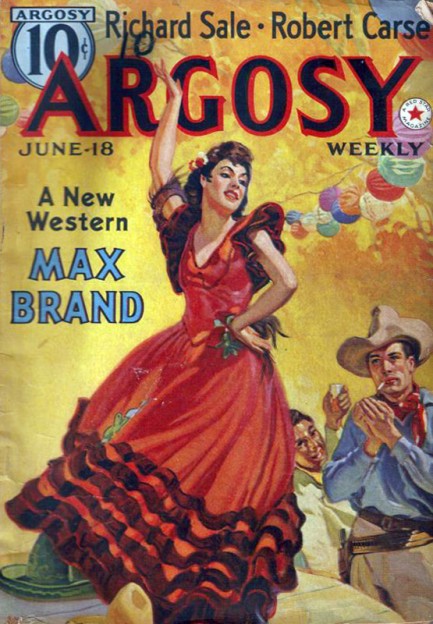
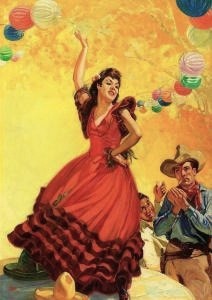
Above is a cover of Frank A. Munsey’s Argosy from June 18, 1938, with a famous painting by Rudolph Belarski for Max Brand’s western adventure story “Señor Coyote”. Even though Argosy was the first real pulp magazine, we haven’t featured it often here because issues in good condition can be difficult to find. With this one we got lucky—the highly regarded antiquarian and collectible website National Road Books, who we’ve bought other magazines from, sent us an e-mail letting us know they’ve uncovered a trove of more than a hundred issues of Argosy, and included the scan. So thanks for the assist, guys. It’s always needed. And speaking of assists, we want to remind everyone that our reader pulp feature, in the sidebar at right, is available to anyone who wants to share pulp treasures. How’s about we all make that a resolution for 2011? Agreed? Great. 

diggfacebookstumbledelicious

Featured Pulp
FEBRUARY 1933 BEAUTE MAGAZINE
JULY 1937 BEAUTES MAGAZINE
JANUARY 1935 PARIS MAGAZINE
JANUARY 1935 POUR LIRE A DEUX
OCTOBER 1929 PARIS PLAISIRS
NOVEMBER 1933 PARIS MAGAZINE
MAY 1935 PARIS MAGAZINE
History Rewind
The headlines that mattered yesteryear.
May 18
1926—Aimee Semple McPherson Disappears
In the U.S., Canadian born evangelist Aimee Semple McPherson disappears from Venice Beach, California in the middle of the afternoon. She is initially thought to have drowned, but on June 23, McPherson stumbles out of the desert in Agua Prieta, a Mexican town across the border from Douglas, Arizona, claiming to have been kidnapped, drugged, tortured and held for ransom in a shack by two people named Steve and Mexicali Rose. However, it soon becomes clear that McPherson's tale is fabricated, though to this day the reasons behind it remain unknown.
1964—Mods and Rockers Jailed After Riots
In Britain, scores of youths are jailed following a weekend of violent clashes between gangs of Mods and Rockers in Brighton and other south coast resorts. Mods listened to ska music and The Who, wore suits and rode Italian scooters, while Rockers listened to Elvis and Gene Vincent, and rode motorcycles. These differences triggered the violence.
May 17
1974—Police Raid SLA Headquarters
In the U.S., Los Angeles police raid the headquarters of the revolutionary group the Symbionese Liberation Army, resulting in the deaths of six members. The SLA had gained international notoriety by kidnapping nineteen-year old media heiress Patty Hearst from her Berkeley, California apartment, an act which precipitated her participation in an armed bank robbery.
1978—Charlie Chaplin's Missing Body Is Found
Eleven weeks after it was disinterred and stolen from a grave in Corsier near Lausanne, Switzerland, Charlie Chaplin's corpse is found by police. Two men—Roman Wardas, a 24-year-old Pole, and Gantscho Ganev, a 38-year-old Bulgarian—are convicted in December of stealing the coffin and trying to extort £400,000 from the Chaplin family.
May 16
1918—U.S. Congress Passes the Sedition Act
In the U.S., Congress passes a set of amendments to the Espionage Act called the Sedition Act, which makes "disloyal, profane, scurrilous, or abusive language" about the United States government, its flag, or its armed forces, as well as language that causes foreigners to view the American government or its institutions with contempt, an imprisonable offense. The Act specifically applies only during times of war, but later is pushed by politicians as a possible peacetime law, specifically to prevent political uprisings in African-American communities. But the Act is never extended and is repealed entirely in 1920.

Advertise Here
Reader Pulp
It's easy. We have an uploader that makes it a snap. Use it to submit your art, text, header, and subhead. Your post can be funny, serious, or anything in between, as long as it's vintage pulp. You'll get a byline and experience the fleeting pride of free authorship. We'll edit your post for typos, but the rest is up to you. Click here to give us your best shot.

Pulp Covers
Pulp art from around the web
muller-fokker.blogspot.com.es/2013/03/la-turlutte-finale.html canadianfly-by-night.blogspot.com.es/2013/04/the-mystery-league-and-harlequin-part-ii.html
jasonnahrung.com/2011/10/11/writerly-round-up-including-the-big-sleep-ive-just-had-and-the-one-im-about-to/big-sleep/ lovethiscover.blogspot.com/2011/01/75.html
giallobookcovers.blogspot.com.es/2013/04/i-gialli-di-margot_14.html cryptofwrestling.tumblr.com/post/6650692441/shut-up-weirdo-title-of-the-year-candidate
Pulp Advertising
Things you'd love to buy but can't anymore
PulpInternational.com Vintage Ads
Humor Blog Directory
About Email Legal RSS RSS Tabloid Femmes Fatales Hollywoodland Intl. Notebook Mondo Bizarro Musiquarium Politique Diabolique Sex Files Sportswire