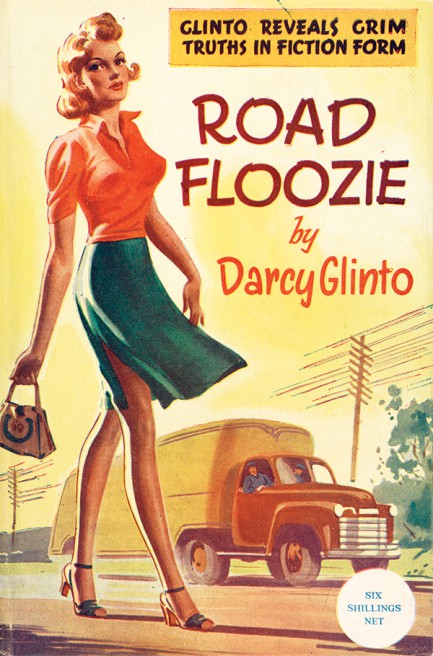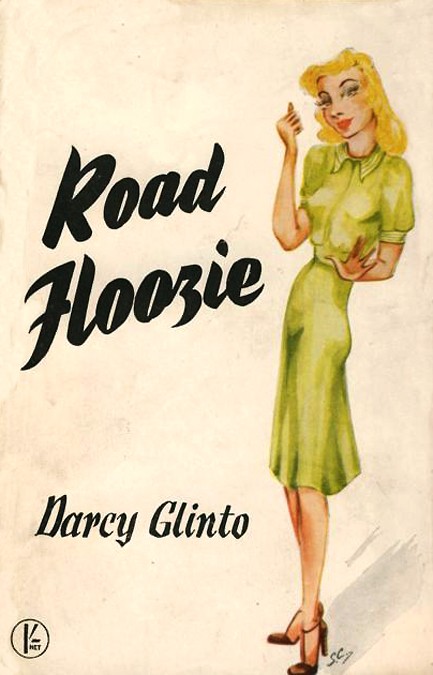
 Darcy Glinto was yet another writer who ran afoul of contemporary morals squads.  
The moment we saw these two versions of 1950's Road Floozie by British author Darcy Glinto, aka Harold Ernest Kelly, we asked one question—why are they so expensive? The sellers were both asking five hundred dollars. That seemingly has to do with the novel being pulled from circulation and republished with certain passages stricken, making the original difficult to find. What was so offensive in 1950? Certainly the idea that a woman would choose life on the road, moving from place to place, sometimes man to man, would have been uncomfortable. But Glinto was probably done in by the double rape of the main character by two truckers, one white, one black. In America, in 1950, black hands on white female flesh was a no-no, in literature and real life. Heck, it’s still a no-no today, in certain backwaters. As his career went on, Glinto/Kelly continued to have legal troubles in both the U.S. and Britain, and eventually he closed Robin Hood Press, which he owned, and sold the rights to the name Darcy Glinto. He moved to the Canary Islands and later died there in 1969.
|
 |
The headlines that mattered yesteryear.

1942—Ted Williams Enlists
Baseball player Ted Williams of the Boston Red Sox enlists in the United States Marine Corps, where he undergoes flight training and eventually serves as a flight instructor in Pensacola, Florida. The years he lost to World War II (and later another year to the Korean War) considerably diminished his career baseball statistics, but even so, he is indisputably one of greatest players in the history of the sport. 1924—Leopold and Loeb Murder Bobby Franks
Two wealthy University of Chicago students named Richard Loeb and Nathan Leopold, Jr. murder 14-year-old Bobby Franks, motivated by no other reason than to prove their intellectual superiority by committing a perfect crime. But the duo are caught and sentenced to life in prison. Their crime becomes known as a "thrill killing", and their story later inspires various works of art, including the 1929 play Rope by Patrick Hamilton, and Alfred Hitchcock's 1948 film of the same name. 1916—Rockwell's First Post Cover Appears
The Saturday Evening Post publishes Norman Rockwell's painting "Boy with Baby Carriage", marking the first time his work appears on the cover of that magazine. Rockwell would go to paint many covers for the Post, becoming indelibly linked with the publication. During his long career Rockwell would eventually paint more than four thousand pieces, the vast majority of which are not on public display due to private ownership and destruction by fire.
|

 |
|
It's easy. We have an uploader that makes it a snap. Use it to submit your art, text, header, and subhead. Your post can be funny, serious, or anything in between, as long as it's vintage pulp. You'll get a byline and experience the fleeting pride of free authorship. We'll edit your post for typos, but the rest is up to you. Click here to give us your best shot.
|
|