 Seems like the news in this paper is always bad. 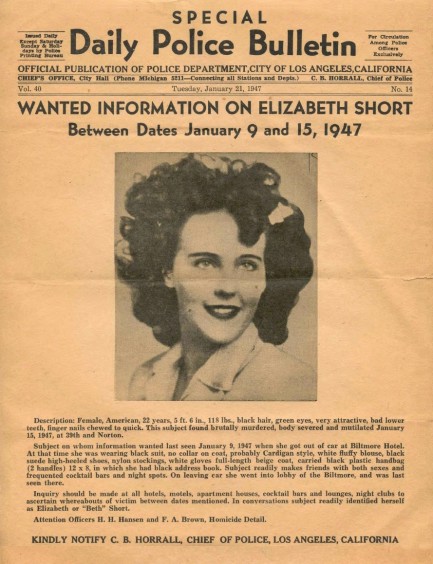
This is an interesting piece of crime memorabilia. We've seen it around a bit, but decided to share it here anyway. It's a copy of the Daily Police Bulletin, a publication put out by the Los Angeles Police Department meant for internal use, updating cops on the department's focus items. We gather the LAPD did this from 1907 until the late 1950s. These were generally two pages in length, with printing on the front and back. We checked around and learned that the Chicago and San Francisco police also printed these newspaper style bulletins. It's a good bet other departments did too. This Bulletin on murdered and mutilated Elizabeth Short, aka the Black Dahlia, is from today in 1947, about a week after her death. The photo used is a headshot she had made, something she needed because she intended to become an actress. She never got the chance. Her life ended at age twenty-two.
 Book on Elizabeth Short murder points at new suspect. 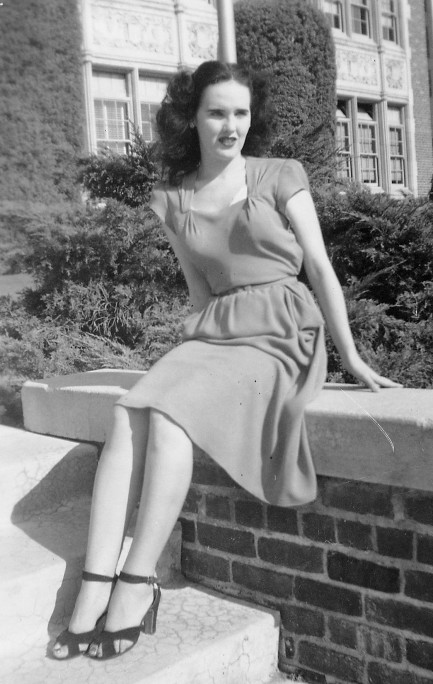
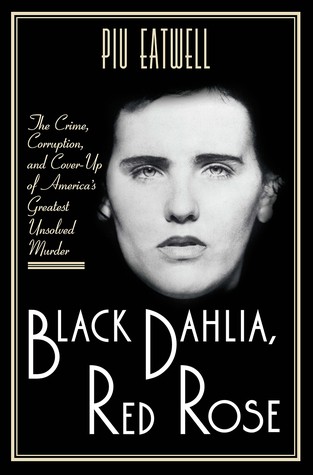 The cultural fetish with cold cases continues with the publication of an article on the Rolling Stone website several days ago about the most famous cold case victim of all—the Black Dahlia, aka Elizabeth Short. The piece talks about a recent book by British author Piu Eatwell that promises new insights into the unsolved murder. The cultural fetish with cold cases continues with the publication of an article on the Rolling Stone website several days ago about the most famous cold case victim of all—the Black Dahlia, aka Elizabeth Short. The piece talks about a recent book by British author Piu Eatwell that promises new insights into the unsolved murder. This latest new look at the crime suggests that Leslie Dillon, a bellhop and aspiring writer, was the murderer. Apparently Dillon, in addition to being in Los Angeles during the crucial time frame, moved to Florida soon after the murder and began writing to an LAPD psychiatrist requesting information about the case. He said he was researching a book about sexual psychopaths, and when his interest led to him being arrested police let him go because they were engaged in a cover-up of the entire case. This is always the way it goes with cold cases, isn't it? The perpetrator was in custody but through incompetence/malice/luck slipped away. Does the author have conclusive proof Dillon did the deed? Apparently not—which means her book Black Dahlia, Red Rose joins the heap of others speculating about the slaying. But we may check it out. Its publication during the autumn flew way wide of our radar screen, so it's good Rolling Stone—also Smithsonian, just yesterday—did a piece on the book. You can read more about the Dahlia, the book, and Piu Eatwell here.
 Were two unsolved murders the work of one killer? 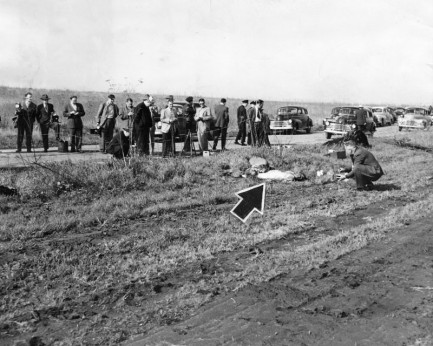
When it comes to mid-century murders in Los Angeles, the Black Dahlia gets all the ink, but during that same winter of 1947 another woman was slain. Like Elizabeth Short, she was found dead in a vacant lot, nude, with massive pre- and post-mortem injuries. Her name was Jeanne French. She had been stomped to death, and her killing became known as the Red Lipstick Murder because of a cryptic message written on her abdomen. It read: “Fuck you B.D.” Next to that it said: “Tex.” The Los Angeles Herald-Express ran a banner headline: “Werewolf Strikes Again Kills L.A. Woman Writes B.D. On Her Body.” By Werewolf, they meant the Black Dahlia killer—the Herald-Express and other papers believed the initials B.D. were a reference to the Dahlia. Above and below are two crime scene photos of police gathered around Jeanne French the morning she was discovered, and below is a close-up of the message scrawled on her skin. Though the killer had left shoe impressions all around—and on—French’s body, police were 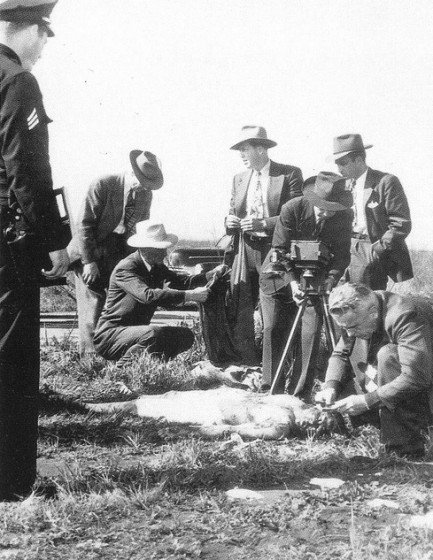 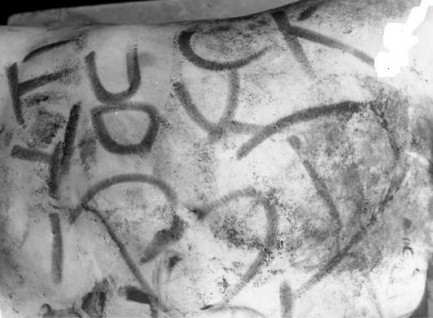 never able to generate any significant leads, and the case went unsolved. They were not sold on the idea of Elizabeth Short and Jeanne French falling victim to the same killer, but many others were convinced. Decades later, a handwriting analysis initiated by writer Steve Hodel tied the Red Lipstick killer and the Black Dahlia killer together. The suspect? Hodel’s father. But the evidence was not considered conclusive enough by police to pursue, and both murders remain officially unsolved. Jeanne French was found dead sixty-six years ago yesterday.
 Yes, sweetie, I’m fine. But it did remind me that we’re out of half and half. Can you pick some up on the way home? 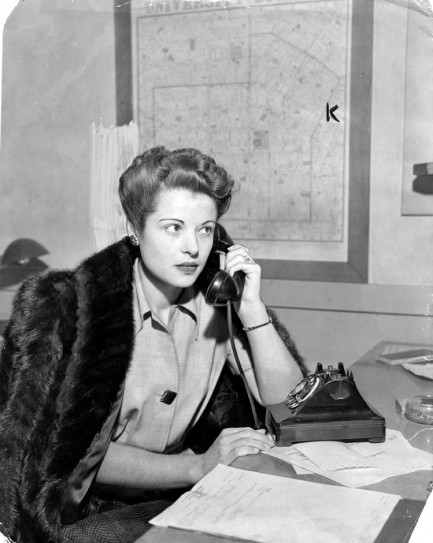
Above, a photo of Betty Bersinger, the woman who discovered the mutilated body of Elizabeth Short, aka The Black Dahlia, seen here at the police station looking unaffected by her grisly encounter. While on a morning walk with her young daughter she saw what she thought was a discarded mannequin that had been broken in two. Instead it was the two halves of Elizabeth Short’s bisected corpse. That happened today in 1947.
 The murder that keeps on giving. 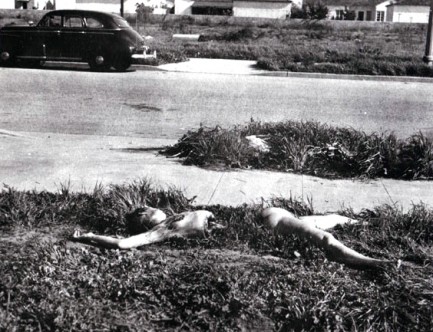
Above is a photograph documenting one of the most important moments in crime history—the discovery of aspiring actress Elizabeth Short’s mutilated corpse, found in a Los Angeles vacant lot early one morning by a woman walking with her three-year-old daughter. Along with a few other murders, such as those committed by Jack the Ripper, the Black Dahlia killing (as it came to be known) began as a case, then became a national obsession, and finally developed into a full-blown industry, as evidenced by the hundreds of millions of dollars made on movies, television shows, books, and websites. All of it began today in 1947. You can see our previous posts on the subject here and here.
 The Black Dahlia legend was born sixty-two years ago today. 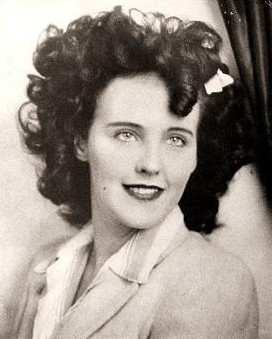
It was today in 1947 that Elizabeth Short, aka The Black Dahlia, was found dead in Leimert Park in Los Angeles, sparking a massive investigation that ultimately came up empty. Short’s may be the most famous unsolved murder in Los Angeles history. It’s certainly one of the most grotesque. She had been beaten, mutilated in numerous vicious ways, cut in two, drained of blood, and arranged in an explicit, spread-legged pose. The killer is always thought of as a man. Safe assumption. The crime just screams hatred and fear of women. The poet Robert Burns wrote famously of man’s inhumanity to man, but he could have added that there seems to be a special type of inhumanity reserved for women. Dahlia material fills the web, so we don’t really need to add much more. But we’d have been remiss in not noting this day, because Short's influence has been strong on crime fiction, and it would not be quite the same without her.
 She earned by dying what she sought while living. 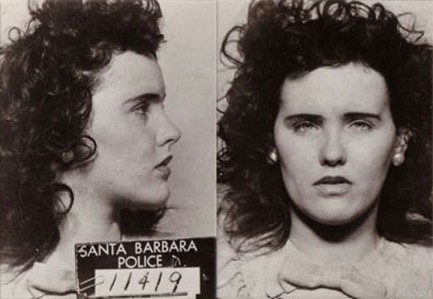
Elizabeth Short was just another girl drawn like a moth to the bright lights of Tinseltown. She dreamed of becoming a star, but instead became the victim of a horrific January 1947 murder. The killing was never solved, and its enduring strange- ness served as creative inspiration for numerous authors, including James Ellroy, who crafted a feverish, violent and definitive crime novel entitled The Black Dahlia. Short was from Massachusetts, but drifted between there, California, and Florida. In 1946 she made a trip to L.A. to reunite with a boyfriend. Six months later she was dead—sexually mutilated, her mouth slashed open, her torso cut completely in half, the pieces carefully arranged in a vacant lot for passersby to discover. Veronica Lake’s film noir The Blue Dahlia was in cinemas at the time, and so reporters christened dark-haired Betty Short the Black Dahlia. At Pulp we often speak of people passing from history, but they arrive as well. The moment Betty Short steps onto the stage is in the mug shot above, from today in 1943, when she was arrested in Santa Barbara, California for underage drinking. After the arrest juvenile authorities shipped her back east, but she didn’t stay. They never stay. She returned to L.A.—and became more famous than she ever could have imagined.
|
 |

The headlines that mattered yesteryear.
1923—Yankee Stadium Opens
In New York City, Yankee Stadium, home of Major League Baseball's New York Yankees, opens with the Yankees beating their eternal rivals the Boston Red Sox 4 to 1. The stadium, which is nicknamed The House that Ruth Built, sees the Yankees become the most successful franchise in baseball history. It is eventually replaced by a new Yankee Stadium and closes in September 2008. 1961—Bay of Pigs Invasion Is Launched
A group of CIA financed and trained Cuban refugees lands at the Bay of Pigs in southern Cuba with the aim of ousting Fidel Castro. However, the invasion fails badly and the result is embarrassment for U.S. president John F. Kennedy and a major boost in popularity for Fidel Castro, and also has the effect of pushing him toward the Soviet Union for protection. 1943—First LSD Trip Takes Place
Swiss scientist Albert Hofmann, while working at Sandoz Laboratories in Basel, accidentally absorbs lysergic acid diethylamide, better known as LSD, and thus discovers its psychedelic properties. He had first synthesized the substance five years earlier but hadn't been aware of its effects. He goes on to write scores of articles and books about his creation.
|

|
|
It's easy. We have an uploader that makes it a snap. Use it to submit your art, text, header, and subhead. Your post can be funny, serious, or anything in between, as long as it's vintage pulp. You'll get a byline and experience the fleeting pride of free authorship. We'll edit your post for typos, but the rest is up to you. Click here to give us your best shot.
|
|