Los Angeles bunker intended to house Adolf Hitler set to be demolished for picnic area.  
The Pulp Intl. tour across America has left San Francisco for our last stop, Los Angeles, and our timing was good, because this interesting item appeared in the news yesterday. Apparently, a Los Angeles bunker intended to house Adolf Hitler is being razed to make room for a picnic area. Set on several acres in what is now Will Rogers State Park, it was built during the 1930s by a group of fascist adherents who called themselves the Silver Legion of America, or Silvershirts, with the idea of giving Hitler a base of operations in America. Though the land was purchased by Winona and Norman Stephens, the mastermind behind the project was William Dudley Pelley, below, a well-known fascist of the time. The sprawling site was inhabited by his Silvershirts, and besides a large house intended for Hitler, included a diesel plant, a sprawling garden, and a bomb shelter. Pelley and his Silvershirts numbered about 15,000 official members during the mid-1930s, and certainly there were many more sympathizers. The group was powerful enough that it became a concern for President Franklin Roosevelt, who ordered FBI director J. Edgar Hoover to keep an eye on them. Hoover did so, but left the group more or less in peace until Pearl Harbor was bombed, at which point feds raided the ranch and arrested the occupants. That was 1941, and by then the Silvershirts had already declined in membership and influence. The raid pretty much destroyed what was left of the group, and the base designed and built for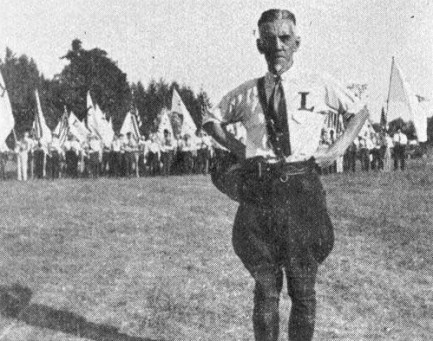 Adolf Hitler fell into disrepair. We think the place would serve an important purpose if at least one building could be saved and perhaps adorned with a historical marker. Picnic areas need bathrooms, after all, and what better place to take a piss than in a monument to global fascism. But of course, what else would we think? We’re a history site, and we believe covering up the past serves no one. Some say the Silvershirts were never important enough to be considered a threat to American democracy, and thus should not be remembered, but they only seem hapless in hindsight. It’s precisely when people think their society is immune to malign influences that they always seem to take hold. Adolf Hitler fell into disrepair. We think the place would serve an important purpose if at least one building could be saved and perhaps adorned with a historical marker. Picnic areas need bathrooms, after all, and what better place to take a piss than in a monument to global fascism. But of course, what else would we think? We’re a history site, and we believe covering up the past serves no one. Some say the Silvershirts were never important enough to be considered a threat to American democracy, and thus should not be remembered, but they only seem hapless in hindsight. It’s precisely when people think their society is immune to malign influences that they always seem to take hold.
|
 |

The headlines that mattered yesteryear.
1939—Batman Debuts
In Detective Comics #27, DC Comics publishes its second major superhero, Batman, who becomes one of the most popular comic book characters of all time, and then a popular camp television series starring Adam West, and lastly a multi-million dollar movie franchise starring Michael Keaton, then George Clooney, and finally Christian Bale. 1953—Crick and Watson Publish DNA Results
British scientists James D Watson and Francis Crick publish an article detailing their discovery of the existence and structure of deoxyribonucleic acid, or DNA, in Nature magazine. Their findings answer one of the oldest and most fundamental questions of biology, that of how living things reproduce themselves. 1967—First Space Program Casualty Occurs
Soviet cosmonaut Vladimir Komarov dies in Soyuz 1 when, during re-entry into Earth's atmosphere after more than ten successful orbits, the capsule's main parachute fails to deploy properly, and the backup chute becomes entangled in the first. The capsule's descent is slowed, but it still hits the ground at about 90 mph, at which point it bursts into flames. Komarov is the first human to die during a space mission. 1986—Otto Preminger Dies
Austro–Hungarian film director Otto Preminger, who directed such eternal classics as Laura, Anatomy of a Murder, Carmen Jones, The Man with the Golden Arm, and Stalag 17, and for his efforts earned a star on Hollywood's Walk of Fame, dies in New York City, aged 80, from cancer and Alzheimer's disease. 1998—James Earl Ray Dies
The convicted assassin of American civil rights leader Martin Luther King, Jr., petty criminal James Earl Ray, dies in prison of hepatitis aged 70, protesting his innocence as he had for decades. Members of the King family who supported Ray's fight to clear his name believed the U.S. Government had been involved in Dr. King's killing, but with Ray's death such questions became moot.
|

|
|
It's easy. We have an uploader that makes it a snap. Use it to submit your art, text, header, and subhead. Your post can be funny, serious, or anything in between, as long as it's vintage pulp. You'll get a byline and experience the fleeting pride of free authorship. We'll edit your post for typos, but the rest is up to you. Click here to give us your best shot.
|
|