 Pacino's violent thriller tells us that sometimes playing a role involves finding out who you really are. 
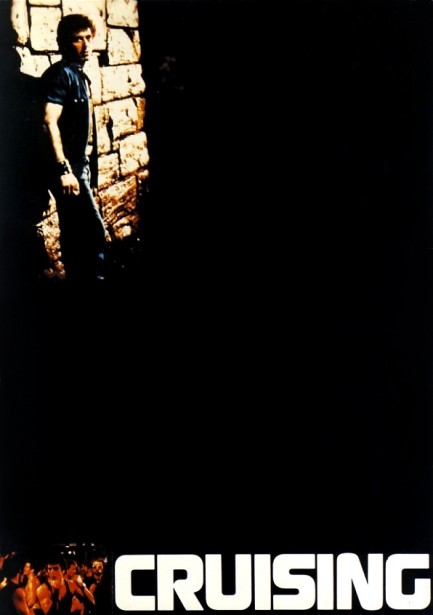
We just saw this movie for the first time a few months ago and it falls squarely into the category: could-not-be-made-today. That doesn’t automatically make it good, but it just so happens this is a pretty good flick. You’ve got a young, intense Al Pacino, noirish direction from William Friedkin of Exorcist fame, and a story focused on sex, drugs, and violence. Basically, Pacino plays a cop who goes undercover in New York City’s gay BDSM subculture. He’s looking for a killer, which requires him to play the role of an available, leather-clad party boy. But there’s deep cover, and then there’s deep cover. When you cross the line trouble always results. The art above comes from a promotional pamphlet, and it conveys the mood of the film quite nicely. We recommend it, with a reservation—if you’re progressive-minded, you’ll probably hate it. But you know that going in. Whenever Hollywood portrays a so-called subculture for a genre flick, it’s an affront to those being portrayed, whether gay, Chinese, black, female, religious, Texan, environmentalist, Iraqi, or what have you. Could Hollywood make films that portrayed all these segments of society in only positive terms? Sure, but who’d go see them? So bring on the action, and we’ll deal with the caricatures by agreeing that they’re just living cartoons, designed to offer some thrills and chills. Cruising premiered in the U.S. today in 1980.
|
 |
The headlines that mattered yesteryear.
1933—Roosevelt Addresses Nation
Franklin D. Roosevelt uses the medium of radio to address the people of the United States for the first time as President, in a tradition that would become known as his "fireside chats". These chats were enormously successful from a participation standpoint, with multi-millions tuning in to listen. In total Roosevelt would make thirty broadcasts over the course of eleven years. 1927—Roxy Theatre Opens
In New York City, showman and impresario Samuel Roxy Rothafel opens the Roxy Theatre, a 5,920-seat cinema. Rothafel would later open Radio City Music Hall in 1932, which featured the precision dance troupe the Roxyettes, later renamed the Rockettes. Rothafel died in 1936, but his Roxy remained one of America's greatest film palaces until it was closed and demolished in 1960. 1977—Polanski Is Charged with Statutory Rape

Polish-born film director Roman Polanski is charged with raping a 13-year-old girl at the home of Hollywood star Jack Nicholson. Polanski allegedly had sex with the girl in a hot tub after plying her with Quaaludes and champagne. Rather than risk prison Polanski fled the U.S. for Europe, but was eventually arrested in Switzerland in 2009. 1945—U.S. Bombs Tokyo

335 American B29 bombers raid Tokyo, dropping so many incendiary bombs that the resulting firestorm kills more than 100,000 people, mostly civilians. The number of injured is estimated to have topped a million, and another million were left homeless, but these figures have been called low by numerous historians, both Japanese and American.
|
blog advertising is good for you

 |
|
It's easy. We have an uploader that makes it a snap. Use it to submit your art, text, header, and subhead. Your post can be funny, serious, or anything in between, as long as it's vintage pulp. You'll get a byline and experience the fleeting pride of free authorship. We'll edit your post for typos, but the rest is up to you. Click here to give us your best shot.
|
|