James M. Cain’s incest-themed pulp loses its power as a movie thanks to Pia Zadora. 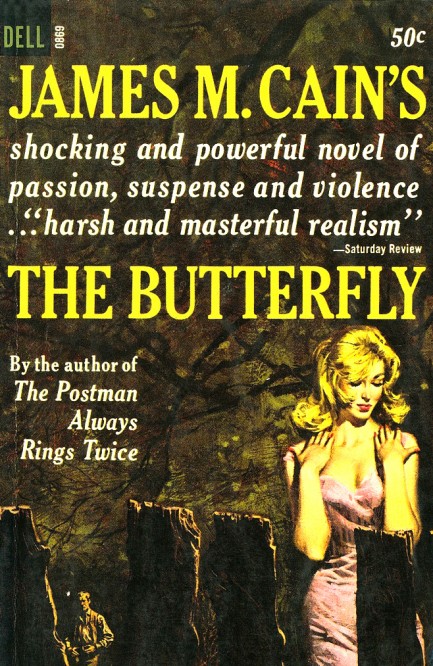
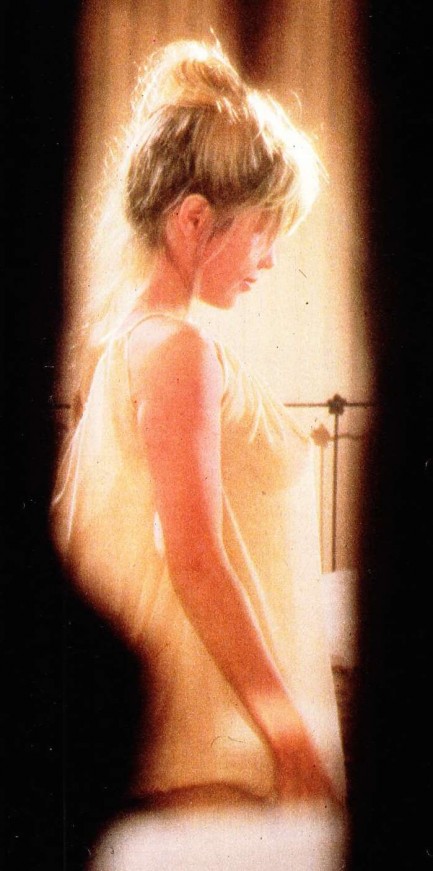
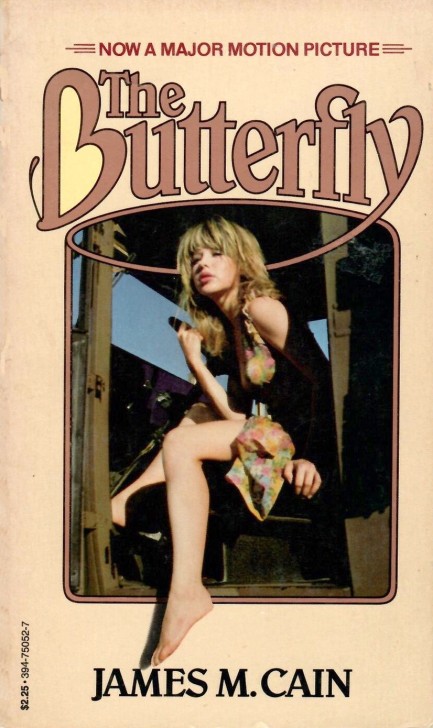
James M. Cain was never one to shy away from provocative subject matter, and The Butterfly, published in 1946, is no exception. In this one a middle-aged coal miner arrives at his backwoods home one day to find a nineteen year-old girl sitting on his stoop. It turns out she’s his long lost daughter, who he’s never known because his wife left him eighteen years ago. The girl, Kady, is precocious to say the least, which means seduction inevitably follows and, just as inevitably, dangerous complications pile up rather quickly. But nothing is quite what it seems and by the end, paternity is in doubt all over the place. The Butterfly isn’t considered one of Cain’s best, but we thought it was a diverting read, certainly worth the time spent. As with most Cain books, it had many editions, but this one is the 1964 Dell paperback, which we think has the best cover art. 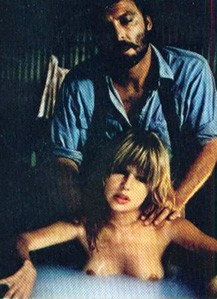 Moving on to the 1982 film adaptation, entitled simply Butterfly, we find ourselves running out of kind words. The film starred Pia Zadora, and while it generated some good reviews and a lot of publicity owing to its supposed steaminess, time has since rendered a judgment and it isn't a kind one. Zadora was not the person for the role of Kady. We have little doubt she's alluring in real life, but cinema is not real life and it takes more than just ordinary beauty to light up the screen as a femme fatale. Moving on to the 1982 film adaptation, entitled simply Butterfly, we find ourselves running out of kind words. The film starred Pia Zadora, and while it generated some good reviews and a lot of publicity owing to its supposed steaminess, time has since rendered a judgment and it isn't a kind one. Zadora was not the person for the role of Kady. We have little doubt she's alluring in real life, but cinema is not real life and it takes more than just ordinary beauty to light up the screen as a femme fatale.
It's the same with men, typically. Bogart wasn’t a classic looker, but he had that thing. Zadora doesn’t. The critics who defended her in this role are still answering for it today, and her award as Newcomer of the Year ranks as one of the Golden Globes' biggest embarrassments. Despite her unwonderful performance, Butterfly is worth a glance for its camp factor, as well as for appearances by Orson Welles as a smalltown judge and Ed McMahon as a boozehound. But if you really want to be entertained, read the book instead.
|
 |

The headlines that mattered yesteryear.
1933—The Gestapo Is Formed
The Geheime Staatspolizei, aka Gestapo, the official secret police force of Nazi Germany, is established. It begins under the administration of SS leader Heinrich Himmler in his position as Chief of German Police, but by 1939 is administered by the Reichssicherheitshauptamt, or Reich Main Security Office, and is a feared entity in every corner of Germany and beyond. 1937—Guernica Is Bombed
In Spain during the Spanish Civil War, the Basque town of Guernica is bombed by the German Luftwaffe, resulting in widespread destruction and casualties. The Basque government reports 1,654 people killed, while later research suggests far fewer deaths, but regardless, Guernica is viewed as an example of terror bombing and other countries learn that Nazi Germany is committed to that tactic. The bombing also becomes inspiration for Pablo Picasso, resulting in a protest painting that is not only his most famous work, but one the most important pieces of art ever produced. 1939—Batman Debuts
In Detective Comics #27, DC Comics publishes its second major superhero, Batman, who becomes one of the most popular comic book characters of all time, and then a popular camp television series starring Adam West, and lastly a multi-million dollar movie franchise starring Michael Keaton, then George Clooney, and finally Christian Bale. 1953—Crick and Watson Publish DNA Results
British scientists James D Watson and Francis Crick publish an article detailing their discovery of the existence and structure of deoxyribonucleic acid, or DNA, in Nature magazine. Their findings answer one of the oldest and most fundamental questions of biology, that of how living things reproduce themselves. 1967—First Space Program Casualty Occurs
Soviet cosmonaut Vladimir Komarov dies in Soyuz 1 when, during re-entry into Earth's atmosphere after more than ten successful orbits, the capsule's main parachute fails to deploy properly, and the backup chute becomes entangled in the first. The capsule's descent is slowed, but it still hits the ground at about 90 mph, at which point it bursts into flames. Komarov is the first human to die during a space mission.
|

|
|
It's easy. We have an uploader that makes it a snap. Use it to submit your art, text, header, and subhead. Your post can be funny, serious, or anything in between, as long as it's vintage pulp. You'll get a byline and experience the fleeting pride of free authorship. We'll edit your post for typos, but the rest is up to you. Click here to give us your best shot.
|
|