Gun goes bang-bang, problem goes bye-bye. 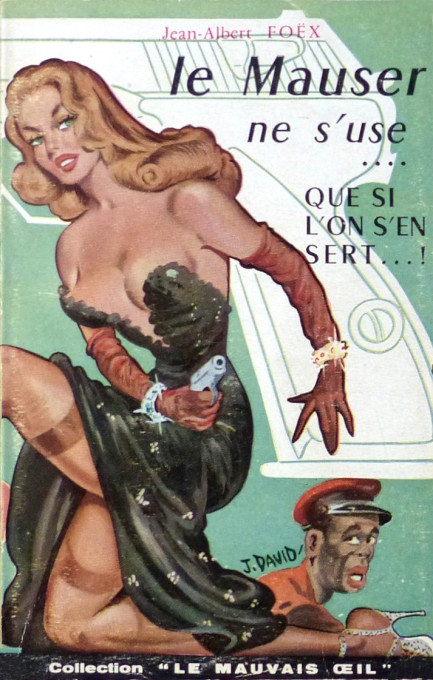
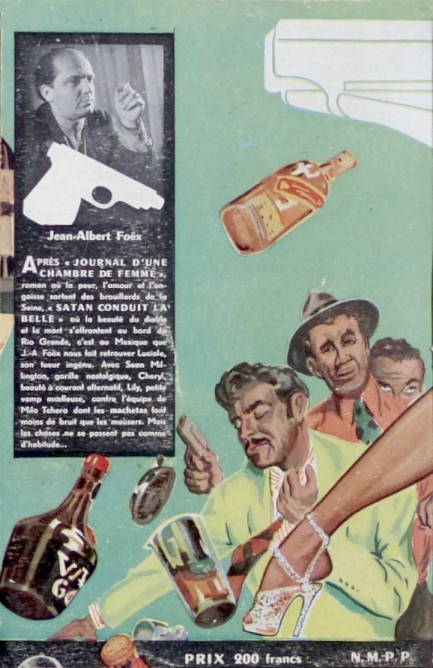
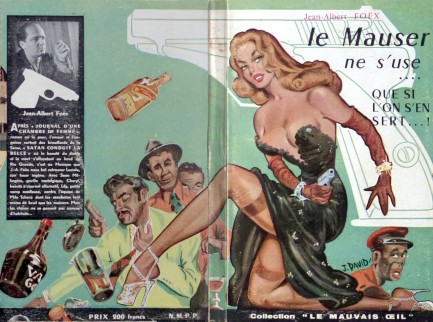
Above is a cover for Jean-Albert Foëx's 1954 crime novel Le Mauser ne s'use que si l'on s'en sert..! painted by French illustrator Jean David, whose work we've shown you before, notably here and at the bottom of this collection. We aren't happy with David's visual treatment of the black character at the lower right, but you can't doubt his technical proficiency. This book, the title of which translates to, “the Mauser only wears out if you use it,” deals with a supervillain named Luciole who gets up to no good in Mexico and is soon pitted against protagonist Milo Tchero and his crack team of sidekicks. We gather these are recurring characters but we don't know how many appearances they made. The publisher here, E.D.I.C.A., liked wraparound covers, as you can see on an example we shared a while back. Jean David will return.
 My husband is clueless. He suspects I'm having an affair, but he thinks it's with a guy from his softball team. 
Above: a nice sleaze cover from Greenleaf Classics' Nightstand imprint for 1960's lesbian novel Sin Girls by Marlene Longman. This has the look of a photo-illustration, but it's credited to Harold W. McCauley.
 The very moment you need help is the moment there's nobody around. 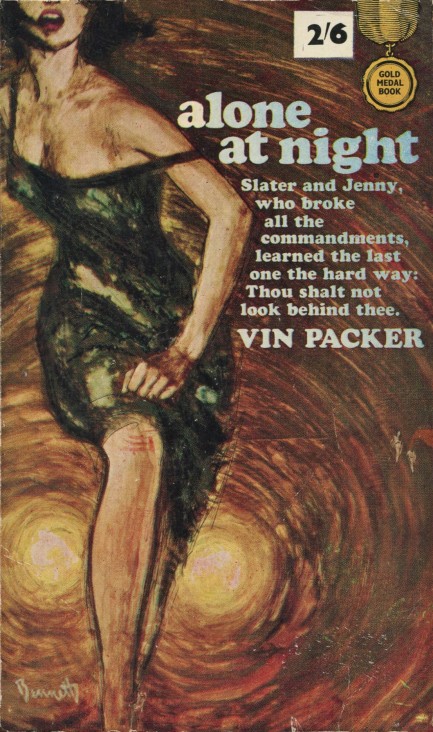
Harry Bennett put together yet another a unique paperback cover, this time for Vin Packer's 1963 novel Alone at Night. Bennett was a master illustrator who specialized in loose yet highly skilled pieces, but he had a range that we've marveled over many times. Just check his solidly representational efforts here, here, and here, as opposed to his somewhat more abstract stylings here and here, then note how he splits the difference between the two here. He's always interesting, and Alone at Night is also an interesting novel.
Vin Packer was a pseudonym for Marijane Meaker, and she sets her story in the actual small town of Cayuta, located in south central New York state. She tells us about a man named Donald Cloward who's sent to prison for fatally running over a woman. By the time he's paroled eight years later he's come to doubt the official story. On the night in question he'd been nearly incapacitated by alcohol, and had blacked out the events, yet has the vaguest memory of being placed behind the wheel of the deadly car—presumably by someone who wanted him to crash and be killed. Once dead, people would assume he stole the car.
Who would do such a thing? His father-in-law, possibly. He had offered his sedan though Cloward was clearly unable to drive. Since his father-in-law loathes him, and is not a generous man—certainly not enough to lend anyone his car—his guilt seems a good bet. On the other hand, the woman who was killed happened to be the wife of a man who desperately wanted out of his marriage in order to wed someone else. Maybe he arranged everything. After all, Cloward was found in that man's Jaguar. Yes, there may have been a switch. Cloward thinks he remembers getting into one car, even though he ended up in another. Is it a false memory?
Alone at Night is built around a leapfrogging present-past structure, and has a multi-pov narrative in which the reader soon knows all, but the characters don't. In trying to sort it all out, Cloward decides that his father-in-law moved him from the sedan to the Jaguar after realizing the second car was already pointed toward the drop-off of a cliff. After all, why merely hope for a road accident when one is already likely just by virtue of the choice of a parking space? But is he missing a few pieces of the puzzle? We won't say more about the plot. This is excellent work from Packer/Meaker. It's our second book from her, and won't be our last.
 This is what's called in the realm of answers a hard no. Don't let the door hit you in the dick on the way out. 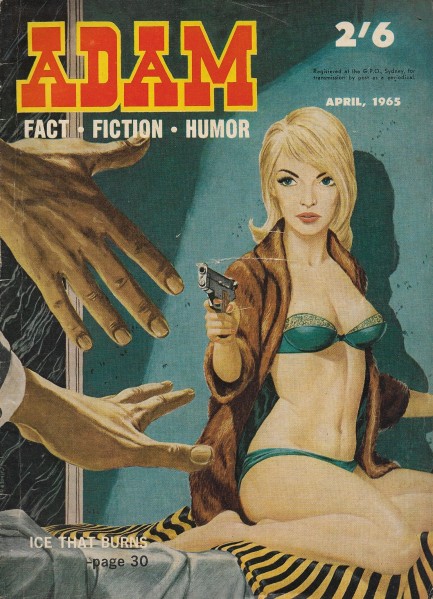
To say that Adam magazine is an interest of ours is an understatement, but we haven't shared an issue for eight months. That's been a result of our drawn out and complicated move, which we initiated last summer, thought we'd have finished by November, but actually just completed to the point of unpacking our scanner last month. Lesson: buying a house in the south of Spain takes three times longer than you anticipate. Rest assured, though, we're still collecting Adam, and today we're sharing our eighty-fourth issue, which takes us down to fifty-four more we need to upload.
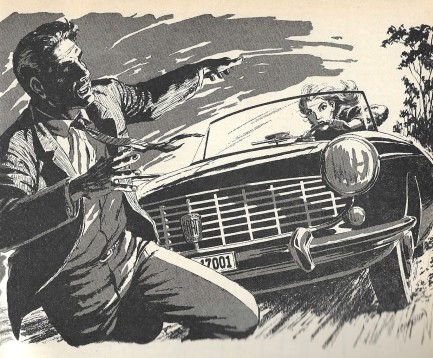
This particular example, which was published this month in 1965, was tightly bound, so we have only a handful of scans because we didn't want to destroy the magazine by flattening it. Apparently there's such a thing as a triangle scanner meant for such situations, but we never heard of one until this week. Anyway, the cover here of a woman holding off a prospective assailant was painted to illustrate Walter S. Bratu's story, “Ice That Burns,” in which a random everyman runs afoul of a Nordic femme fatale, and gets snared in a blackmail and bribery plot. In a twist he eventually uses his car to bash hers off a cliff, but it didn't surprise us. In vintage men's magazines women who are sexually unavailable to the hero usually come to bad ends.
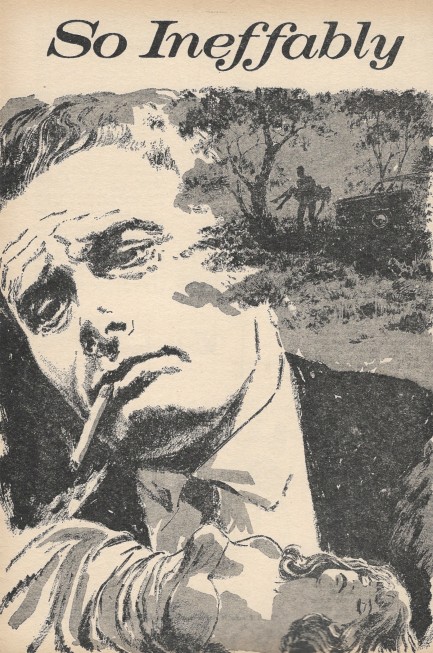
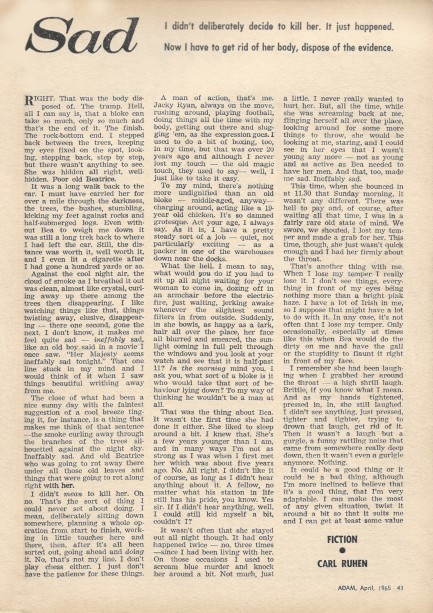
There's also a story from Carl Ruhen that wins the award for best title of the issue, if not all of 1965: “So Ineffably Sad.” It's about a man named Jacky Ryan who accidentally kills a woman and must somehow cover up the crime. This issue also has signed work from Jack Waugh (he'd give up on signatures as the years progressed), and of course a couple of pictorials, both with unidentified models. As we said, we can't show you everything because of our desire to preserve the magazine, but if we ever get a triangle scanner we'll add to this post. For now, we have a mere fifteen panels below.
 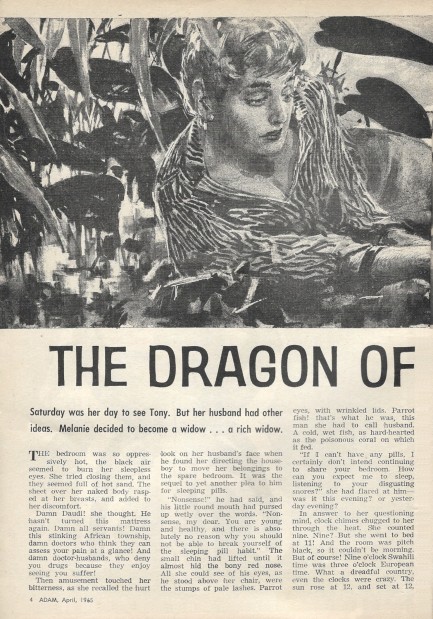 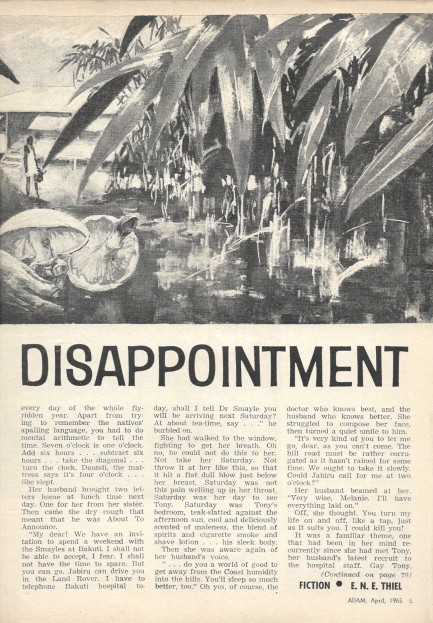 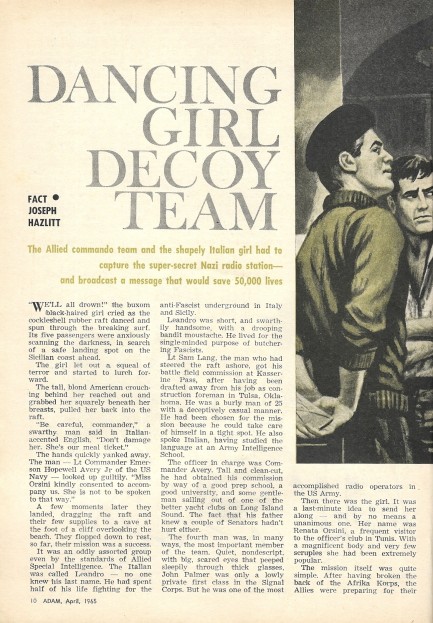 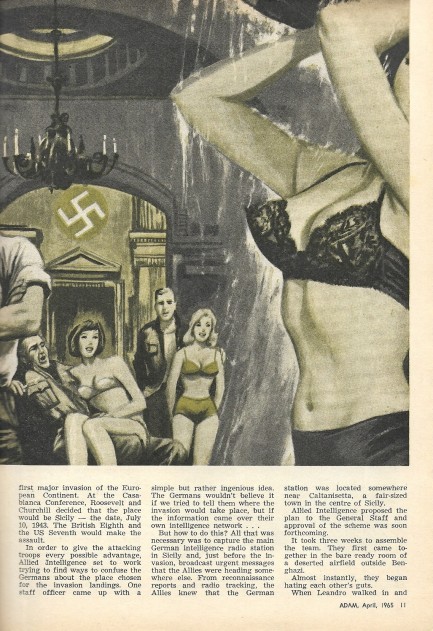    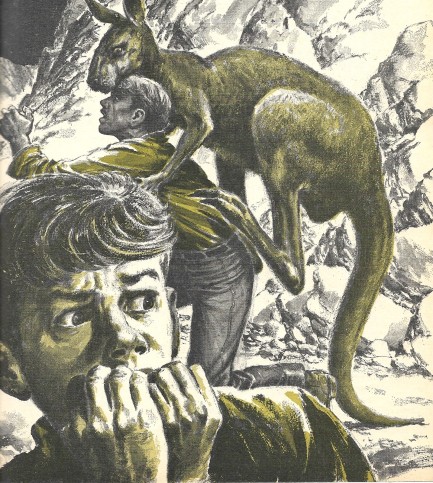 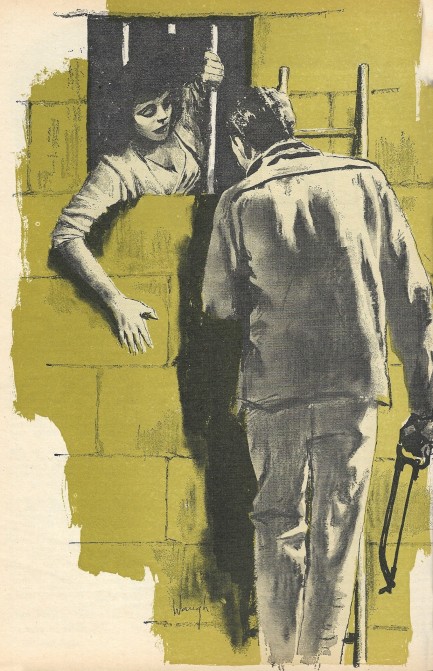 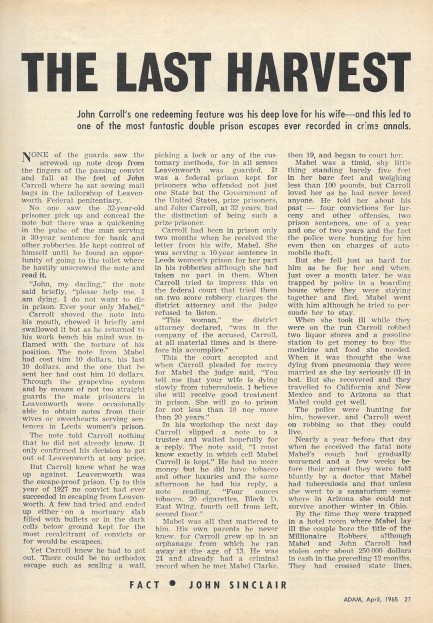    
 No, darling, I'm not screwing my secretary. I have a new boss, and she's screwing me. 
Bee Line Books was one of the imprints that transitioned from painted covers (examples here and here) into photo fronts, as you see with Roy Battle's 1974 novel Something for the Boss. We wanted something to read on a train ride and this fit the bill. The story deals with a suburban wife and her banker husband, and how his ambition to ascend the corporate ladder leads him to press her to have sex with the branch president. She does, and this leads to a full fledged swapping lifestyle, not only with the president and his wife, but with their two depraved collegiate children. Yeah, it's pretty kinky, but that's no surprise for a sleaze novel published during the ’70s. By then there were no limits. Despite the raunch, Something for the Boss isn't anything you can bank on for entertainment. Next.
 You're upset I betrayed your trust. But if I hadn't, all the publishers calling about your scandals would have been even more upset. 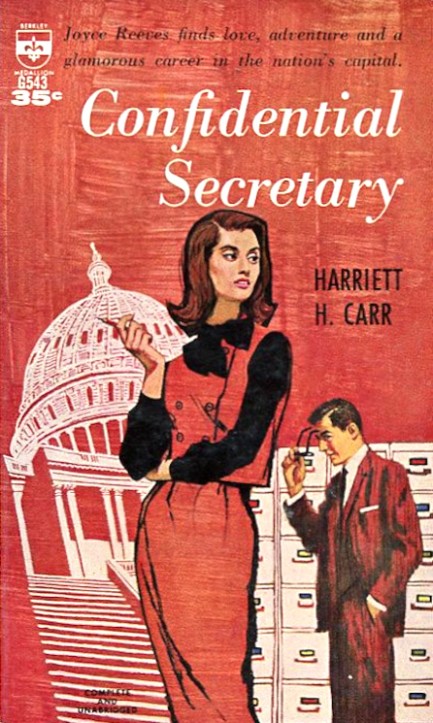
It's election season in the U.S., so above we have a cover for Harriett H. Carr's Confidential Secretary, originally published in 1958, with this Berkley paperback arriving in 1961. It's about a woman who takes a job in a Washington, D.C. corporation and is drawn into congressional intrigue, over the course of which she finds true love. This isn't one we'd read, but it does fit into our cover collection featuring the U.S. Capitol building—soon to be belching smoke and flames, the way things are going over there. The art is uncredited.
 Why, thank you, ladies, I am a goat, and proud of it. Um—you mean greatest of all time, right? 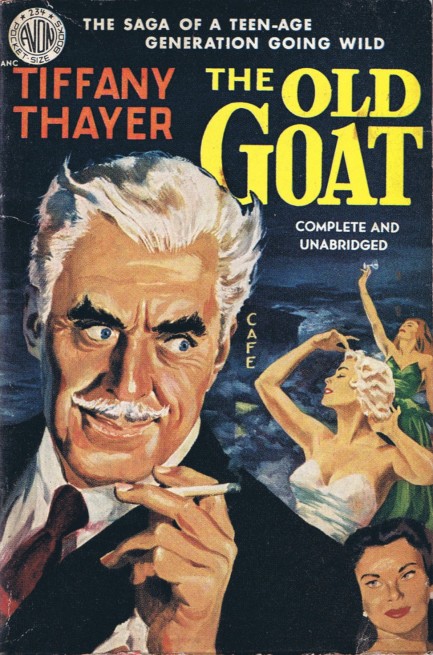
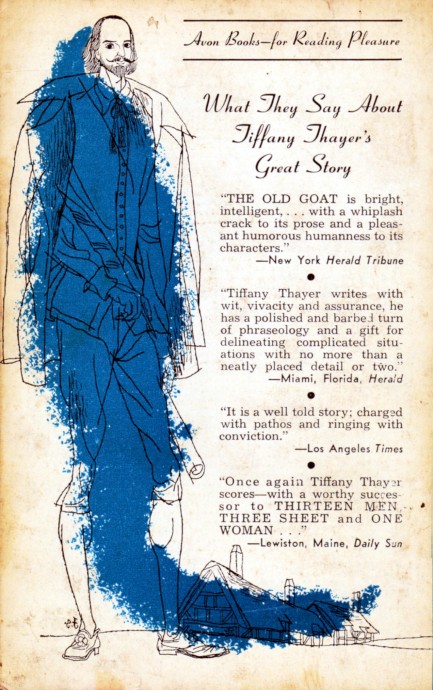
We've been having an ongoing conversation with the Pulp Intl. girlfriends about the word, “cougar,” when used to refer to older women who chase younger men. They say there's no male equivalent. If you're an older man chasing after young women, you're just a man, we were told. We think cougar is kind of a fun slang term, but then we are neither women, nor women in that age range, so our opinion doesn't actually count. Anyway, we came across this cover for Tiffany Thayer's 1950 novel The Old Goat, and we're going to go with "goat" as a term for a male cougar. And no, not “greatest of all time.” Just goat. We'd like it to catch on, but sports fans have a firm hold on it at the moment. However, we'll do our part to change that if you do yours. The art on this, by the way, is by an unknown, but the rear cover and several interior illustrations are by Lyle Justis.
 You don't mind if I keep the blinds up, do you? The guys in the building across the street like to watch. 
Above: a cover for the 1963 novel Bachelor Girl by Francis Loren. This was painted by acknowledged master Robert Maguire. As for Loren, we'll soon find out about him. We have one of his novels on deck. We've put together a couple of collections of covers featuring Venetian blinds. You can see those here and here.
 Baby, if God had meant for you to cover yourself he'd have given you three hands. 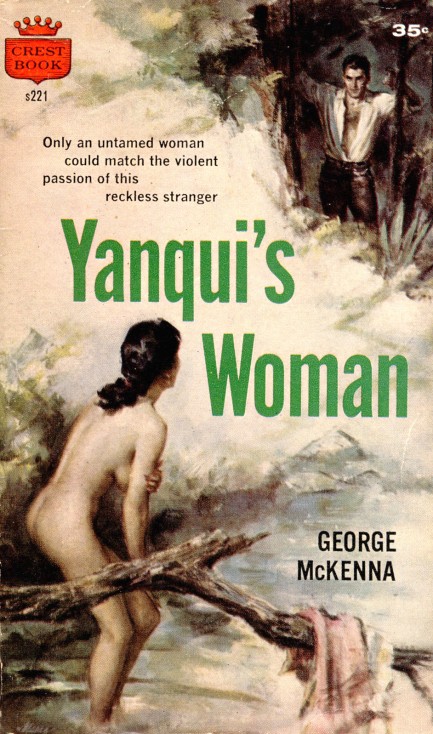
We've shared so many covers of unfortunate women being surprised while bathing in ponds and streams that we can't believe we missed this one by James Meese for George McKenna's 1958 novel Yanqui's Woman. Well, consider it an addition to the group, which is scattered in posts here, here, here, and here.
 Eight! Nine! Nine and a half! Nine and five-eighths! Get up! I'm bought off but I can't be obvious! You think I'm a Supreme Court justice or something? 
This Dutch paperback cover was painted by an unknown, but we love it. It fronts Judson P. Philips' De gouden handscheon. “Handschoen” is a pretty easy translation if you think literally—handshoe. But what the hell is a handshoe? *checking internet* In Dutch it means “glove.” Makes perfect sense. What do they call a condom? *checking internet* Sadly, it isn't “dickshoe.” Anyway, Philips was a pseudonym for Hugh Pentecost, and this was published by Uitgeverij de Combinatie in 1948.
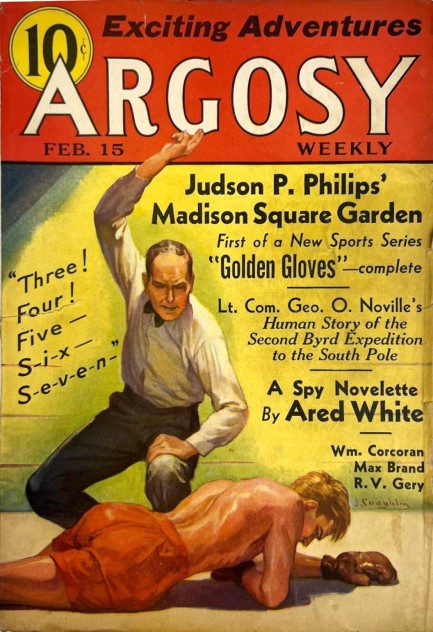
Update: Same day update, actually, which should give you an idea how much time we spend poking around for information. Turns out the above cover was adapted from a 1936 issue of the pulp magazine Argosy. The art is signed by John A. Coughlin. Also note that Judson P. Philips has a story in the issue. That leads to the reasonable conclusion that De gouden handschoen is a Dutch translation of that story typeset to paperback length.

|
 |

The headlines that mattered yesteryear.
1945—Mussolini Is Arrested
Italian dictator Benito Mussolini, his mistress Clara Petacci, and fifteen supporters are arrested by Italian partisans in Dongo, Italy while attempting to escape the region in the wake of the collapse of Mussolini's fascist government. The next day, Mussolini and his mistress are both executed, along with most of the members of their group. Their bodies are then trucked to Milan where they are hung upside down on meathooks from the roof of a gas station, then spat upon and stoned until they are unrecognizable. 1933—The Gestapo Is Formed
The Geheime Staatspolizei, aka Gestapo, the official secret police force of Nazi Germany, is established. It begins under the administration of SS leader Heinrich Himmler in his position as Chief of German Police, but by 1939 is administered by the Reichssicherheitshauptamt, or Reich Main Security Office, and is a feared entity in every corner of Germany and beyond. 1937—Guernica Is Bombed
In Spain during the Spanish Civil War, the Basque town of Guernica is bombed by the German Luftwaffe, resulting in widespread destruction and casualties. The Basque government reports 1,654 people killed, while later research suggests far fewer deaths, but regardless, Guernica is viewed as an example of terror bombing and other countries learn that Nazi Germany is committed to that tactic. The bombing also becomes inspiration for Pablo Picasso, resulting in a protest painting that is not only his most famous work, but one the most important pieces of art ever produced. 1939—Batman Debuts
In Detective Comics #27, DC Comics publishes its second major superhero, Batman, who becomes one of the most popular comic book characters of all time, and then a popular camp television series starring Adam West, and lastly a multi-million dollar movie franchise starring Michael Keaton, then George Clooney, and finally Christian Bale. 1953—Crick and Watson Publish DNA Results
British scientists James D Watson and Francis Crick publish an article detailing their discovery of the existence and structure of deoxyribonucleic acid, or DNA, in Nature magazine. Their findings answer one of the oldest and most fundamental questions of biology, that of how living things reproduce themselves.
|

|
|
It's easy. We have an uploader that makes it a snap. Use it to submit your art, text, header, and subhead. Your post can be funny, serious, or anything in between, as long as it's vintage pulp. You'll get a byline and experience the fleeting pride of free authorship. We'll edit your post for typos, but the rest is up to you. Click here to give us your best shot.

|
|