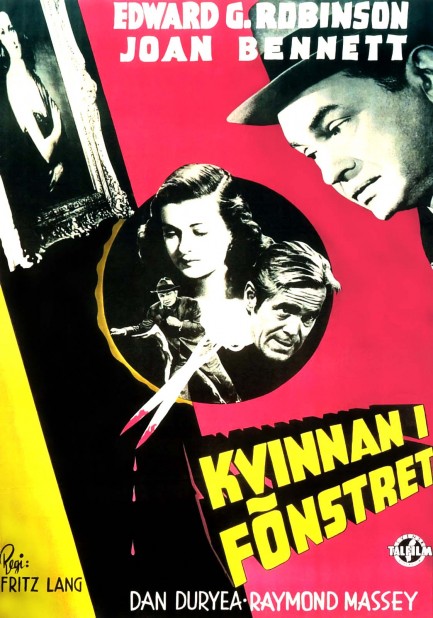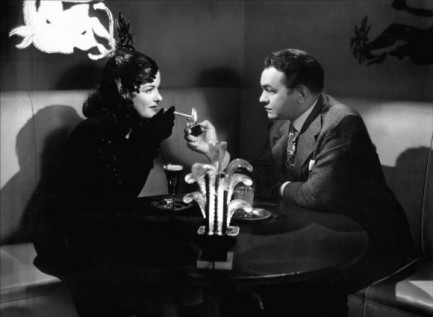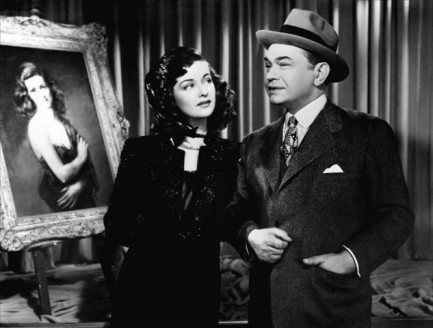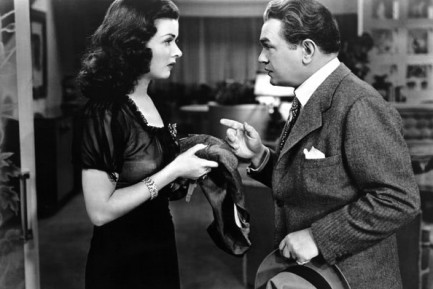
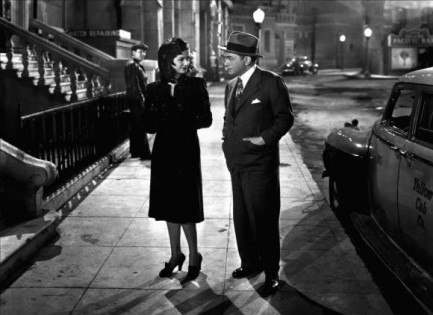
 Edward G. Robinson learns to be thankful for what he’s got. 
Above is a Swedish promo poster for Kvinnan i fönstret , better known as The Woman in the Window, from German expressionist master Fritz Lang. Anything from the director who gave us Metropolis is must-see, however, we have to warn you that the finale to this one may come as a let-down, or more accurately a cop-out. But don’t blame Lang—blame the censors of the day, who wouldn’t let him use the ending from the source material, J. H. Wallis’s novel Once Off Guard. If judged in the forgiving frame of mind that the ending shouldn’t be held against it, The Woman in the Window can’t be considered anything but a top-notch effort. Basically, it’s worth it just to see Edward G. Robinson in the lead as a stuffy college professor who wishes for more excitement in his life. He learns the hard lesson—thanks to femme fatale Joan Bennett—that he isn’t built for adventure. So the film is a cautionary tale. It warns middle-aged men that stable lives may be boring, but hot young women lead to directly to trouble, terror and tragedy (best case scenario: after a lot of screamingly good sex). The Woman in the Window opened in Sweden today in 1947.    
Sweden, Germany, Kvinnan i fönstret, The Woman in the Window, Metropolis, Once Off Guard, Fritz Lang, J. H. Wallis, Edward G. Robinson, Joan Bennett, film noir, poster art, cinema, movie review

|
 |
The headlines that mattered yesteryear.
1934—Bonnie and Clyde Are Shot To Death
Outlaws Bonnie Parker and Clyde Barrow, who traveled the central United States during the Great Depression robbing banks, stores and gas stations, are ambushed and shot to death in Louisiana by a posse of six law officers. Officially, the autopsy report lists seventeen separate entrance wounds on Barrow and twenty-six on Parker, including several head shots on each. So numerous are the bullet holes that an undertaker claims to have difficulty embalming the bodies because they won't hold the embalming fluid. 1942—Ted Williams Enlists
Baseball player Ted Williams of the Boston Red Sox enlists in the United States Marine Corps, where he undergoes flight training and eventually serves as a flight instructor in Pensacola, Florida. The years he lost to World War II (and later another year to the Korean War) considerably diminished his career baseball statistics, but even so, he is indisputably one of greatest players in the history of the sport. 1924—Leopold and Loeb Murder Bobby Franks
Two wealthy University of Chicago students named Richard Loeb and Nathan Leopold, Jr. murder 14-year-old Bobby Franks, motivated by no other reason than to prove their intellectual superiority by committing a perfect crime. But the duo are caught and sentenced to life in prison. Their crime becomes known as a "thrill killing", and their story later inspires various works of art, including the 1929 play Rope by Patrick Hamilton, and Alfred Hitchcock's 1948 film of the same name.
|

 |
|
It's easy. We have an uploader that makes it a snap. Use it to submit your art, text, header, and subhead. Your post can be funny, serious, or anything in between, as long as it's vintage pulp. You'll get a byline and experience the fleeting pride of free authorship. We'll edit your post for typos, but the rest is up to you. Click here to give us your best shot.
|
|