 A man called Hawk. 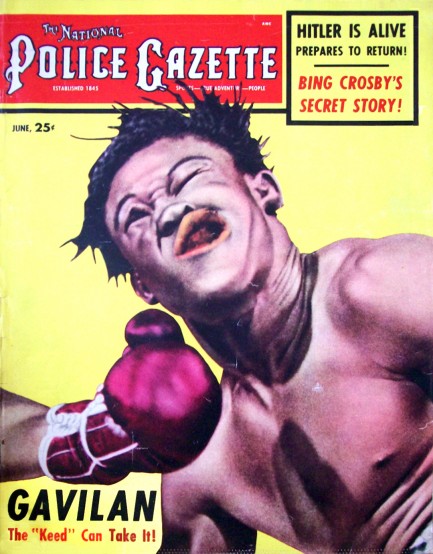 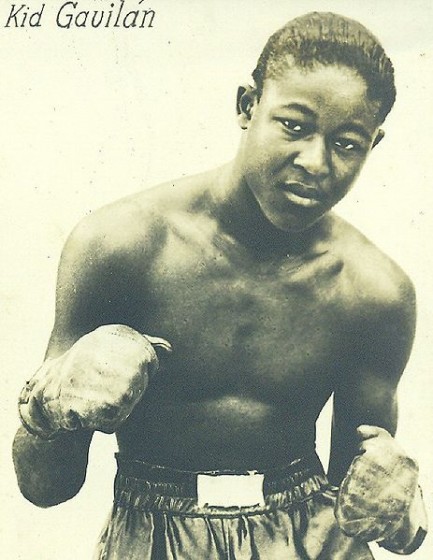
Above is a classic boxing cover from The National Police Gazette, a magazine whose specialization in this area we’ve shared with you before. This time the unlucky pugilist is Kid Gavilán, née Gerardo González, aka The Cuban Hawk (gavilán is Spanish for hawk), who on this June 1953 cover is taking a beating from Sugar Ray Robinson. The occasion was 23 September 1948. Robinson won a controversial decision, and when the two met again the next year Robinson won by decision again. Though Gavilán never beat Robinson he did win the world welterweight title in 1951, and throughout that year, 1952, and 1953 defended it by winning brutal bout after brutal bout. That’s why the Gazette says Gavilán can take it. In 1954 he jumped weight classes and lost a middleweight title bout to Bobo Olson, then afterward fought Johnny Saxton and lost his welterweight crown. The rest of Gavilán’s career was up and down, but he’s remembered in boxing circles as one tough hombre. Below is the unaltered photo from which the Gazette made its great cover. 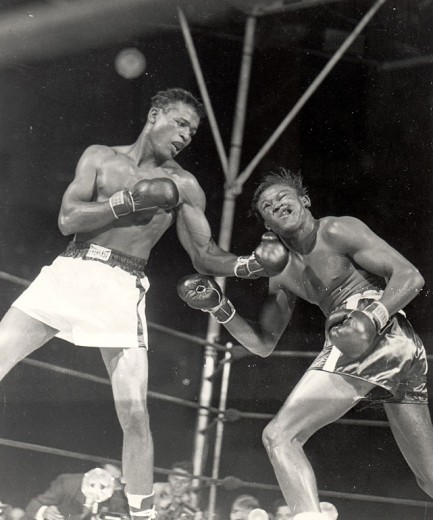
 Yeah, but you should see the other guy. 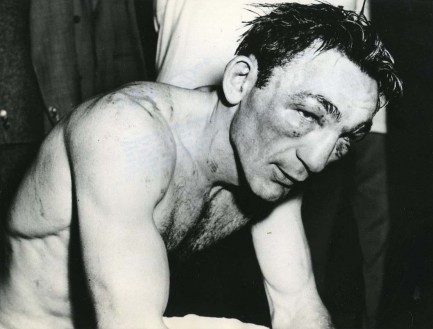
This is American boxer Carmen Basilio, and bad as he looks on the outside, he feels even worse inside because he’s just learned he lost his welterweight title to challenger Johnny Saxton. That wasn’t what Basilio, the crowd of thousands, and the television audience of millions thought when the final bell rang, but the judges somehow saw a different fight than everyone else and awarded Saxton the decision. Did it have anything to do with the fact that Saxton was mafia-connected, and his “manager, friend, and adviser” was Philly mobster and notorious fight fixer Frank “Blinky” Palermo? Very possible. Basilio later said of the decision, which occurred in March 1956, “It was like being robbed in a dark alley.” Well, he certainly looks like a guy who was robbed. See more on Basilio here.
 He had a face only a mother could love. 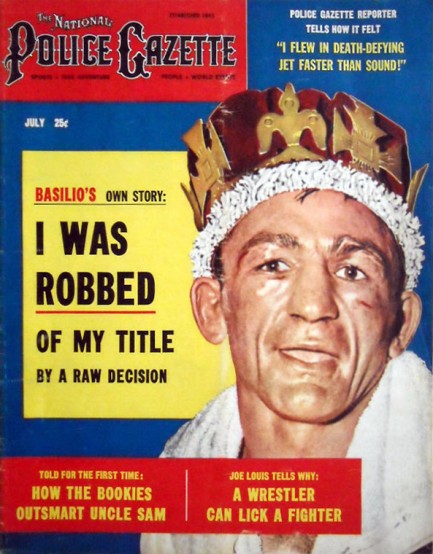
The National Police Gazette focuses on sports with this July 1956 cover of welterweight and middleweight boxing champion Carmen Basilio. According to the Gazette, Basilio lost his welterwight title to challenger Johnny Saxton due to the fact that the judges had been bought off by local mob figures. This may have been true. Saxton was tight with—or perhaps controlled by—a Philadelphia wiseguy named Blinky Palermo. Saxton was no hack—he went 39-0-1 to start his career—but in some of those fights his opponents gave less than their all, conspicuously so. Saxton won his first title in 1954 against Kid Gavilán, and that fight was openly discussed as a fixed affair. When Saxton topped Basilio in March 1956 in a fifteen round decision, Basilio said bluntly of the judging, “It was like being robbed in a dark alley.” The Gazette took up his case four months later. Other magazines weighed in on Basilio’s behalf as well, and in September 1956 he  got his revenge when he knocked out Saxton in a rematch. got his revenge when he knocked out Saxton in a rematch. Basilio finished his career with a respectable record of 56-27-7, having taken quite a few beatings, but also having dished quite a few out. In the end his face was a topographical map of all those battles, with ridges and hillocks everywhere, but on this Gazette cover showing him after winning the welterweight title, he positively glows. There’s nothing quite like winning.
|
 |

The headlines that mattered yesteryear.
1945—Hitler Marries Braun
During the last days of the Third Reich, as Russia's Red Army closes in from the east, Adolf Hitler marries his long-time partner Eva Braun in a Berlin bunker during a brief civil ceremony witnessed by Joseph Goebbels and Martin Bormann. Both Hitler and Braun commit suicide the next day, and their corpses are burned in the Reich Chancellery garden. 1967—Ali Is Stripped of His Title
After refusing induction into the United States Army the day before due to religious reasons, Muhammad Ali is stripped of his heavyweight boxing title. He is found guilty of a felony in refusing to be drafted for service in Vietnam, but he does not serve prison time, and on June 28, 1971, the U.S. Supreme Court reverses his conviction. His stand against the war had made him a hated figure in mainstream America, but in the black community and the rest of the world he had become an icon. 1947—Heyerdahl Embarks on Kon-Tiki
Norwegian ethnographer and adventurer Thor Heyerdahl and his five man crew set out from Peru on a giant balsa wood raft called the Kon-Tiki in order to prove that Peruvian natives could have settled Polynesia. After a 101 day, 4,300 mile (8,000 km) journey, Kon-Tiki smashes into the reef at Raroia in the Tuamotu Islands on August 7, 1947, thus demonstrating that it is possible for a primitive craft to survive a Pacific crossing. 1989—Soviets Acknowledge Chernobyl Accident
After two days of rumors and denials the Soviet Union admits there was an accident at the Chernobyl nuclear power plant in Ukraine. Reactor number four had suffered a meltdown, sending a plume of radioactive fallout into the atmosphere and over an extensive geographical area. Today the abandoned radioactive area surrounding Chernobyl is rife with local wildlife and has been converted into a wildlife sanctuary, one of the largest in Europe. 1945—Mussolini Is Arrested
Italian dictator Benito Mussolini, his mistress Clara Petacci, and fifteen supporters are arrested by Italian partisans in Dongo, Italy while attempting to escape the region in the wake of the collapse of Mussolini's fascist government. The next day, Mussolini and his mistress are both executed, along with most of the members of their group. Their bodies are then trucked to Milan where they are hung upside down on meathooks from the roof of a gas station, then spat upon and stoned until they are unrecognizable.
|

|
|
It's easy. We have an uploader that makes it a snap. Use it to submit your art, text, header, and subhead. Your post can be funny, serious, or anything in between, as long as it's vintage pulp. You'll get a byline and experience the fleeting pride of free authorship. We'll edit your post for typos, but the rest is up to you. Click here to give us your best shot.
|
|