Oh my God, my head is murdering me and I'm pretty sure I didn't even score last night. 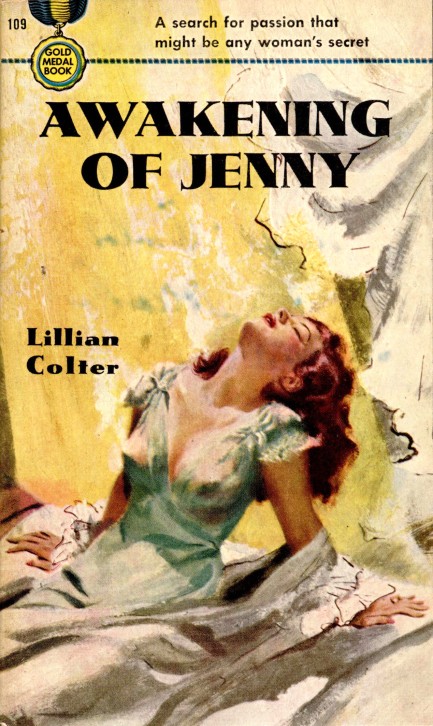
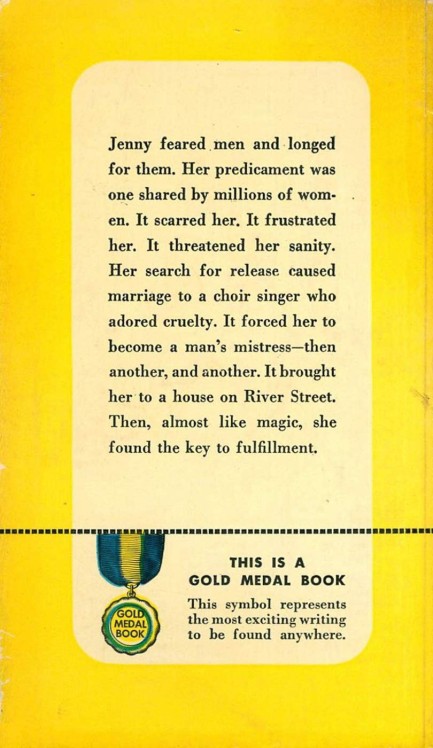 Some nights don't go as planned. But ours went fine, thanks. Hope yours was good too. The Awakening of Jenny, written by Lillian Colter and published in 1950, is pretty much as you'd guess from the title and Barye Phillips cover art. The rear cover confirms it—a woman named Jenny Adams searches for sexual and romantic fulfillment by going through a succession of men. The focus doesn't seem to be on titillation, but on psychological drama. It was a successful book, from what we gather, but Colter never wrote anything afterward, which has caused most vintage book aficionados to determine that she was a pseudonym. Some nights don't go as planned. But ours went fine, thanks. Hope yours was good too. The Awakening of Jenny, written by Lillian Colter and published in 1950, is pretty much as you'd guess from the title and Barye Phillips cover art. The rear cover confirms it—a woman named Jenny Adams searches for sexual and romantic fulfillment by going through a succession of men. The focus doesn't seem to be on titillation, but on psychological drama. It was a successful book, from what we gather, but Colter never wrote anything afterward, which has caused most vintage book aficionados to determine that she was a pseudonym.
 It's lovely out here, but the serenity and quiet just magnify everything about each other we dislike. 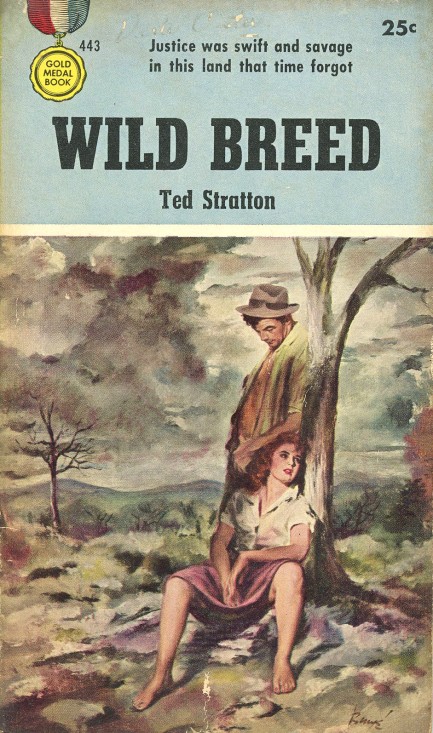 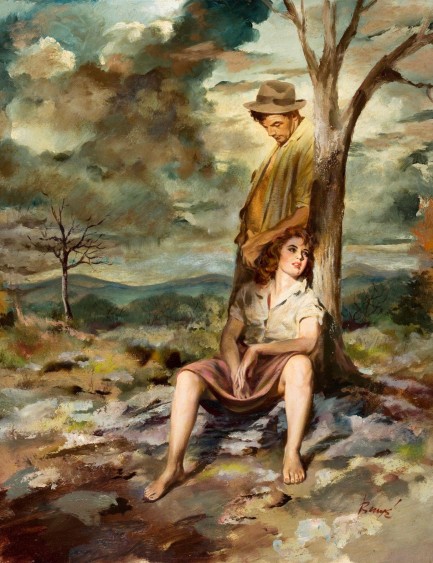
Barye Phillips handled the cover chores for Ted Stratton's 1954 novel Wild Breed, and as you can see by looking at the original reproduction we've included, the piece he produced was fine art adjacent. At least it looks that way to us. Compared to much of his other work, the detail here suggests a different frame of mind in execution, if not even a planned usage outside the realm of paperback covers for the finished piece. Its dimensions normally would have required that the work be radically cropped, but Fawcett Publications solved that by placing a solid rectangle at top to hold the text and Gold Medal logo, reducing the required trimming to a minimum. The editors knew quality when they saw it.
 Maybe it's too soon to bring it up, but if you ever remarry maybe choose someone who isn't a Red Sox fan. 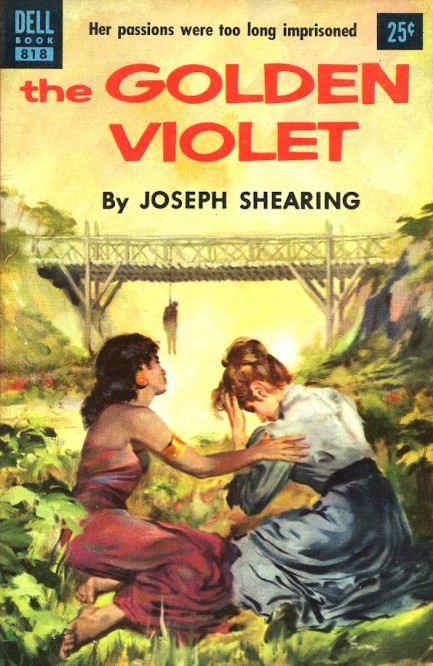
Awhile back we put together a small collection of vintage paperback covers featuring hanging figures. The above cover for Joseph Shearing's The Golden Violet is an addition to that group. Shearing was actually Margaret Gabrielle Vere Long, who earned acclaim writing numerous historical and gothic horror novels, with The Golden Violet part of the latter group. The cover on this Dell edition was painted by Barye Phillips. Side note: the Red Sox are going to miss the playoffs again, and they might even finish last. We're devastated—not. That's for you, Dan. With love, of course.
 Except for a few quaint customs she clings to, she's a typical conservative society lady. 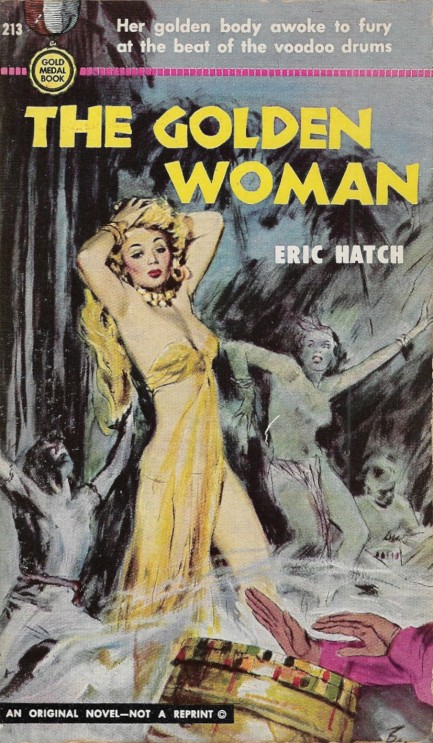
Love at first sight, and marriage on first night. At least a few mid-century writers worked this theme, and readers seemed to buy it. A few descriptions of how beautiful the woman was and voilà—hearts and wedding bells. But whether it actually worked as a device depended upon plot and writing skill. Eric Hatch, in his 1952 novel The Golden Woman, uses the exotic surroundings of Port-au-Prince, Haiti to weave the spell needed to make readers believe a fantastically rich young virgin named Yvette du Chambrigne and a naval officer named Walter Moore meet, fall in love, and marry over the course of a night and day. The romantic but reckless decision brings them into conflict with the Haitian elite, as Yvette has defied her powerful father's wishes to marry her off for political gain to a cruel army general named La Borde.
Yvette is Haitian, but she's also white. Well, near enough to count, though as Hatch writes the character, her smidge of African blood makes her—in some mysterious way that must have made sense to readers back in the day—primitive. We know, we know. We didn't write the thing. We just work here. Hatch's protagonist Walter Moore says he wouldn't care if Yvette were fully and visibly black, but since she's by any realistic measure fully and visibly white, he would say that, wouldn't he? Whether the young lovers are culturally compatible becomes a key question of the story, and this brackets a central plotline in which Moore becomes swept up in—you guessed it—revolution. We've read a few books now that have used the same idea. In this case, Moore basically leads the revolution. While riding a horse. And carrying a sword. While under the protection of the voodoo god Mala. Sounds silly, right? It is. But we have to admit it's also fun.
Eric Hatch is remembered today for his books 1101 Park Avenue (filmed in 1936 as My Man Godfrey) and The Year of the Horse (filmed as The Horse in the Gray Flannel Suit). With The Golden Girl he reminds readers that if you got one drop of ink in the milk, the milk was perceived to be fully ink. Even today, someone who is three quarters white and one quarter black is going to be seen as black. The Golden Woman is, in the Year of Our Division 2023, a reminder that ideas around "purity" still predominate—even if unconsciously—for many people. But leaving that fraught discussion aside and judging the book solely as a thriller, it's worth a read, absurd though the story may be. If you're interested in island adventures in general, or Haiti in particular, we say go for it. The art on this Gold Medal edition is by Barye Phillips, influenced by a Life magazine photo from 1948, which you see below.

 There's no plan B. There's only payback. 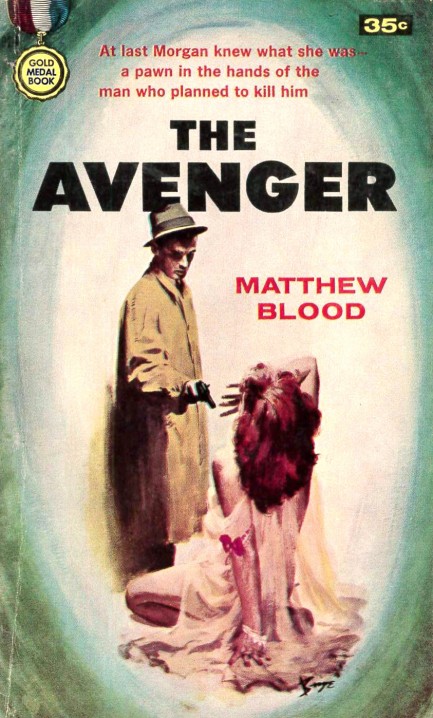
Above you see a cover for The Avenger, written by Matthew Blood and published in 1952. It's a detective novel that reads like a parody. It was the first of two starring hard-boiled private dick Morgan Wayne, and it's immediately clear why the character lasted only two outings. In many hard-boiled detective books the hero is unrealistically tough and the women unbelieveably pliant, but here that's taken to a ridiculous extreme, only with poor writing that makes clear that this is not a parody, but a serious attempt at urban crime drama in the Spillane mold. At one point the anti-hero Wayne bites the head off a crook's prized goldfish then shoots him. This is all in pursuit of the person who killed Wayne's new secretary Lois, who he'd been looking forward to laying:
He concentrated fiercely on visualizing her as she must be waiting for him now. That was the only drawback to this affair. There hadn't been enough build-up. Not enough expectation. Nothing at all of the slow and delicious burning that gradually takes complete possession of a man during the period of delightful dalliance that generally precedes the consummation of a civilized love affair.
So much wrong with that paragraph. Delightful dalliance that precedes consummation? But we'll let it pass:
She must be waiting for him in her apartment now, damn it. Soaking up the warmth of a hot bath while she waited for him and anticipated his coming. He savagely cursed the circumstances that were keeping them apart, and unconsciously trod the accelerator closer and closer to the floor boards...
That's pretty bad too. Anyway, Wayne arrives at Lois's apartment to find her dead and mutilated, and along the road to solving the crime he's pursued sexually by a sixteen-year-old, her mother, and various other cock-starved characters, before climbing the ladder to the person who ordered the murder and taking care of business. It's all written in the same graceless fashion as the above examples. The amazing part is that Matthew Blood was a pseudonym for W. Ryerson Johnson and David Dresser. There's no excuse for two brains producing a half-witted book. We do like the cover art, though, and no wonder—it's Barye Phillips again.
 This Cameron Kay fella might just amount to something one day. 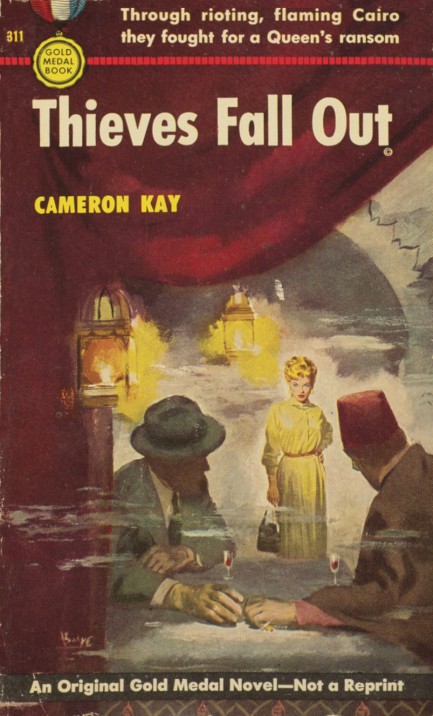
Cameron Kay was a pseudonym used by literary leading light Gore Vidal when he was short of cash and needed to publish and get paid fast. He'd used other pseudonyms for this purpose, including Edgar Box and Katherine Everard. It took him about three weeks to produce 1953's Thieves Fall Out, and he made three grand on the deal. It's one of those books where a money-seeking rando goes to a foreign country and immediately inserts himself into the biggest caper going for hundreds of miles around—and does it, improbably, with great ease, while seeming to think, irrationally, that it's a good idea. This character, named Peter Wells, ultimately turns sour on the venture and must figure out a way to flee Egypt with his true love by his side.
Though Vidal is not at the heights he'd reach in his best writing, you already know that going in. In the final analysis he gets the job done, like a good carpenter working on a quick side project. We glanced at a few reviews after finishing the story and they seem to miss the point that Vidal does exactly what adventure fiction requires. Saying the book's plot is stock is like saying dance music is repetitive. It has to be that way to make you dance. Because of the identity of the author, it feels as if reviewers try to flaunt their intellectual bona fides by trashing the result. We're not going to do that. The book is satisfactory.
What Vidal does especially well is local color—though refracted through a wealthy Western prism that few Egyptians would appreciate. Yet it's clear he tries to be egalitarian, if imperfectly, and he crafts a tale with unique characters. There's a piano playing hunchback who hides behind a wall and looks at his nightclub through a peephole, a beautiful French countess who was once the mistress of Egypt's top Nazi, and a fresh young beauty who's the unrequited love of King Farouk of Egypt—who has her followed everywhere by his secret police. Those ideas are unusual, for sure, but they're not as farfetched as some reviewers would like you to think.
We make that statement confidently because we've lived in the wilder world. In Guatemala we met an ex-judge from a proximate country who had fled because of being targeted for death by the new ruling party, but who was a drunk who craved public enjoyment and had shaved his head and grown a beard in order to hang in dive bars unrecognized. Was his story true? Maybe. He had a judicial identification card he eventually showed us that looked real enough. Real enough, in fact, that we gave him a wide berth from then on, thinking that if he was assassinated we didn't want to be in the line of fire. It may not sound real, but there you go. It happened.
Therefore we don't agree with reviewers who think Vidal's characters are intentionally absurd, and that he was pushing the envelope of how bizarre he could make his cast. Such people exist. Vidal would have found them. They make Thieves Fall Out a fascinating read. The book isn't top of the genre, nor bottom, but it's unique, and has a fun climax tied into the burgeoning Egyptian revolution and the real-life fire that destroyed one of the most famous hotels in the world. Here's what Thieves Fall Out is in summation: readable, distracting, and just leftfield enough to let you know the author is someone with a different take on the world, who'd later distill his ideas into fiction that would make him a literary sensation.
 They say no sacrifice is too great. She might disagree. 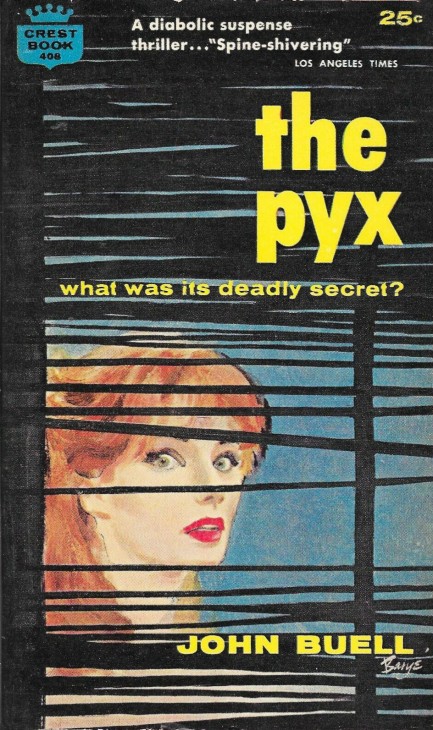
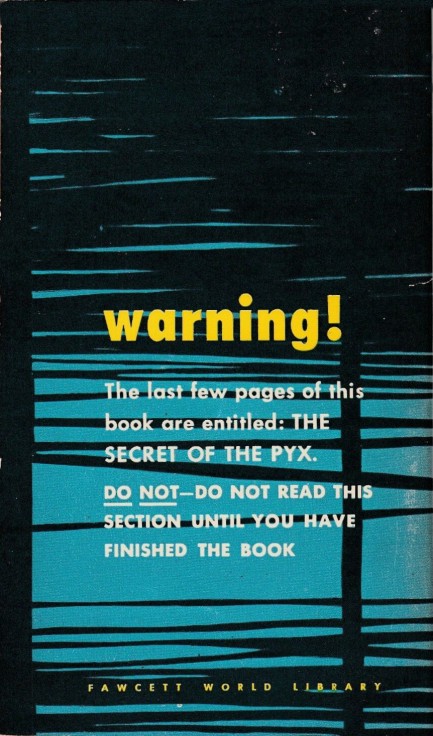
There's always the potential for spoilers when discussing books, but we don't have to worry about that with The Pyx, because the honchos at Fawcett Publications teased its weirdness on the front and rear covers, which means you can't help but know it isn't a standard crime novel. And if you're Catholic, you don't even need the teasers. The title is enough to suggest where the story goes.
John Buell's tale deals with a Montreal prostitute named Elizabeth Lucy who apparently commits suicide, but who we get to know via flashback chapters titled, “The Past.” As you'd guess, the other chapters are titled, “The Present,” and in those a police detective tries to determine whether Lucy leapt off a penthouse balcony, fell off by accident while high on heroin, or was pushed.
It's a good book, well written, heavily atmospheric and at times abstract, with cool little moments like, “The rhythm of the wipers was like time running ahead.” It's clear why it's been reprinted more than once, and why the book spawned a 1973 movie. We recommend it, and we suggest staying away from any detailed reviews (or any descriptions of the film) before you read it. It's from 1959 with Barye Phillips on the cover chores.
 But I don't want to swim with you. Walking with you was already enough of an ordeal. 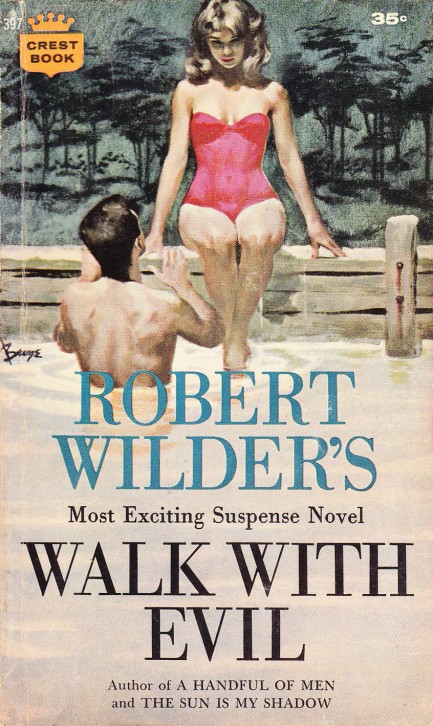
The front of Robert Wilder's Walk with Evil calls it the author's most exciting suspense novel. We wouldn't know, because we've read only this one, but it's good. The dispersed narrative follows a reporter who vacations in the environs of Palm Beach and stumbles upon one of the most famous missing persons in recent history—a federal judge who vanished without a trace years ago. Meanwhile, a recently paroled crime kingpin is cruising the Florida coast in a yacht. The missing-now-found judge and the kingpin are connected. The former once presided over the trial that sent the latter to prison.
Wilder's tale skips around between the kingpin and his henchmen, the judge and his daughter, the reporter, and an insurance investigator also poking around. We soon learn that the kingpin is searching for a million robbery dollars that are hidden somewhere along the coast, and that the judge may hold the key. The plot threads which inexorably twist into a knot of tension and danger are very competently managed by Wilder. The only weakness—as usual with these vintage thrillers—is the love story, which once again is perfunctory, with the woman given no concrete reason to fall for the hero other than that he's there.
But it's a minor issue. The story works, and the characters are interesting and diverse. We'll never know if Walk with Evil is really Wilder's most exciting novel unless we try a couple more, so maybe we'll do that, assuming we can find some with reasonable price tags. The cover art on this was painted by Barye Phillips—yes, again. The man was simply among the most ubiquitous illustrators of his era. The copyright is listed online as 1958, however ours says clear as day on the inside that the original publication year was 1957, with this Crest edition arriving in 1960.
 They say vengeance is a dish best served cold. But hot works fine too. 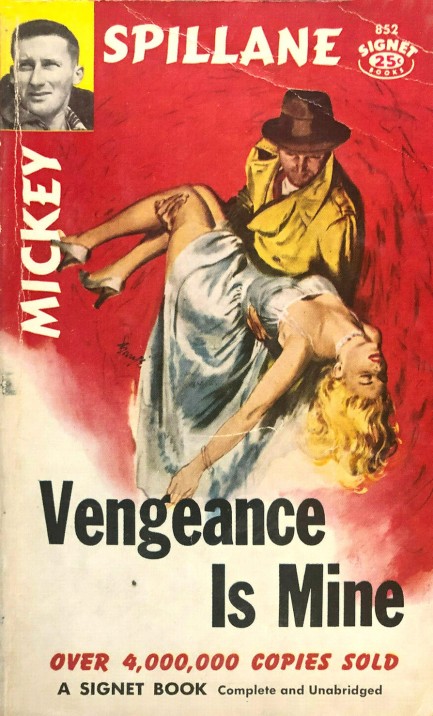
Vengeance Is Mine is Mickey Spillane's third Mike Hammer novel, and sees the violence addicted shamus lose his investigative license, then a close army buddy, then be haunted when a woman enters his life who resembles his fiancée Charlotte Manning, who he killed in his debut outing I, the Jury. This new woman is named Juno Reeves, and as Hammer attempts to avenge the murder of his friend, she provides an unnerving reminder of his past. She'll be even more unnerving in his future, but that's all we'll say about her. On the subject of revenge best served cold, forget it. Hammer wants white hot vengeance right now. The stark difference between Spillane's approach and that of other crime authors is that he writes Hammer as so mean the character is actually odious, but that's his game, and as a reader you go in accepting it. Sometimes, as in I, the Jury and Kiss Me Deadly, it's pulp gold. Vengeance Is Mine is more like silver, however it does have an incredible punchline ending you won't forget. The cover art here is by Barye Phillips, part of a set he painted for the series. You can see the others here. 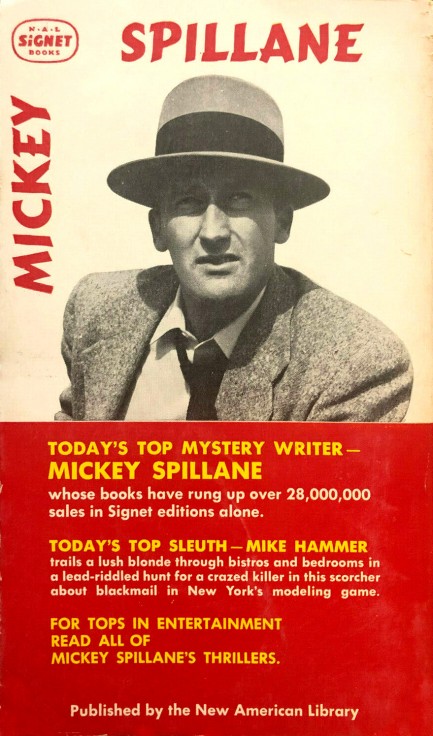
 I know—a magenta coat and white beret are bold choices for a clandestine meeting. But just look at the results. 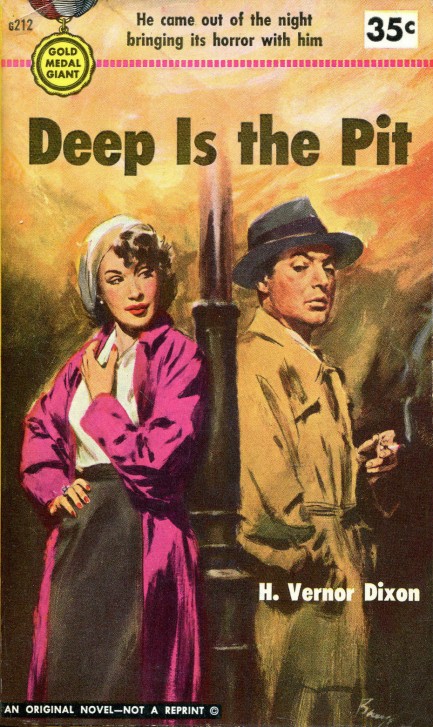
Deep Is the Pit, for which you see Barye Phillips cover art above, is the story of a thief and killer named Marty Lee, who, like Stringer Bell of The Wire, tries to plow his ill-gotten gains into legitimate business. In this case, he swings a deal to buy the decaying old Stannard Hotel in San Francisco, which he turns into one of the hot spots of the West Coast by installing several themed bars and nightclubs. Since all his crimes were committed under a well established false identity and in disguise, he feels pretty safe, even when hostelry success makes him part of Frisco's highly scrutinized glitterati. There's only one snag—his former girlfriend from his criminal days is still around. But because she wants to make it big as a singer and actress, she has no reason to cross a guy who now owns some of the best clubs in California. Her knowledge of his past is neutralized by her ambition, and that's the only reason he hasn't killed her. Well, not the only reason. She's also great in bed.
He eventually jilts her for the rich daughter of the Stannard clan, Karen, and it's here that we see Marty's true colors. His bride is a virgin, and he pretty much ruins sex for her from the word go by ravaging her like an animal, which is the way he's always done it. Her pain and humiliation don't matter to him. He thinks her growing reluctance and eventual refusal to have sex with him is her fault. Even though he understands on some level that she needs gentleness and affection, he can only take what he wants, at whatever time and as violently as his mood dictates. He inevitably turns back to his old girlfriend, carrying on an affair while his upper crust marriage appears on the surface to be a happy one. Yet at the same time, he's very attached to his wife. It isn't love. It's something more akin to bedazzlement.
H. Vernor Dixon is one of those writers who lacks a strong or notable style, yet still puts a story across entertainingly. We were never tempted to skip even a paragraph. It's at about the two-thirds point that Marty's problems arrive in a bunch. His hotel is robbed by some of the subordinates he trained in the art of theft, an underworld figure with whom he's had dealings starts hanging around the property, and his old girlfriend suddenly wants more than just a singing career—or else. He can't do much about the robbers or the mobster, but he can handle his old flame. If he gets rid of her, his other problems will likely sort themselves out. But in these books supposedly disposable women can have tricks of their own up their sleeves. Deep Is the Pit ultimately hinges on Marty's desperate attempt to murder his mistress, which Dixon manages to describe tautly and with good twists. The pit is deep indeed, but for readers falling in is a good time.

|
 |

The headlines that mattered yesteryear.
1945—Mussolini Is Arrested
Italian dictator Benito Mussolini, his mistress Clara Petacci, and fifteen supporters are arrested by Italian partisans in Dongo, Italy while attempting to escape the region in the wake of the collapse of Mussolini's fascist government. The next day, Mussolini and his mistress are both executed, along with most of the members of their group. Their bodies are then trucked to Milan where they are hung upside down on meathooks from the roof of a gas station, then spat upon and stoned until they are unrecognizable. 1933—The Gestapo Is Formed
The Geheime Staatspolizei, aka Gestapo, the official secret police force of Nazi Germany, is established. It begins under the administration of SS leader Heinrich Himmler in his position as Chief of German Police, but by 1939 is administered by the Reichssicherheitshauptamt, or Reich Main Security Office, and is a feared entity in every corner of Germany and beyond. 1937—Guernica Is Bombed
In Spain during the Spanish Civil War, the Basque town of Guernica is bombed by the German Luftwaffe, resulting in widespread destruction and casualties. The Basque government reports 1,654 people killed, while later research suggests far fewer deaths, but regardless, Guernica is viewed as an example of terror bombing and other countries learn that Nazi Germany is committed to that tactic. The bombing also becomes inspiration for Pablo Picasso, resulting in a protest painting that is not only his most famous work, but one the most important pieces of art ever produced. 1939—Batman Debuts
In Detective Comics #27, DC Comics publishes its second major superhero, Batman, who becomes one of the most popular comic book characters of all time, and then a popular camp television series starring Adam West, and lastly a multi-million dollar movie franchise starring Michael Keaton, then George Clooney, and finally Christian Bale. 1953—Crick and Watson Publish DNA Results
British scientists James D Watson and Francis Crick publish an article detailing their discovery of the existence and structure of deoxyribonucleic acid, or DNA, in Nature magazine. Their findings answer one of the oldest and most fundamental questions of biology, that of how living things reproduce themselves.
|

|
|
It's easy. We have an uploader that makes it a snap. Use it to submit your art, text, header, and subhead. Your post can be funny, serious, or anything in between, as long as it's vintage pulp. You'll get a byline and experience the fleeting pride of free authorship. We'll edit your post for typos, but the rest is up to you. Click here to give us your best shot.

|
|