 Claire Kelly demonstrates the fine art of strap-tease. 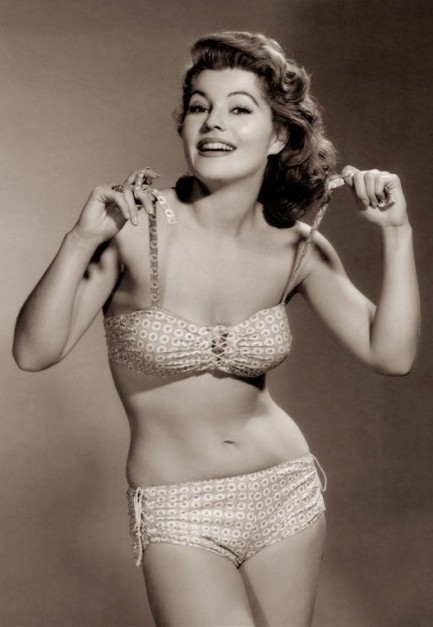
American actress Claire Kelly was once called the screen’s most exciting discovery since Rita Hayworth, but her career comprised mainly unremarkable film and television appearances. She did, however, spend a lot of time in the tabloids thanks to a messy divorce/custody battle with George DeWitt, and her liaisons with Frank Sinatra, Conrad “Nicky” Hilton, and Lance Reventlow (son of Barbara Hutton, who for a while was the second richest woman in the world). Kelly eventually gave up acting and married into money. This nice shot of her is from around 1959.
 Confidential sinks its teeth into the juiciest celebrity secrets. 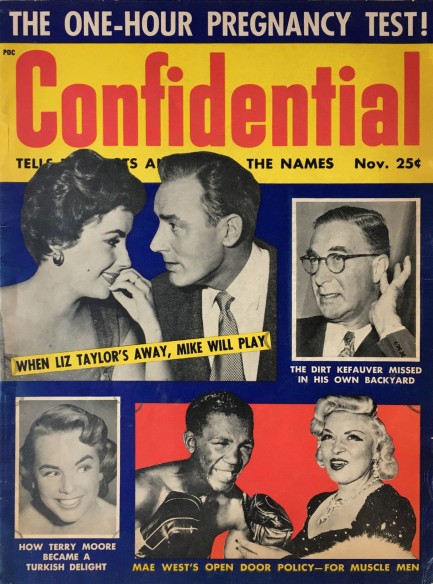
Confidential magazine had two distinct periods in its life—the fanged version and the de-fanged version, with the tooth pulling done courtesy of a series of defamation lawsuits that made publisher Robert Harrison think twice about harassing celebrities. This example published this month in 1955 is all fangs. The magazine was printing five million copies of each issue and Harrison was like a vampire in a blood fever, hurting anyone who came within reach, using an extensive network spies from coast to coast and overseas to out celebs' most intimate secrets.
In this issue editors blatantly call singer Johnnie Ray a gay predator, spinning a tale about him drunkenly pounding on doors in a swanky London hotel looking for a man—any man—to satisfy his needs. The magazine also implies that Mae West hooked up with boxer Chalky White, who was nearly thirty years her junior—and black. It tells readers about Edith Piaf living during her youth in a brothel, a fact which is well known today but which wasn't back then.
The list goes on—who was caught in whose bedroom, who shook down who for money, who ingested what substances, all splashed across Confidential's trademark blue and red pages. Other celebs who appear include Julie London, Jack Webb, Gregg Sherwood, and—of course—Elizabeth Taylor. Had we been around in 1955 we're sure we would have been on the side of privacy rights for these stars, but today we can read all this guilt-free because none of it can harm anyone anymore. Forty panels of images below, and lots more Confidential here. 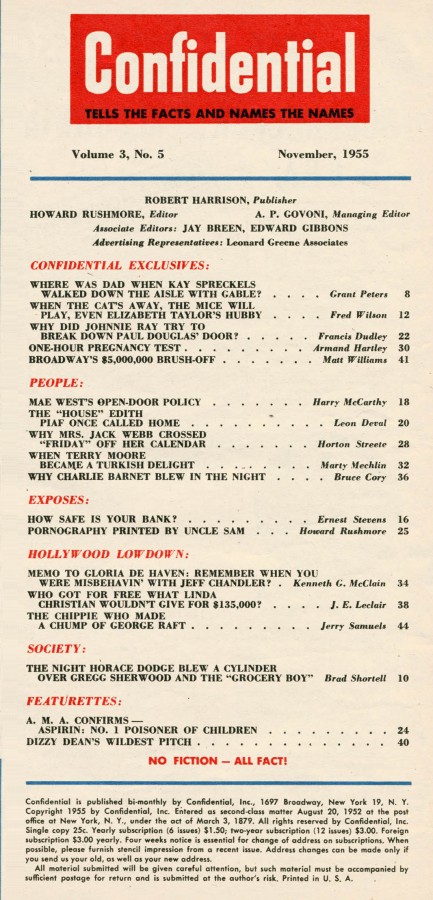 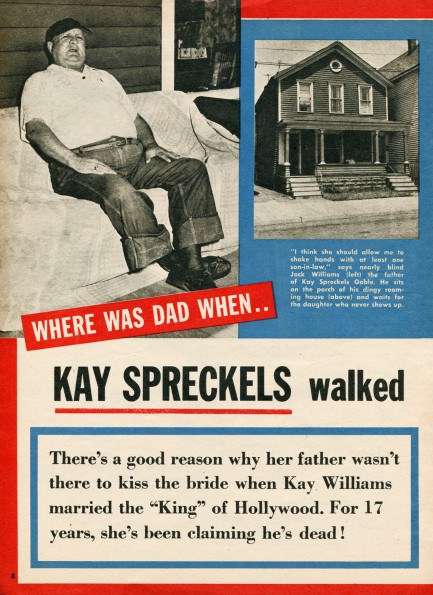 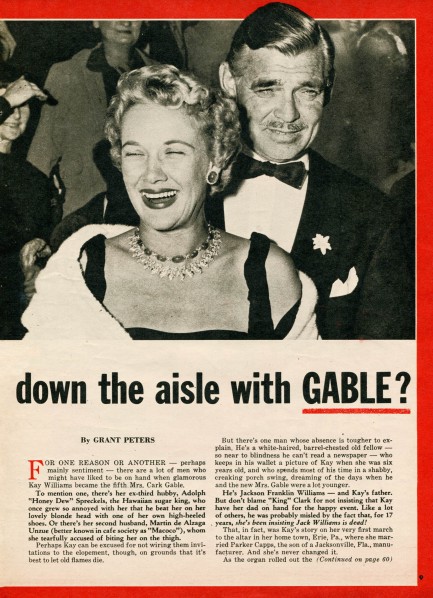 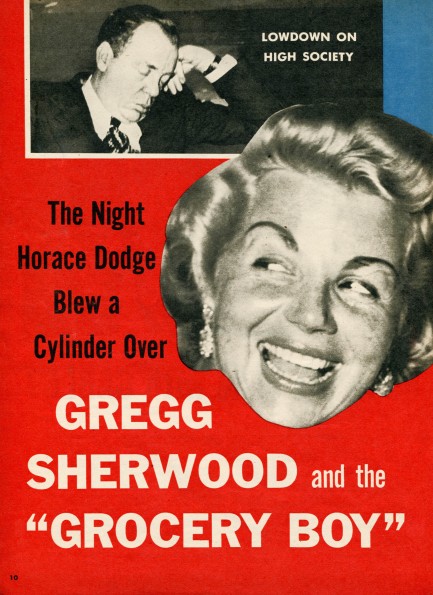 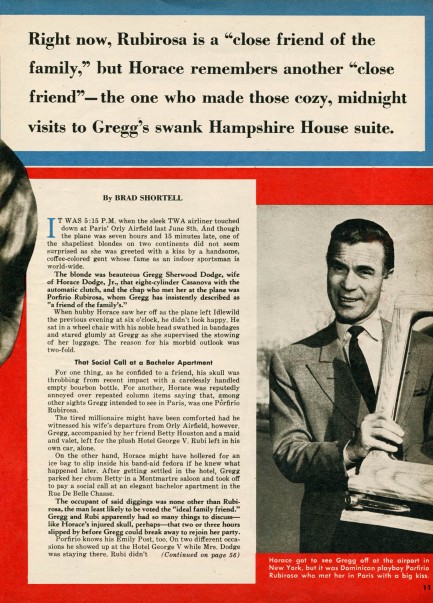 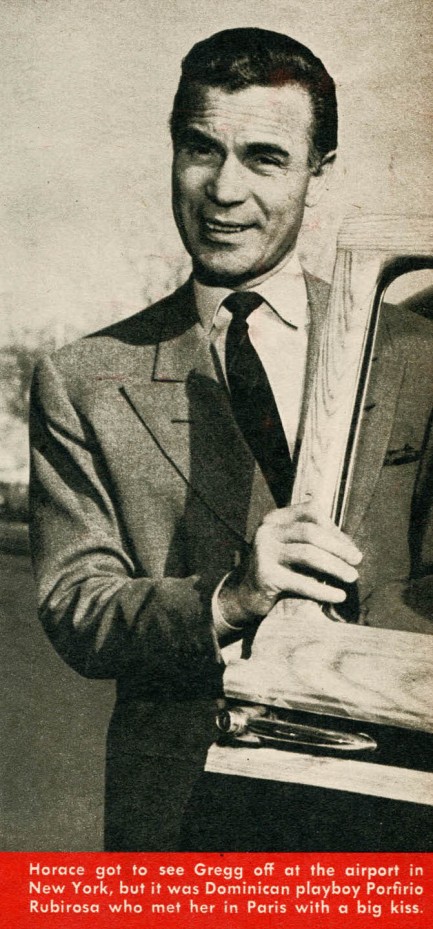 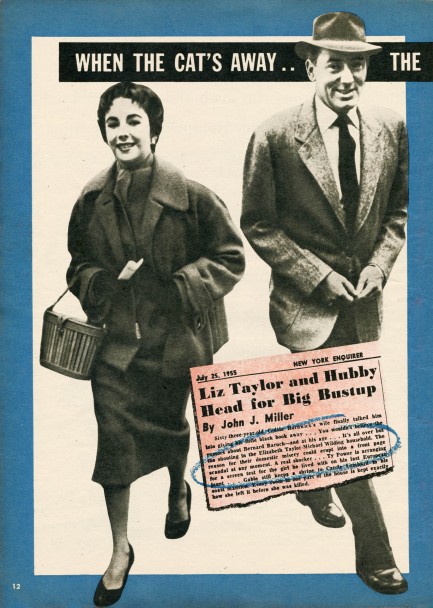 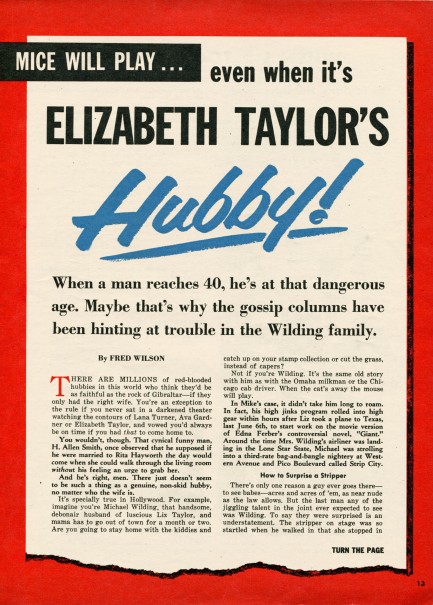 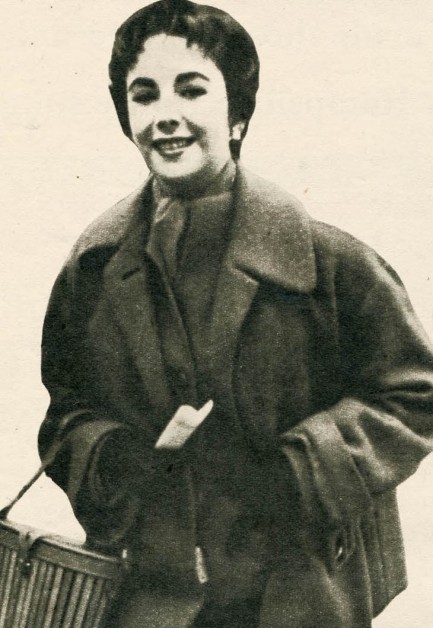 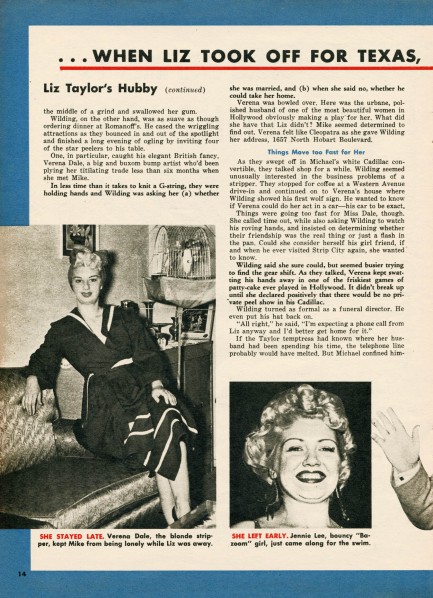 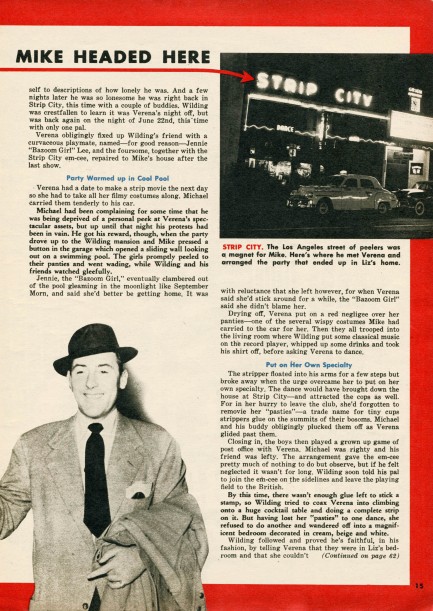   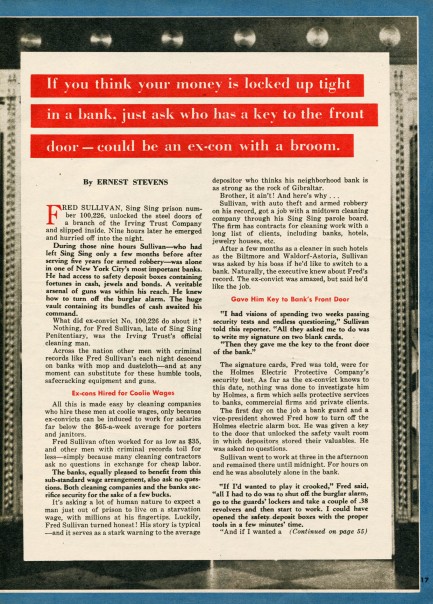 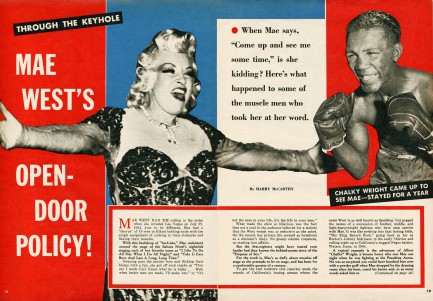 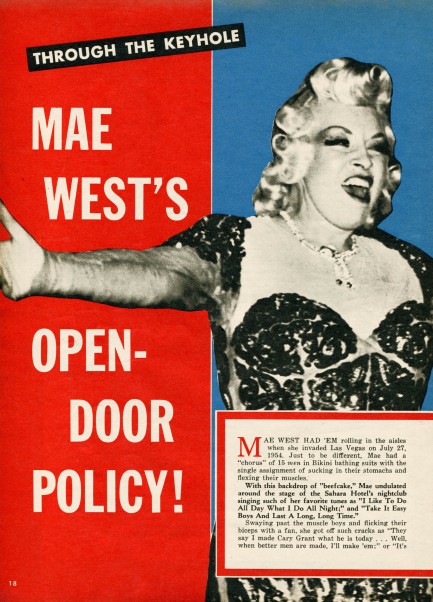 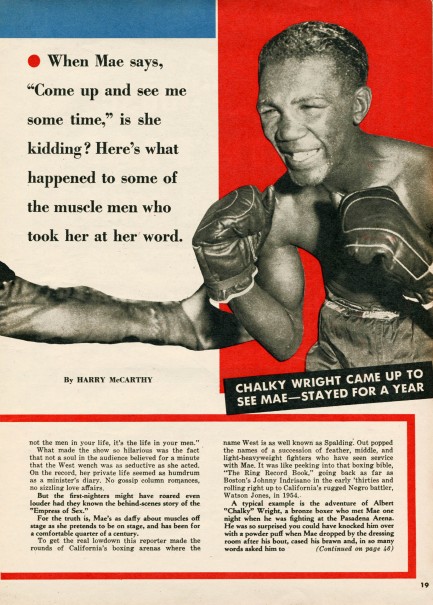 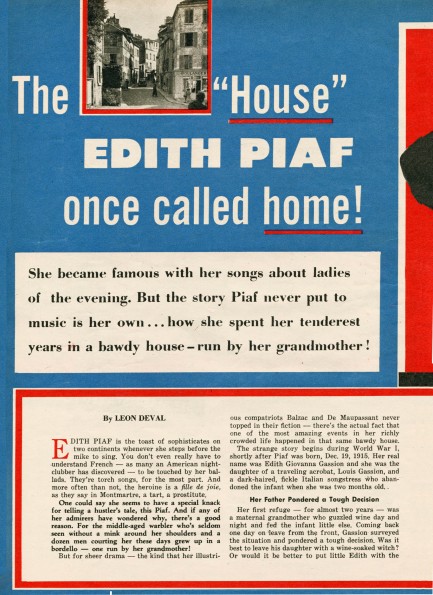 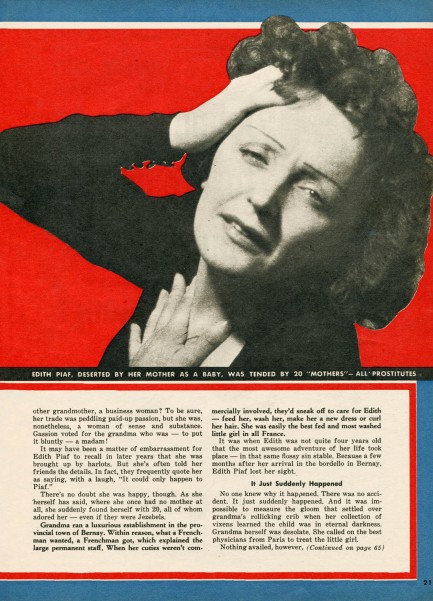 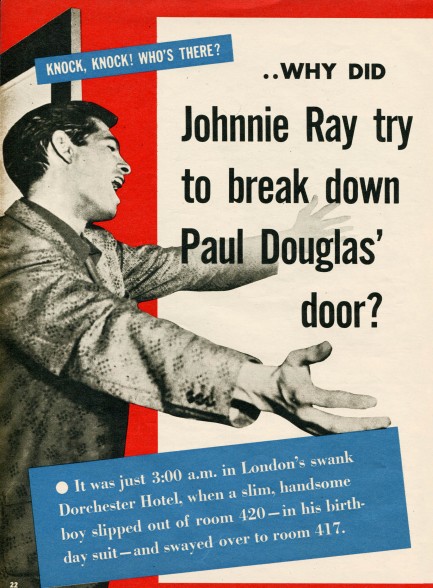 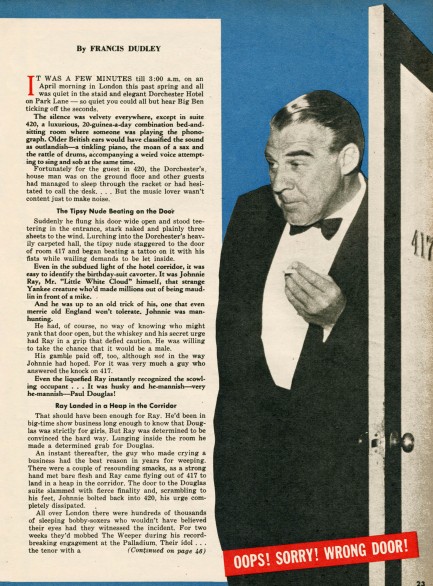 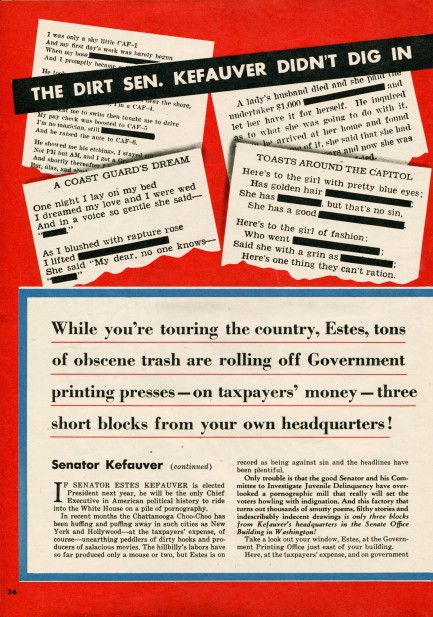 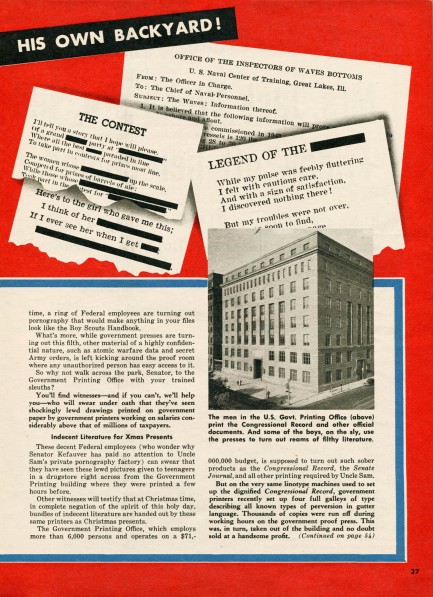 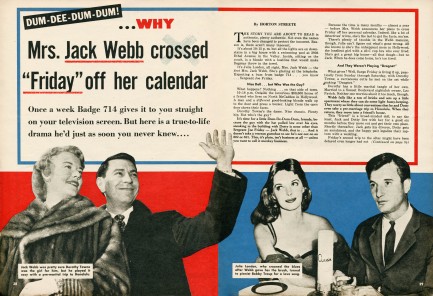 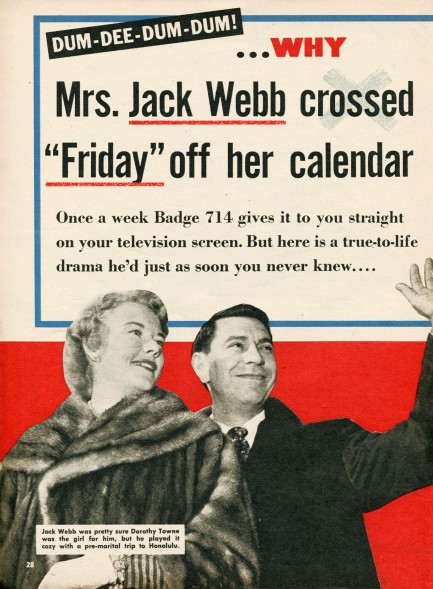 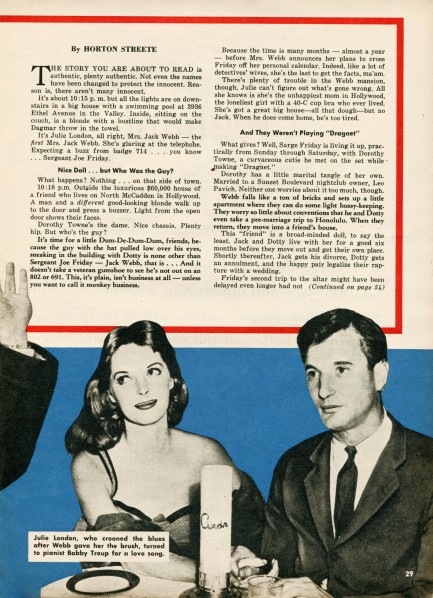 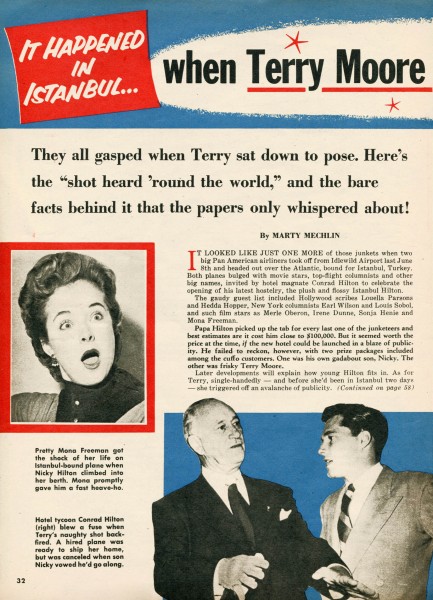 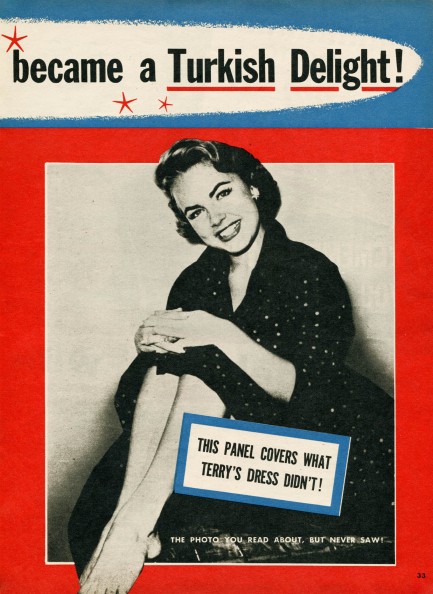 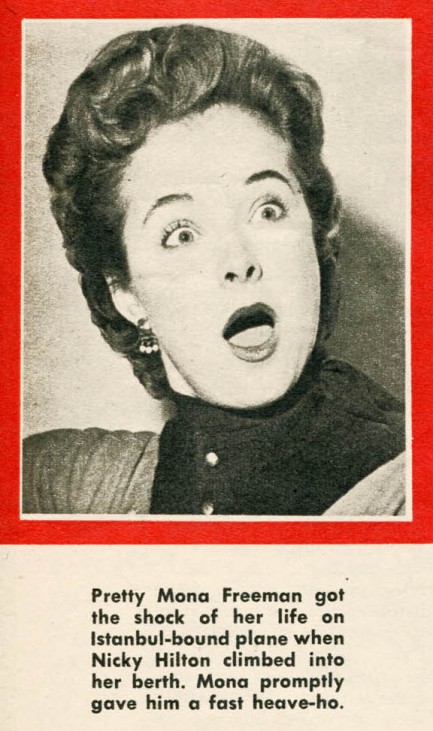 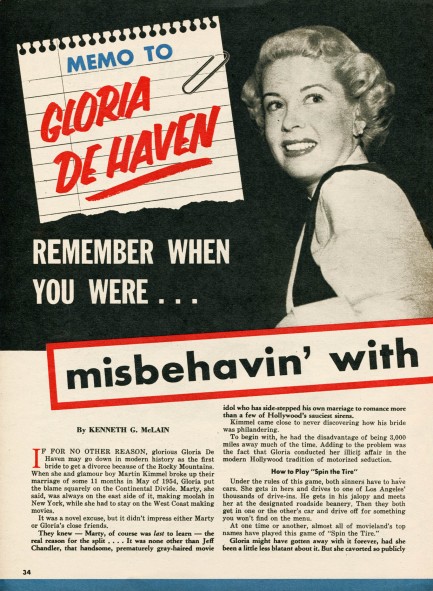 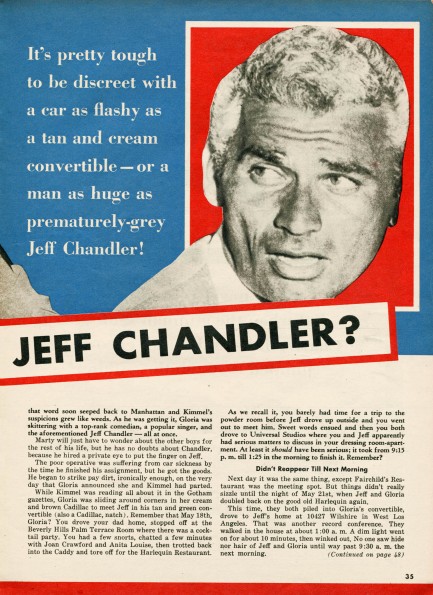 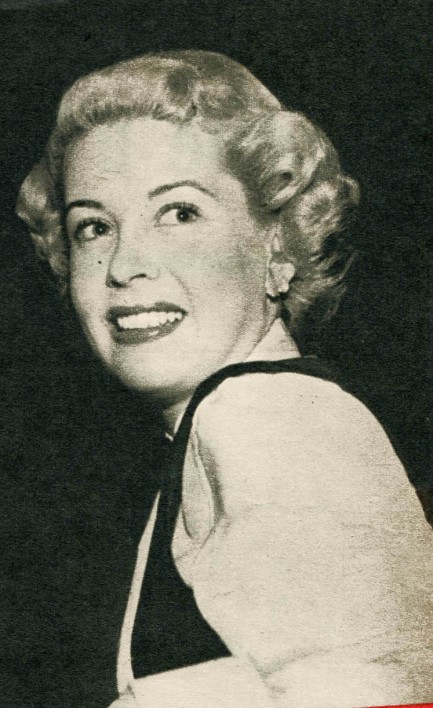 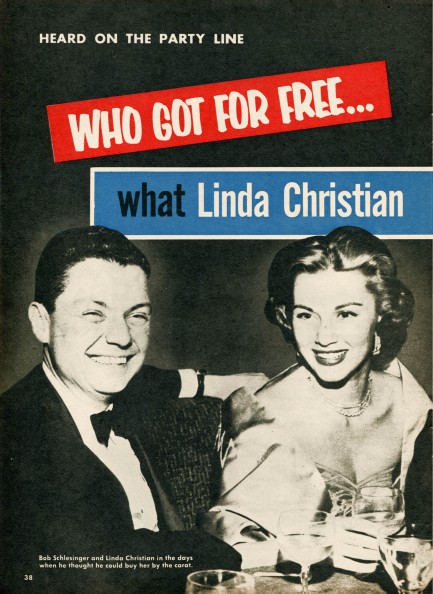 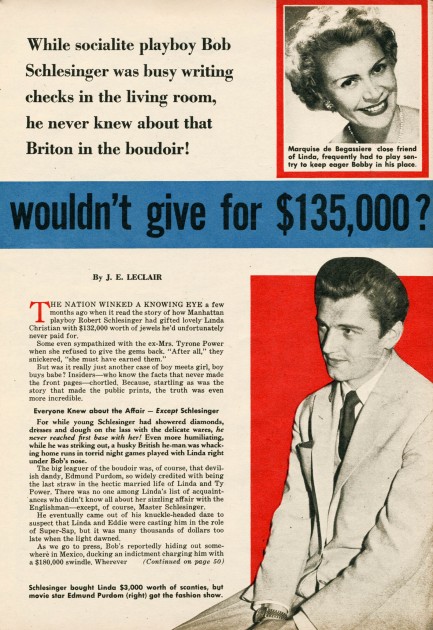 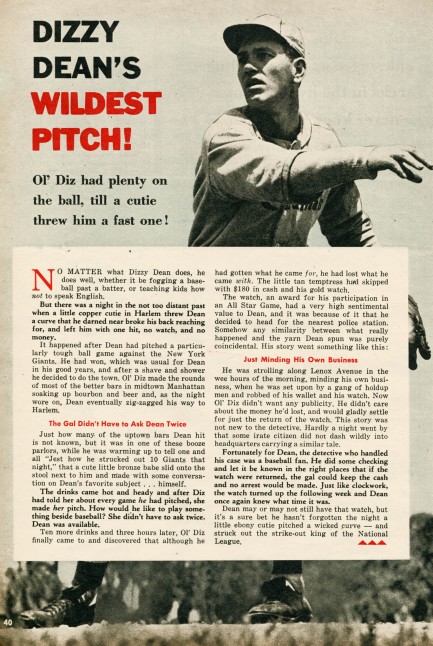 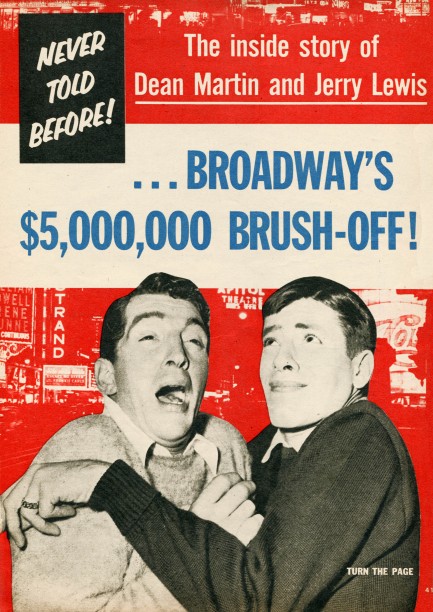 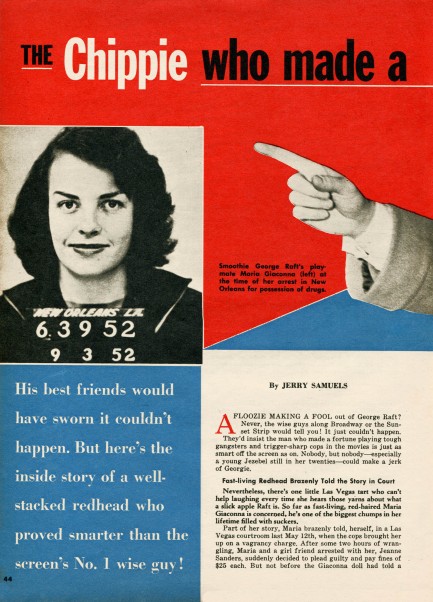 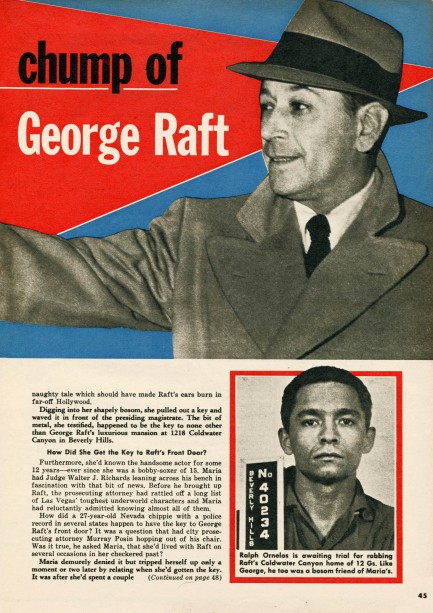 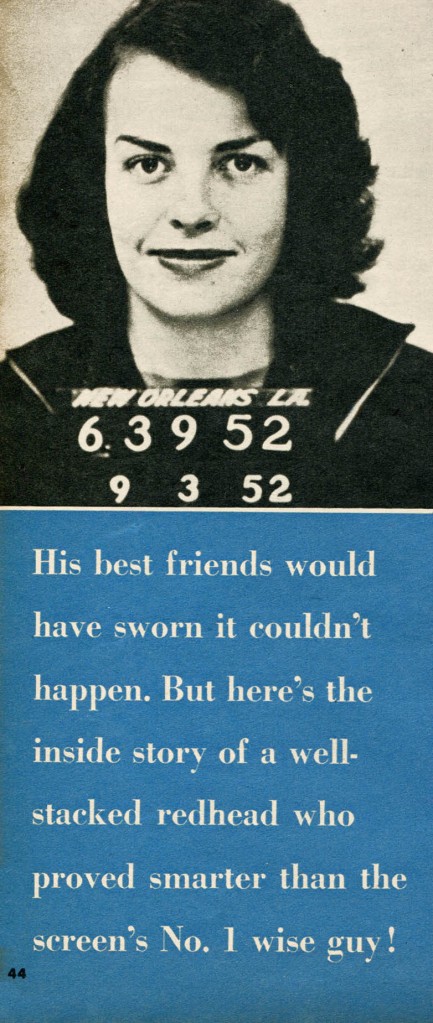
 You wouldn’t mind terribly if we steal your nickname? 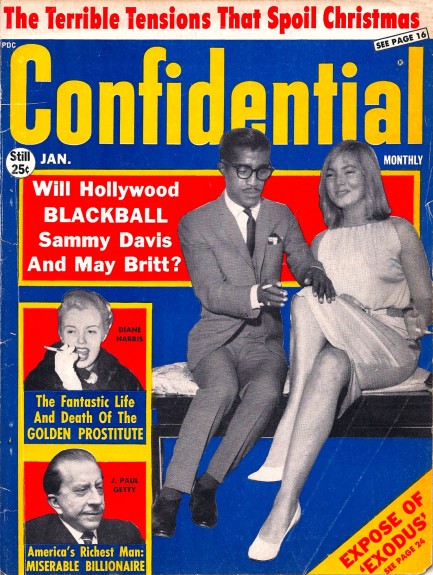 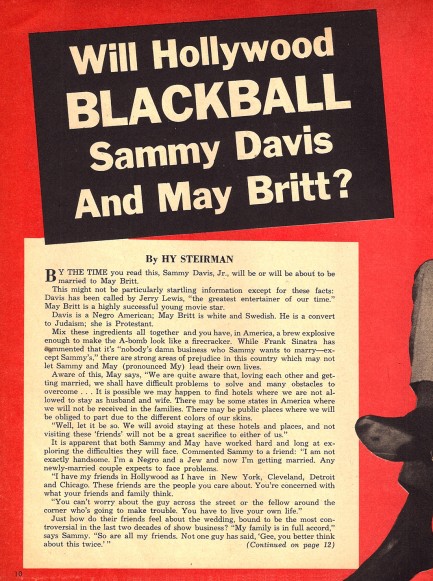 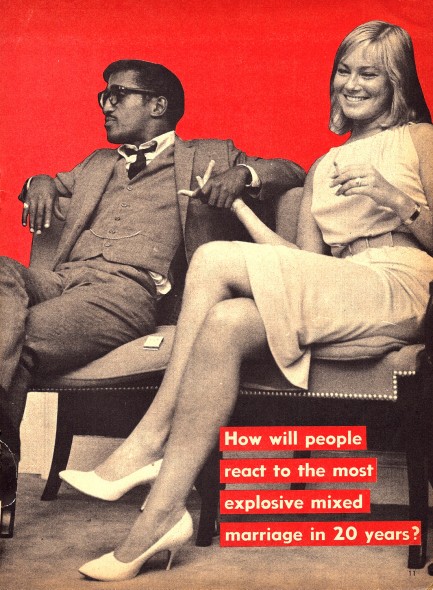
Today we have a January 1961 issue of Confidential for you, with cover stars Sammy Davis, Jr. and May Britt. Since we’ve already discussed Sammy and May of late, and even made her a recent femme fatale, we’ll skip past them and focus on another interesting story—the tale of Diane Harris, who shot to notoriety as a witness in the infamous Minot Jelke pimping trial of 1952. We wrote about it back in 2009—Jelke was an oleomargarine heir who was cut off from his trust fund and decided to turn his girlfriend Patricia Ward into a prostitute in order to make ends meet. Ward became known as the “Golden Girl of Vice” and “The Golden Girl of Café Society,” which is why it’s interesting that Confidential calls Diane Harris “The Golden Prostitute.” Apparently Jelke had the Midas touch. Confidential wastes no time in its article. It begins: She gave herself a title… Lady Diana Harrington. The New York D.A. gave her another… the Golden Girl of Café Society. Houston police gave her a third, less flamboyant title… prostitute. Uh oh—the New York District Attorney’s nickname for Harris is identical to Patricia Ward’s nickname. After a few more paragraphs of reading, it becomes clear that Confidential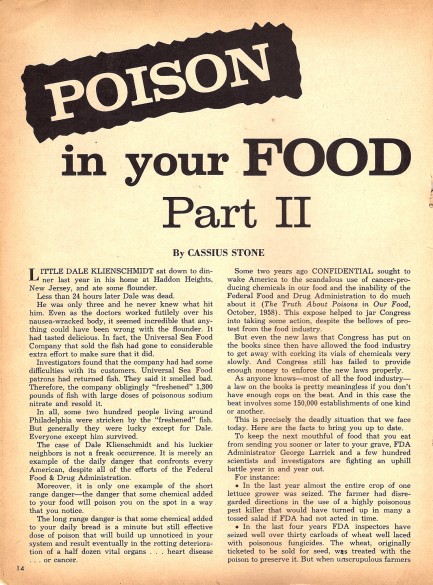 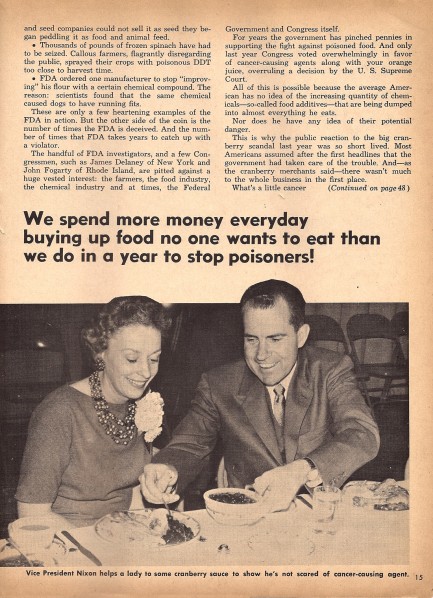 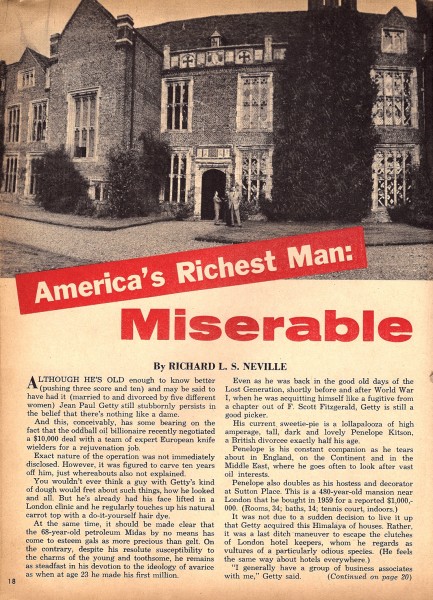  believes the Golden Girl is Diane Harris—not Patricia Ward. While it’s true that Harris did use some aliases, including Lady Diana Harrington and Mary Lou Brew, nowhere is the name Ward mentioned as a pseudonym. believes the Golden Girl is Diane Harris—not Patricia Ward. While it’s true that Harris did use some aliases, including Lady Diana Harrington and Mary Lou Brew, nowhere is the name Ward mentioned as a pseudonym. After searching high and low for some idea of whether we were dealing with one woman or two, we finally saw in the IMDB page on the 1995 Jelke biopic Café Society that Patricia Ward and Diana Harris were played by separate actresses—Lara Flynn Boyle and Cynthia Watrous. So was there some confusion in 1961 about who exactly the Golden Girl was? Looking back at our original post on the subject, the photo of the Golden Girl on the cover of Hush-Hush shows a blonde. Confidential has numerous photos of their Golden Girl Diane Harris, and a single photo they identify as Pat Ward. Just plain Pat—no Golden, no nickname at all. And she’s a brunette. So not only does Confidential identify the Golden Girl of Café Society as Diane Harris—turns out so did that March 1961 Hush-Hush. We just didn’t realize it at the time. Our mistake came when we first researched the Jelke trial and found a New York Times movie review that identified Pat Ward as the Golden Girl. From that point we just ran with it and never thought to doublecheck. Until today. Now, based on available evidence, it seems that at some point over the intervening years the historical record got twisted and the label Golden Girl was applied to Patricia Ward, where it stayed even up to the  point of a Hollywood motion picture misidentifying her. She was indeed Minot Jelke’s girlfriend, whereas Harris was just a fellow high dollar prostie (and corroborating witness), so perhaps some clever scribe, or even the writers of the 1995 movie, decided that such a catchy nickname would be better applied to the girlfriend. At least that’s the way it looks to us. point of a Hollywood motion picture misidentifying her. She was indeed Minot Jelke’s girlfriend, whereas Harris was just a fellow high dollar prostie (and corroborating witness), so perhaps some clever scribe, or even the writers of the 1995 movie, decided that such a catchy nickname would be better applied to the girlfriend. At least that’s the way it looks to us. If we’re right, is any of this important? Does it matter that Harris was fleeced of her nickname, or possibly that a movie took liberties and those liberties were later assumed to be facts? Do we expect an award? No, not really, but it’s interesting. Confidential barely recounts the events of the trial. The story is actually about Diane Harris being found dead in a Houston apartment eight years afterward, in September 1960. She was still a prostitute at the time. Confidential tells us: The blonde’s nude body was in bed, a green sheet and a pink blanket covered her. Pictures of her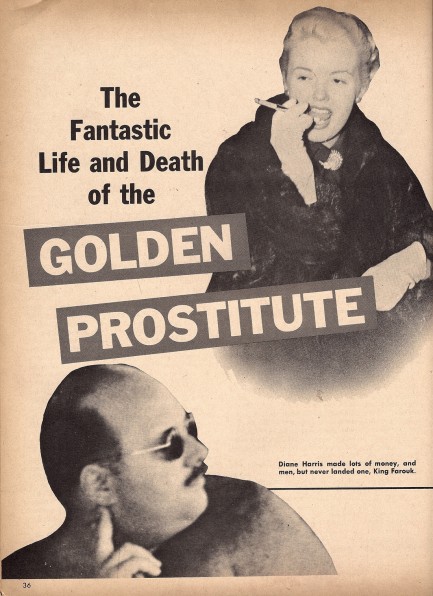 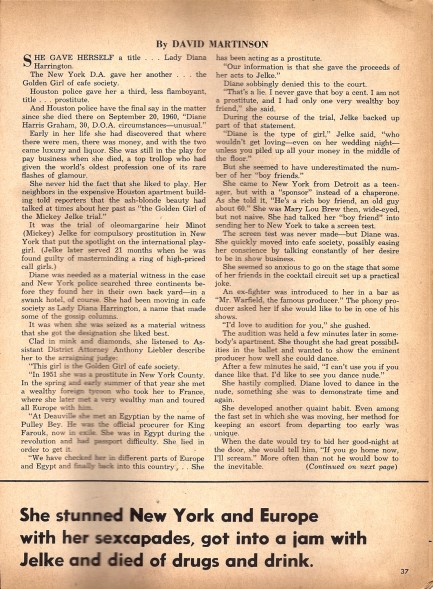 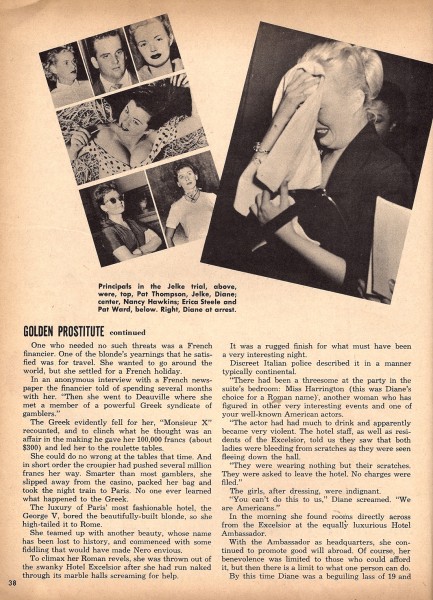 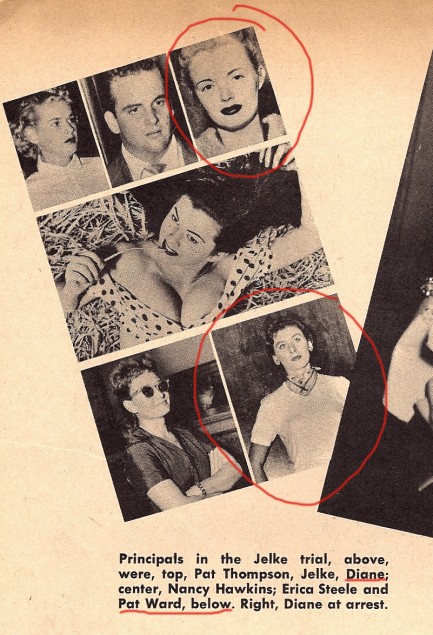 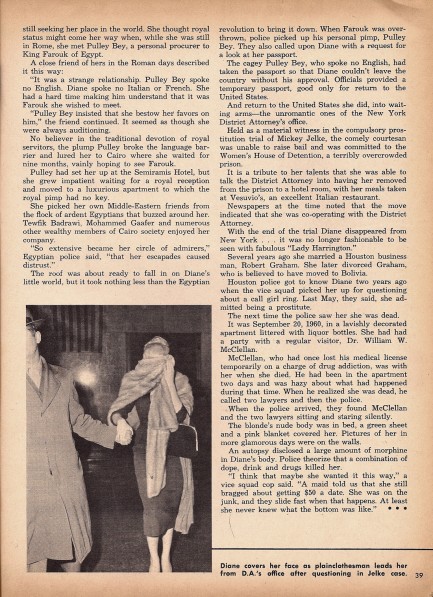 in more glamorous days were on the walls. An autopsy disclosed a large amount of morphine in her body. Police theorize that a combination of drink and drugs killed her. in more glamorous days were on the walls. An autopsy disclosed a large amount of morphine in her body. Police theorize that a combination of drink and drugs killed her. Diane Harris had wanted the best life had to offer, and money meant everything. All her friends and acquaintances knew that about her. According to her maid, even at the end she still bragged about once being able to command fifty dollars per date. An obsessive desire for luxury drove her into the arms of rich, uncaring men, and eventually, in order to maintain her high flying lifestyle, into prostitution. The one piece of her that endured long after she died naked and surrounded by bottles and pills was her famous nickname—The Golden Girl of Café Society. But she eventually lost that too.
 Kicking ass and taking names. 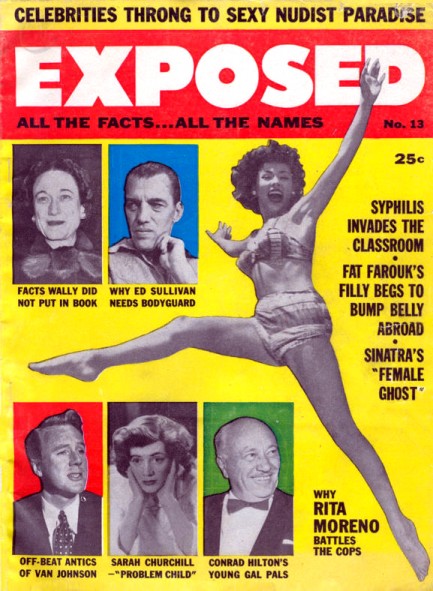
Today we have another copy of the tabloid Exposed, this one from March 1957 with a nice shot of actress and dancer Rita Moreno on the cover. The text beneath her claims she battles the cops, and inside she’s referred to as a “cop fighting wildcat.” Why? Because in June 1955 Moreno slapped an LAPD officer three times across the mouth and kicked him because he was arresting her boyfriend George Hormel II for marijuana possession. It’s lucky for Rita the taser hadn’t been invented yet. If it had, we suspect she would have learned the electric boogaloo the hard way. In any case, she got away with it and has gone on to sustain her screen and stage career over five more decades, winning multiple awards and earning a star on Hollywood’s Walk of Fame.
|
 |

The headlines that mattered yesteryear.
1933—The Gestapo Is Formed
The Geheime Staatspolizei, aka Gestapo, the official secret police force of Nazi Germany, is established. It begins under the administration of SS leader Heinrich Himmler in his position as Chief of German Police, but by 1939 is administered by the Reichssicherheitshauptamt, or Reich Main Security Office, and is a feared entity in every corner of Germany and beyond. 1937—Guernica Is Bombed
In Spain during the Spanish Civil War, the Basque town of Guernica is bombed by the German Luftwaffe, resulting in widespread destruction and casualties. The Basque government reports 1,654 people killed, while later research suggests far fewer deaths, but regardless, Guernica is viewed as an example of terror bombing and other countries learn that Nazi Germany is committed to that tactic. The bombing also becomes inspiration for Pablo Picasso, resulting in a protest painting that is not only his most famous work, but one the most important pieces of art ever produced. 1939—Batman Debuts
In Detective Comics #27, DC Comics publishes its second major superhero, Batman, who becomes one of the most popular comic book characters of all time, and then a popular camp television series starring Adam West, and lastly a multi-million dollar movie franchise starring Michael Keaton, then George Clooney, and finally Christian Bale. 1953—Crick and Watson Publish DNA Results
British scientists James D Watson and Francis Crick publish an article detailing their discovery of the existence and structure of deoxyribonucleic acid, or DNA, in Nature magazine. Their findings answer one of the oldest and most fundamental questions of biology, that of how living things reproduce themselves. 1967—First Space Program Casualty Occurs
Soviet cosmonaut Vladimir Komarov dies in Soyuz 1 when, during re-entry into Earth's atmosphere after more than ten successful orbits, the capsule's main parachute fails to deploy properly, and the backup chute becomes entangled in the first. The capsule's descent is slowed, but it still hits the ground at about 90 mph, at which point it bursts into flames. Komarov is the first human to die during a space mission.
|

|
|
It's easy. We have an uploader that makes it a snap. Use it to submit your art, text, header, and subhead. Your post can be funny, serious, or anything in between, as long as it's vintage pulp. You'll get a byline and experience the fleeting pride of free authorship. We'll edit your post for typos, but the rest is up to you. Click here to give us your best shot.
|
|