Fear and loathing are the least of his problems. 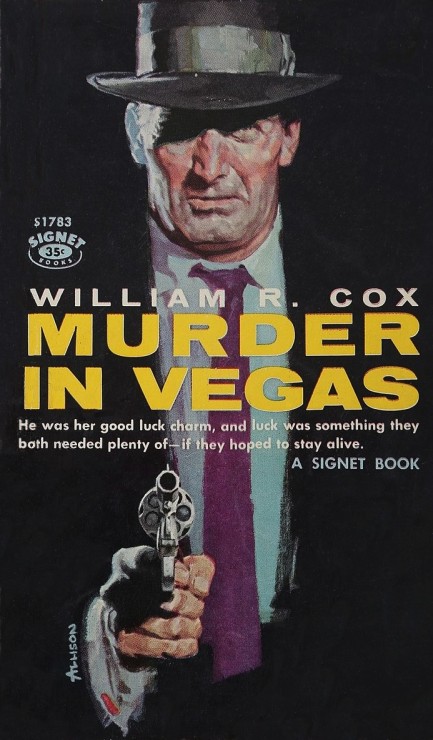
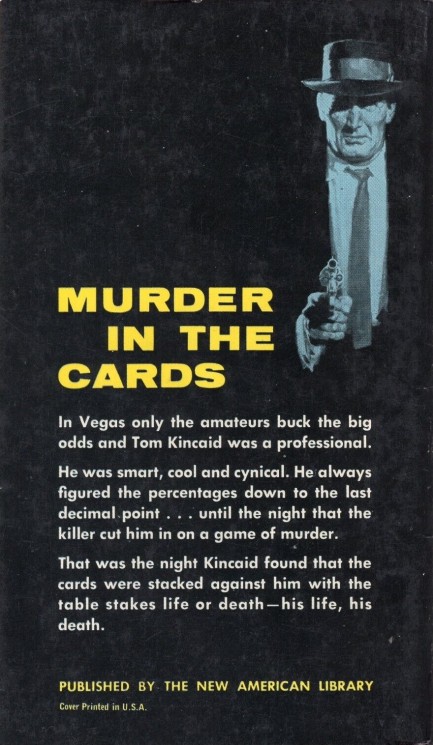
Jerry Allison art strikes a menacing note on the cover of William R. Cox's 1960 novel Murder in Vegas, in which Cox's gambler hero Tom Kincaid from 1958's Hell To Pay, which we recently discussed, returns to the written page to find more trouble. The first murder in the book actually occurs in Los Angeles, but someone is later knocked off in Vegas and as a direct result Kincaid is elevated from silent partner to full owner of a casino called the White Elephant. Simultaneously his girlfriend Jean Harper is in town filming a movie, and the murder and film production seem tied together. Kincaid is as interesting as before, but the fun creation here is down-on-her-luck party girl Carry Cain, who mixes sexiness and vulnerability with a beatnik mentality. She's an aspiring actress and gambling addict who thinks Kincaid might finally bring her the luck she's been seeking. Instead she finds herself in the middle of a Vegas-sized mess. Cox has talent, as we've noted before. It shines bright in Murder in Vegas.
 Take a picture, perv. It'll last longer. 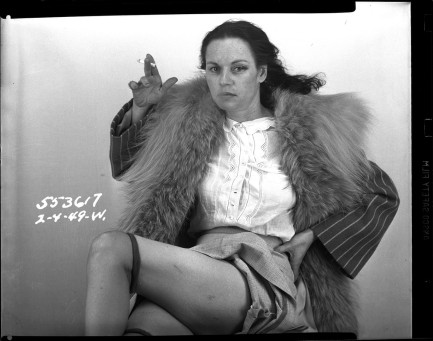 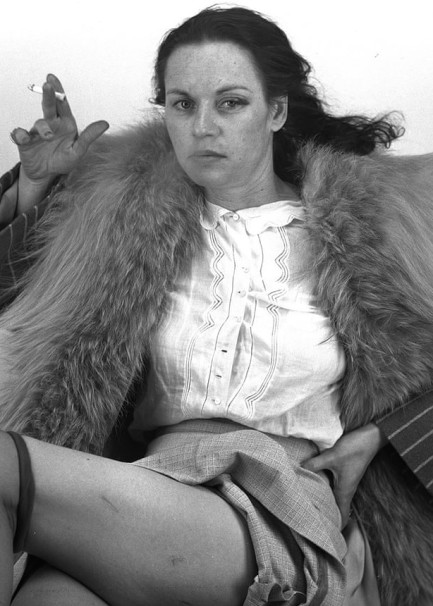
Above is another striking image from the 2019 Lucie Foundation exhibit of Los Angeles crime photos, most of which have been widely disseminated across the internet since then. That means we can always grab one when we want to dip into the mid-century crime underworld. The subject here, with her unfliching gaze and lit cigarette, has been arrested but there's no info revealing why. We're thinking public check and pinstripe clashing? No, probably not that. Imitating Sharon Stone in Basic Instinct? No, that was before her time. Felony cruelty to fur-bearing mammals? No. Okay, here's a shot in the dark—probably she was arrested for prostitution. That's our final guess. The photo was made today in 1949.
 I'd have sex for free, but that would be irresponsible from a business perspective. 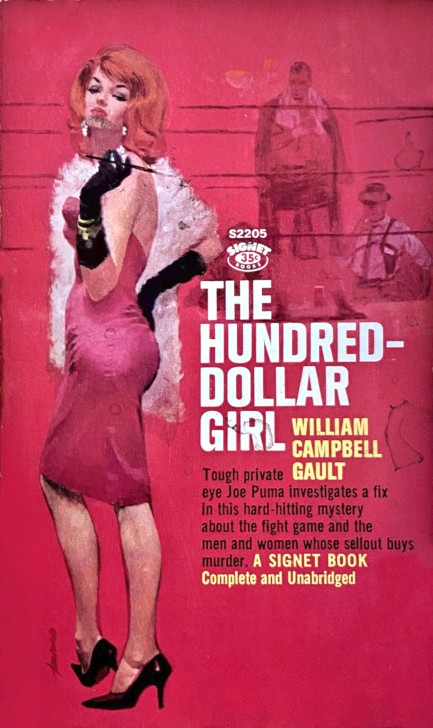
The 1962 Signet paperback of The Hundred-Dollar Girl has striking cover art by Jerry Allison, whose nice work we've seen before here, here, and here. William Campbell Gault's tale sees L.A. private dick Joe Puma investigating whether a boxing match was fixed, then finding himself in the middle of murder and an organized crime takeover of the fight racket. This is the second Puma we've read, and as with the previous book, he gets laid a couple of times, gets ko'd a couple of times, and beats up a couple of guys. All this is fine, but we haven't yet read the Gault novel that makes us sit up and go, "Ahh!" Certainly though, he's been good enough to make looking for that special book a pursuit we expect to pay off. We'll keep looking. In the meantime, if you want an L.A. crime read, you can do worse than The Hundred-Dollar Girl.
 You’re nobody ’til somebody loves you. 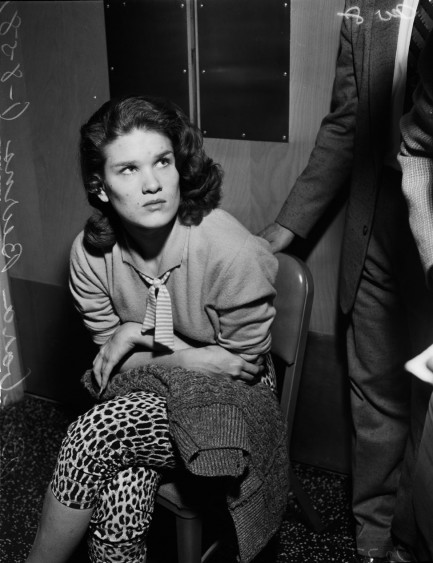 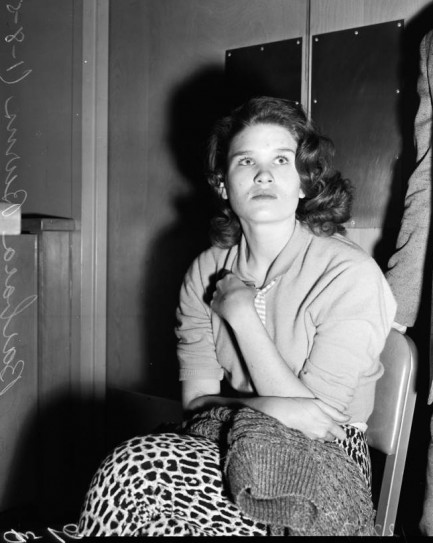
The above photos show Barbara Burns when she was busted for drugs today in 1958 after LAPD officers found track marks on her arms. Burns was the well-to-do daughter of famed comedian Bob Burns, but her father had died of kidney cancer in 1956. Barbara Burns was sentenced to probation after the arrest, and the story got some play in national newspapers, with several calling her probation sentence a storybook opportunity at a second chance. But she didn’t cooperate in the role. She managed to cobble together some behind-the-cameras television work, but was arrested for heroin possession in 1959. That time she served ninety days in jail and admitted in an interview, “I’m really hooked. I had nothing else to do, and my mother wouldn’t talk to me. I wanted to be a singer but I was too heavy and they told me it would help me lose weight.” Burns had always called herself an ugly duckling, compared herself unfavorably to her siblings, and felt she could never live up to family expectations. But even though her own words told the world that low self esteem was the root of her problems, a dead father and an estrangement from her mother probably didn't help things. The downward spiral continued. She was arrested for marijuana possession in early 1960 and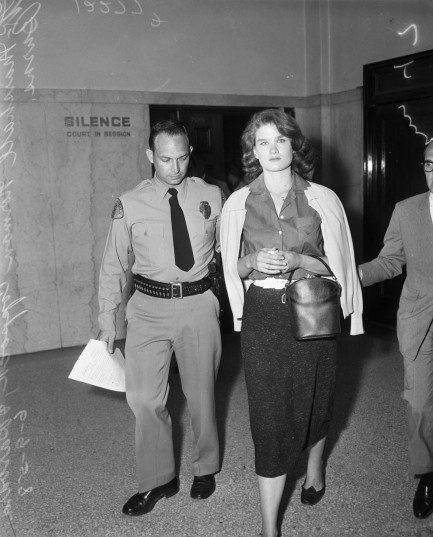 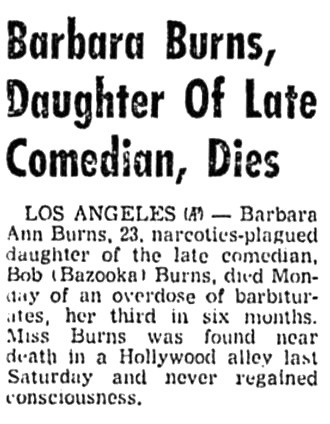 earned ninety days in Camarillo State Hospital. In November 1960 she was snared in another weed bust, but that time she walked after a jury acquitted her. When she was arrested for heroin possession again in June 1961, she lamented what had probably been true for longer than she admitted—that she had doomed her chance to have a career in show business. earned ninety days in Camarillo State Hospital. In November 1960 she was snared in another weed bust, but that time she walked after a jury acquitted her. When she was arrested for heroin possession again in June 1961, she lamented what had probably been true for longer than she admitted—that she had doomed her chance to have a career in show business.
At some point she sought medical treatment for an eye problem and was told by a doctor that she was losing her vision in her right eye. In both August and September of 1961 she attempted suicide, and in January 1962 while awaiting trial on one of her narcotics busts she was found overdosed and unconscious on a Hollywood street, and died a few days later in the hospital. Her suicide note said all she wanted was to be loved but everyone hated her. Many of her obituaries, ironically, described her as “tall and beautiful,” which she certainly would not have believed. They also noted her advantages in life—how she had won the crucial lottery of being born to wealth. But Barbara Burns didn’t see it that way. She once said, “I wish I had been born in some poor, obscure family that nobody knew. Then maybe I would have tried to become somebody.”
 It's nobody's business but their own. 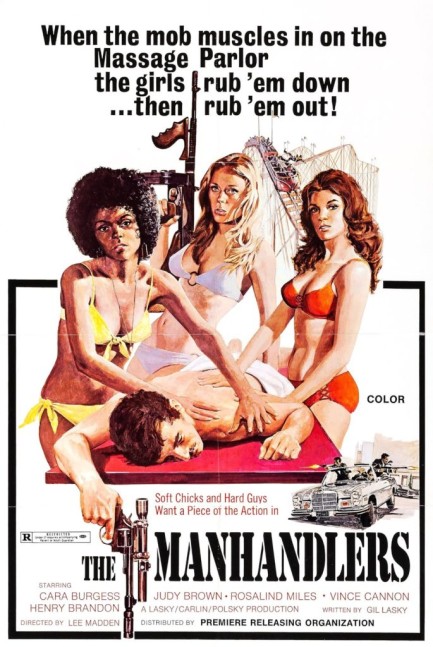
Manhandlers, right? It's a good title for a sexploitation movie, and John Solie painted a nice promo poster, but the actual product is a limp drama with dopy comedic episodes about a woman played by Cara Burgess who inherits her mobbed up uncle's L.A. massage parlor and finds that it's a front for a brothel. Her uncle was killed for being uncooperative with the mafia, and now they come after her, trying to intimidate her into signing away half of the place's profits. One the one hand, she'd supposedly net a nice income just for looking the other way and doing nothing. On the other, she'd be giving in to organized crime. The answer? Fill both hands with scented oil, massage the mob into a sense of false security, then make her move. None of it is as interesting as it sounds, at no point are machine guns wielded, and for sexploitation the extracurriculars aren't very erotic, even with Judy Brown and Rosalind Miles in support. You can give this one a pass. The Manhandlers premiered—and went limp at the box office—today in 1974.
 Life to draws to a close in the City of Angels. 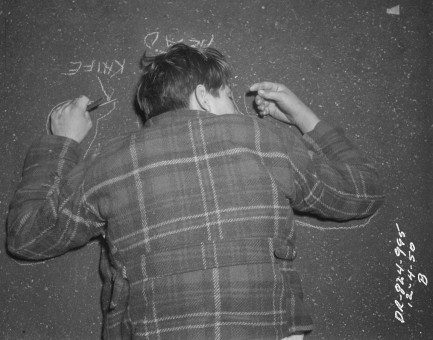
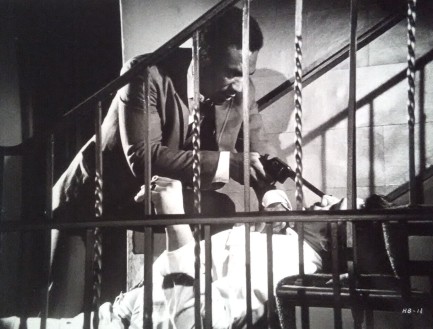
This photo, which is another one from the Los Angeles Police Department photo archive, shows an unidentified man after police crime scene detectives have outlined his body in chalk. Note the knife. He defended himself against an attacker, but unsuccessfully. Or perhaps he attacked someone and they defended themself successfully. The photos from the archive carry only the information written on them, and in this case that's nothing. But it's a compelling shot, made today in 1950.
 Say it with words! Seriously! I very much prefer words! 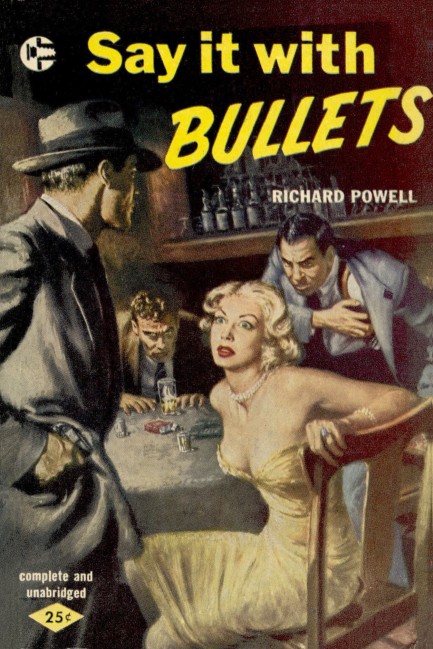
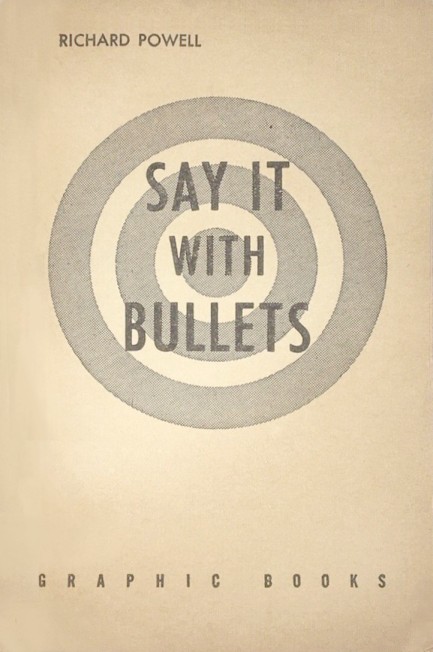
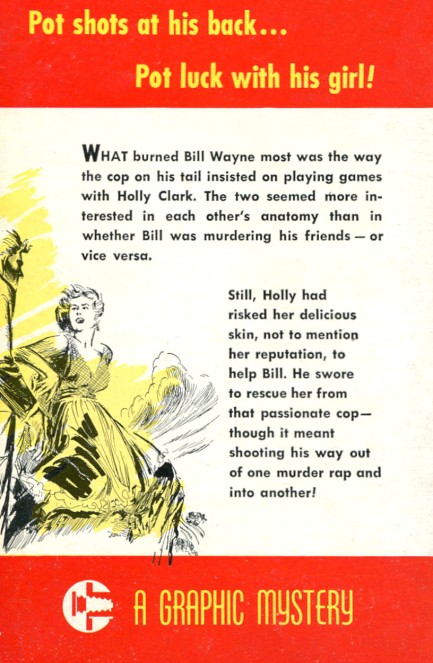
Say It with Bullets was written by Richard Powell and published by Graphic Books in 1954 with great Walter Popp cover art of the instant before all hell breaks loose in a bar. It's the tale of a man named Bill Wayne who, while serving as a pilot in China in World War II, is shot by another pilot, one of five who betray him over half a million dollars in contraband gold. He's left behind but survives, and years later, now in the U.S., has found where each of his almost-killers are residing. He books a spot on a cross-country bus tour called Treasure Trip of the Old West that happens to be passing through those cities, and plans to dispose of his compatriots one by one.
So, obviously, booking a tour that goes through Cheyenne, Salt Lake City, Reno, San Francisco, and Los Angeles, where one's betrayers coincidentally live, is a reach. Actually, let's just call it impossible. But we're believers in accepting the premise of a book, and since Powell explains this set-up in paragraph five we were willing to go with it. Need we say that revenge isn't as clinical as Wayne imagines? It's complicated by a nosy tour director—young and beautiful, of course—an ambitious deputy sheriff, and the growing realization that he's being trailed by a party or parties unknown.
The book is unusual on multiple fronts but the most notable element is that Wayne is one of the biggest wise-asses we've come across in literature. Here's a typical line, delivered after he's taken a beating from the aforementioned sheriff and, dismayingly, run into him the next morning on a street corner: There was Deputy Sheriff Carson Smith, on leave of absence from a dude ranch advertisement. “Hello,” Wayne said. “Did your knuckles recover from that severe bandaging they got here last night?” Wayne is amusing—or tries to be—even in his direst moments. His attitude pushes Say It with Bullets into farce at times, but he also makes an uneven book more interesting than it deserves to be.
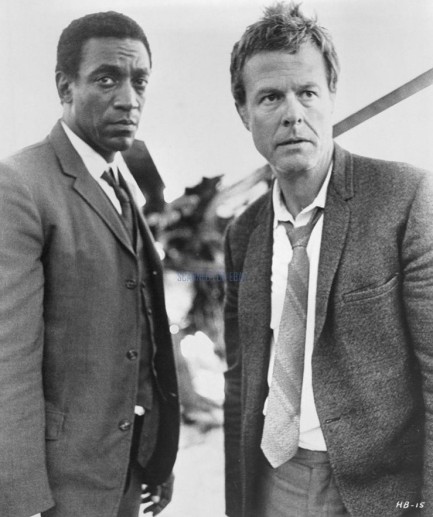
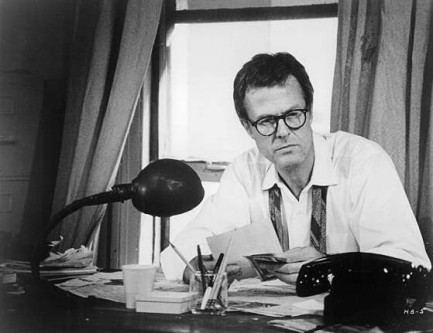
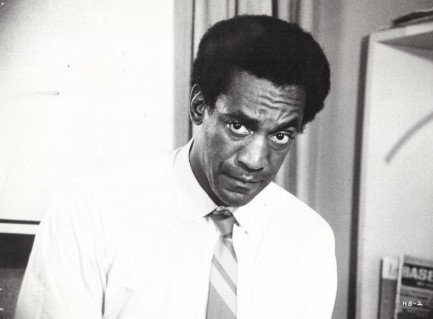
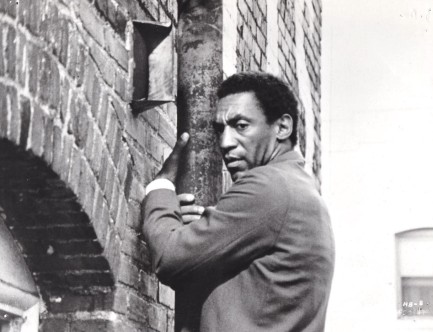
 Cosby and Culp go all out in gritty detective thriller. 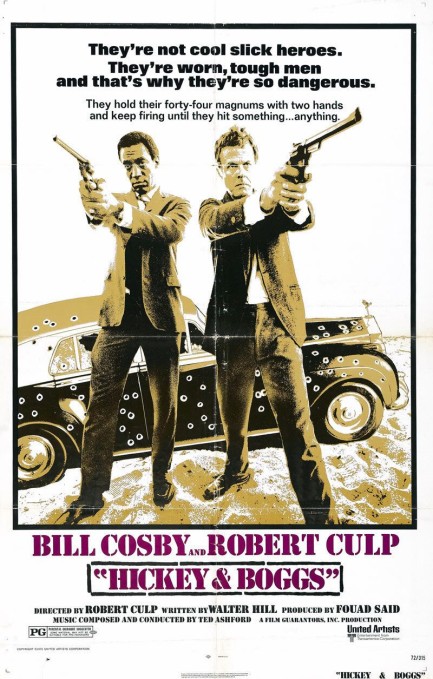
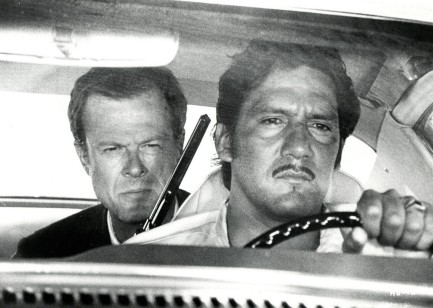
Hickey & Boggs is not a good name for a movie unless it's a buddy action/comedy. You'd never look at the title and think: hardcore crime thriller. It makes us think of one time when we were brainstorming with an actor friend, trying to think of the worst possible title for an action/buddy comedy, and we came up with "Jackson and Frisbee." But title notwithstanding, hardcore drama is what you get with Hickey & Boggs. The plot, courtesy of future 48 Hours director/co-writer Walter Hill, follows two down-at-the-heels dicks played by Bill Cosby and Robert Culp as they're hired to locate a missing woman who somehow may hold the key to recovering $400,000 in loot from a bank heist. In typical detective movie fashion, Cosby and Culp deal with cops, crooks, and ambushes as they work their way to the center of a mystery that progresses from danger to personal tragedy.
You'll sometimes see Hickey & Boggs described as a modern film noir, but it doesn't fit the brief. The two detectives are cynical, broke, and alienated, and there are several night sequences, but we're not sure if those elements are enough to automatically make a noir. There's very little high-contrast cinematography, no flashbacks, no narration, no shadowplay, no dream sequences, no extremely skewed angle shots, and no legit femme fatale. Getting into specific iconography, there's no rain, no silhouetting, no mirrors or blinds, no smart aleck bartenders or cab drivers, and virtually no sexual innuendo.
If Hickey & Boggs is a film noir then scores of other 70's crime movies are too, from Serpico to Magnum Force. And if the net is that wide then film noir is a pointless distinction. The American Film Institute, whose categories are expert-derived, calls Hickey & Boggs a drama in the action and detective sub-genres. And, yes, they do categorize neo-noir. Hickey & Boggs didn't make the cut. It's very good, though. It takes an unblinking look at the unglamorous side of Los Angeles and de-mystifies the private dick business—for about the umpteenth time, but very effectively just the same. As long as you're willing to watch Cosby—and we're not suggesting you should be—it's worth your time. It premiered today in 1972.
 Tracy and Castle try to avoid a watery grave in low budget crime thriller. 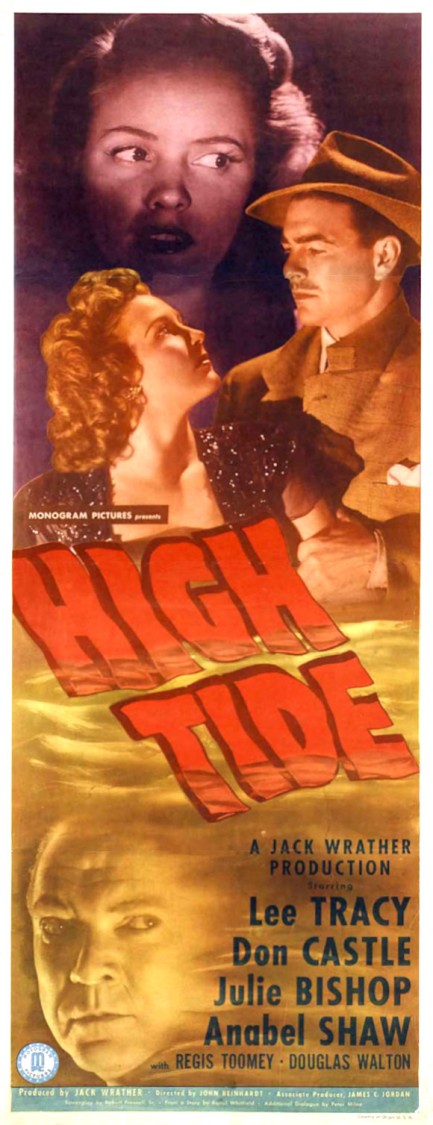
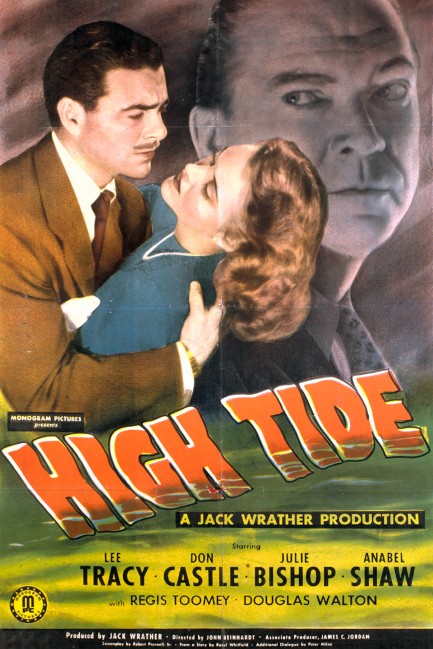
Above is a rare poster for the 1947 drama High Tide, which starred Lee Tracy and Don Castle as an editor of a fictional Los Angeles newspaper and a private investigator who crash while driving on what is presumably the Pacific Coast Highway, and find themselves immobilized in the wreckage. Trapped and thinking they're doomed to drown when the sea rises, they discuss the events leading up to their mishap. It's a b-movie all the way, a mere seventy minutes long, with stock footage, day-for-night shooting, and mise-en-scène on the more static end of the spectrum, but the story is interesting and the film noir flourishes are fun.
Some of the dialogue scores too: “He's having a slight attack of rigor mortis right in the middle of my living room floor.” That's not bad. We know, of course, that Tracy and Castle didn't just drive off the PCH but crashed for a pivotal reason. No spoiler there. It's an assumption you'll have made just reading the film's synopsis. We can't recommend High Tide strongly because it's too bottom bin to be really exciting, but it might give you intermittent pleasures anyway. It's certainly instructive in terms of making a workable movie with very little money. It premiered today in 1947. 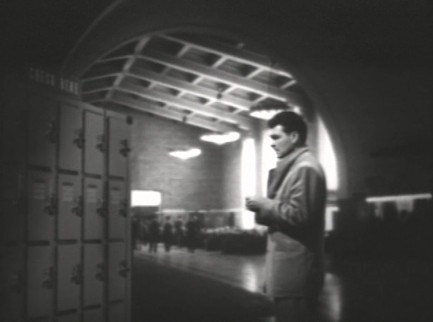 I've spotted him. He's in front of that rear projection of the main lobby of Union Station. I've spotted him. He's in front of that rear projection of the main lobby of Union Station.
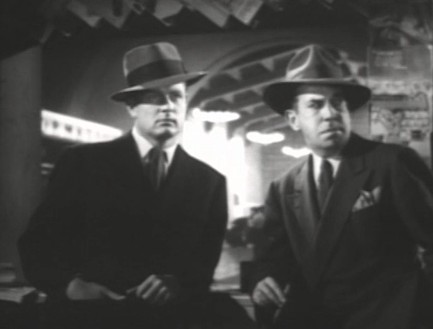 Hey, that's strange. That looks like our rear projection, only reversed. Hey, that's strange. That looks like our rear projection, only reversed.
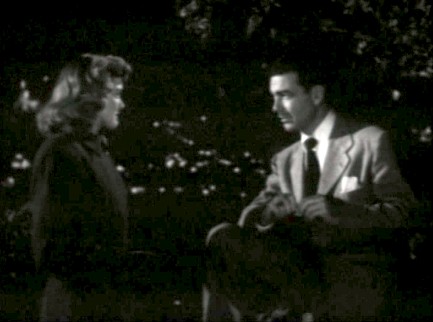 The rear projection of Los Angeles is lovely tonight. But not as lovely as you, my dear. The rear projection of Los Angeles is lovely tonight. But not as lovely as you, my dear.
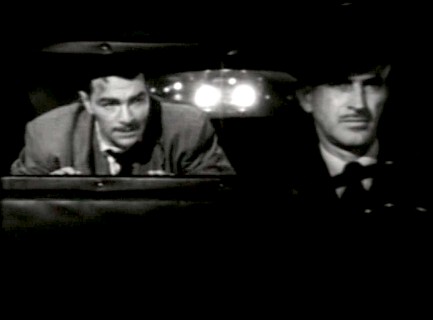 Driver, step on it. We've got to outrun that projectionist. Driver, step on it. We've got to outrun that projectionist.
 What goes up must come down. 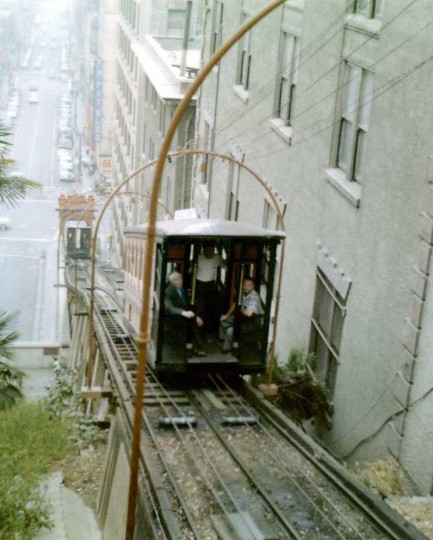
Funiculars in their most primitive form date back to Germany's Hohensalzburg Castle in the 1500s. The famous 1880 Italian song “Funiculì, funiculà” was written to commemorate the opening of the first funicular on Mount Vesuvius, and helped spread awareness of such railways. Angels Flight was the first funicular in Los Angeles. We stumbled across this shot made today in 1959 of the venerable tram and liked the way it captures the steepness of the ascent/descent, and makes clear how much strenuous climbing the railway saved pedestrians. Its name, by the way, is spelled correctly here, without an apostrophe. As we've noted before, Angels Flight was featured in several vintage books, including Lou Cameron's 1960 novel Angel's Flight, and in a score of vintage movies. Some of those we didn't mention in our previous discussion of this subject: Cry of the Hunted, The Glenn Miller Story, The Indestructible Man, The Turning Point, and The Exiles. The tram gets only cameos, but with the exception of The Indestructible Man all those films are good-to-excellent, so maybe watch them anyway.

|
 |

The headlines that mattered yesteryear.
1945—Mussolini Is Arrested
Italian dictator Benito Mussolini, his mistress Clara Petacci, and fifteen supporters are arrested by Italian partisans in Dongo, Italy while attempting to escape the region in the wake of the collapse of Mussolini's fascist government. The next day, Mussolini and his mistress are both executed, along with most of the members of their group. Their bodies are then trucked to Milan where they are hung upside down on meathooks from the roof of a gas station, then spat upon and stoned until they are unrecognizable. 1933—The Gestapo Is Formed
The Geheime Staatspolizei, aka Gestapo, the official secret police force of Nazi Germany, is established. It begins under the administration of SS leader Heinrich Himmler in his position as Chief of German Police, but by 1939 is administered by the Reichssicherheitshauptamt, or Reich Main Security Office, and is a feared entity in every corner of Germany and beyond. 1937—Guernica Is Bombed
In Spain during the Spanish Civil War, the Basque town of Guernica is bombed by the German Luftwaffe, resulting in widespread destruction and casualties. The Basque government reports 1,654 people killed, while later research suggests far fewer deaths, but regardless, Guernica is viewed as an example of terror bombing and other countries learn that Nazi Germany is committed to that tactic. The bombing also becomes inspiration for Pablo Picasso, resulting in a protest painting that is not only his most famous work, but one the most important pieces of art ever produced. 1939—Batman Debuts
In Detective Comics #27, DC Comics publishes its second major superhero, Batman, who becomes one of the most popular comic book characters of all time, and then a popular camp television series starring Adam West, and lastly a multi-million dollar movie franchise starring Michael Keaton, then George Clooney, and finally Christian Bale. 1953—Crick and Watson Publish DNA Results
British scientists James D Watson and Francis Crick publish an article detailing their discovery of the existence and structure of deoxyribonucleic acid, or DNA, in Nature magazine. Their findings answer one of the oldest and most fundamental questions of biology, that of how living things reproduce themselves.
|

|
|
It's easy. We have an uploader that makes it a snap. Use it to submit your art, text, header, and subhead. Your post can be funny, serious, or anything in between, as long as it's vintage pulp. You'll get a byline and experience the fleeting pride of free authorship. We'll edit your post for typos, but the rest is up to you. Click here to give us your best shot.
|
|