| Vintage Pulp | Apr 19 2024 |

When there's a killer on the loose you'd better sleep with one eye open.
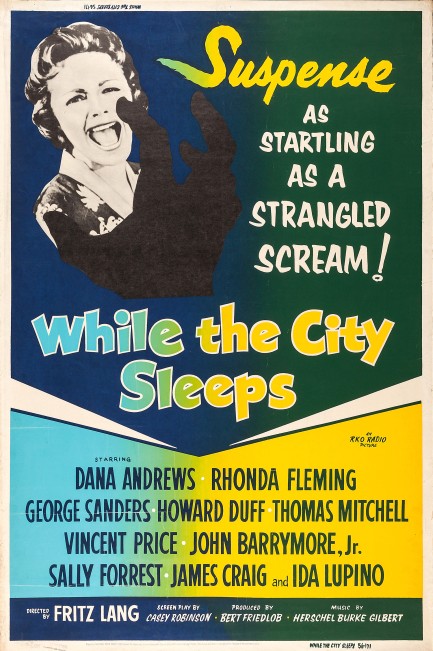
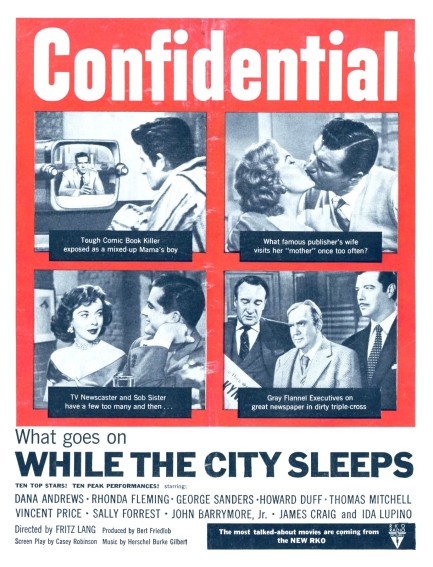
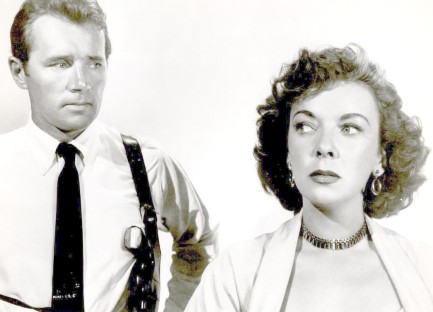
This poster for While the City Sleeps doesn't impress with masterly art the way so many vintage promos do, but its simplicity is, in an oblique sort of way, we think, meant to echo tabloid covers from the era. RKO made a special poster in collaboration with Confidential magazine, which you'll see below. The movie's plot is pure tabloid fodder. A serial killer has slain women in New York City, leaving the cryptic message “Ask mother,” written on the walls of one murder scene. Vincent Price, owner of Kyne News Service, part of a media empire comprising ten newspapers, a wire service, and other interests, offers the position of executive director to three employees in order to draw them into cutthroat competition with each other. Soon it becomes clear that finding the identity of the “lipstick killer” is the winning move. Intrigue and subterfuge take over the office. Everyone gets involved, from senior editors to stringers to gossip columnist Ida Lupino, but the killer is too clever to be caught.
At least until intrepid Pulitzer Prize winning television reporter Dana Andrews airs a scornful and taunting broadcast, deliberately setting up his own fiancée as bait. He doesn't even ask her permission. Well, he does, but only after arranging to publish their engagement announcement in the New York Sentinel right next to a story about the killer. Reckless? Yes. Presumptuous? For sure. There are intertwined plotlines here, but Andrews using his true love as a lure was the most interesting aspect for us. He isn't the only heel on display. The movie is ostensibly about a serial killer, but is really a framework for exposing backbiting and cynical ambition in the big city. Director Fritz Lang, in what was his penultimate U.S. film, explores the cruel banality of what, these days, some call “hustle culture,” and brings the production to a conclusion that's, in the words of Thomas Mitchell's character, “Neat, but nasty.” Our words are: a mandatory watch. While the City Sleeps had a special world premiere today in 1956.
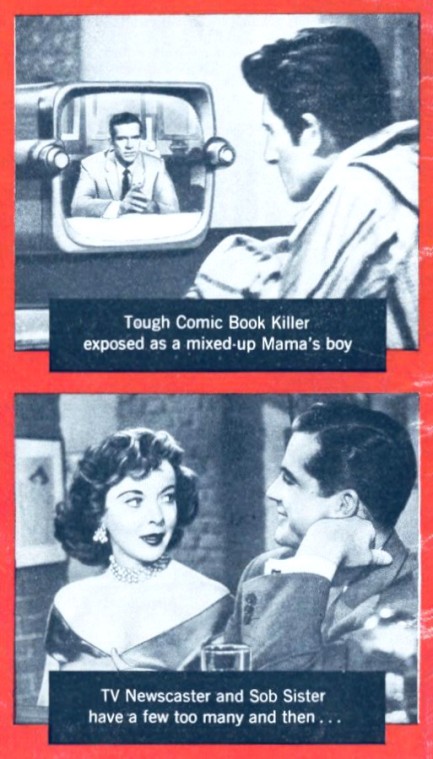
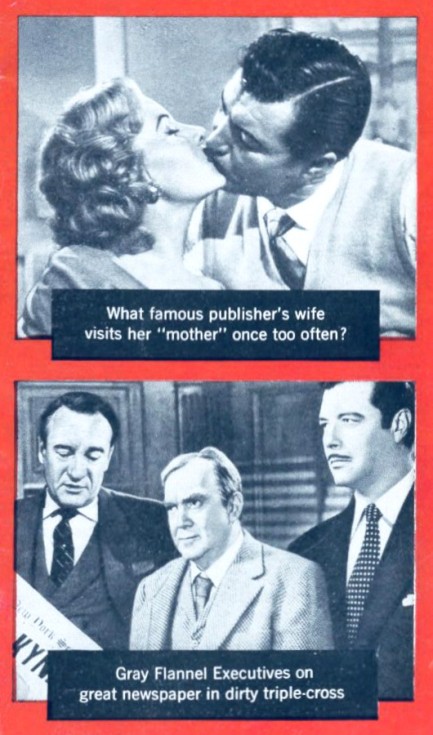
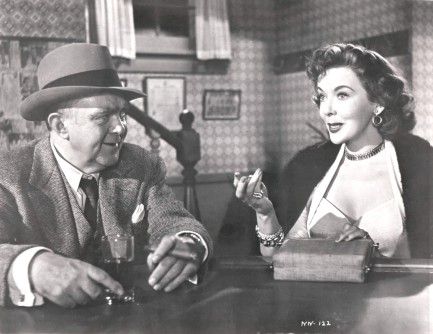
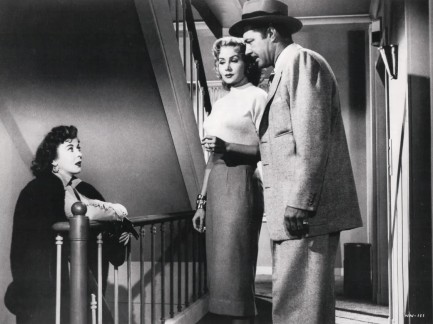
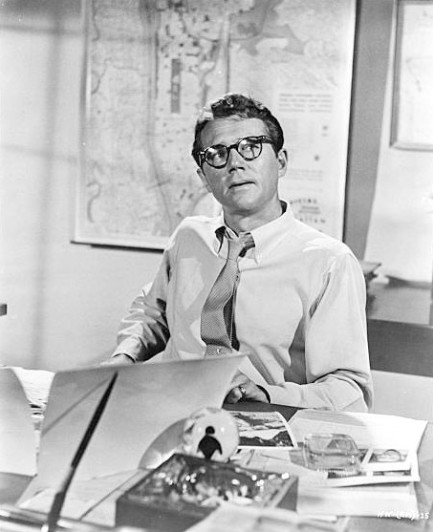
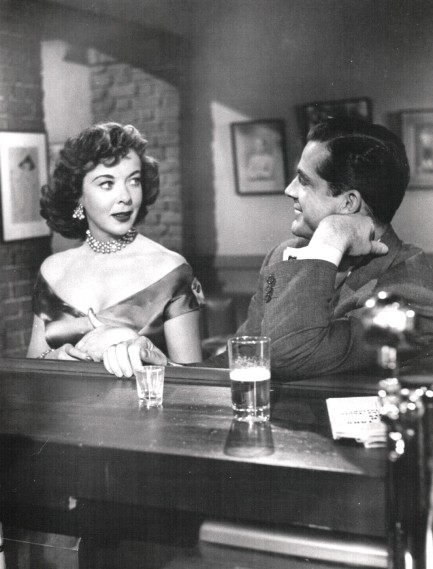
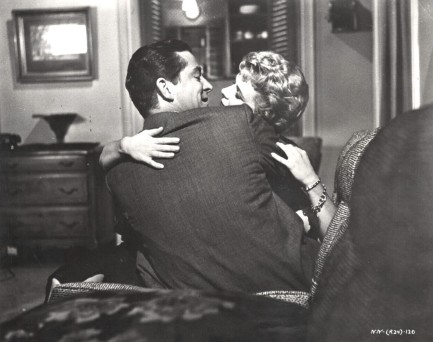
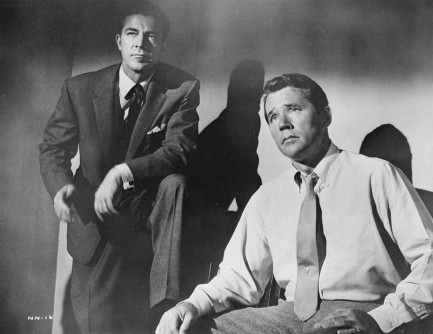
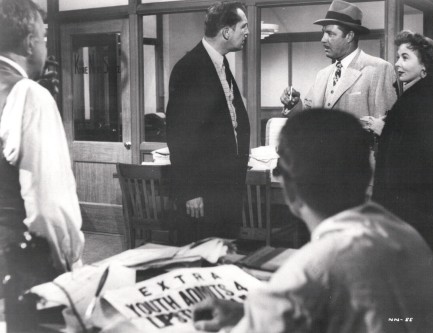
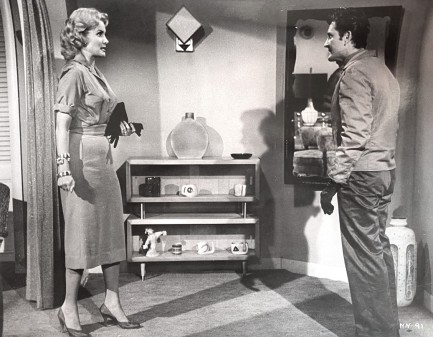
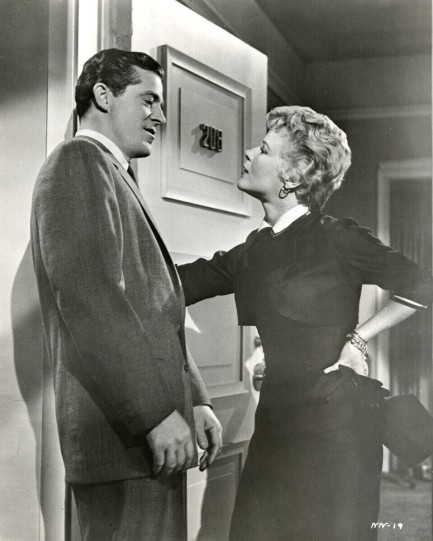
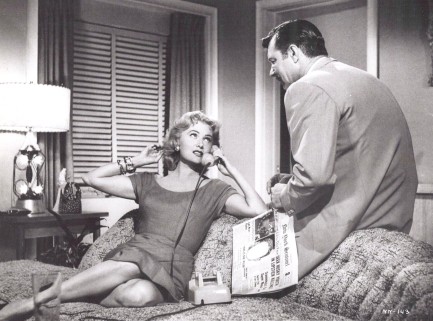
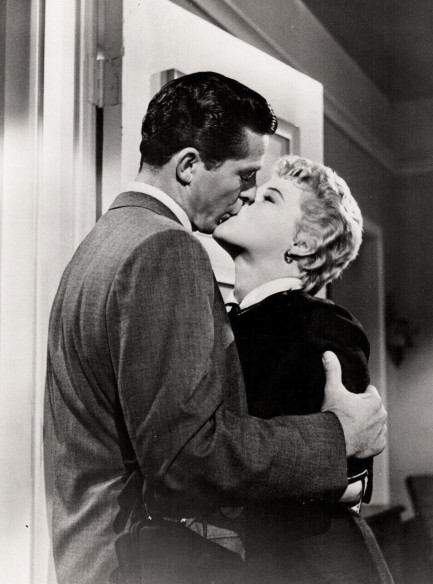
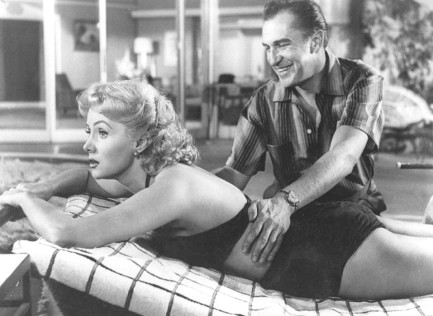
 Edit: Vintage movies are excellent windows into bygone customs and practices. There's a great moment in this one. Rhonda Fleming and James Craig are chatting in her apartment late one night when the doorbell unexpectedly buzzes. They look at each other confused for a second, then Fleming says, “It's probably the drugstore. That was the last bottle of Scotch.”
You know, there were a lot of things wrong with the mid-century era. But there were a few things right too. Getting the all-night drugstore to deliver booze has to be one of the most right things we've ever heard of, so we give thanks to While the City Drinks—er Sleeps—for clueing us in, and suggest you call your congressional rep immediately and ask for a law allowing pharmacies to deliver alcohol. If not for yourself, do it for the children.
New York CityRKO Radio PicturesConfidentialWhile the City SleepsDana AndrewsRhonda FlemingGeorge SandersHoward DuffVincent PriceJohn Barrymore Jr.Ida LupinoSally ForrestFritz Langposter artcinematabloidmovie review


| Vintage Pulp | Sep 12 2023 |

Think your boss is bad? Then you've never dealt with a mob boss.
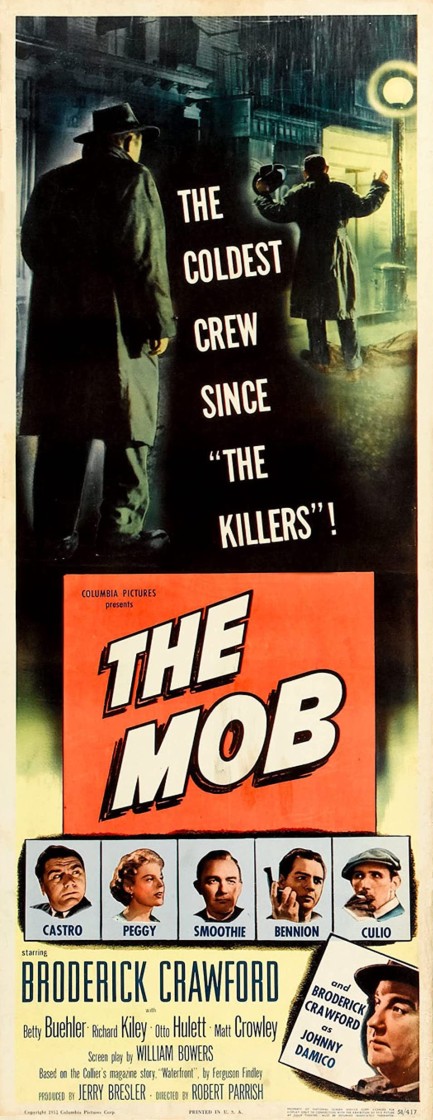
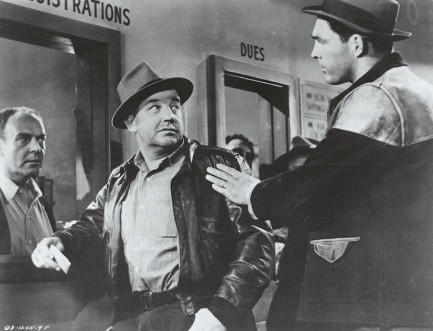
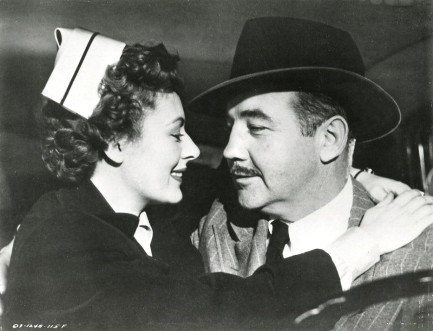
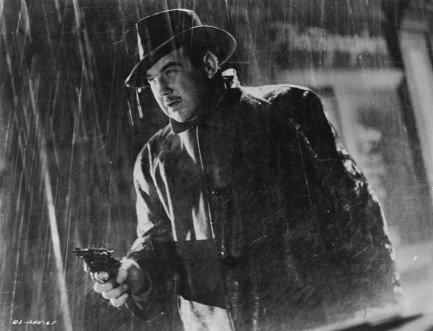
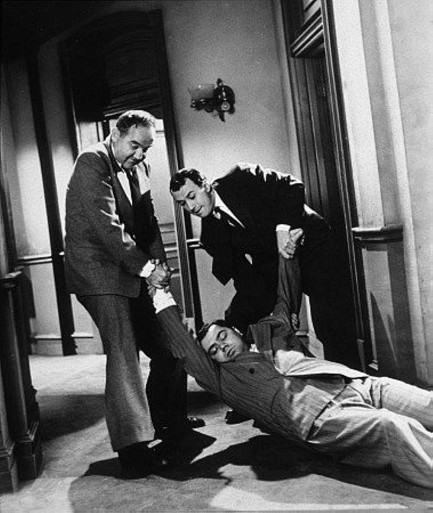
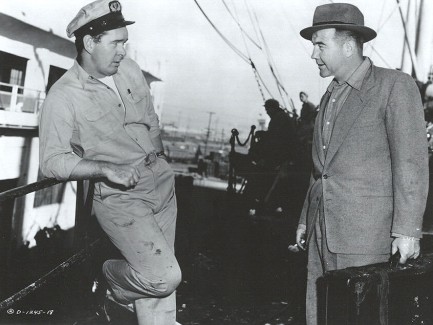
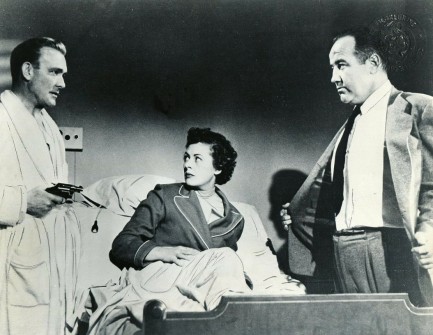
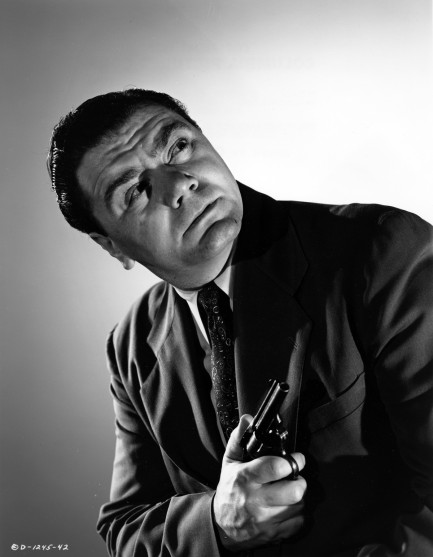
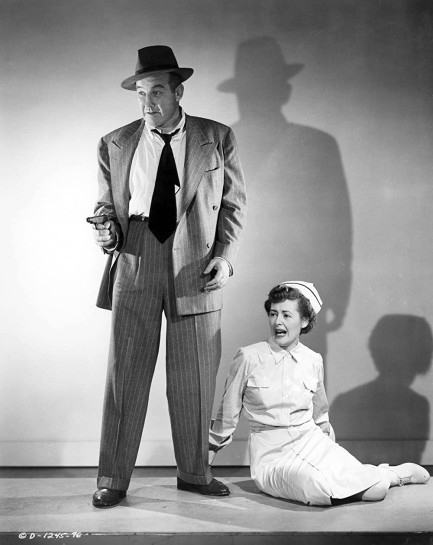
Falling into the category of pleasant surprises, The Mob, for which you see an evocative promo poster above, stars Broderick Crawford as a cop sent to infiltrate an organized crime syndicate. You've seen the idea before. He works his way up the ladder and brings the bad guys down, but this iteration comes with brisk pacing, a set of unpredictable twists, and a supporting cast that includes Ernest Borgine, Richard Kiley, and Lynn Baggett. If you keep your eyes open you might even spot Charles Bronson.
Crawford had already won an Academy Award and a Golden Globe for 1949's All the King's Men, so he unsurprisingly does a bang-up job in this film, instilling his deep cover cop with believable toughness and a gruff but relatable humanity. Crawford would later appear in such excellent films as Scandal Sheet, New York Confidential, Born Yesterday, and Human Desire, but The Mob may be his underrated classic.
The only flaw with this film, in our opinion, is a goofball denouement. We suppose, after ninety minutes of almost nonstop high tension, the filmmakers wanted audiences to leave smiling, and we're sure they did, because the scene, while dumb, is pretty funny. But in any case, we recommend giving The Mob a whirl. You'll enjoy it. It opened nationally in the U.S. in late September, but had its actual debut at special premiere today in Dayton, Ohio (why, we don't know) in 1951.
New OrleansAcademy AwardGolden Globe AwardThe MobAll the King's MenNew York ConfidentialScandal SheetHuman DesireBorn YesterdayBroderick CrawfordBetty BuehlerErnest BorgnineLynn BaggettCharles Bronsonposter artcinemamovie review

| Vintage Pulp | Feb 18 2023 |

Some people just can't handle any excitement.
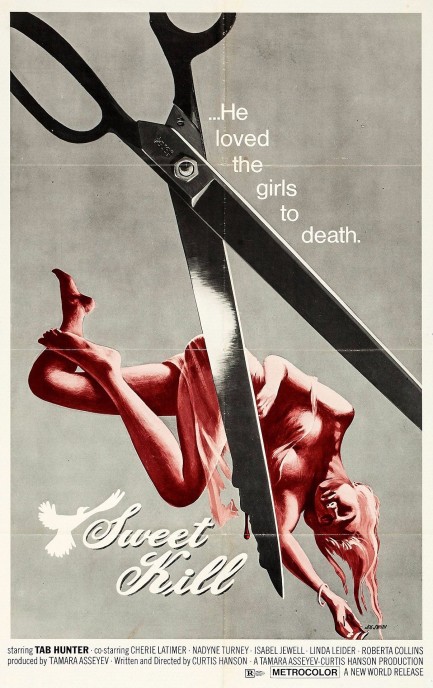
It's hard to believe that Curtis Hanson—the man who directed The River Wild, the acclaimed L.A. Confidential, and the underrated Wonder Boys, got his start with Sweet Kill, which he directed and wrote, but it's true. Everyone has to start somewhere. Even Francis Ford Coppola started in nudie flicks. Sweet Kill stars Tab Hunter, who plays a sort of beach hunk version of Norman Bates who stabs women when he's sexually aroused—hence the movie's alternate title, The Arousers. Those arousers, who you'll see below in a series of production photos made for the film, include Roberta Collins. Cherie Latimer, Brandy Herred, and others.
Sweet Kill is an interesting mood piece but we can't call the movie a success on the whole because it isn't scary—an aspiration for slasher flicks (its main inspiration Psycho is scary, after all). The main problem here is the acting, that bugaboo of ambitious young directors the world over. Collins is okay, but Hunter is out of his depth, and the other participants clearly didn't have the time and talent to hone their performances. In the end what you get is a lot of standing around, a fair amount of nudity, and minor tension derived from whether Hunter can somehow curb his murderous urges. Spoiler alert: he can't. Sweet Kill premiered in the U.S. today in 1972.
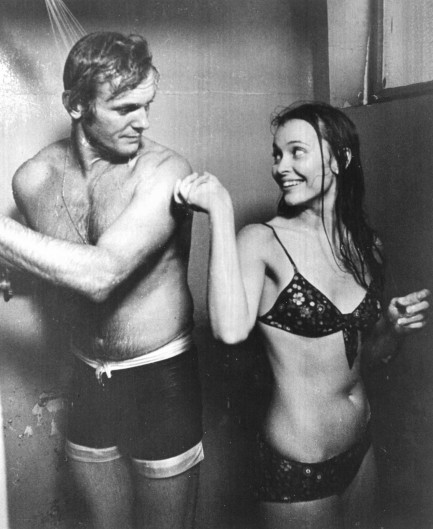
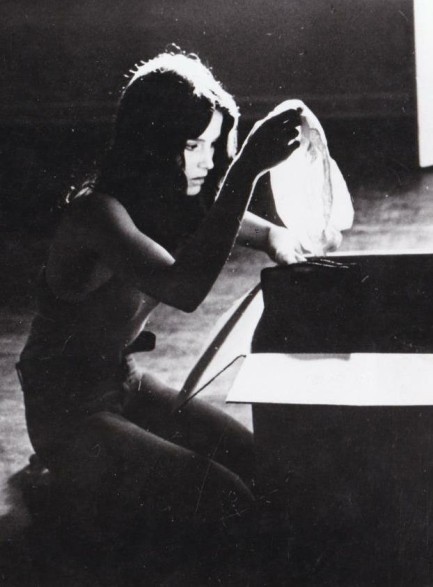
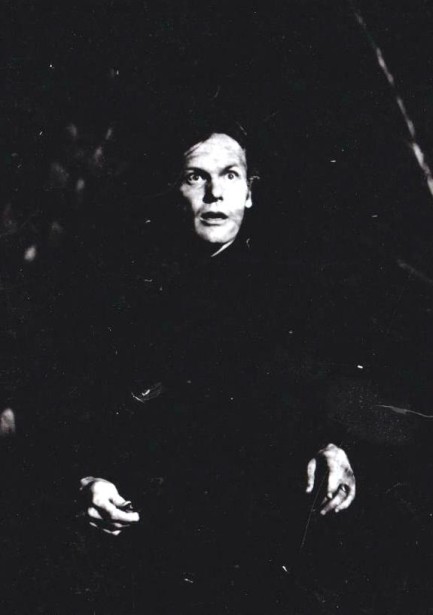
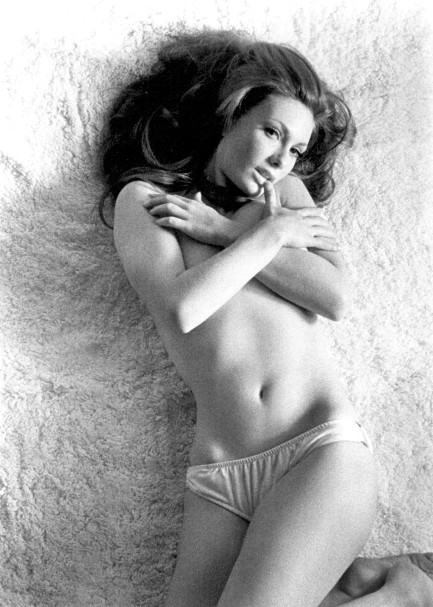
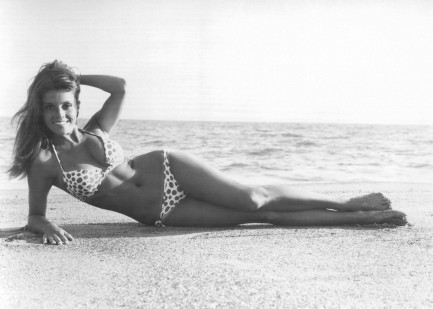
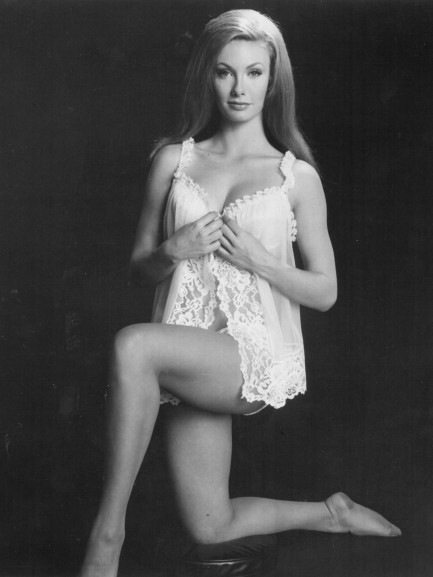
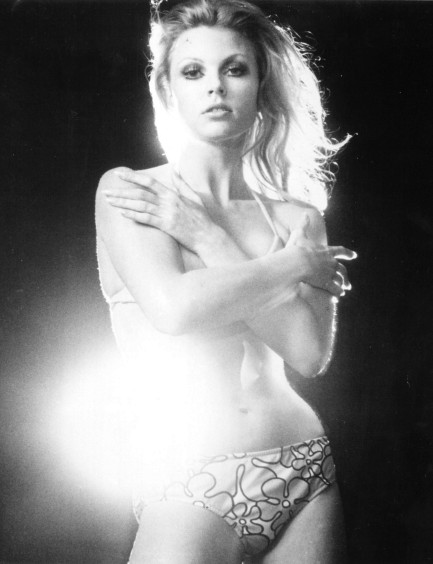
Sweet KillThe ArousersThe River WildL.A. ConfidentialWonder BoysPsychoTab HunterRoberta CollinsLinda LeiderCherie LatimerBrandy HerredAngel FoxAngus ScrimmCurtis Hansonposter artcinemasexploitationmovie review

| Hollywoodland | Intl. Notebook | Jan 26 2022 |

The king of tabloids sets its sights on the Queen of Greece.
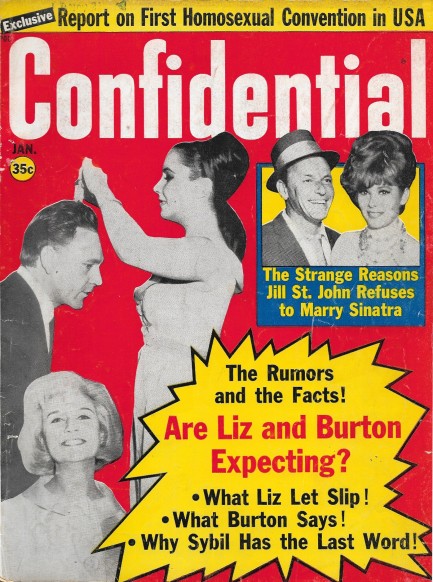
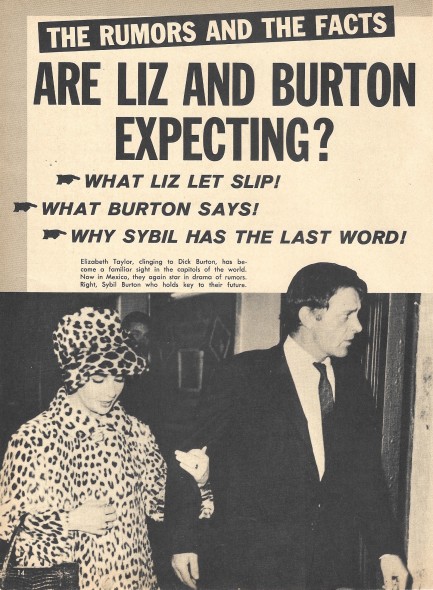
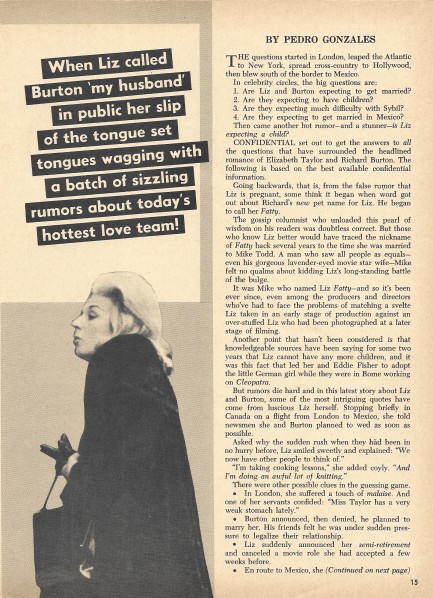
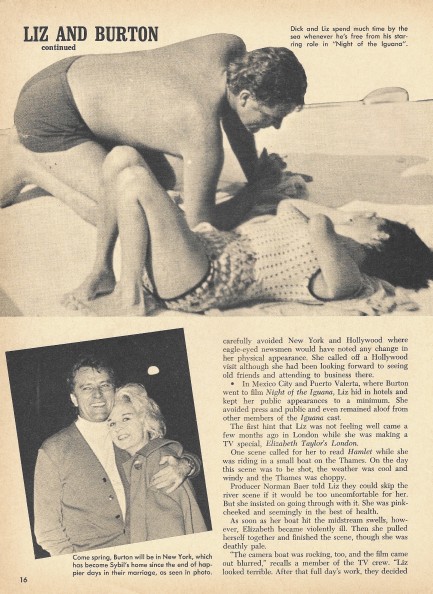
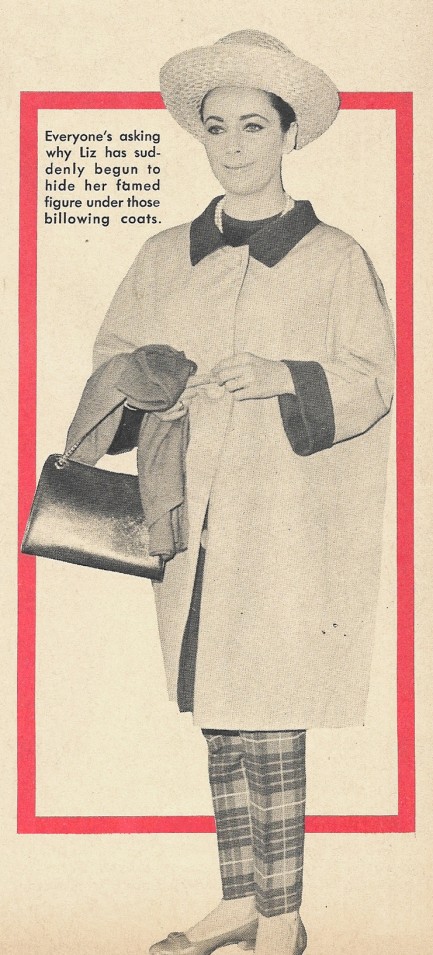
Every month when Confidential magazine hit newsstands, we imagine Hollywood celebrities receiving the bad news that they'd made the cover, and going, “Shit.” This issue published in January 1964 features Elizabeth Taylor, Richard Burton, Frank Sinatra, and Jill St. John. The first three members of that group probably took the news in stride, since they were all tabloid staples by then. St. John wasn't quite at their level, but her links with Sinatra kept her in the scandal sheets for a while too.
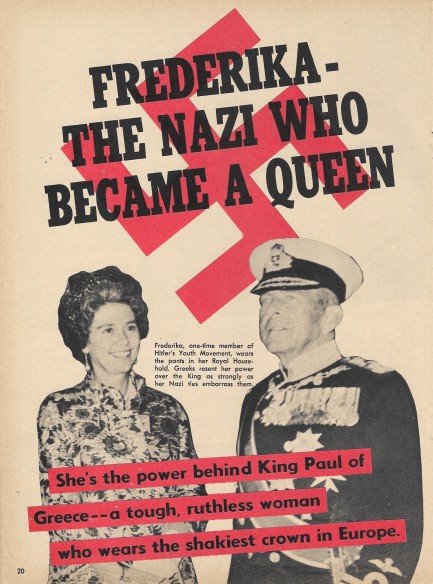
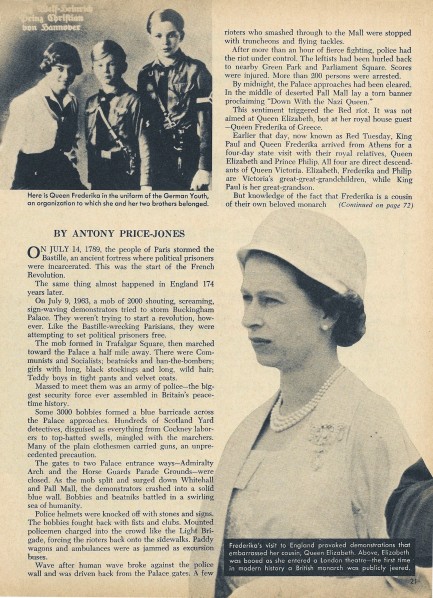
A person who wasn't used to Confidential's attentions was Frederica of Hanover, who at the time was Queen Consort of Greece—which is just a fancy way of saying she was married to the King of Greece. Confidential says she was a Nazi, a pretty serious charge, needless to say. Was she? Well, her grandfather was Kaiser Wilhelm II, as a girl she was a member of Bund Deutscher Mädel, which was a branch of the Hitler Youth, and she had brothers in the SS. Also, back in 1934 Adolf Hitler wanted to link the British and German royal houses, and tried to pressure Frederica's parents into arranging for the seventeen-year-old girl to marry the Prince of Wales, Edward VIII. And as Queen Consort she made a habit of meddling in Greek politics in ways that made clear she was not a fan of democracy. None of that is a particularly good look.
She had defenders, though, who believed that for a person in her position it would have been impossible not to have been a member of certain groups and to have socialized with Nazis. It's interesting, isn't it, how the rich and powerful always benefit from a special set of excuses? People can't really expect her to have made a stand, can they? But the excuse is hollow. As a high ranking royal she could have avoided anything she wished. Membership in organizations when she was a little girl is one thing, but as an adult she could have denounced Nazism with damage to her reputation the only potential result. A damaged reputation is no small thing, but if we expect resistance from people who'd have been imprisoned or shot for doing so, we should probably expect the same from people who would have suffered mostly dirty looks.
Confidential focuses on Frederica's July 1963 visit to England. The visit was no big surprise—Frederica, her husband King Paul of Greece, Queen Elizabeth, and her husband Prince Philip, were all related. They were all direct descendants of Queen Victoria. Monarchy is a funny thing, isn't it? The visit triggered a protest of about three thousand British leftists that was violently broken up by five thousand police. The protestors carried banners that said, “Down with the Nazi Queen.” After mentioning this fiasco, Confidential delves into Frederica's history, some of which we've outlined above, then loops back to the protests, which she blamed on the British press. But she had already reached a level of notoriety that usually brought out protestors who loudly booed her, particularly in Greece. She eventually retreated from public life, became a Buddhist, and died early at age sixty-three.
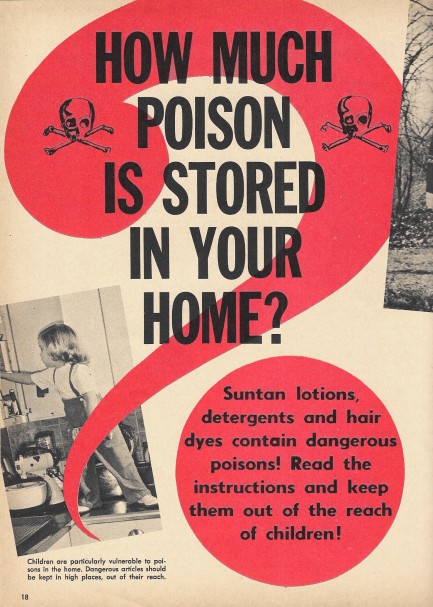
Confidential's unexpected exposé on Frederica wasn't out of character for the magazine. It was the top tabloid dog in a very large kennel. It had an expansive staff, serious reporters, hundreds of informers spread across the U.S. and Britain, and published stories about heavy hitters from all sectors of society. It had a regressive political agenda, as its article filled with terrible slander against gays and lesbians makes clear, but even with its rightward slant it took pains to keep its reporting framework factual. That makes it a priceless source of contemporaneous info about public figures, particularly of the Hollywood variety. We doubt we'll ever stop buying it, because we never know who we'll find inside. Twenty-plus scans below.

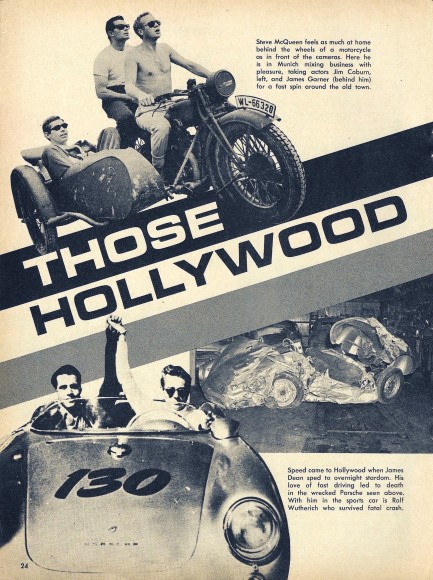
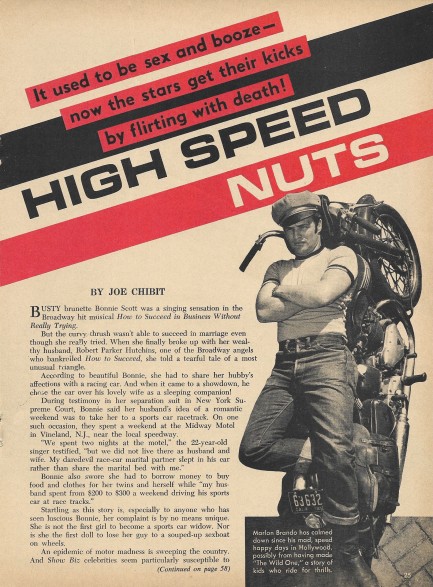
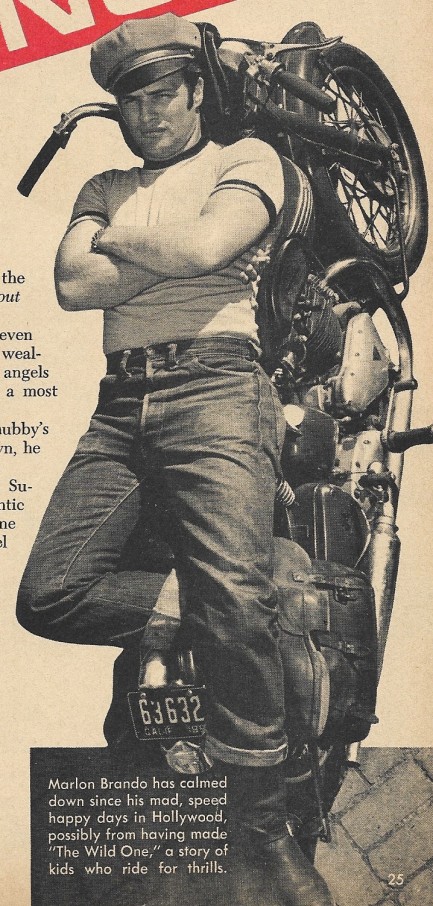
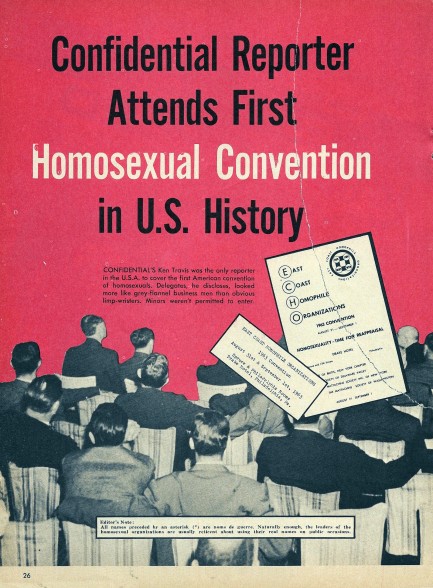
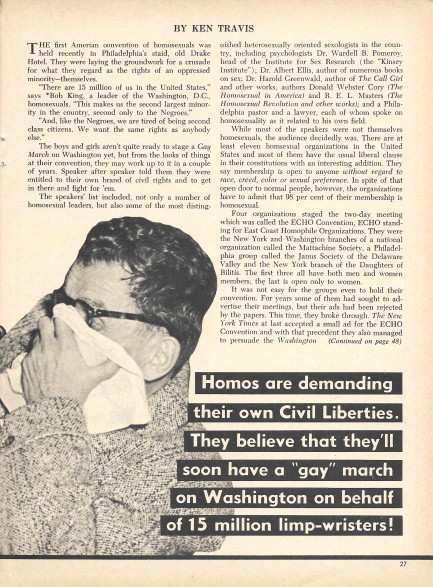
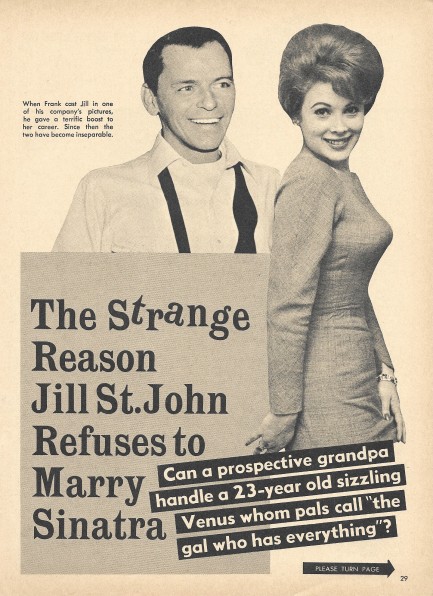
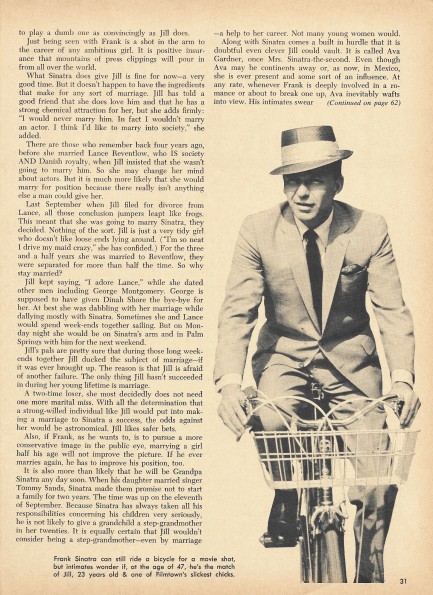
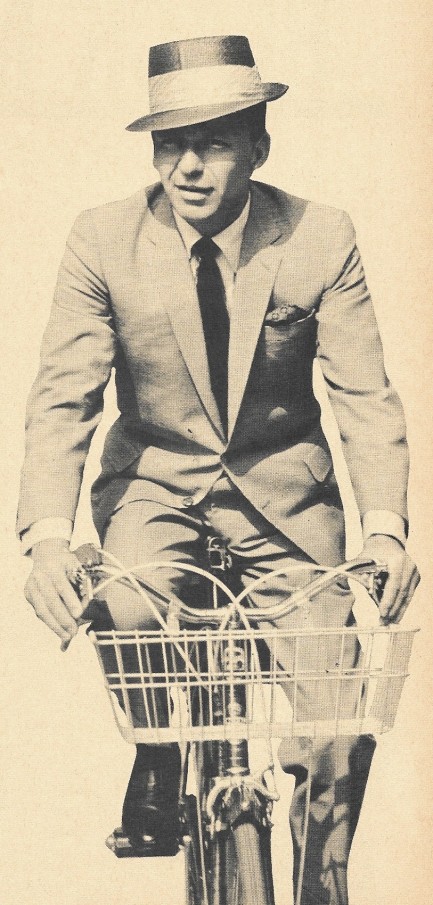
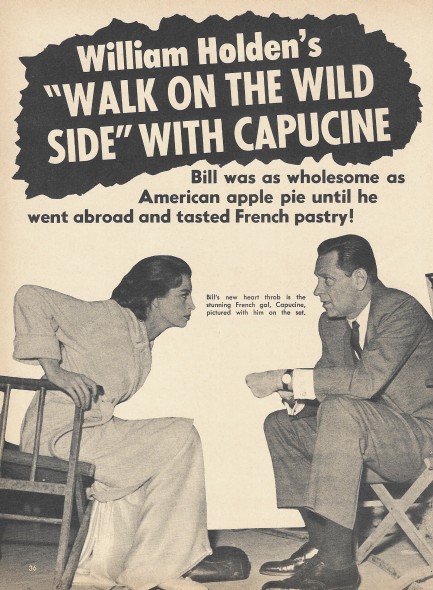
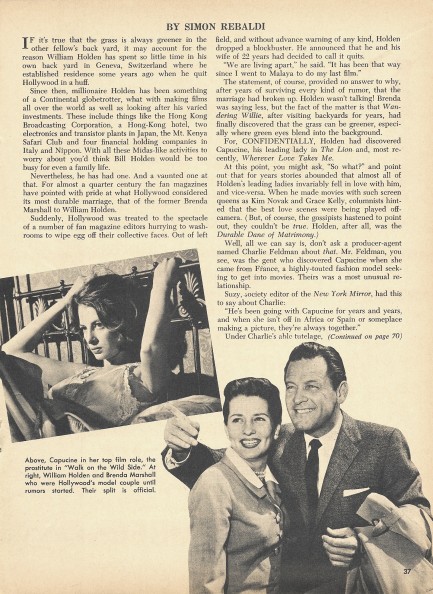
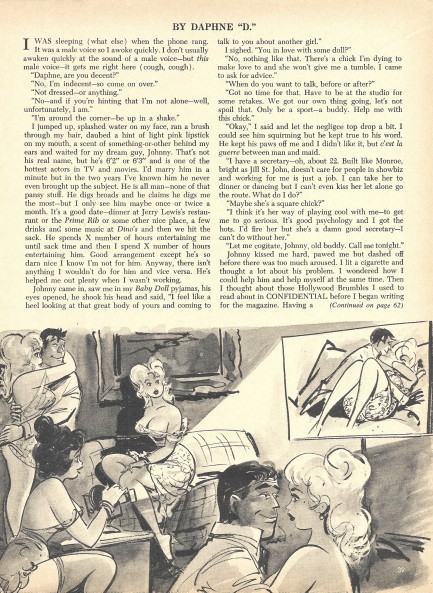
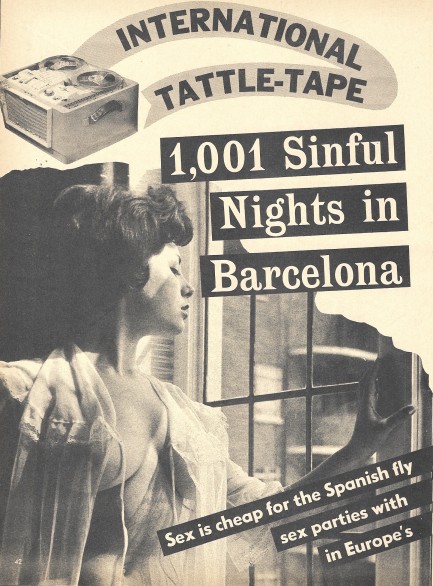
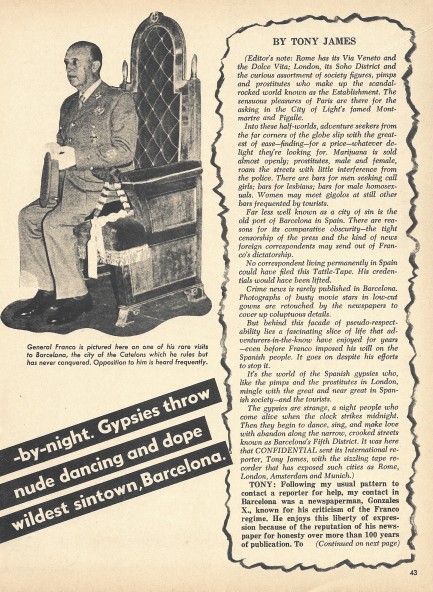
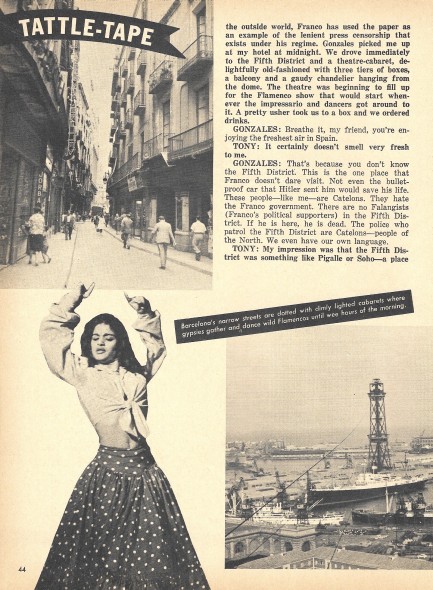
GreeceGermanySpainBarcelonaHannoverConfidentialElizabeth TaylorRichard BurtonFrank SinatraJill St. JohnFrederica of HanoverFriederike LuiseQueen Elizabeth IISteve McQueenJames DeanMarlon BrandoWilliam HoldenCapucineFrancisco FrancoEdward VIIIAdolf Hitlertabloidnazislgbt

| Femmes Fatales | Sep 20 2021 |

Downtime always means pooltime in Hollywood.
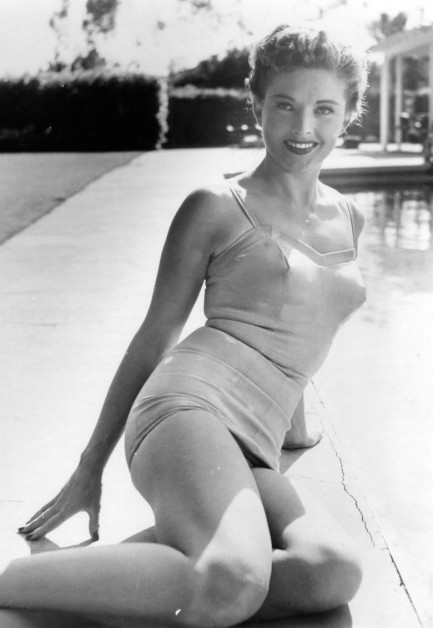
We like this shot of Coleen Gray, née Doris Bernice Jensen, with its casual day-off feel. Gray appeared in some very good movies, including Kiss of Death, The Killing, Kansas City Confidential, State Fair, and The Leech Woman (well, maybe that one's not so good, but it's really fun). All told, she amassed more than one hundred credits in cinema and on television. We obviously haven't seen them all, but our favorite role of hers is as Molly in Nightmare Alley. Interest in that one will pick up soon because it's being remade by Guillermo del Toro, with Willem Dafoe, Cate Blanchett, and Bradley Cooper in the leads. We can understand why a maestro of the weird like del Toro was attracted to that film, and we expect the remake to be very interesting. But do yourself a favor and watch the original sometime too.
Nightmare AlleyKansas City ConfidentialThe KillingThe KillingKansas City ConfidentialState FairThe Leech WomanColeen Gray

| Hollywoodland | May 22 2021 |

It's shocking how many Hollywood stars did smack.
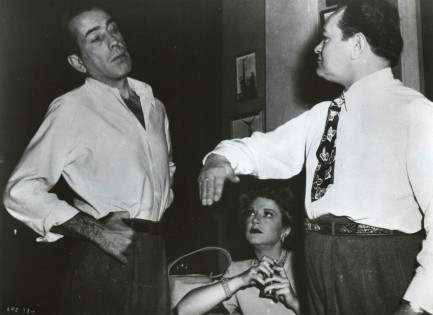
Everybody wants to slap somebody sometime. Luckily, actors in movies do it so you don't have to. The above shot is a good example. Edward G. Robinson lets Humphrey Bogart have it in 1948's Key Largo, as Claire Trevor looks on. In vintage cinema, people were constantly slapping. Men slapped men, men slapped women, women slapped women, and women slapped men. The recipient was usually the protagonist because—though some readers may not realize this—even during the ’40s and 50s, slapping was considered uncouth at a minimum, and downright villainous at worst, particularly when men did it. So generally, bad guys did the slapping, with some exceptions. Glenn Ford slaps Rita Hayworth in Gilda, for example, out of humiliation. Still wrong, but he wasn't the film's villain is our point. Humphrey Bogart lightly slaps Martha Vickers in The Big Sleep to bring her out of a drug stupor. He's like a doctor. Sort of.
In any case, most cinematic slapping is fake, and when it wasn't it was done with the consent of the participants (No, really slap me! It'll look more realistic.). There are some famous examples of chipped teeth and bloody noses deriving from the pursuit of realism. We can envision a museum exhibit of photos like these, followed by a lot of conversation around film, social mores, masculinity, and their intersection. We can also envison a conversation around the difference between fantasy and reality. There are some who believe portryals of bad things endorse the same. But movies succeed largely by thrilling, shocking, and scaring audiences, which requires portraying thrilling, shocking, and frightening moments. If actors can't do that, then ultimately movies must become as banal as everyday llife. Enjoy the slapfest.
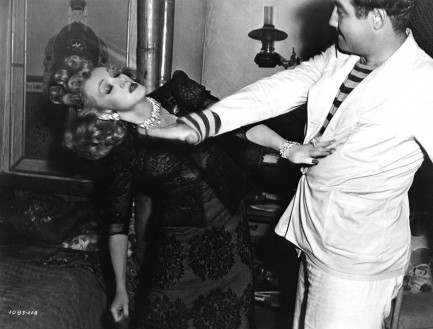 Broderick Crawford slaps Marlene Dietrich in the 1940's Seven Sinners.
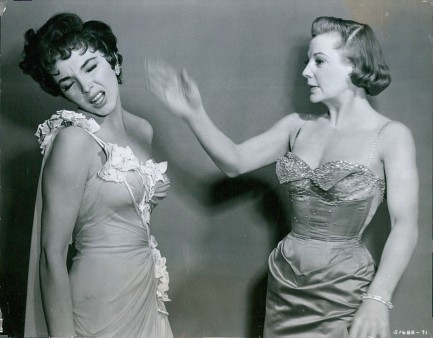 June Allyson lets Joan Collins have it across the kisser in a promo image for The Opposite Sex, 1956.
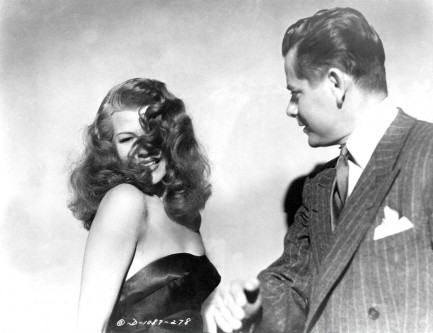 Speaking of Gilda, here's one of Glenn Ford and Rita Hayworth re-enacting the slap heard round the world. Hayworth gets to slap Ford too, and according to some accounts she loosened two of his teeth. We don't know if that's true, but if you watch the sequence it is indeed quite a blow. 100% real. We looked for a photo of it but had no luck.
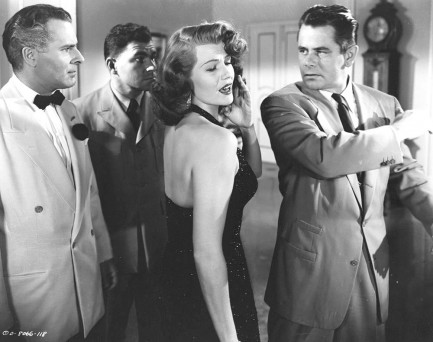 Don't mess with box office success. Ford and Hayworth did it again in 1952's Affair in Trinidad.
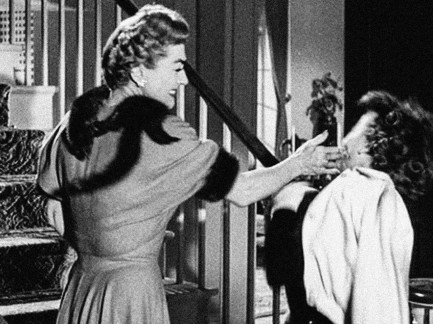 All-time film diva Joan Crawford gets in a good shot on Lucy Marlow in 1955's Queen Bee.
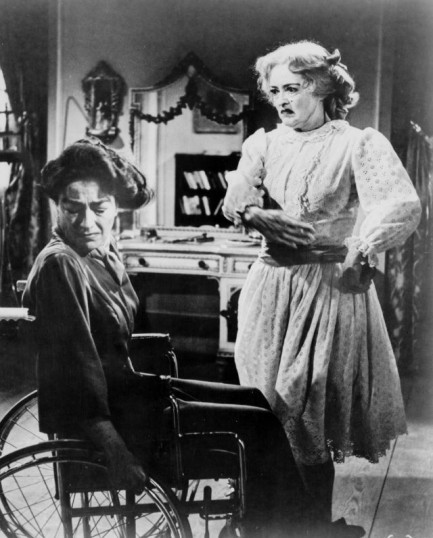 The answer to the forthcoming question is: She turned into a human monster, that's what. Joan Crawford is now on the receiving end, with Bette Davis issuing the slap in Whatever Happened to Baby Jane? Later Davis kicks Crawford, so the slap is just a warm-up.
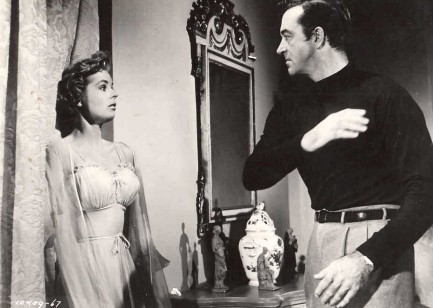 Mary Murphy awaits the inevitable from John Payne in 1955's Hell's Island.
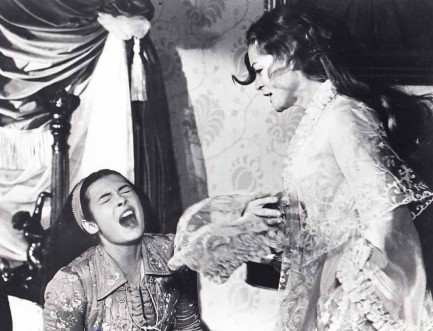 Romy Schneider slaps Sonia Petrova in 1972's Ludwig.
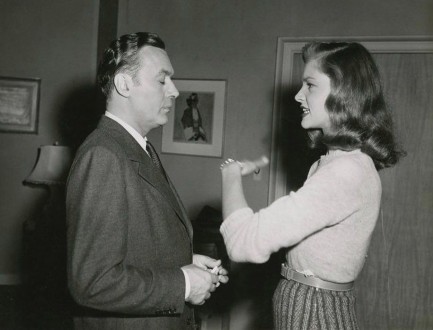 Lauren Bacall lays into Charles Boyer in 1945's Confidential Agent and garnishes the slap with a brilliant snarl.
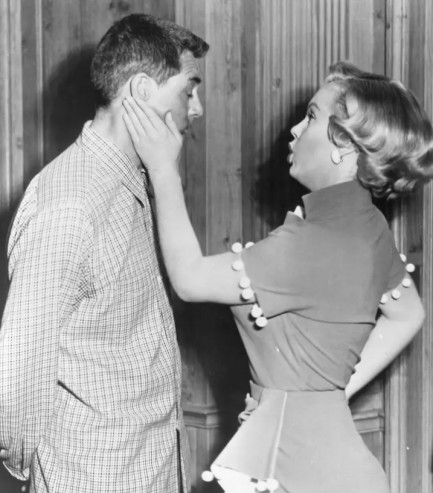 Iconic bombshell Marilyn Monroe drops a smart bomb on Cary Grant in the 1952 comedy Monkey Business.
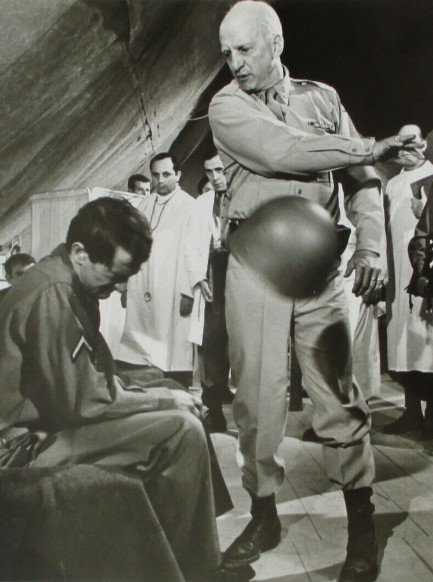 This is the most brutal slap of the bunch, we think, from 1969's Patton, as George C. Scott de-helmets an unfortunate soldier played by Tim Considine.
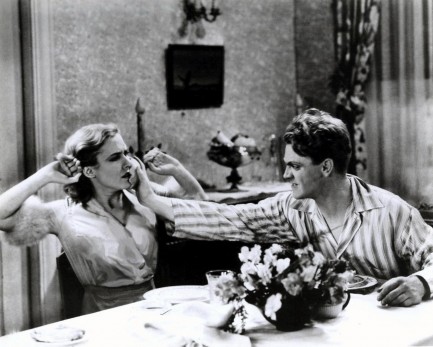 A legendary scene in filmdom is when James Cagney shoves a grapefruit in Mae Clark's face in The Public Enemy. Is it a slap? He does it pretty damn hard, so we think it's close enough. They re-enact that moment here in a promo photo made in 1931.
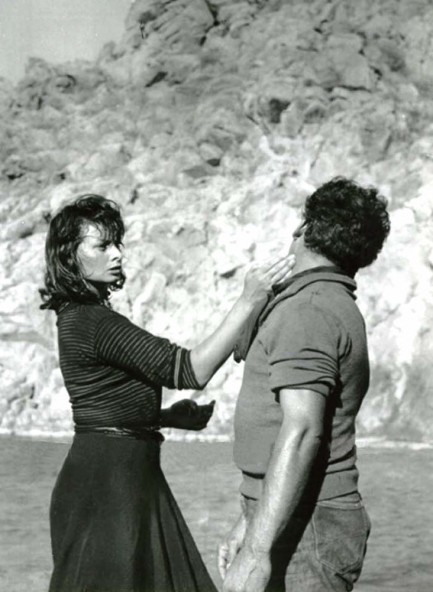 Sophia Loren gives Jorge Mistral a scenic seaside slap in 1957's Boy on a Dolphin.
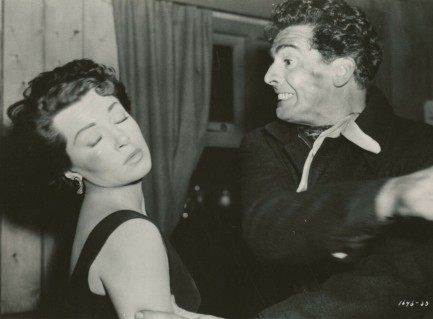 Victor Mature fails to live up to his last name as he slaps Lana Turner in 1954's Betrayed.
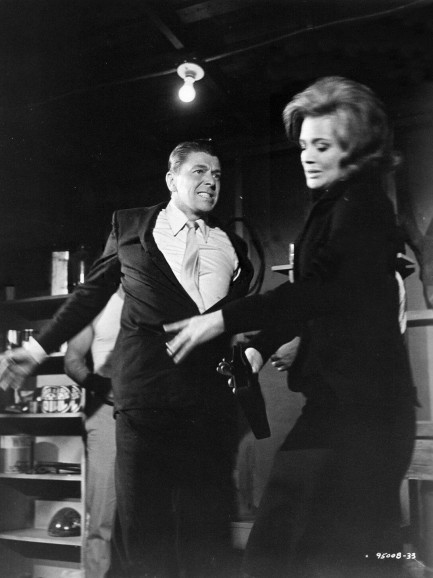 Ronald Reagan teaches Angie Dickinson how supply side economics work in 1964's The Killers.
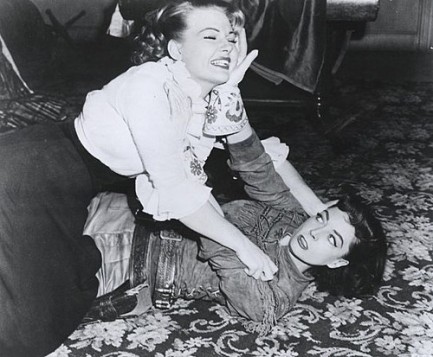 Marie Windsor gets in one against Mary Castle from the guard position in an episode of television's Stories of the Century in 1954. Windsor eventually won this bout with a rear naked choke.
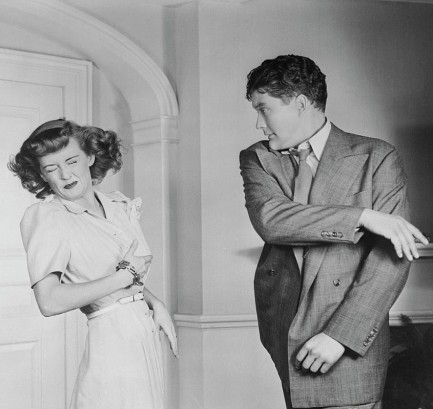 It's better to give than receive, but sadly it's Bette Davis's turn, as she takes one from Dennis Morgan in In This Our Life, 1942.
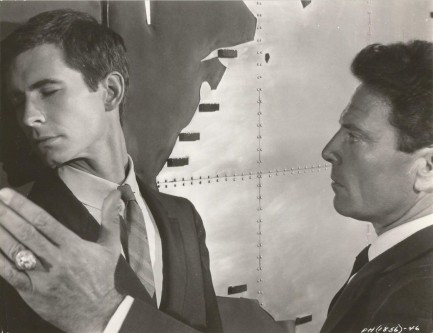 Anthony Perkins and Raf Vallone dance the dance in 1962's Phaedra, with Vallone taking the lead.
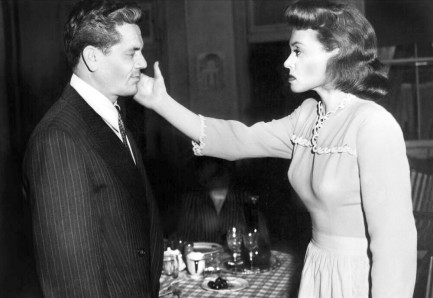 And he thought being inside the ring was hard. Lilli Palmer nails John Garfield with a roundhouse right in the 1947 boxing classic Body and Soul.
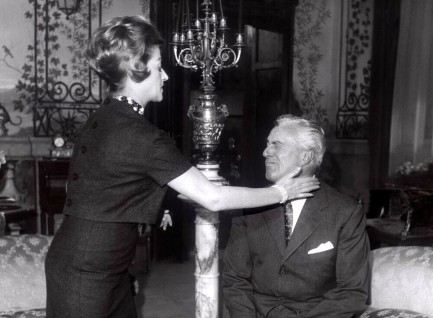 1960's Il vigile, aka The Mayor, sees Vittorio De Sica rebuked by a member of the electorate Lia Zoppelli. She's more than a voter in this—she's also his wife, so you can be sure he deserved it.
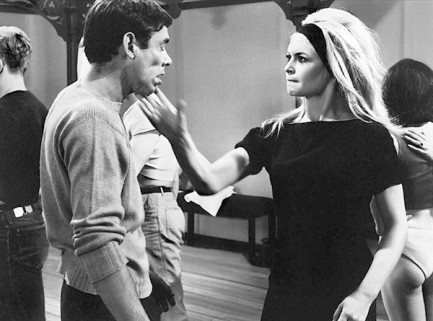 Brigitte Bardot delivers a not-so-private slap to Dirk Sanders in 1962's Vie privée, aka A Very Private Affair.
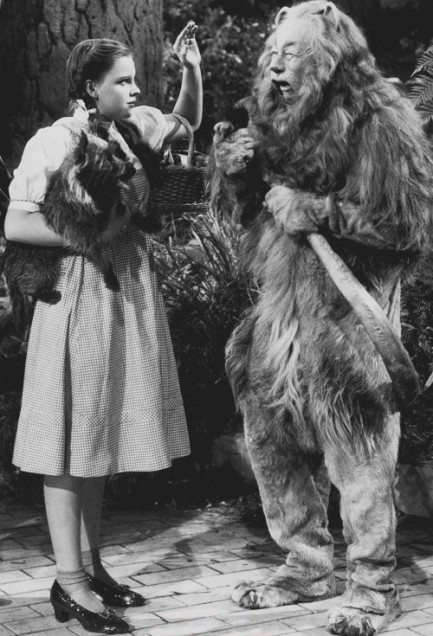 In a classic case of animal abuse. Judy Garland gives cowardly lion Bert Lahr a slap on the nose in The Wizard of Oz. Is it his fault he's a pussy? Accept him as he is, Judy.
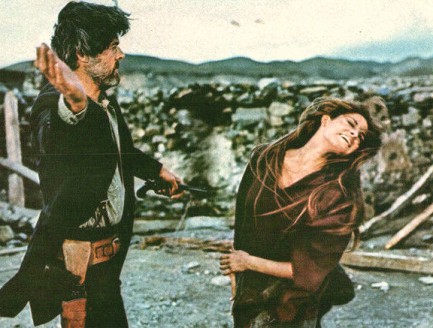 Robert Culp backhands Raquel Welch in 1971's Hannie Caudler.
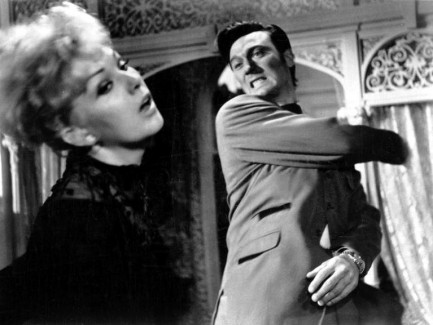 And finally, Laurence Harvey dares to lay hands on the perfect Kim Novak in Of Human Bondage.
 Key LargoSeven SinnersThe Opposite SexGildaThe KillersWhatever Happened to Baby Jane?LudwigConfidential AgentPattonThe Public EnemyBoy on a DolphinOf Human BondageQueen BeeBetrayedStories of the CenturyIn This Our LifePhaedraBody and SoulIl vigileThe MayorThe Wizard of OzHannie CaulderVie privéeA Very Private AffairEdward G. RobinsonHumphrey BogartClaire TrevorMarlene DietrichBroderick CrawfordJune AllysonJoan CollinsGlenn FordRita HayworthBette FordJoan CrawfordMary MurphyJohn PayneRomy SchneiderSonia PetrovaLauren BacallCharles BoyerMarilyn MonroeCary GrantGeorge C. ScottTim ConsidineJames CagneyMae ClarkeSophia LorenJorge MistralJoan CrawfordLucy MarlowVictor MatureLana TurnerMarie WindsorMary CastleDennis MorganRaf ValloneAnthony PerkinsLilli PalmerJohn GarfieldLia ZoppelliKim NovakLaurence HarveyVittorio De SicaDirk SandersBrigitte BardotJudy GarlandBert LahrRaquel WelchRobert CulpRonald ReaganAngie Dickinson

| Musiquarium | May 29 2020 |

If you're happy and you know it drop your shirt.
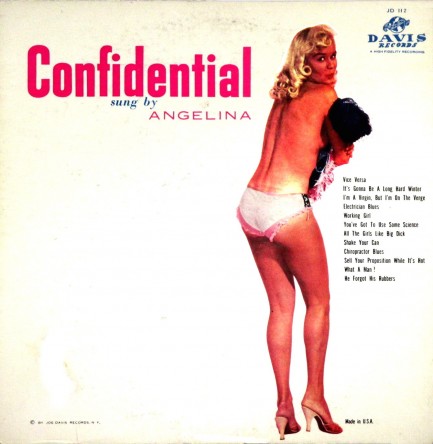
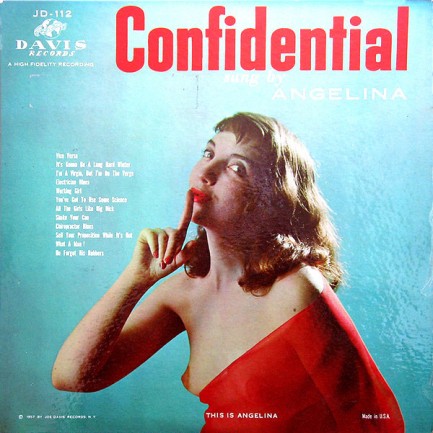
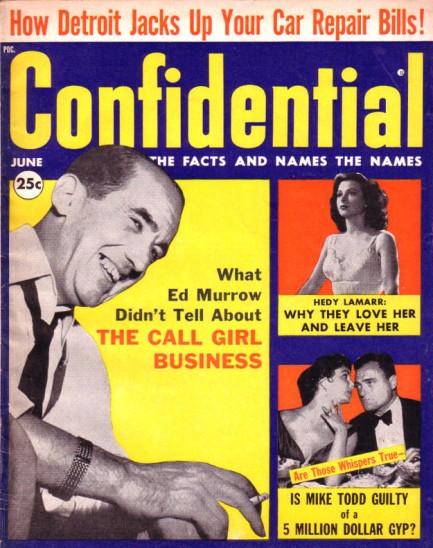
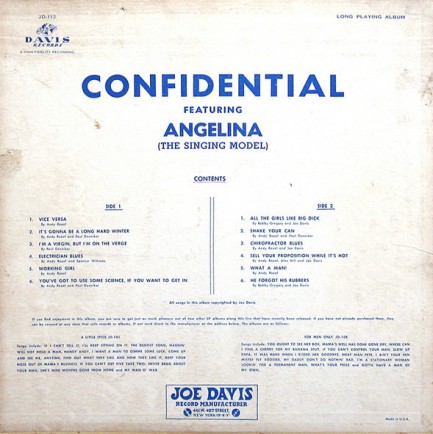
Here's a historical curiosity. Above are two pressings of an album from Angelina, aka Angelina the Singing Model, released in 1957. Sharp-eyed readers may notice that the sleeves use the name and title font of the iconic mid-century tabloid Confidential. The platters were put out by Davis Records, owned by recording entrepreneur Joe Davis, and try as we might, we uncovered no connection between him and Confidential publisher Robert Harrison. Anything is possible, though. They were both New York based, were both publishers—though of different media—so we bet they knew each other. Did Harrison have any idea his font had been borrowed? There's no way we can know.
During the summer of 1957, when this album was recorded and hit stores, Harrison was deeply involved in the libel case that would lead to him selling Confidential. The trial was in L.A., and he stayed in NYC, refusing to appear in court out west, but even so the proceedings kept him plenty busy. Too busy to notice that a novelty album infringed on his logo? We doubt it. Someone, somewhere in Manhattan, would have said, “Hey, Robert, have you seen this new record that uses the font from your magazine?” For that reason we can't help feeling there's some link between Davis and Harrison that led to the look of these LPs, but for now that will have to remain a mystery.
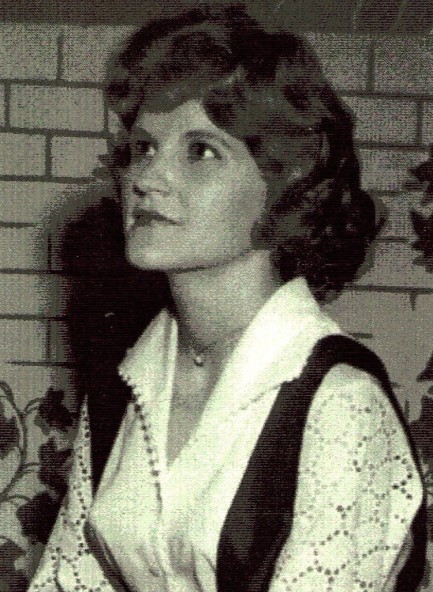
 Moving on to the singer, Angelina was actually New York City-based Joyce Heath, who later founded Joyce Heath and the Privateers. These platters, unlikely as the possibility seems, may have actually helped launch her career. As we said, they came in 1957, and Heath's first recordings under her own name were in 1959. Maybe she kept her semi-topless starring role on the cover of Confidential quiet, but we think it more likely she embraced it. While she does show her breast on the second cover, one little boob, after all, was not that big of a deal post-Monroe and Mansfield.
The album had either a repressing or was initially released with two sleeves. Since there are two levels of explicitness, we suspect the latter. Davis probably wanted a suggestive cover, and one that was even more risqué. On the other hand, the change in Heath's hair color suggests the former possibility—two pressings at different times with a change of hairstyle between. Both albums have 1957 copyrights, though, which means little time would have elapsed. Alternatively it could be that Heath wasn't the model for both covers. But we think she was. The second sleeve says in white lettering across her red shirt, “This is Angelina.” So there you go. And the first model, if you look past the hair color, resembles Heath strongly. At least to us.
And now we get to the music. You want to know whether it's any good, right? Well, it's a joke record, with double entendre songs like, “All the Girls Like Big Dick,” “Shake Your Can,” and “He Forgot His Rubbers.” We gave it a listen and all the tunes are cabaret style, pairing piano and vocal with no other accompaniment. Twelve tunes of that ilk would begin to sound similar anyway, but in this case, they really are all the same song. Same key, same tempo, same mood, etc. We have it on good authority Heath recorded this in one afternoon and what we heard sure lends credence to that assertion. Still, limited as the music may be, it's pretty fun. If you want to know more about Joyce Heath, check the blog whitedoowopcollector at this link.

| Hollywoodland | May 28 2019 |

Everybody who was anybody was fair game in Harrison's Hollywood.
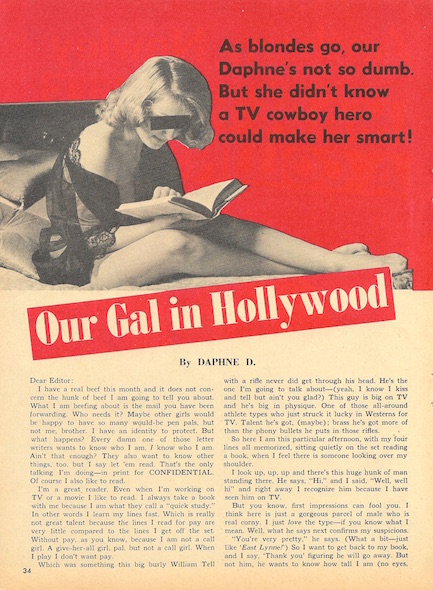
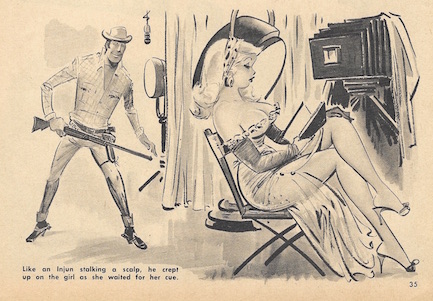
In independent journalism there's a battle raging at all times, as those with power attempt to intimidate the press, make its work difficult, control its narrative, restrict its access, redefine what constitutes journalism, or even cast individual members of the press as public enemies. It's a battle that never ends. Confidential magazine was an important soldier on the journalistic battlefield. For ages anything that appeared in Hollywood gossip magazines was carefully crafted and groomed by the studios, which maintained power by denying access to all but officially accredited press outlets.
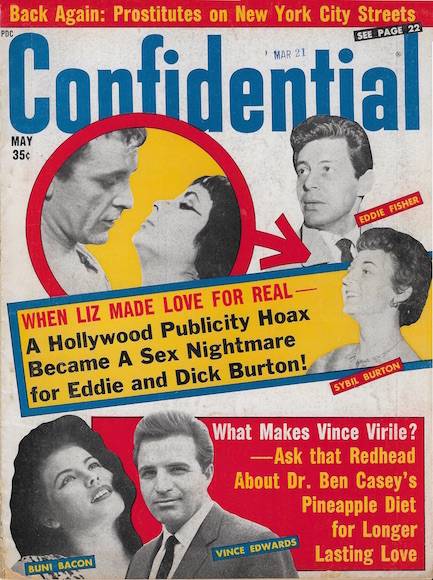
Maverick publisher Robert Harrison was a visionary who realized the public would open their wallets and pay for the lurid truth—even if the rush to get startling scoops meant the truth was sometimes only half-correct. Confidential appeared in 1952, and had the studios quivering in their boots by 1954. The issue you see here came later, this month in 1963, in what is acknowledged as the magazine's later, tamer period, a defanging that came about thanks to numerous lawsuits launched by Hollywood stars, backed by powerful California politicians.
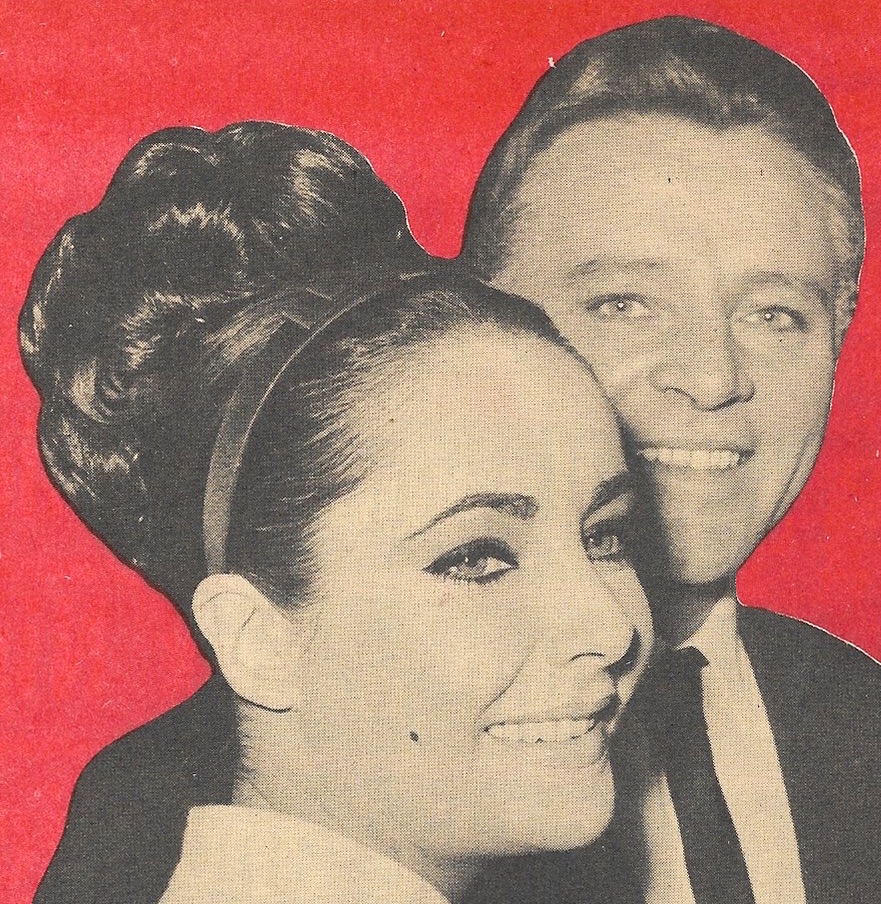
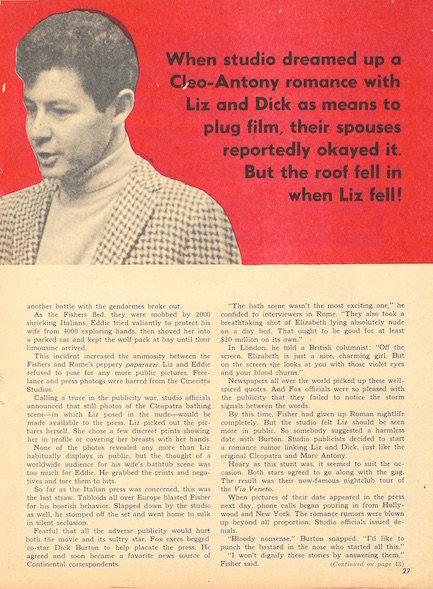
Confidential still managed to entertain, even if its stories were of a less invasive nature than before. But notwithstanding the new rules of engagement, some targets received particularly scathing treatment. Liz Taylor and Richard Burton were among them. The magazine says their legendary affair on the set of Cleopatra began as a studio publicity stunt, which backfired when Taylor actually fell for Burton—and into his bed. That may be true, but failure can be relative. On one hand Taylor's squeaky clean image was ruined forever, but on the other the story of her affair generated immense amounts of free press for Cleopatra.
Confidential still managed to entertain, even if its stories were of a less invasive nature than before. But notwithstanding the new rules of engagement, some targets received particularly scathing treatment. Liz Taylor and Richard Burton were among them. The magazine says their legendary affair on the set of Cleopatra began as a studio publicity stunt, which backfired when Taylor actually fell for Burton—and into his bed. That may be true, but failure can be relative. On one hand Taylor's squeaky clean image was ruined forever, but on the other the story of her affair generated immense amounts of free press for Cleopatra.
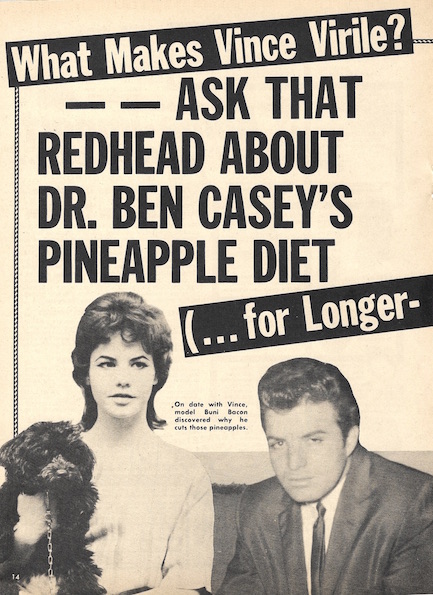
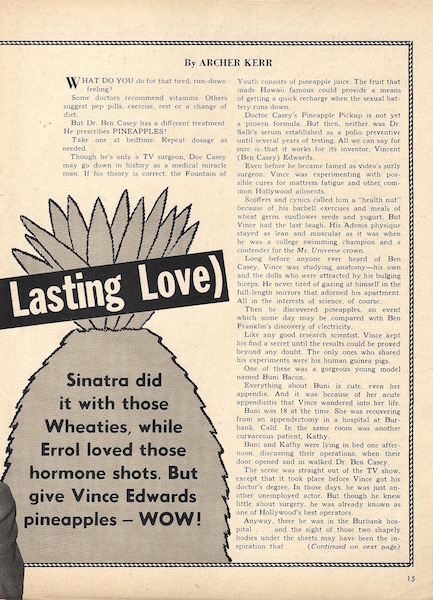
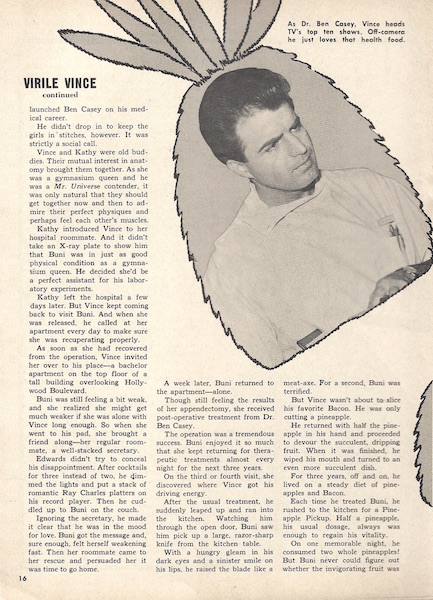
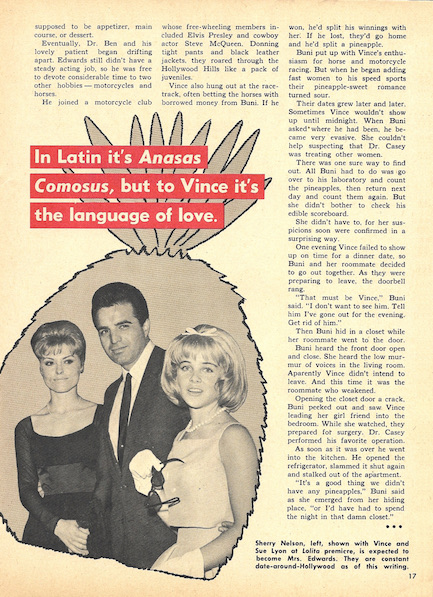
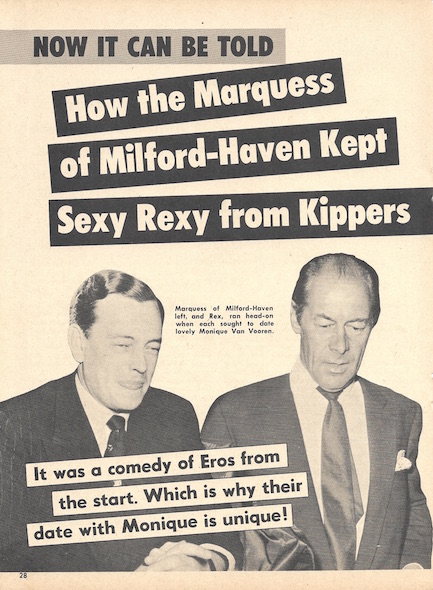
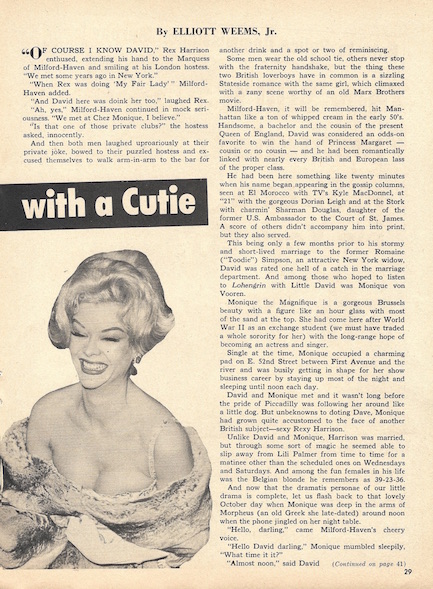
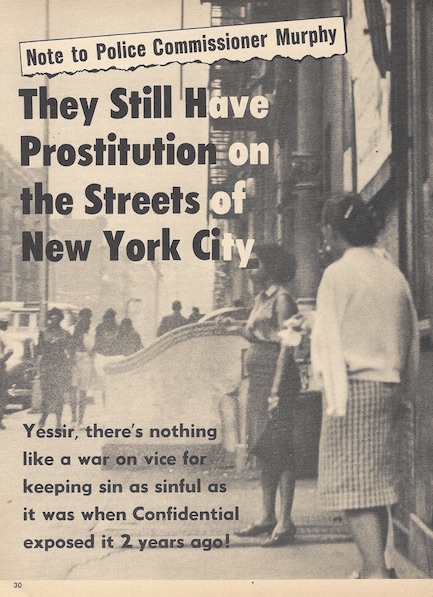
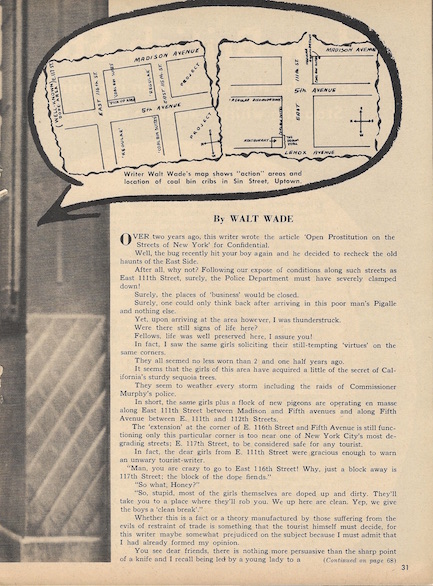
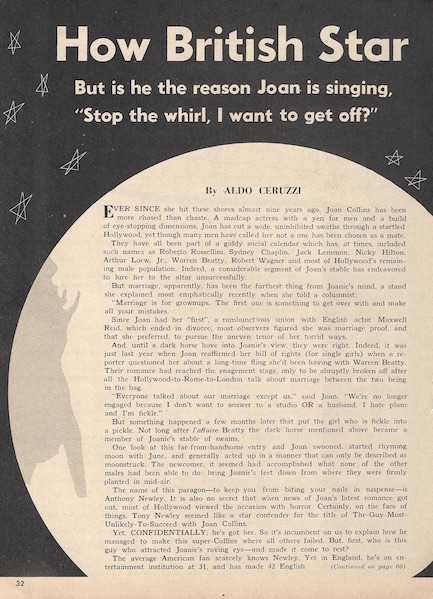
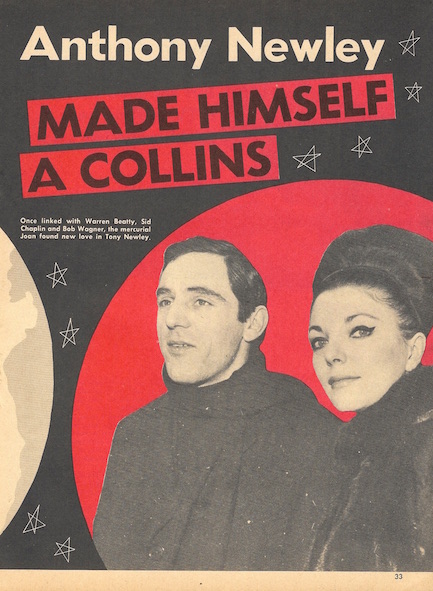
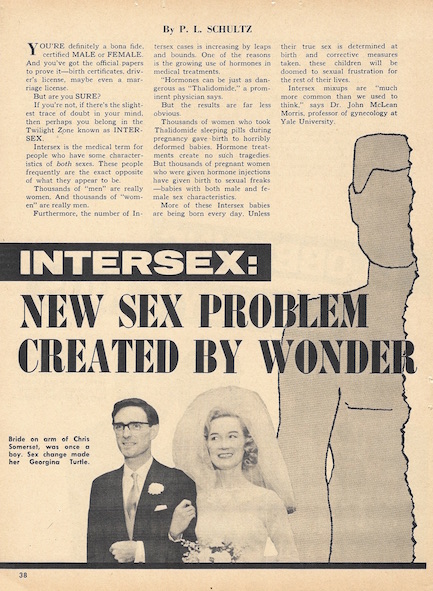
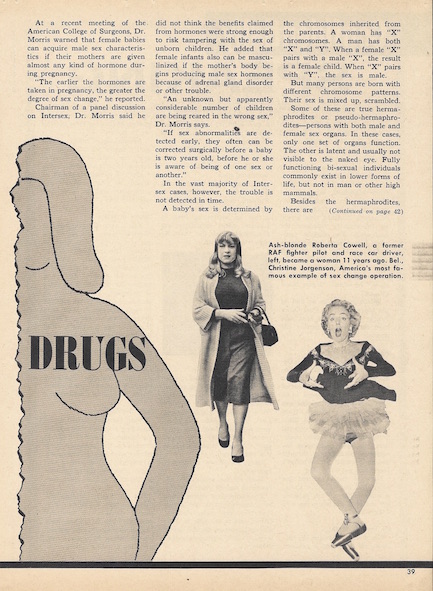
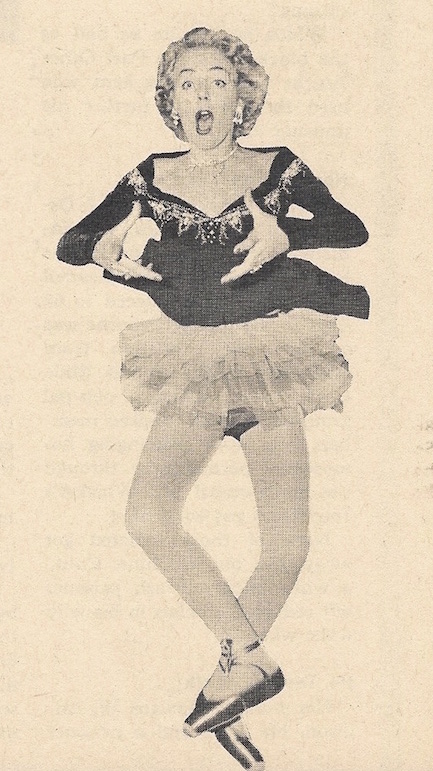
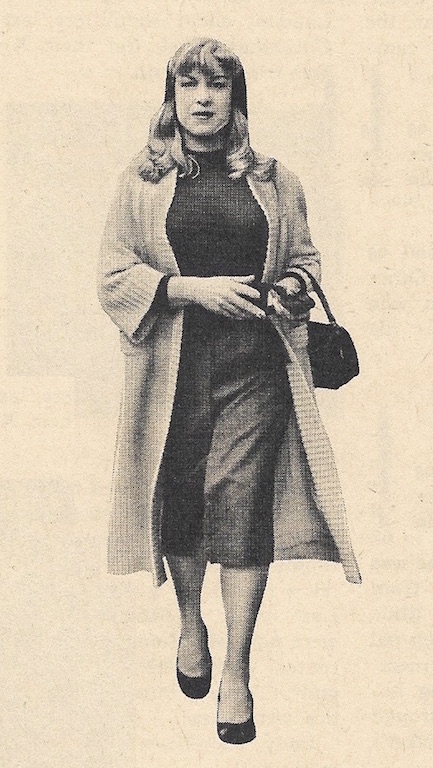
Other celebs who get cooked on the rotisserie include Joan Collins, Anthony Newley, Rex Harrison, Vince Edwards, and pioneering trans entertainer Christine Jorgensen. The magazine also tackled the issue of street prostitution in New York City and an epidemic of glue sniffing among American teens. We have a set of scans below and—stop us if you've heard this before—an entire tabloid index with thirty more posts about Confidential, to be found here.
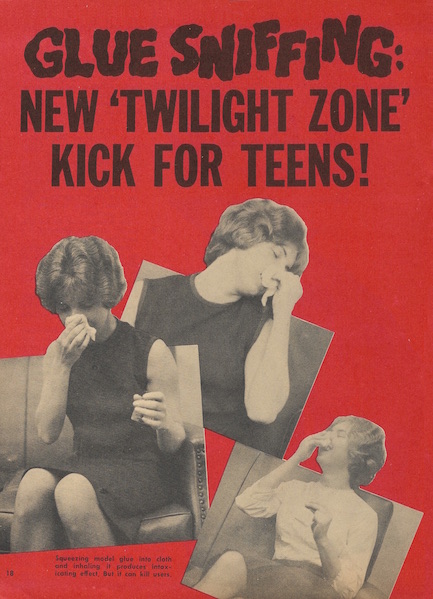
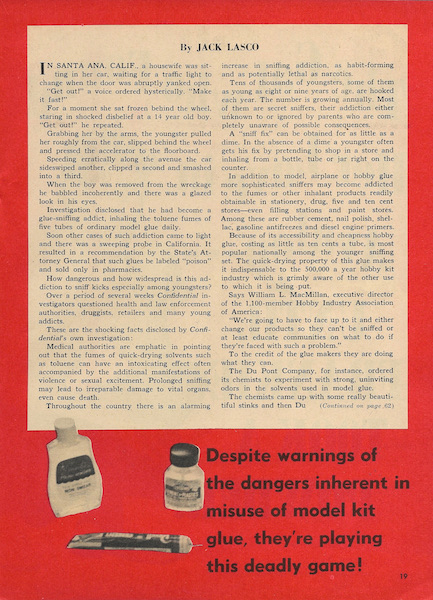
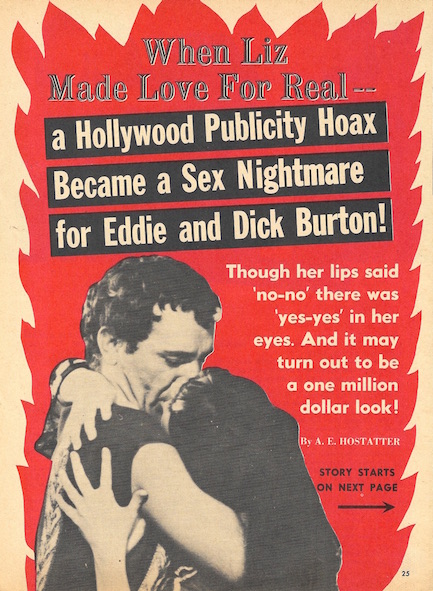
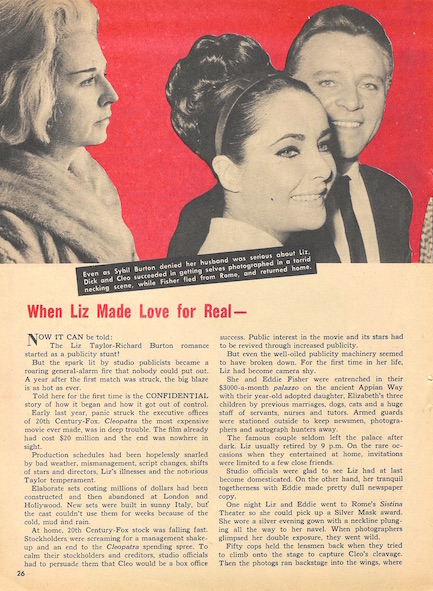
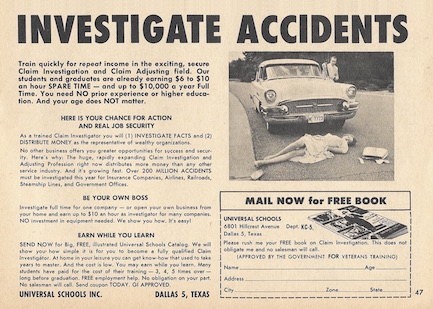
New York CityConfidentialRobert HarrisonLiz TaylorRichard BurtonJoan CollinsAnthony NewleyRex HarrisonVince EdwardsChristine JorgensenSybil BurtonBuni BakerEddie Fishertabloidlgbtprostitution

| Hollywoodland | Nov 14 2018 |

Confidential sinks its teeth into the juiciest celebrity secrets.
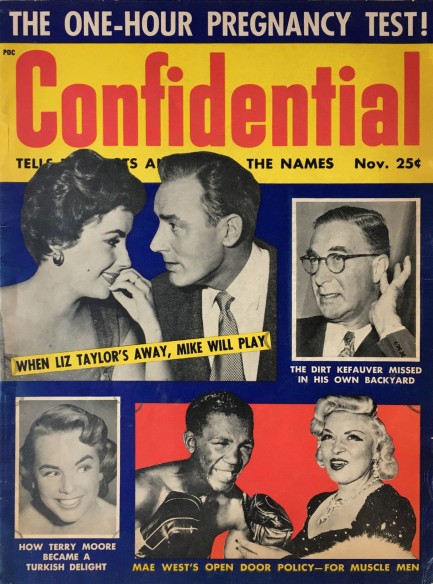
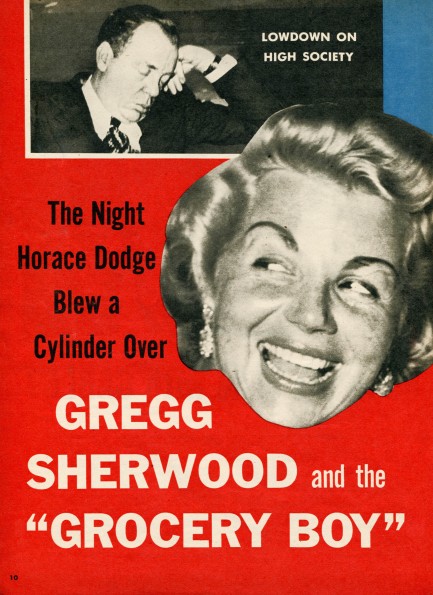
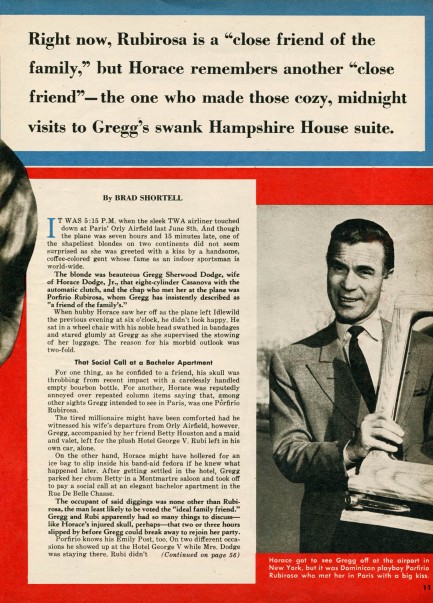
Confidential magazine had two distinct periods in its life—the fanged version and the de-fanged version, with the tooth pulling done courtesy of a series of defamation lawsuits that made publisher Robert Harrison think twice about harassing celebrities. This example published this month in 1955 is all fangs. The magazine was printing five million copies of each issue and Harrison was like a vampire in a blood fever, hurting anyone who came within reach, using an extensive network spies from coast to coast and overseas to out celebs' most intimate secrets.
In this issue editors blatantly call singer Johnnie Ray a gay predator, spinning a tale about him drunkenly pounding on doors in a swanky London hotel looking for a man—any man—to satisfy his needs. The magazine also implies that Mae West hooked up with boxer Chalky White, who was nearly thirty years her junior—and black. It tells readers about Edith Piaf living during her youth in a brothel, a fact which is well known today but which wasn't back then.
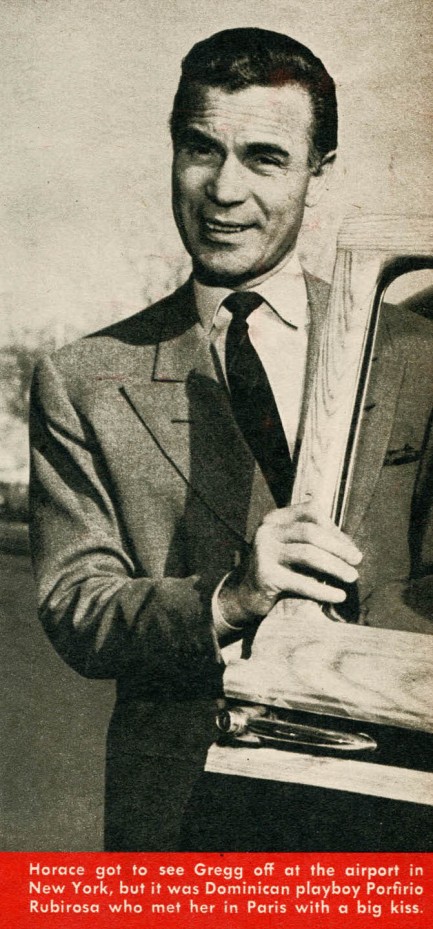
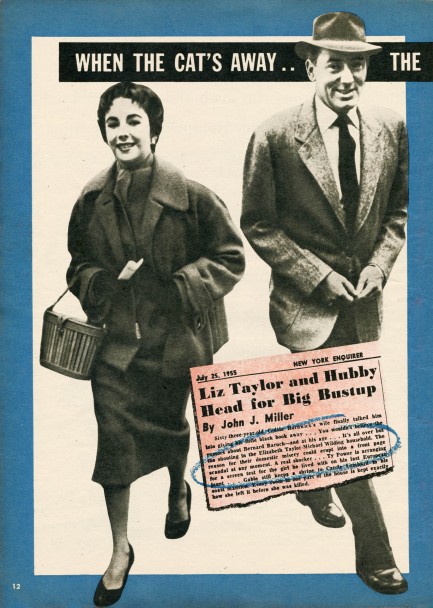
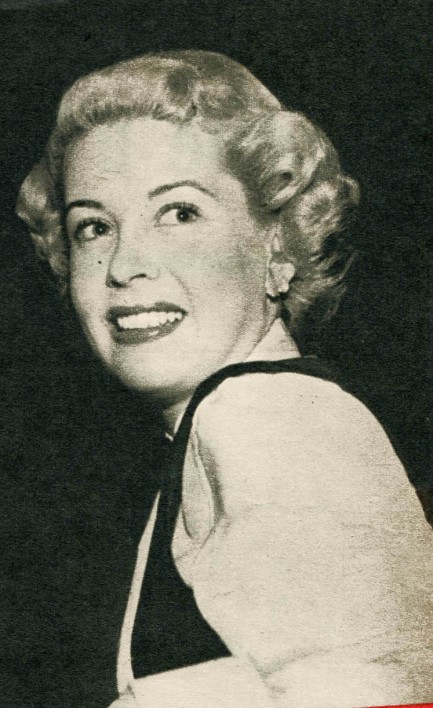
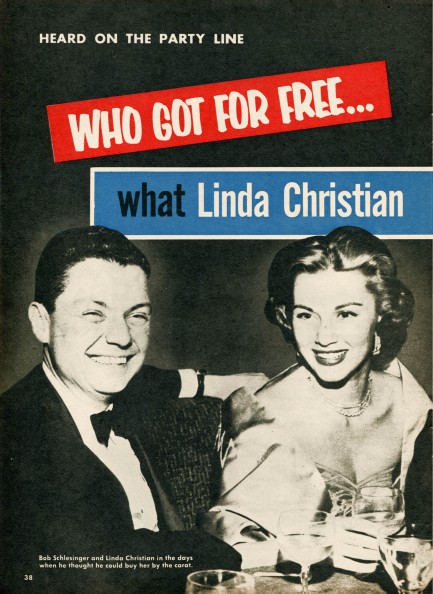
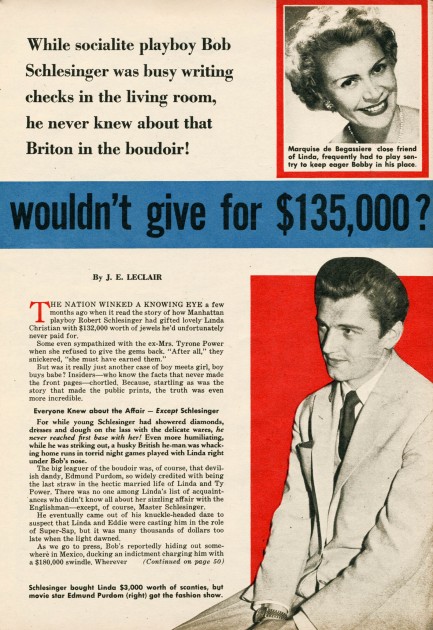
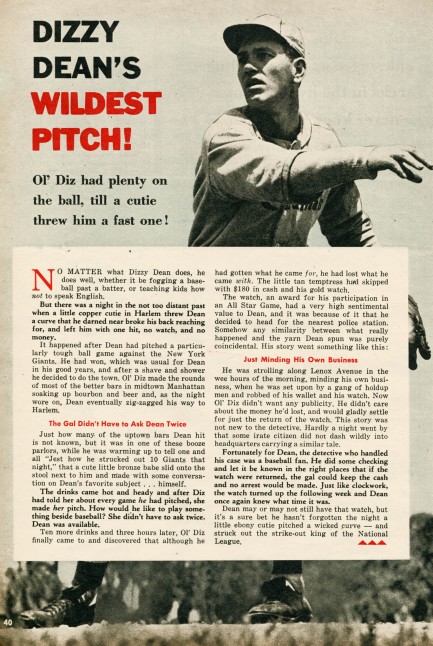
The list goes on—who was caught in whose bedroom, who shook down who for money, who ingested what substances, all splashed across Confidential's trademark blue and red pages. Other celebs who appear include Julie London, Jack Webb, Gregg Sherwood, and—of course—Elizabeth Taylor. Had we been around in 1955 we're sure we would have been on the side of privacy rights for these stars, but today we can read all this guilt-free because none of it can harm anyone anymore. Forty panels of images below, and lots more Confidential here.
The list goes on—who was caught in whose bedroom, who shook down who for money, who ingested what substances, all splashed across Confidential's trademark blue and red pages. Other celebs who appear include Julie London, Jack Webb, Gregg Sherwood, and—of course—Elizabeth Taylor. Had we been around in 1955 we're sure we would have been on the side of privacy rights for these stars, but today we can read all this guilt-free because none of it can harm anyone anymore. Forty panels of images below, and lots more Confidential here.
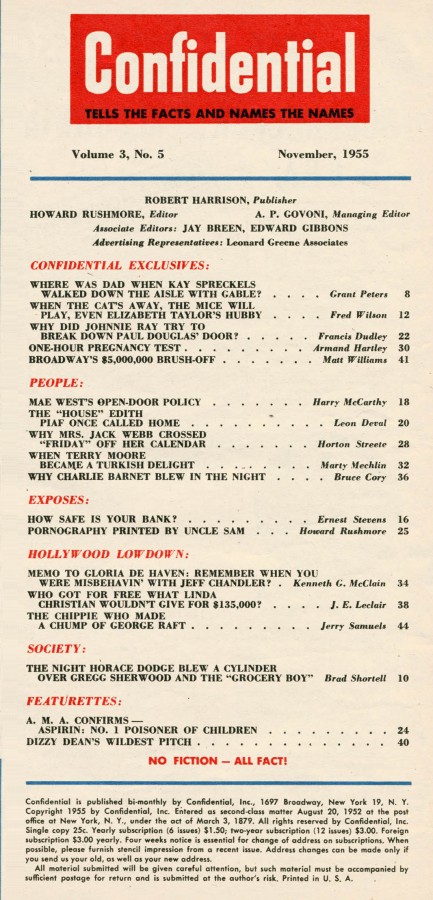
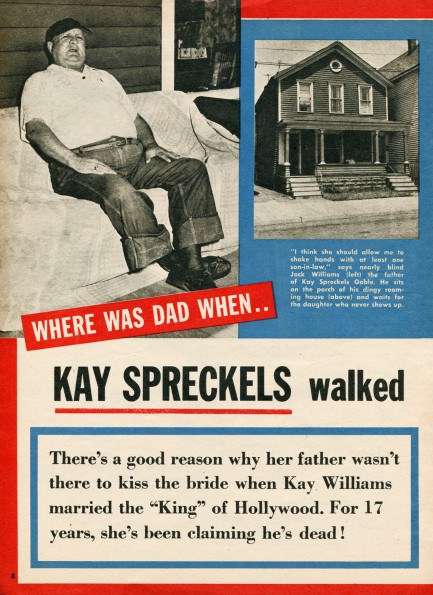
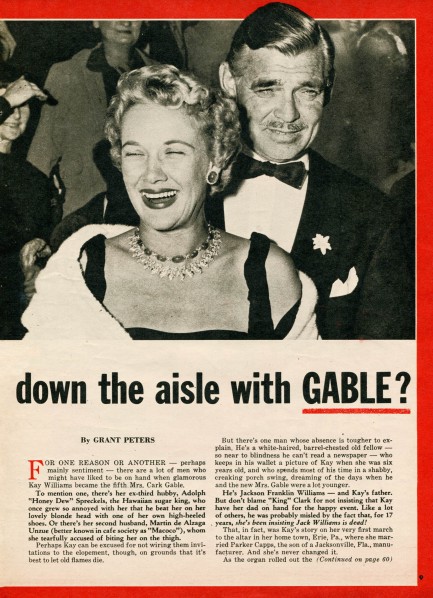
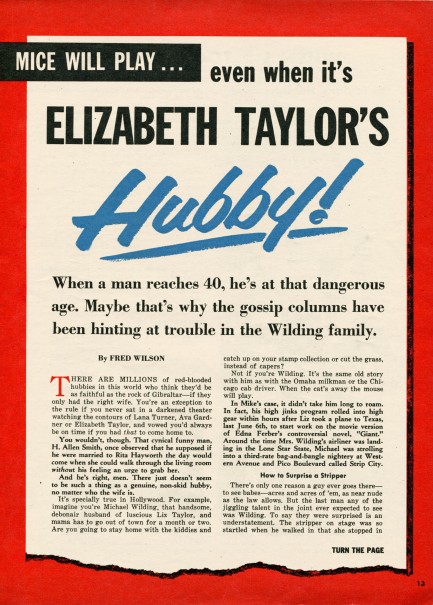
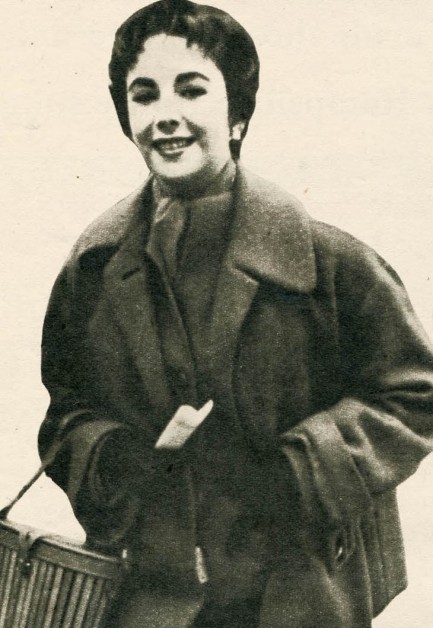
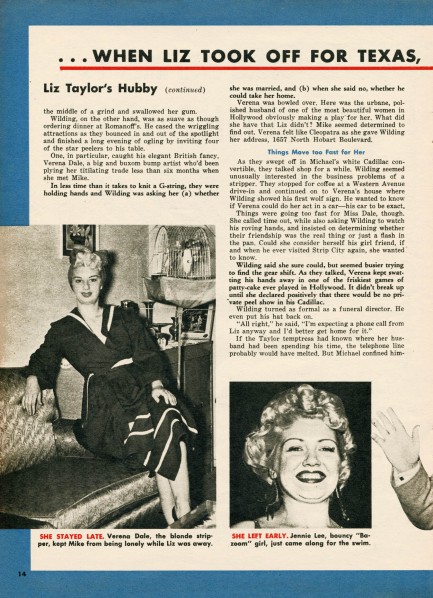
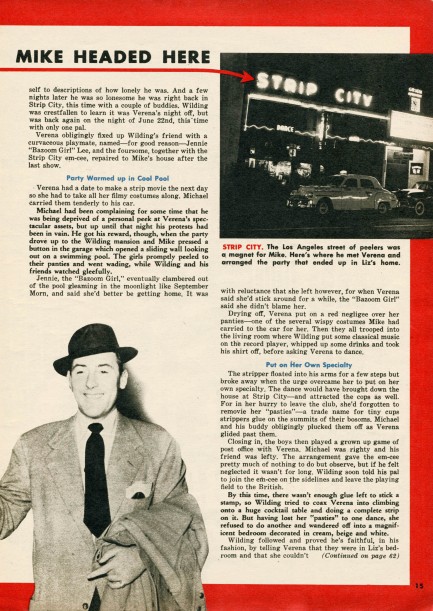
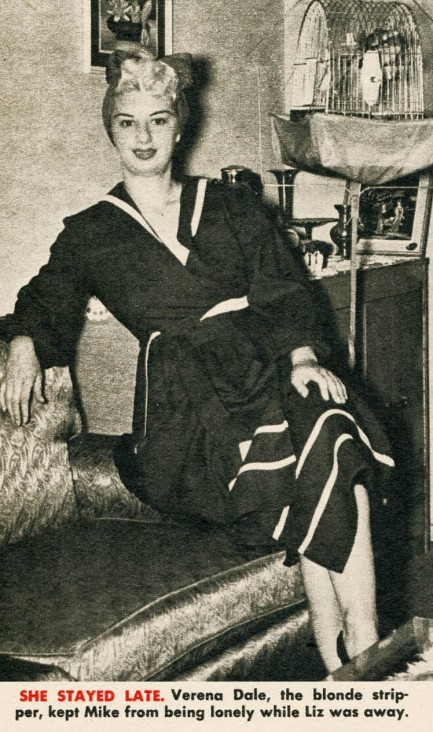
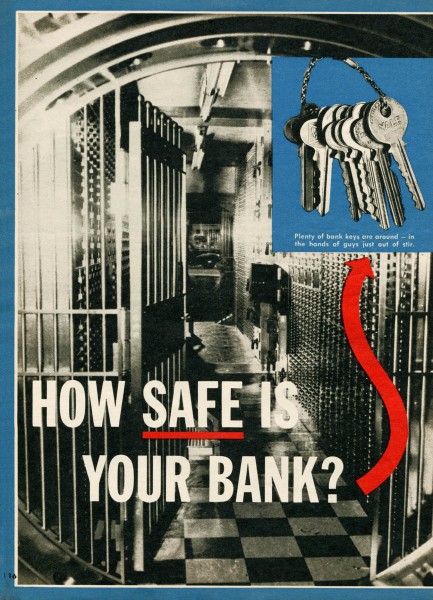
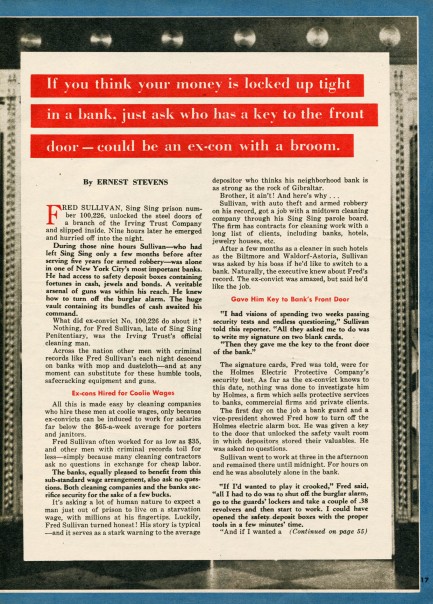
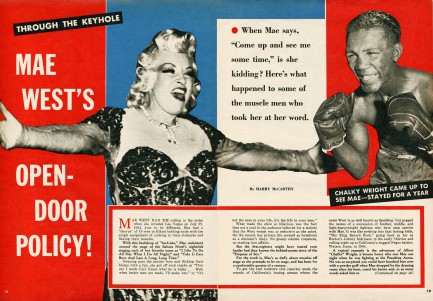
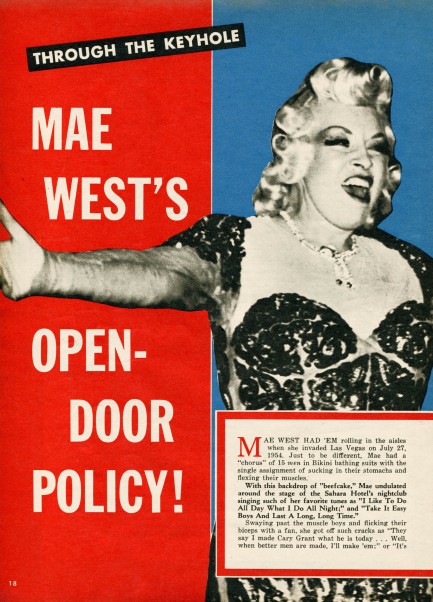
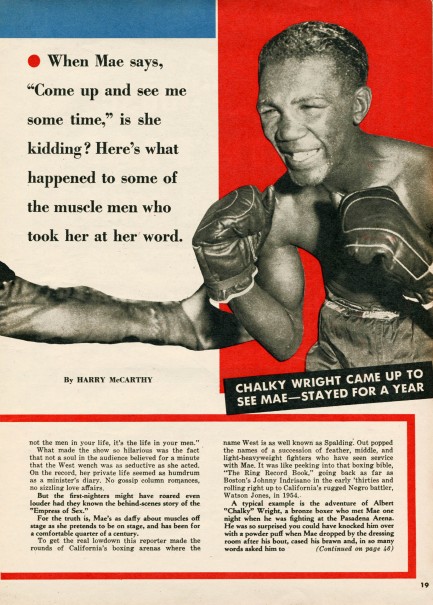
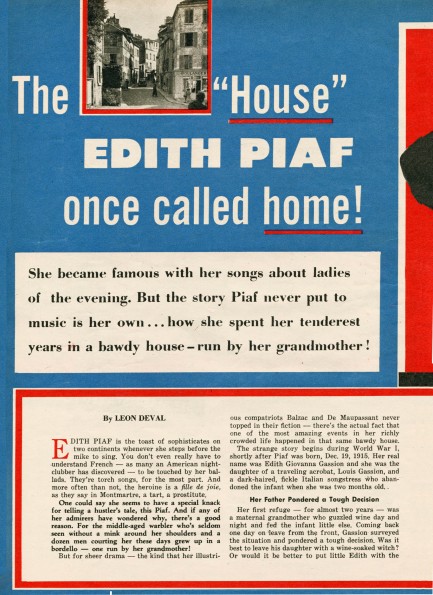
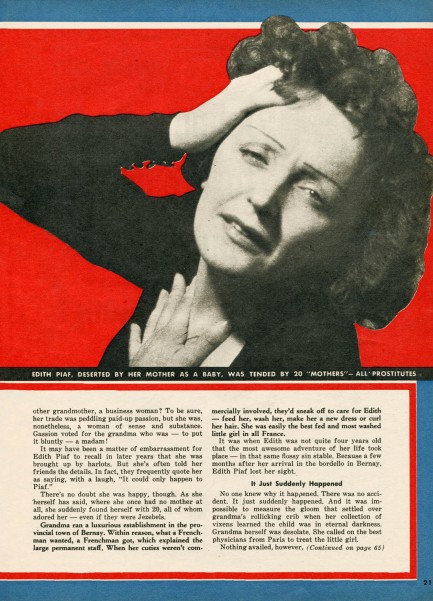
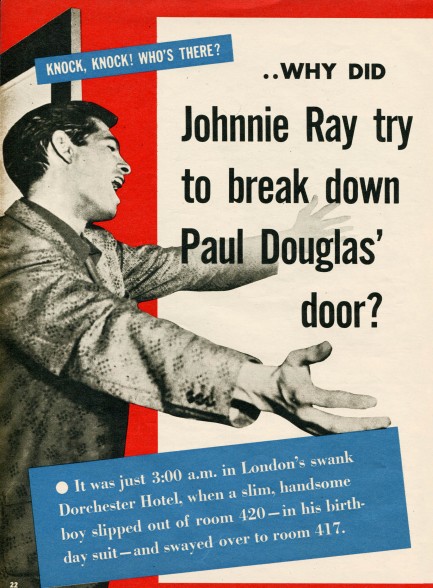
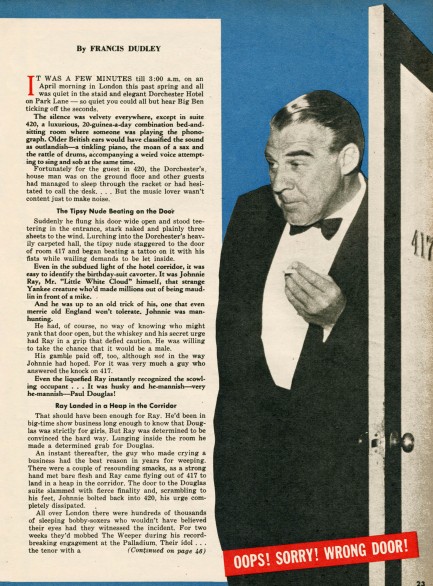
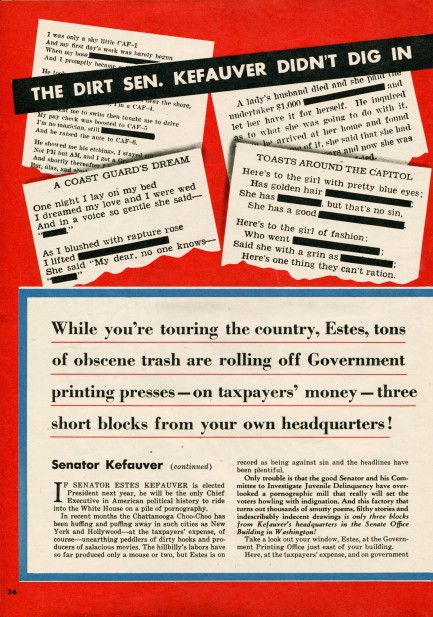
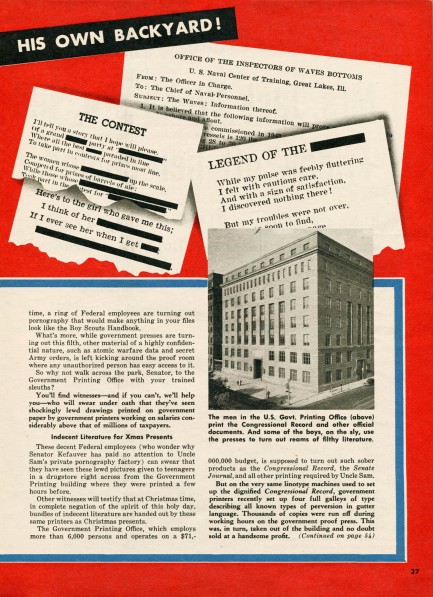
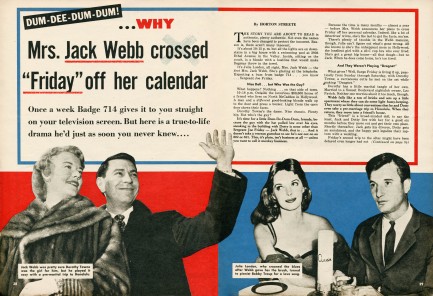
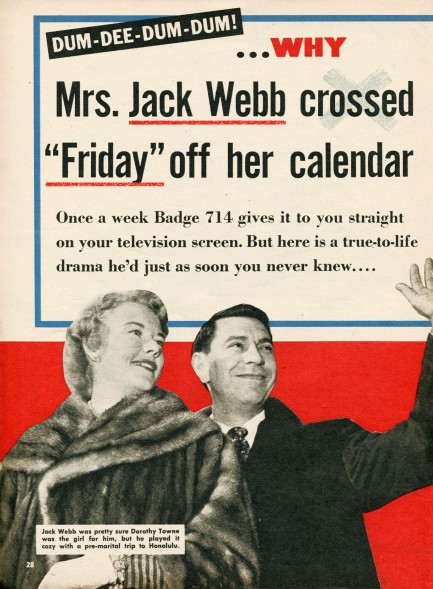
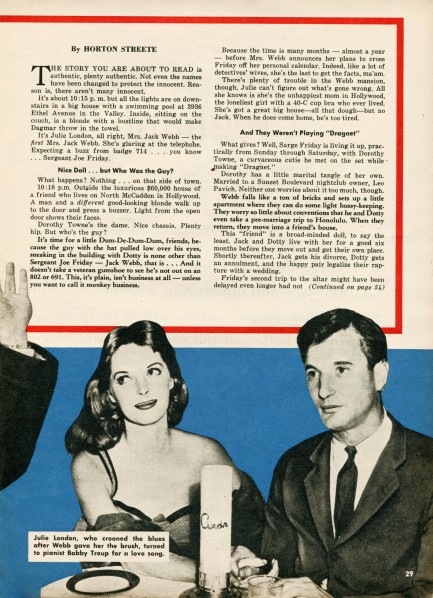
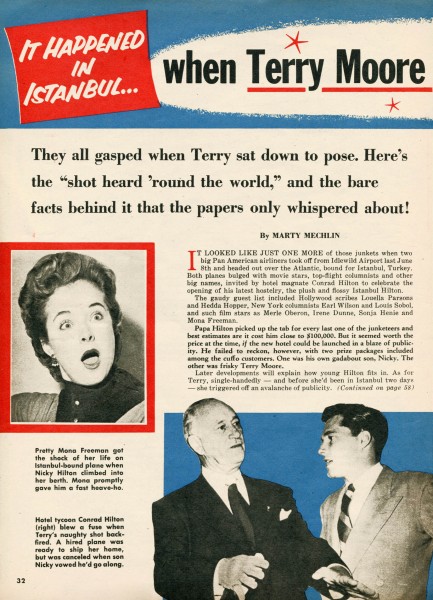
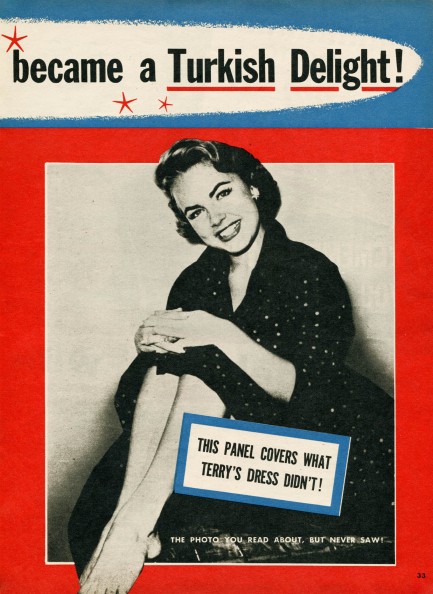
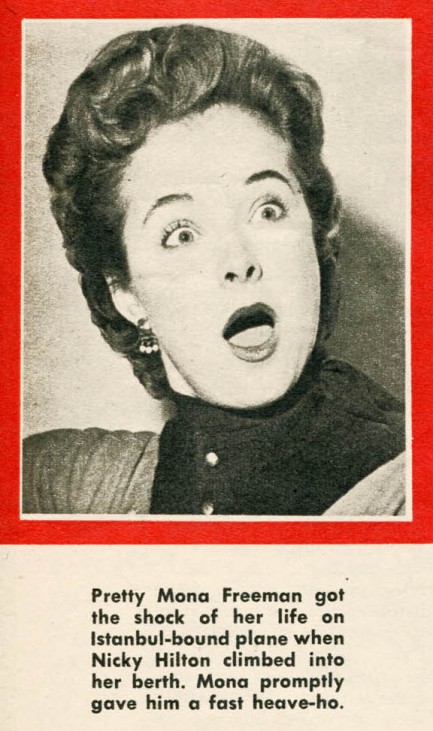
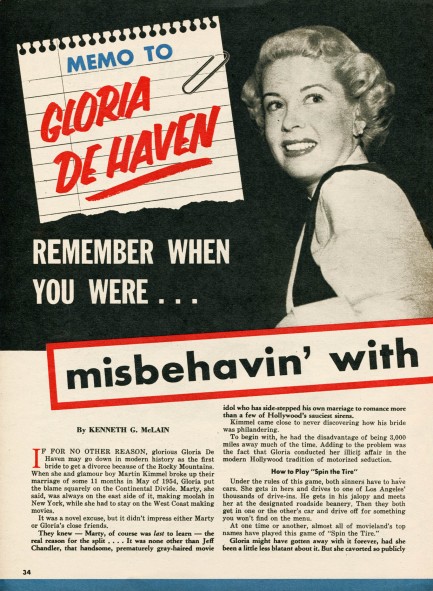
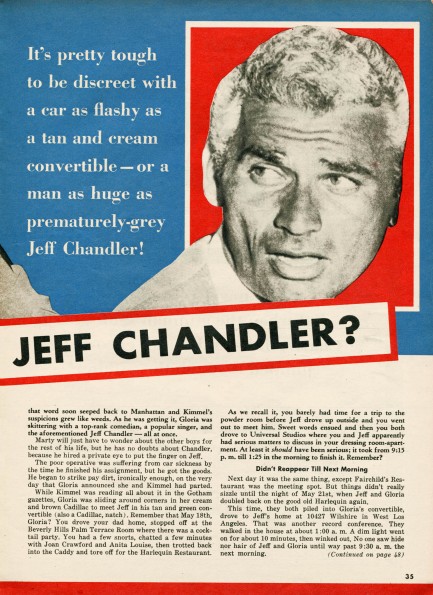
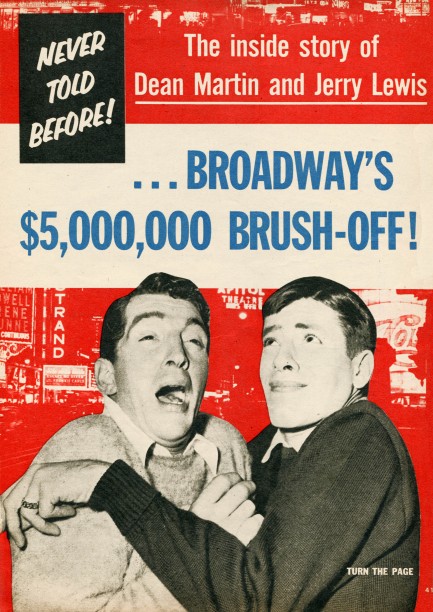
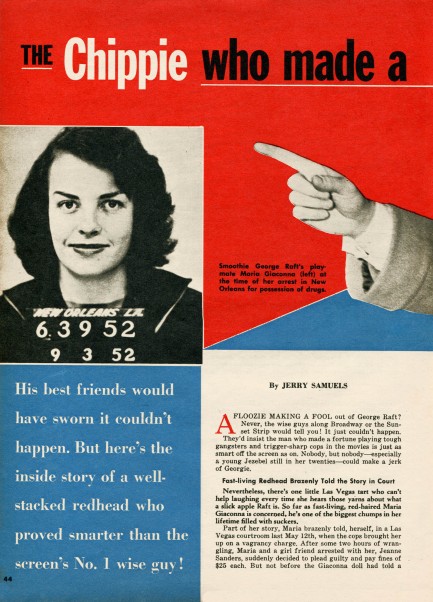
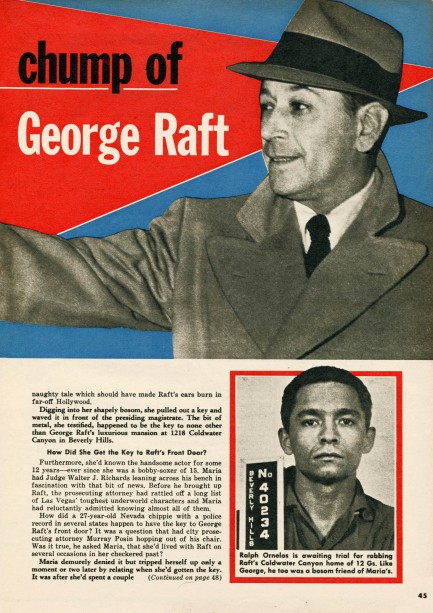
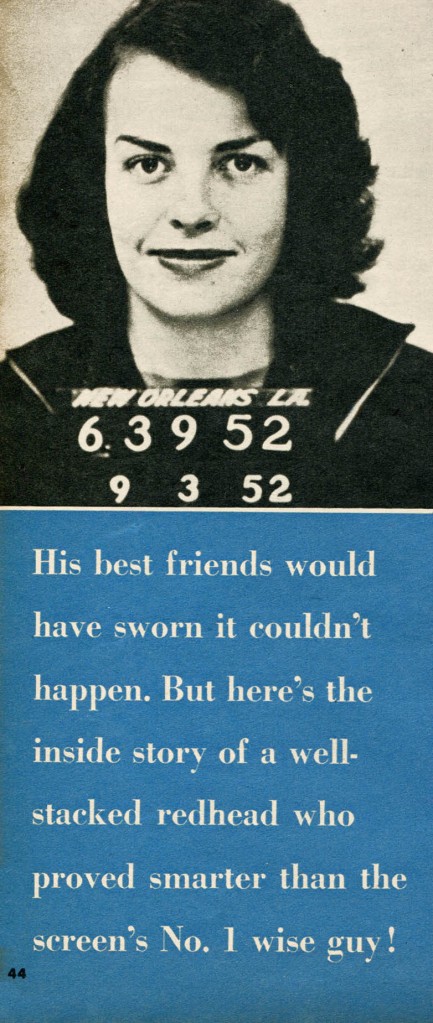
LondonConfidentialKay SpreckelsClark GableGregg SherwoodHorace DodgePorfirio RubirosaElizabeth Taylor. Michael WildingVerena DaleMae WestAlbert WhiteEdith PaifJohnnie RayPaul DouglasEstes KefauverJack WebbDorothy TownsJulie LondonBobby TroupTerry MooreMona FreemanConrad HiltonNicky HiltonGloria De HavenJeff ChandlerLinda ChristianDizzy DeanDean MartinJerry LewisMaria GiacomaGeorge Rafttabloid

| The Naked City | Apr 28 2018 |

Beautiful jinx finally jinxes herself.
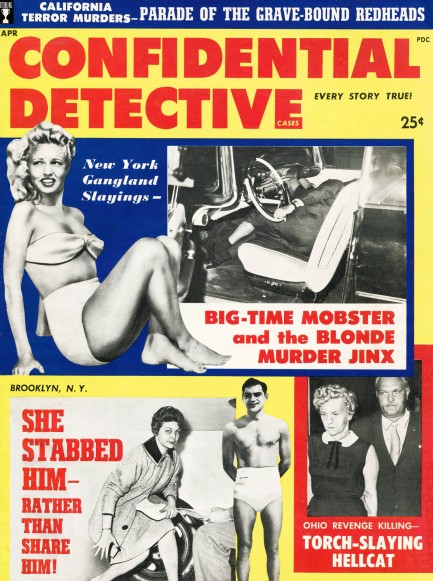
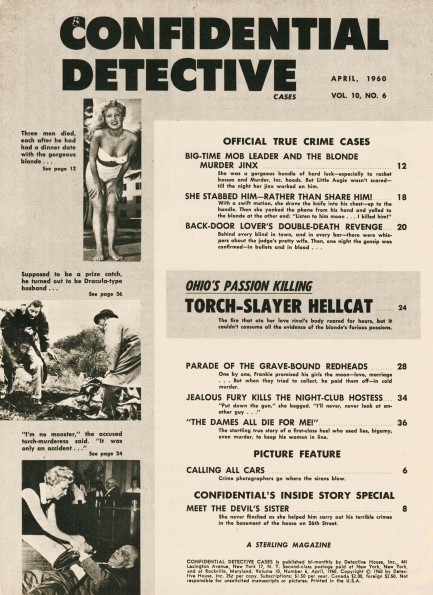
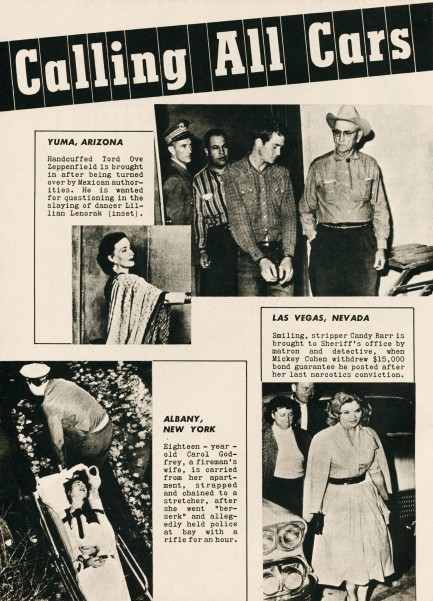
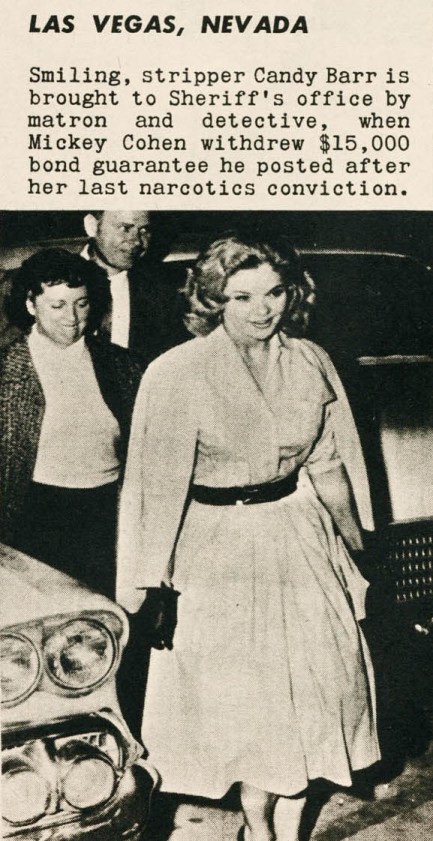
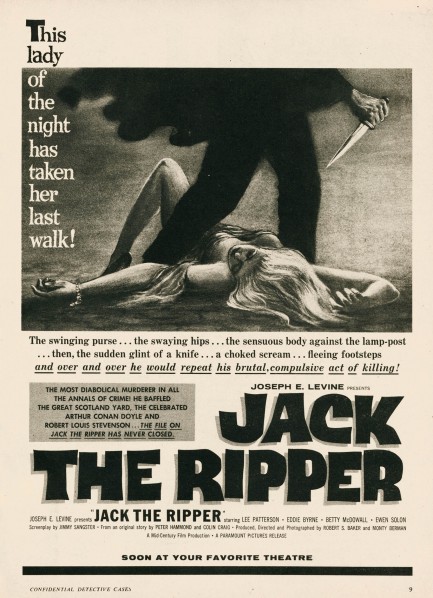
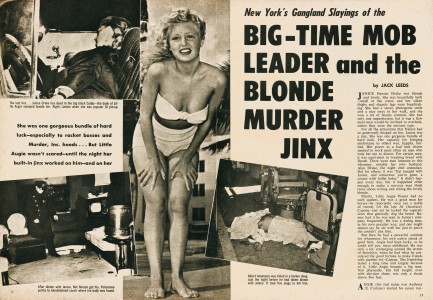
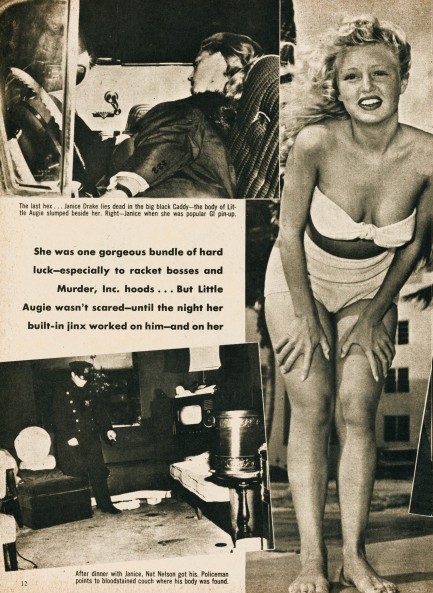
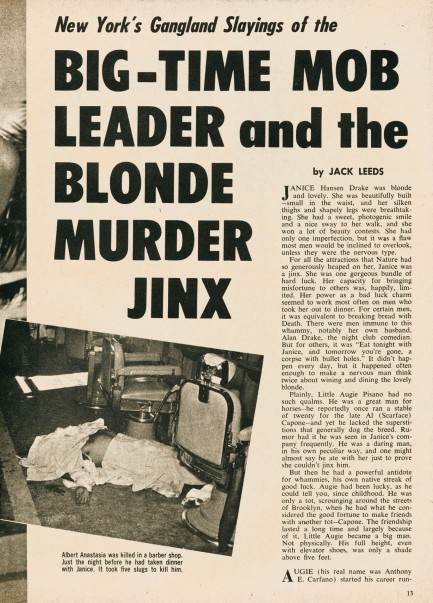
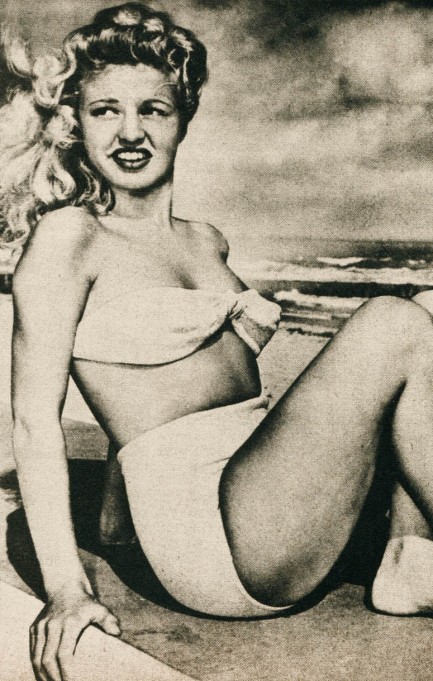
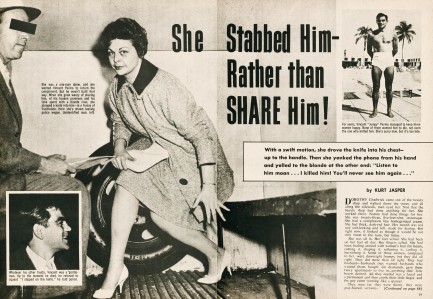
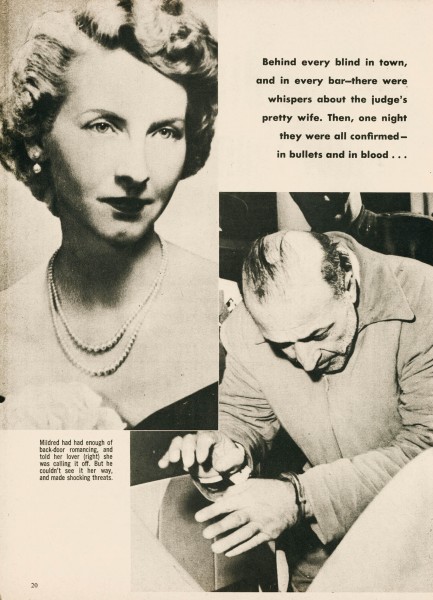
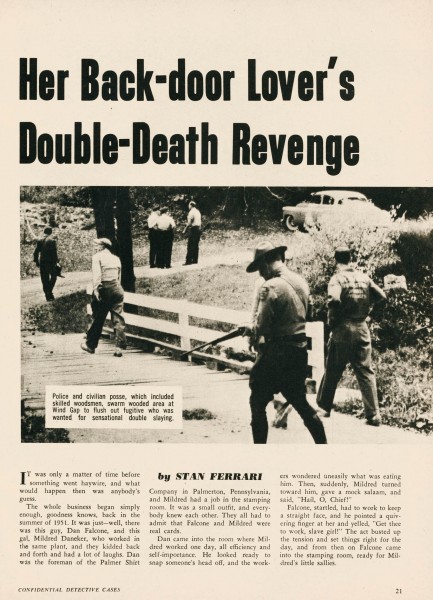
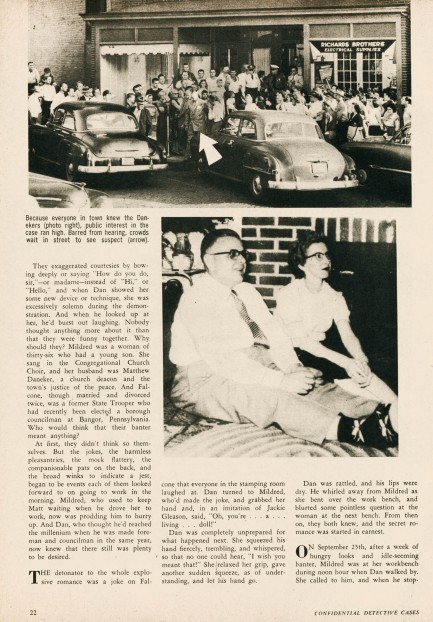
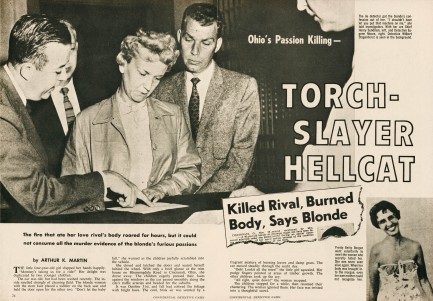
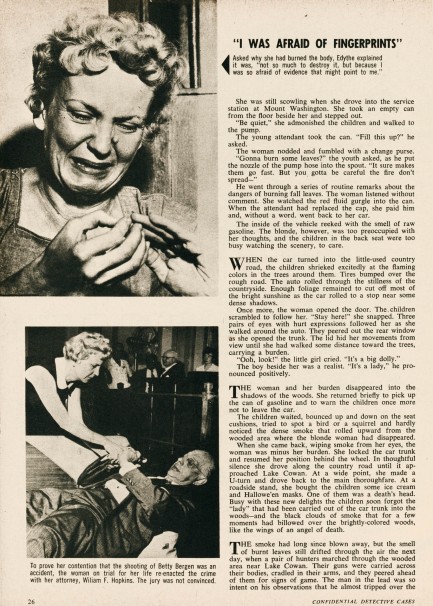
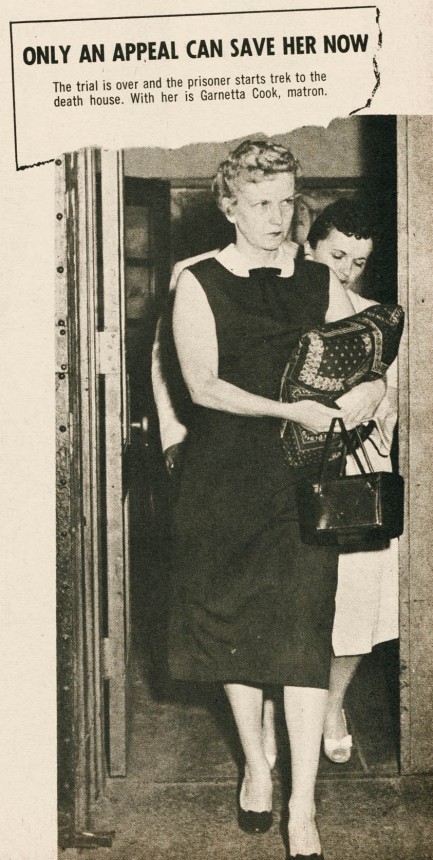
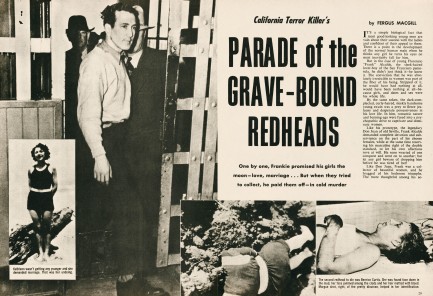
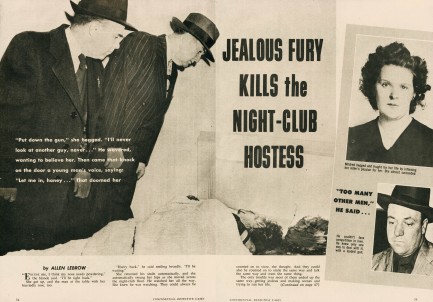
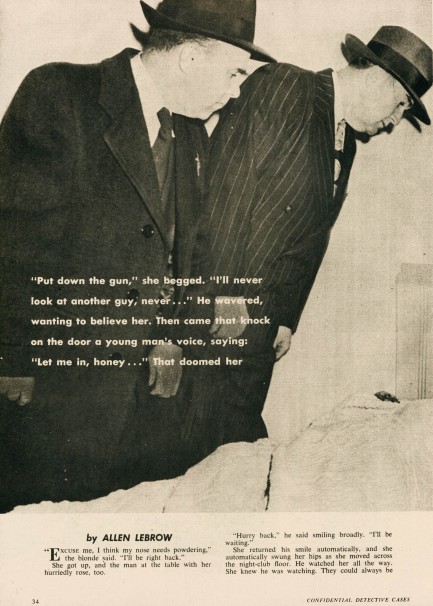
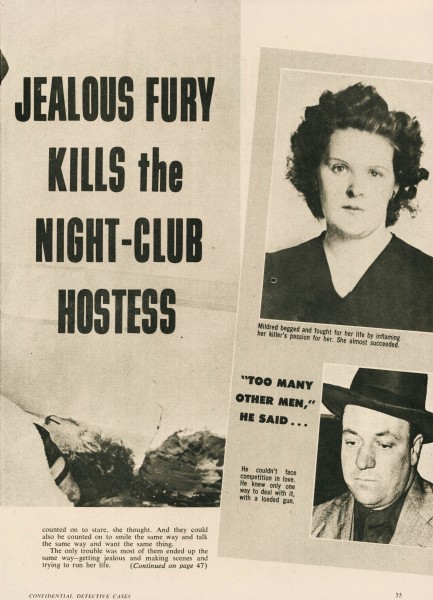
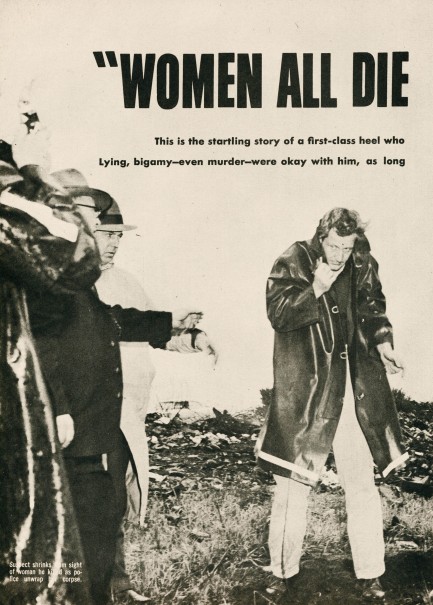
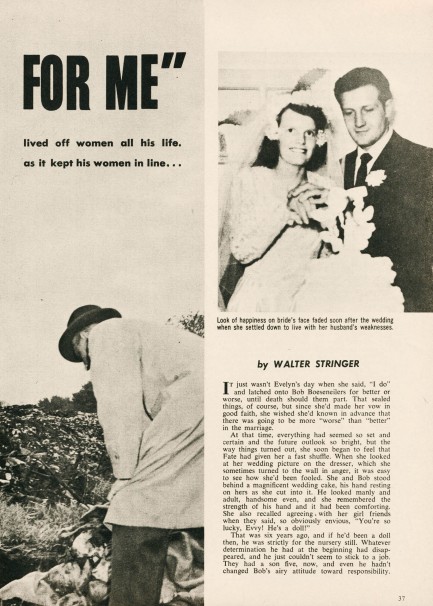
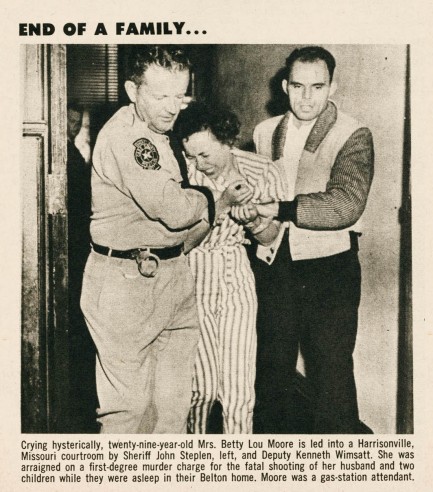
Confidential Detective Cases, for which see an April 1960 cover above, was published bi-monthly from 1942 to 1978 by New York City based Detective House, Inc. The magazine has an appropriately garish crime rag look and many stories of interest, breathlessly reported. The headers are entertaining: “She Stabbed Him—Rather Than Share Him!” “Parade of the Grave-Bound Redheads.” “The Dames All Die for Me.” All these tales are of interest, but today we're focused on one story—the piece about the unlucky death of Janice Drake. It's titled “Big-Time Mob Leader and the Blonde Murder Jinx.” A jinx is of course someone who brings bad luck to others, but what do you call someone who brings bad luck on herself?
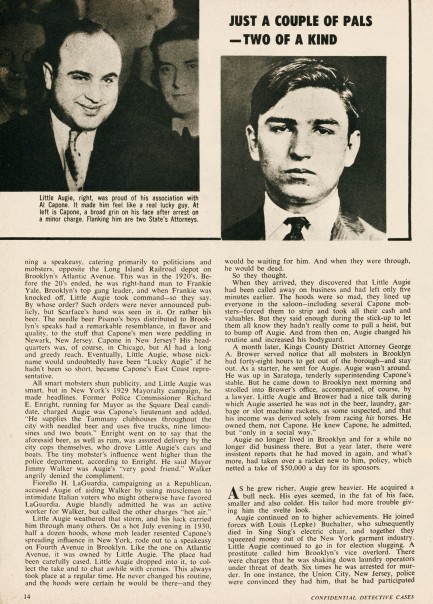
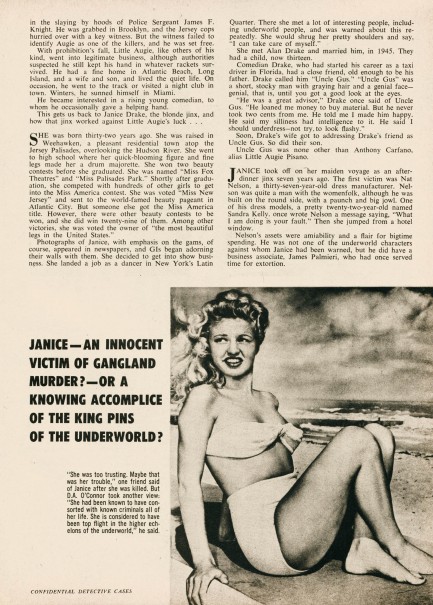
Drake was a former Miss New Jersey who had competed in the Miss America pageant, was a semi-famous G.I. pin-up, a professional dancer, and the wife of comedian Allan Drake. She and her husband were known to have an open marriage, and among Janice's male friends were several New York City mobsters. One of these was Anthony Carfano, aka Little Augie Pisano, an associate of crime boss Frank Costello, who was pitted against mob rival Vito Genovese in a power play for control of the New York City rackets. Carfano had thrown his support behind Costello, causing Genovese to develop a homicidal grudge.
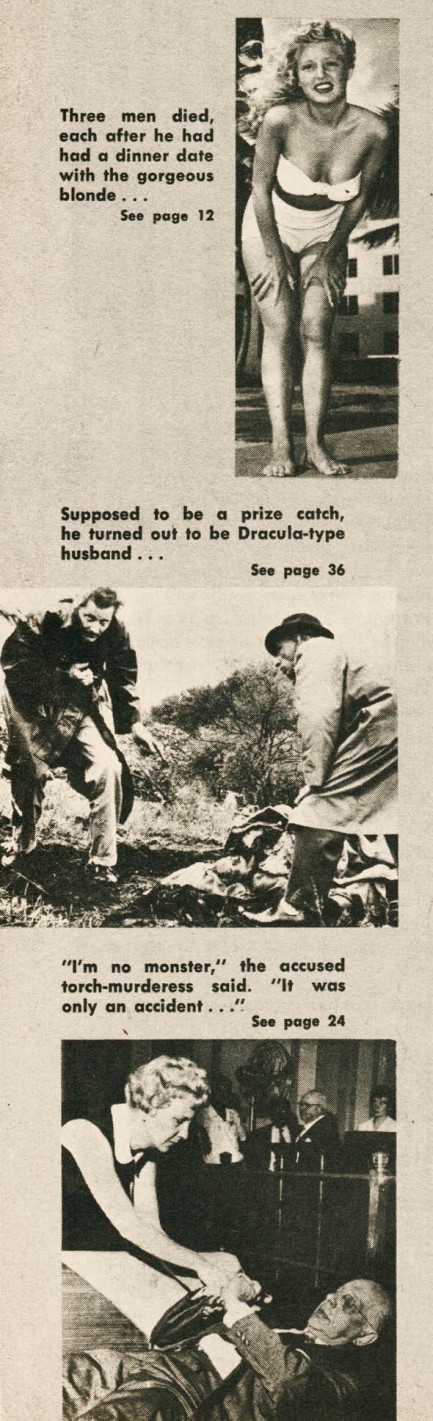
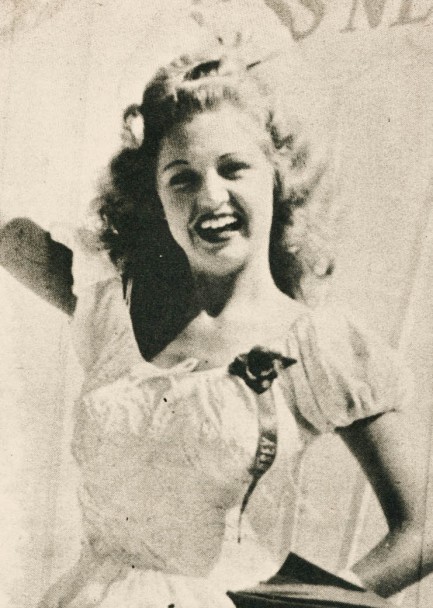 This was not a guy to go to dinner with, but on the night of September 29, 1959, Drake accompanied Carfano to a restaurant called Marino's, where they dined with a mob caporegime named Tony Strollo. Strollo was Genovese's right hand man, but Carfano had no idea Genovese was bent on revenge, nor that Strollo had been assigned the job. When Carfano and Drake left Marino's, they were planning to drive to La Guardia Airport to board a night flight to Miami. But two gunmen were stationed in the rear of Carfano's Cadillac and they forced him to drive to a secluded area near the airport, where they shot both him and Janice Drake twice in the head and once in the back of the neck.
Bad luck for Drake, but don't feel overwhelmingly sympathetic. She may not have been married to the mob, as the saying goes, but she was definitely playing footsie with it. Twice she had been present at a mobster's last supper. She went to dinner with Garment District kingpin Nathan Nelson the night he was murdered, and dined with Gambino crime family boss Albert Anastasia the night before he was whacked in a barbershop. Talk about a jinx. She was called to testify in court concerning both slayings, yet for some reason never seemed to comprehend the risks of running with a dangerous—and highly endangered—crowd.
More than a few police figures believed Drake was a mob courier, a high level go-between, a role in which she may learned the identities of Nelson's and Anastasia's killers. She may not have been a target the night she had her last supper and met a messy end, but it could be that since she knew too much, her loss as collateral damage was deemed an acceptable outcome. Others think she was just mob arm candy and finally ended up in the wrong place at the wrong time; anyone in the car with Carfano would have bought it the same brutal way. Whatever the specifics, Drake's early death—she was thirty-two when it happened—was probably inevitable.
New JerseyNew York CityConfidential Detective CasesJanice DrakeAllan DrakeAnthony CarfanoLittle Augie PisanoAlbert AnastasiaNathan NelsonTony StrolloVito GenoveseCandy Barrtrue crime magazinemurdermafia