 The movie is a Horn of plenty—of sticky historical issues. 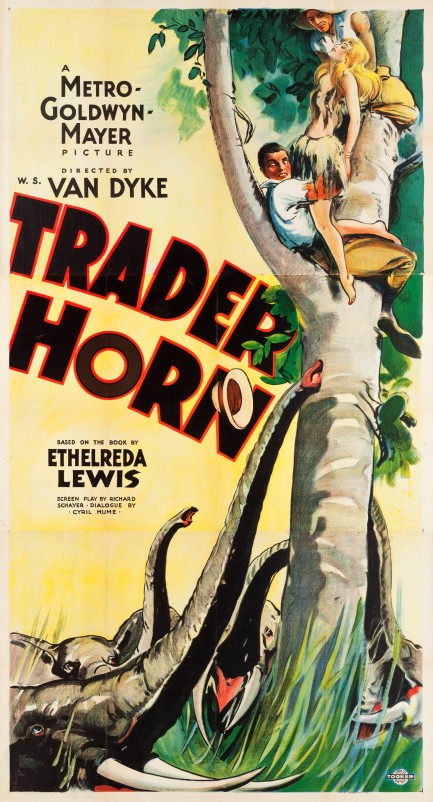
Trader Horn is an Academy Award nominated movie adapted from the real life African adventures of the explorer Alfred Aloysius “Trader” Horn, and as a major production has many high quality posters. The one above is our favorite, but all the promos are impressive, as you'll see when we share some a little later. Trader Horn is an archetypal white goddess movie—which is to say, a group of intrepid adventurers encounter a white woman reigning over an African tribe. Obviously, Hollywood took a bit of creative license with Horn's biographical writings. At least, we assume so. Harry Carey plays Horn, an old hand on the Dark Continent, whose aplomb in the face of danger is nothing short of Richard B. Riddickesque: “The good Lord only gives us one death to die and a fellow musn't bungle it.”
On the other side of the emotional spectrum is the white goddess, played with pre-Hays Code abandon by a half-clad Edwina Booth. The central thrust of the plot is Horn's efforts to return Booth to the modern world. That's standard for the white goddess sub-genre. What isn't standard is Trader Horn's location shooting in the places known back then as the Terrritory of Tanganyika, the Protectorate of Uganda, Kenya Colony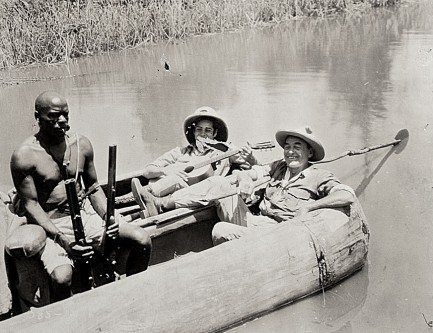 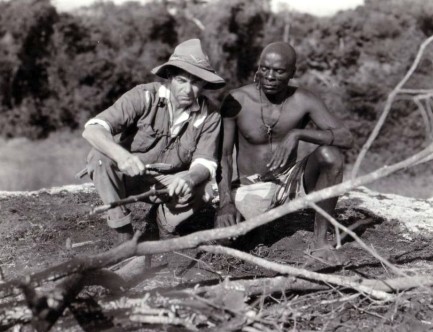 Anglo-Egyptian Sudan, and the Belgian Congo. The expenduture must have been enormous, but the money shows—vividly. You won't be surprised to learn that people died making the film—one by being consumed by a crocodile, and the other by being trampled by a rhino. There were also numerous illnesses and accidents. And... it was all worth it! Just kidding. Thoughts and prayers. Anglo-Egyptian Sudan, and the Belgian Congo. The expenduture must have been enormous, but the money shows—vividly. You won't be surprised to learn that people died making the film—one by being consumed by a crocodile, and the other by being trampled by a rhino. There were also numerous illnesses and accidents. And... it was all worth it! Just kidding. Thoughts and prayers.
We don't have to get into specifics on the movie's plot. There isn't much of one. It's more of a narrated travelogue than a linear story. Even so, it's a massive production well worth seeing. Obviously, old movies usually have their issues, none more so than old movies set in Africa. But if you go in with the right attitude they can be fun. For example, anytime a white character says something about how savage Africans are, just add to the end of the line of dialogue something like: “Says the guy from the race that invented flame throwers and the electric chair.” Also, take a drink (optional). The subsequent occasion an awful generalization is made about Africans, come up with two more horribly savage things whites invented. You'll never run out. Best pair from our screening: “Says the guy from the race that invented the Spanish Donkey and pension clawbacks.”
Look, here's the thing—it can be a good idea to keep it light when it comes to ninety-year-old movies that touch on race, sort of the way it can be a good idea to laugh it off when your grandfather tells you that during his miliary service he once went to Tokyo on shore leave and found the Japanese to be, “an inscrutable little people.” You can't change him, so you save your valuable anger for when you'll really need it, like when you go to Florida, where racism officially doesn't exist. In Trader Horn's defense, it may have been—like your grandpa—fairly liberal for the period. Kenyan castmember and Masai chieftain Mutia Omoolu gets at least a dozen lines of dialogue. We bet he didn't get paid union scale, though. Actually, the SAG didn't exist until 1933, but you get the point. Omoolu and fellow Kenyan performer Riano Tindama did, however, earn a trip to L.A. for reshoots, an event that occasioned some sensationalistic press coverage of a predictable nature.
We've wandered far afield. Let's crank this careening post back onto the main roadway and ask: Is Trader Horn a good movie? Owing to its age, we obviously wouldn't go that far. But it's a tremendous spectacle, and serious film buffs should see it. The idea that actors were out there on the veldt shooting this stuff instead of in front of a green screen emoting opposite a volleyball on a stick is amazing. But that type of unfiltered filmmaking is possibly gone for good. For one thing it costs a fortune. And generally, the arc of cultural development tends toward more safety, whether physically, mentally, professionally, or whatever. Beyond a doubt, certain things are lost along the way. Visceral cinematic realism comes to mind. But on the other hand, it's good for people not to be eaten by reptiles or contract schistosomiasis. Watch the movie and see what you think. It premiered in the U.S. today in 1931. 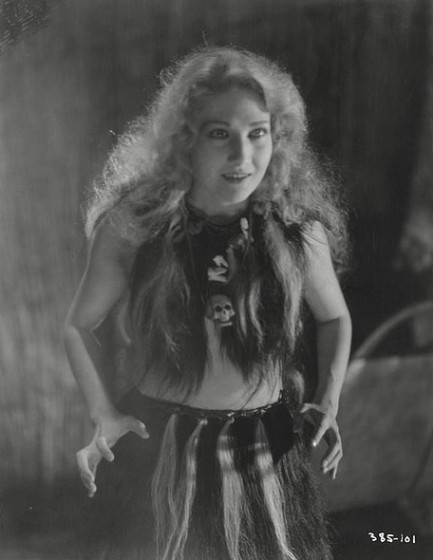 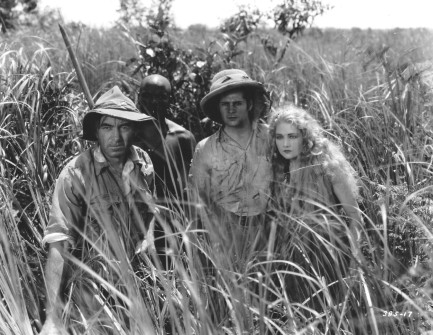 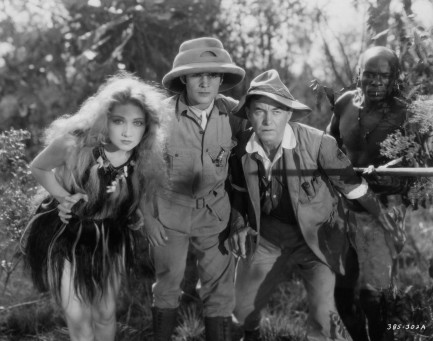 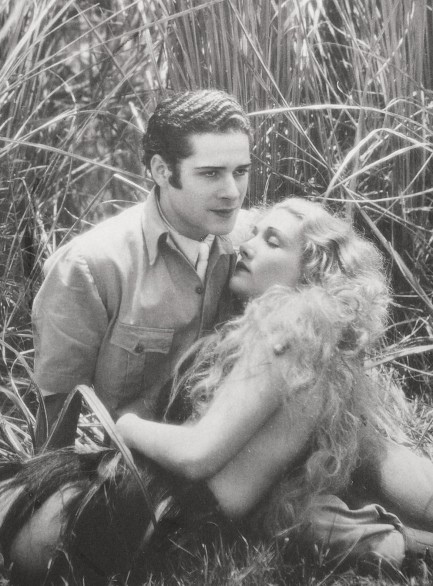 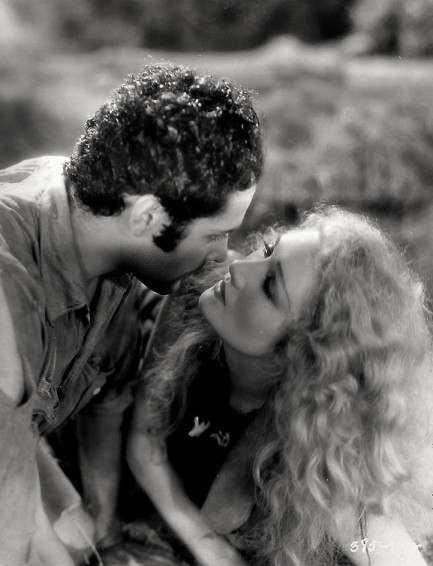 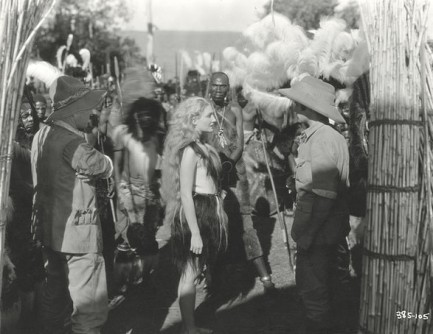 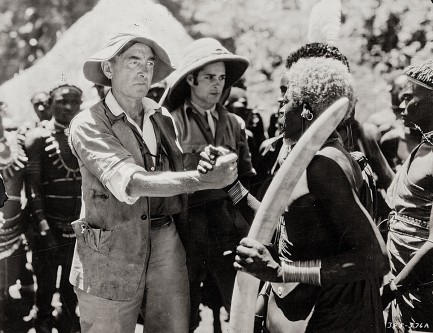 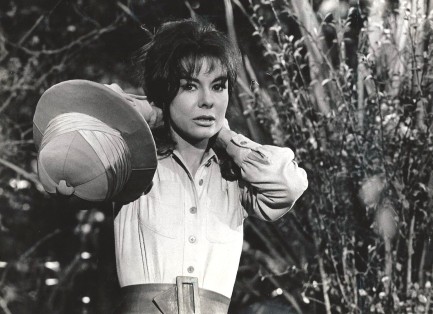 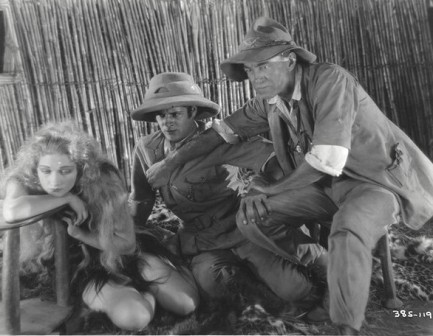 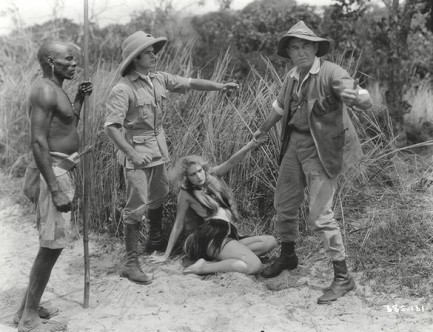 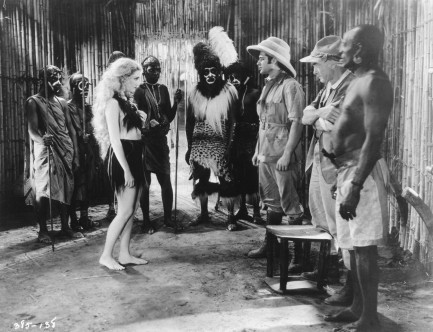 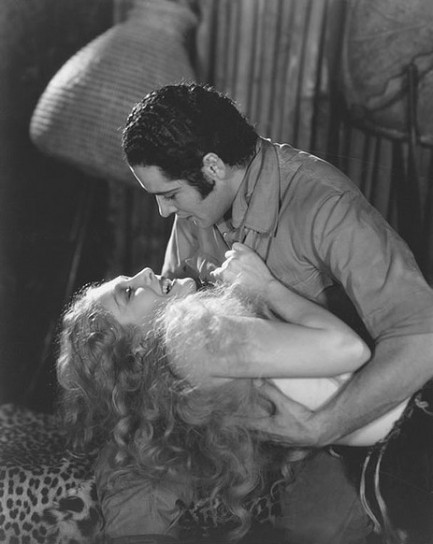 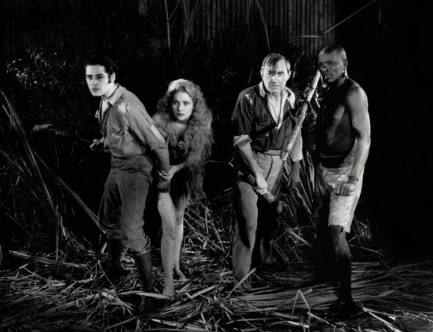 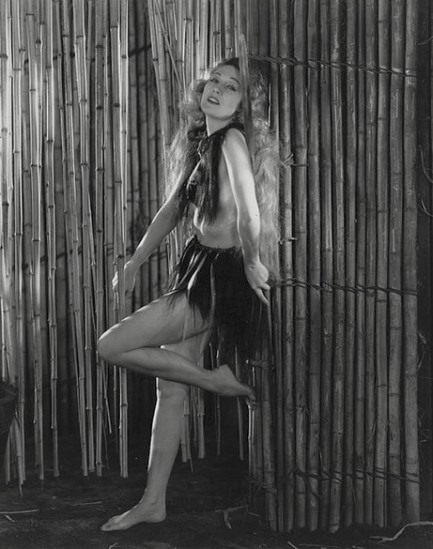 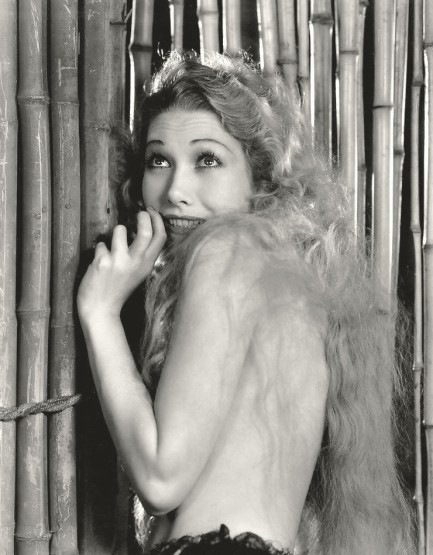 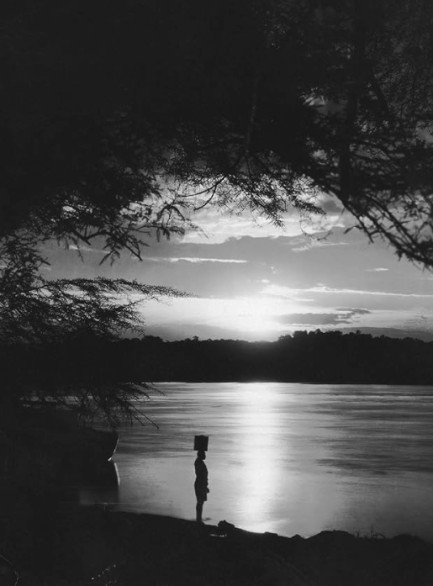
 Think your boss is bad? Then you've never dealt with a mob boss. 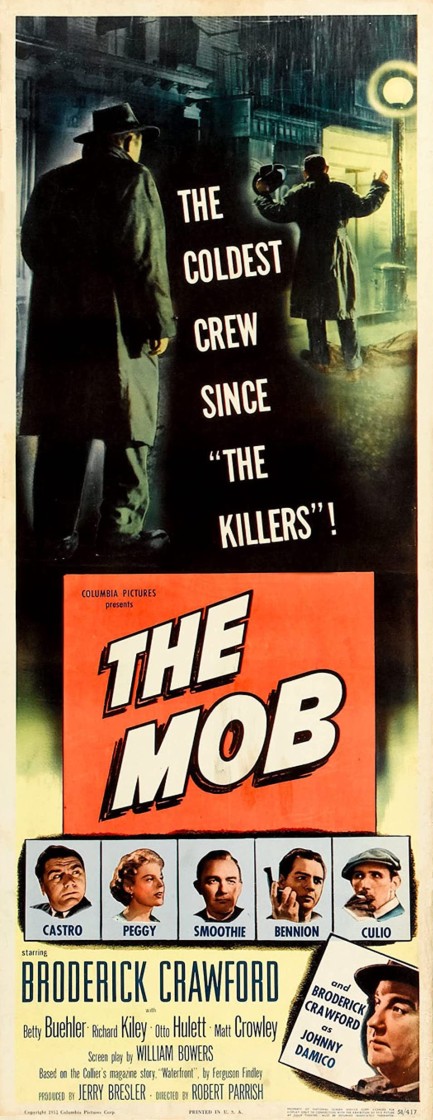
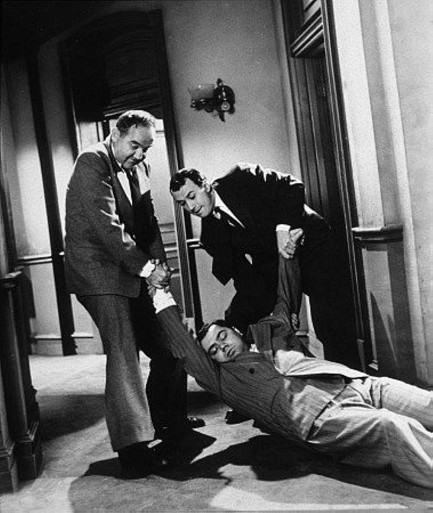
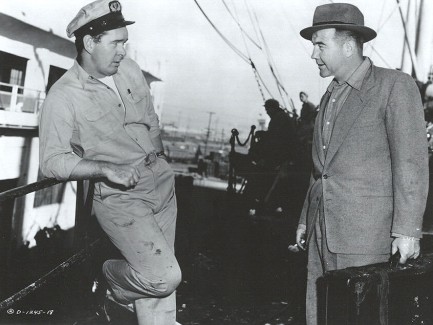
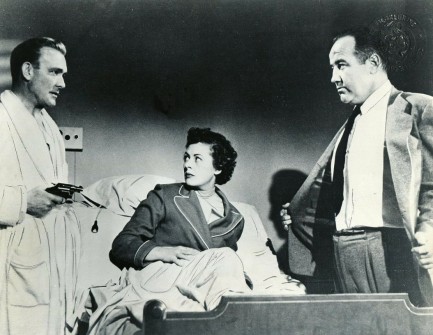
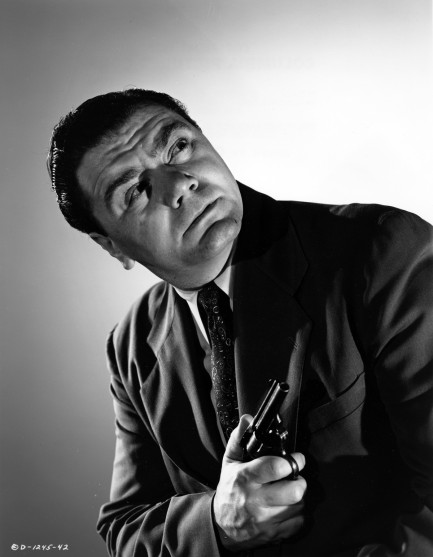
Falling into the category of pleasant surprises, The Mob, for which you see an evocative promo poster above, stars Broderick Crawford as a cop sent to infiltrate an organized crime syndicate. You've seen the idea before. He works his way up the ladder and brings the bad guys down, but this iteration comes with brisk pacing, a set of unpredictable twists, and a supporting cast that includes Ernest Borgine, Richard Kiley, and Lynn Baggett. If you keep your eyes open you might even spot Charles Bronson.
Crawford had already won an Academy Award and a Golden Globe for 1949's All the King's Men, so he unsurprisingly does a bang-up job in this film, instilling his deep cover cop with believable toughness and a gruff but relatable humanity. Crawford would later appear in such excellent films as Scandal Sheet, New York Confidential, Born Yesterday, and Human Desire, but The Mob may be his underrated classic.
The only flaw with this film, in our opinion, is a goofball denouement. We suppose, after ninety minutes of almost nonstop high tension, the filmmakers wanted audiences to leave smiling, and we're sure they did, because the scene, while dumb, is pretty funny. But in any case, we recommend giving The Mob a whirl. You'll enjoy it. It opened nationally in the U.S. in late September, but had its actual debut at special premiere today in Dayton, Ohio (why, we don't know) in 1951.
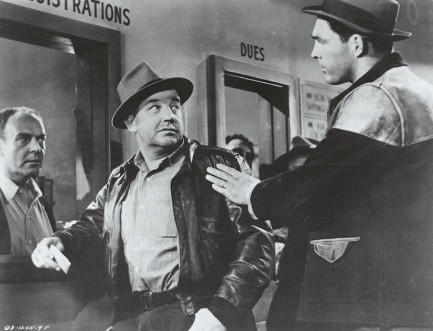 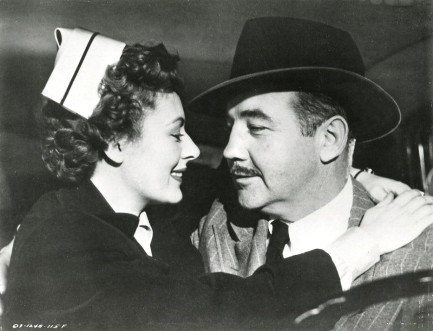 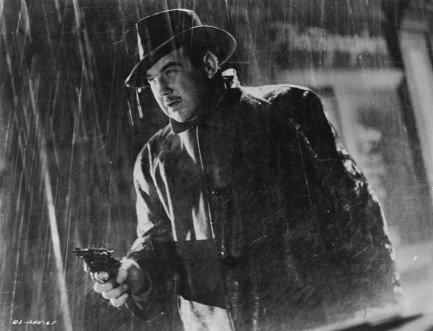     
 Taylor and Turner make an explosive pairing in hit gangster romance. 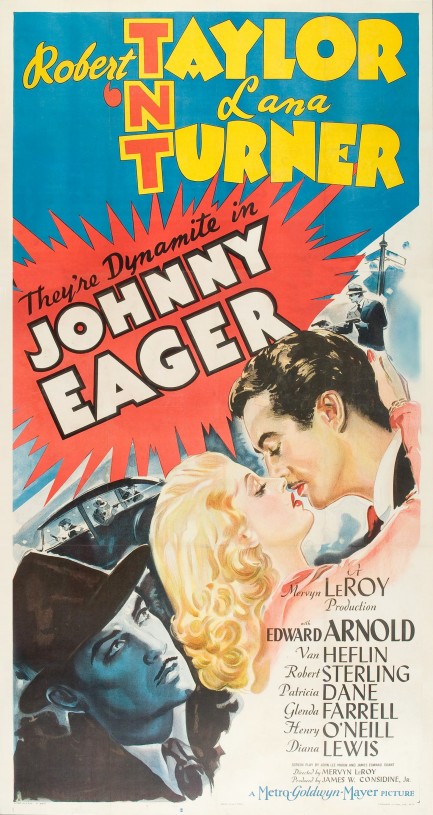
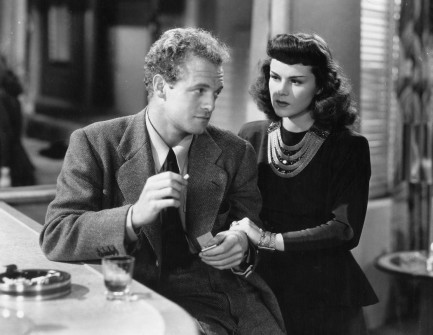
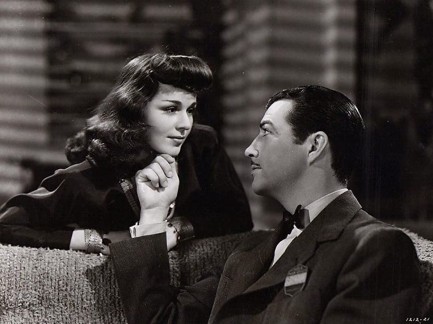
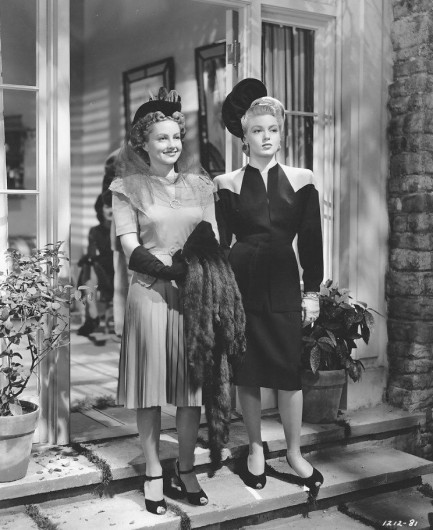
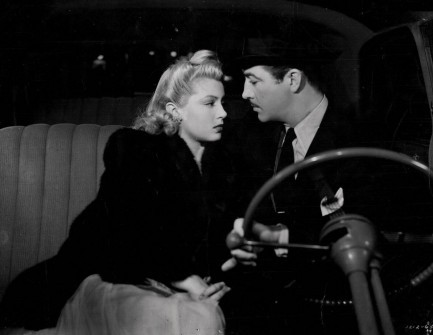
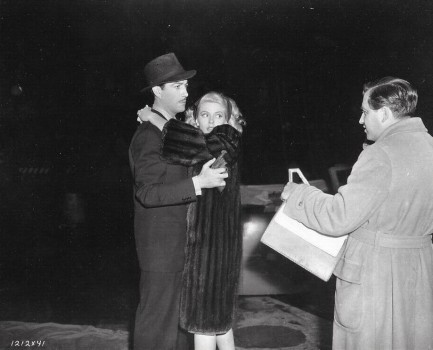
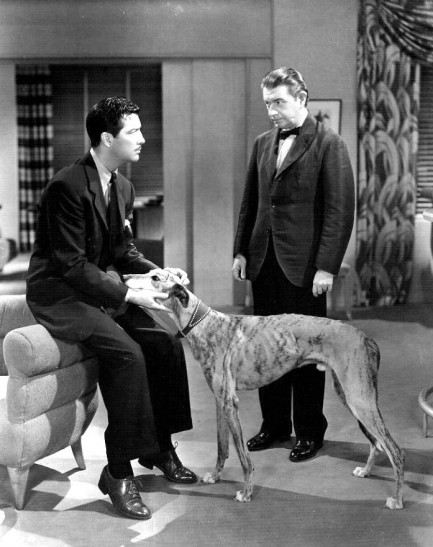
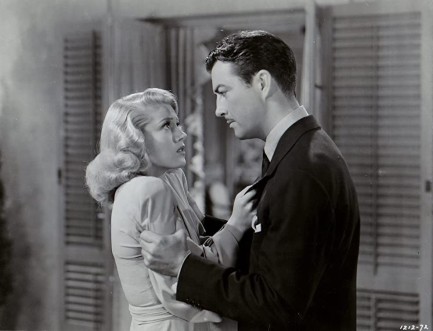
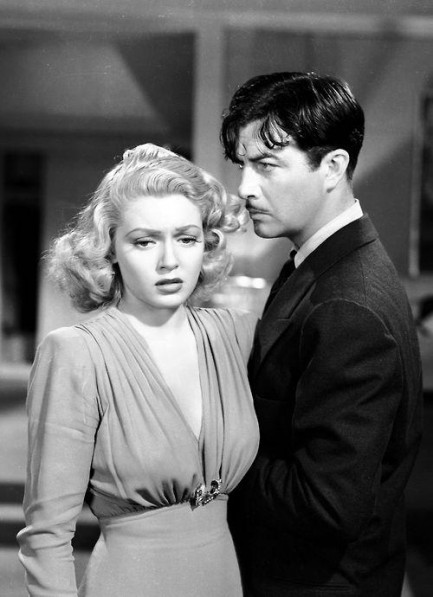
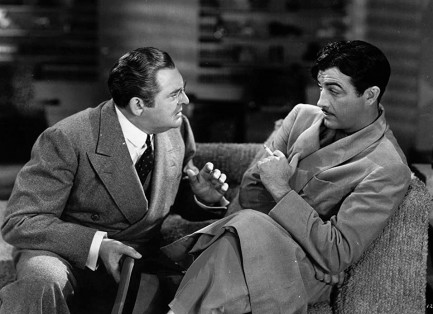
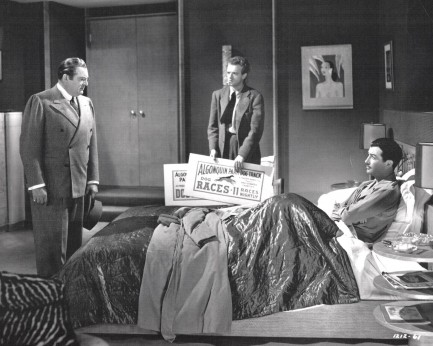
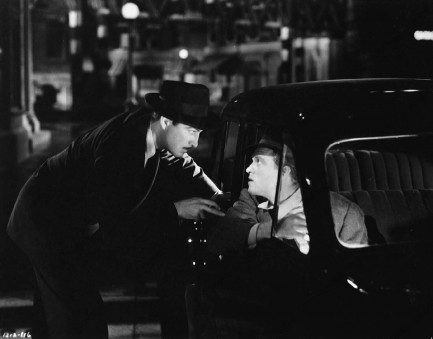
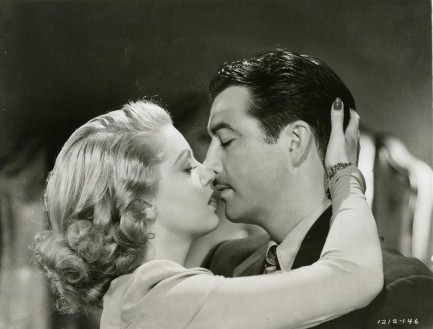
MGM produced a beautiful poster for its 1941 melodrama Johnny Eager, which you see here in all its vibrancy and clever design. Starring Robert Taylor and Lana Turner, the unknown creator or creators used the stars' names crossword style to include “TNT” into the text. MGM knew they had something special on their hands in Turner and had been trundling her out for audiences to goggle at in awe and wonder, building up her career in comedy, musicals, straight drama, a western, and even horror in 1941's Dr. Jekyll and Mr. Hyde. Now at age twenty it was time for her to co-anchor a crime melodrama.
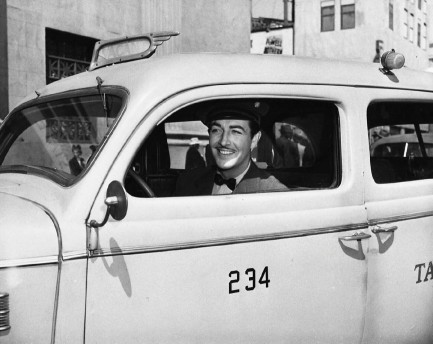
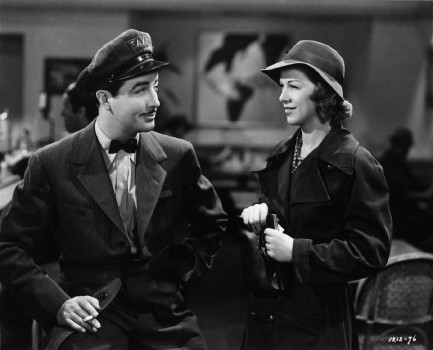
Turner is a sociology student who crosses the path of an ex-con named John Eager (Taylor) at his parole office. Turner is smitten, as well as impressed with Taylor's efforts to stay on the straight and narrow by working as a cab driver. The problem is Taylor is actually running an elaborate scam, heading a criminal enterprise in the form of a profitable gambling racket while keeping his parole officer bamboozled, and others either paid off or bedazzled into silence. Such is his charm that even the head secretary at the parole office is helping him.
Turner, as an innocent young student who isn't in on the scam, of course throws a wrench in Taylor's plans by finding out he's lying. But it turns out she's a little more worldly than she at first seemed. When she learns Taylor is still an underworld goon she's fine with it. She's just gotta have the guy. It means jilting her square boyfriend and disappointing her protective dad, plus she's warned that disaster will result, but the heart wants what it wants. Will she be corrupted? Will Taylor become so loopy that he loses control of his empire? Can true love blossom in the barren soil of the organized crime underground?
In the end Johnny Eager is a smart, well-written movie, with memorable lines aplenty and several refreshing plot surprises. Burgeoning superstar Turner does just fine in her key role, and it helps that her surrounding cast are all confident and talented. Van Heflin even won a supporting actor Academy Award for his role as a poetry spouting, alcoholic sidekick to Taylor's smooth gangster, and the accolade was well deserved. Johnny Eager is a movie every vintage film buff should add to their queue. It premiered today in 1941.
 She's always been considered a very capable woman. 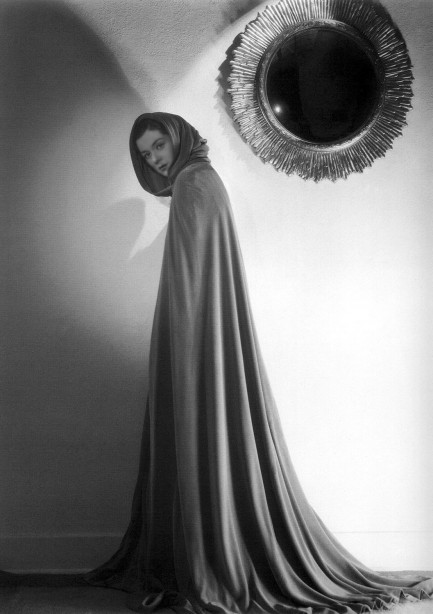
What's the difference between a cloak and a cape? Is it that capes are short and cloaks are long? Is it that cloaks always have hoods? Those distinctions don't stand in the way of companies looking to sell the things. We found many capes with hoods in online stores that were called “hooded capes,” and we found many long garments we thought would be called cloaks but which were categorized as “long capes.” Well, whatever you call it, Rosalind Russell makes good use of it in this shot made for her 1936 drama Trouble for Two.
Russell was one of the great actresses, winning, amazingly, every Golden Globe Award for which she was nominated—five. Conversely, she was nominated for four Academy Awards and got shut out. Such is life. But she received a special Oscar in 1978 for her humanitarian work. She specialized in comedies such as the 1940 smash hit His Girl Friday, but she also starred in several notable dramas. The most interesting for our purposes is probably the 1948 murder tale The Velvet Touch. We plan to check that out and report back.
 She's dressed for a funeral—yours. 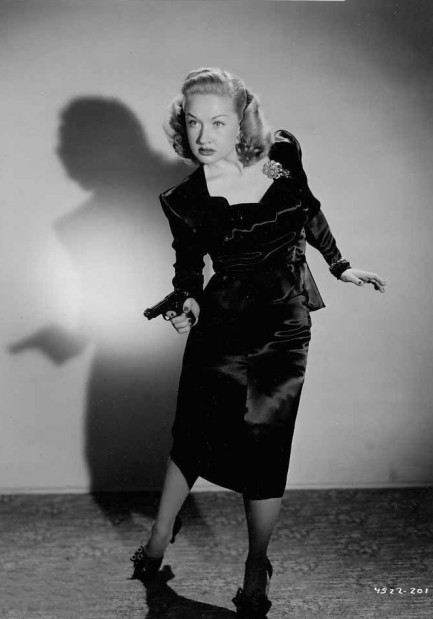
U.S. actress Bonita Granville appears to shoot from hip in this fun promo image made for her 1946 film noir Suspense, in which she starred with Barry Sullivan and Belita. In addition to the unusual pose and the shiny black dress, which we love, the lighting on this creates the illusion of the gun being fired. Granville was an acting prodigy. She began her career on stage at age three, was successful in cinema by age ten, and received an Academy Award nomination for Best Supporting Actress in 1936's These Three at age fourteen. We talked about Suspense several years ago, so if you're interested you can read about it here.
 Hepburn brings a special kind of style to Hollywood. 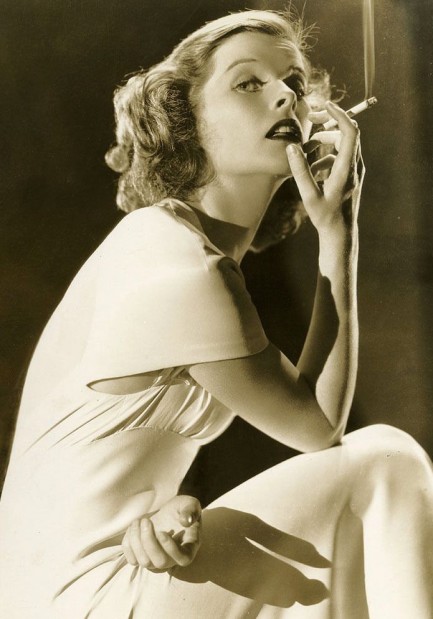
We don't smoke, but Katherine Hepburn sure makes smoking look good in this RKO promo photo shot by Ernest Bachrach in 1935. Though she had a long and storied career, this early shot is pretty much her iconic image. Prints of it are even sold on Wal-Mart's website. Hepburn is incomparable. Her must-watch films include Bringing Up Baby, Adam's Rib, The Philadelphia Story, The African Queen, Long Day's Journey into Night, The Lion in Winter, the groundbreaking Guess Who's Coming to Dinner (which inspired an excellent reggae song by Black Uhuru), and On Golden Pond. You can sum up Hepburn's output by saying she was nominated for a Best Actress Oscar twelve times and won a quartet, the most ever. The Oscar has failed to stay as relevant as it could have over recent decades, and the Academy has made some embarrassing Best Picture choices (Forrest Gump over Pulp Fiction—really?), but it's always been a reliable measure of acting quality, so Hepburn's four wins are meaningful. The one thing she didn't do was make a lot of pulp style movies. One that looks as if it qualifies is the 1946 drama Undercurrent. We'll circle back to that and the divine Miss H. in a bit.
 Subway commuters now running to work after latest round of NYC budget cuts eliminates trains. 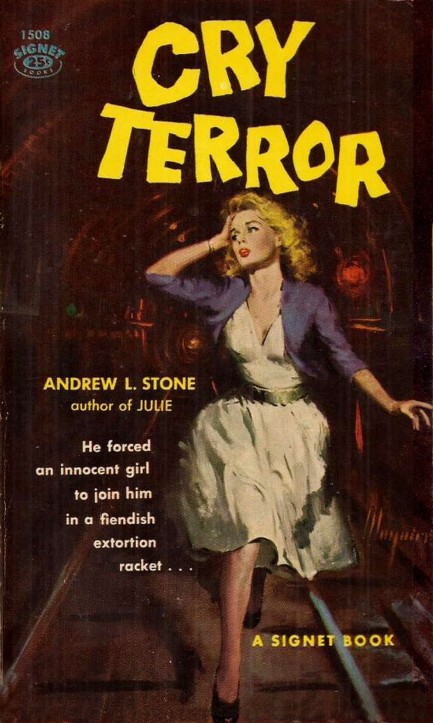
Andrew L. Stone may be unique in the realm of vintage literature. His 1958 thriller Cry Terror is a novelization of the film of the same name, which he wrote, directed, and co-produced. Cry Terror wasn't the first time Stone wore multiple hats. Two years earlier he had written and directed the thriller Julie, and written the novelization too. The screenplay earned him an Academy Award nomination. He racked up thirty-seven directorial credits during his career, and among his output was Stormy Weather, The Hard-Boiled Canary, Highway 301, Confidence Girl, and A Blueprint for Murder. He ended up with a star on the Hollywood Walk of Fame.
Another reason we wanted to highlight Cry Terror today is because of the excellent cover art by Robert Maguire. It was modeled after a promo shot from the film of lead actress Inger Stevens. You see that below. We were thinking about buying the book, but digging up all this info has revealed the entire plot to us, so we won't bother. Also, the copies that are currently out there are going for fifty dollars and up. As we mentioned before, we don't go that high for anything we'd be tempted to swat flies with. Plus we have a ton of books piled up. We may watch the movie, though. Less time, less expense. If we do we'll report back.
 It took nature millions of years to evolve the bikini body. And a costume designer one movie to exploit it. 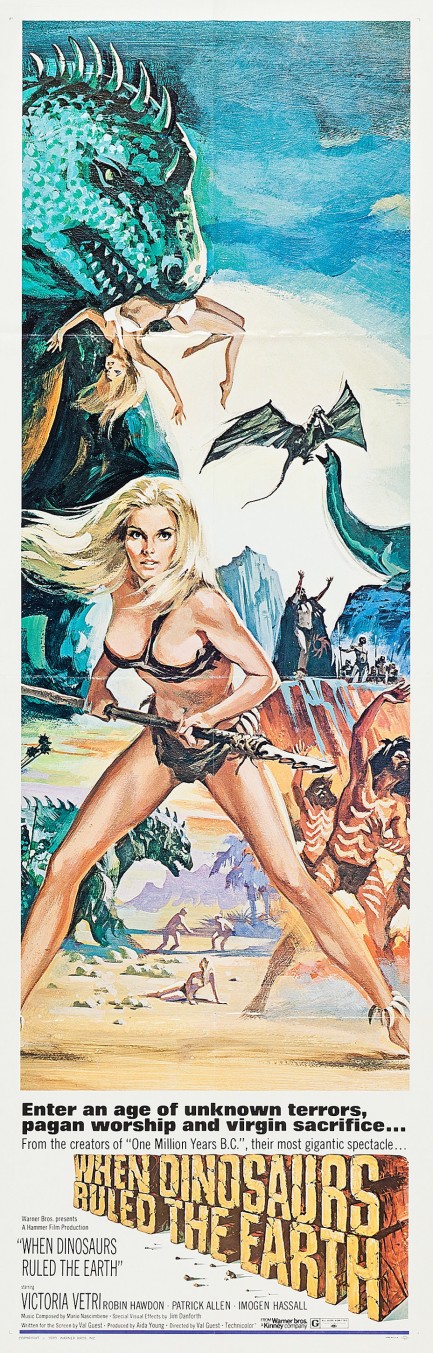
When Dinosaurs Ruled the Earth was part of a short trend of ’60s/’70s films that defied science and showed dinosaurs and humans living together. In this case, one of the humans was beautiful star Victoria Vetri, aka Angela Dorian. The movie would be perfect entertainment for creationists, except it's also procreationist—i.e. there's nudity and sex in it. The very religious may not like cinematic skin, but in our book the movie is a natural selection for an evening's entertainment. This promo poster is similar to the Japanese promo we showed you several years ago, but even rarer. In addition all three female co-stars—Vetri, Imogen Hassall, and Magda Konopka—get life-sized promo posters, seen below. These items are real gems.
Here's a bit of trivia. Efx duo Jim Danforth and Roger Dicken earned an Academy Award nomination for Best Achievement in Special Visual Effects, and we don't mean for the fur bikinis. We know—it's hard to believe the movie won anything except the eternal disdain of evolutionary scientists, but it was a box office hit partly thanks to Danforth and Dicken's miniature stop action work. We guess Vetri and company had a little something to do with it too. Check the movie out sometime. It's fun, whether your preference in partly clothed actors runs to male, female, or both. After opening in England in 1970, When Dinosaurs Ruled the Earth premiered in the U.S. today in 1971. You can read more about it here and here. 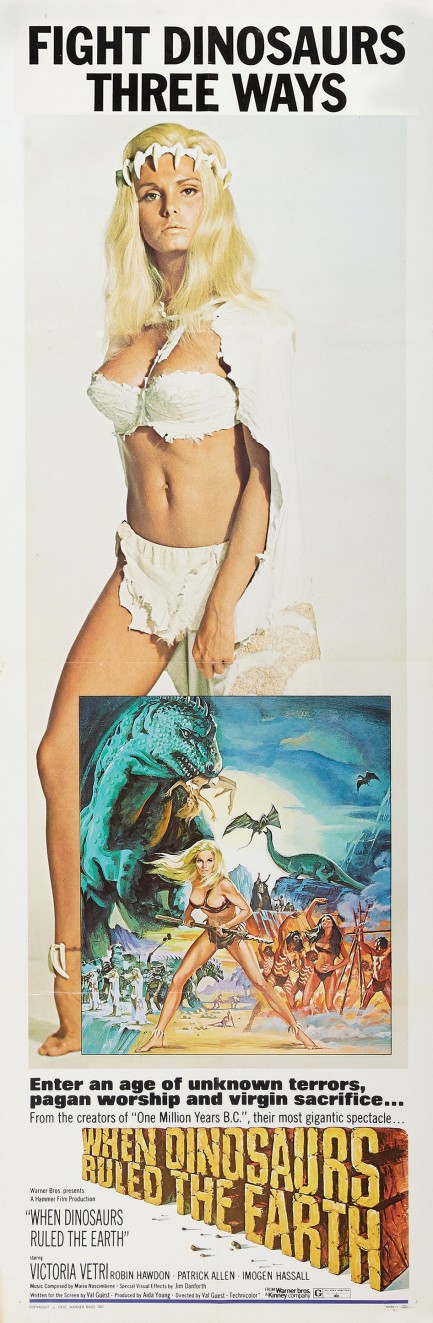 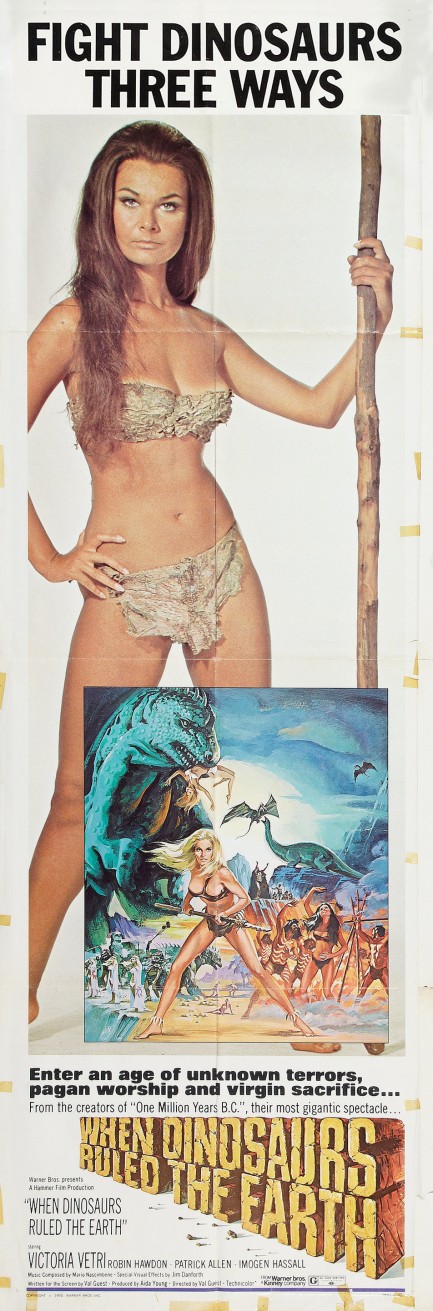 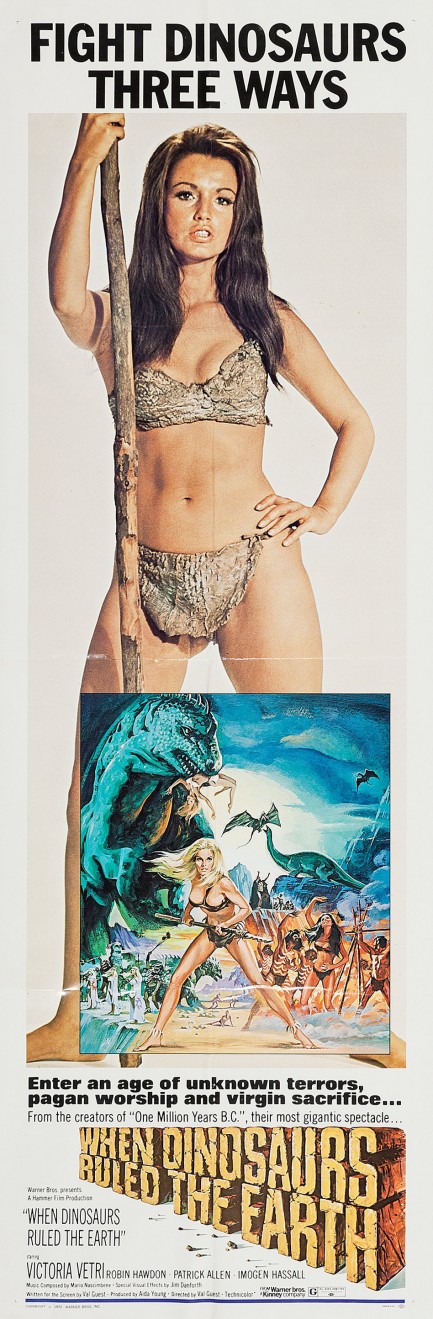
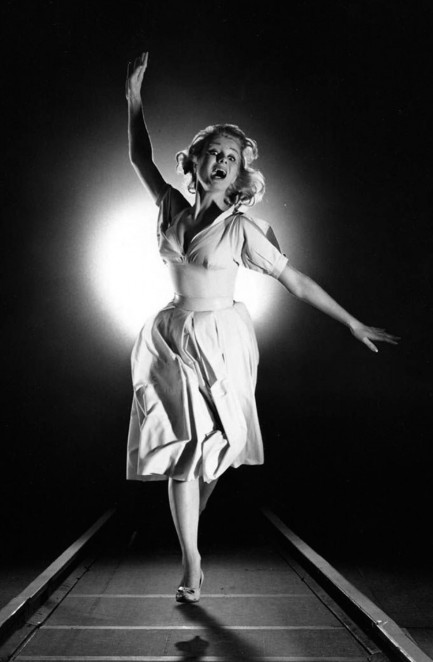
 Compson curls up with some good music. 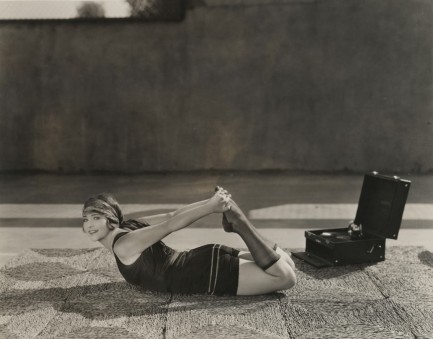 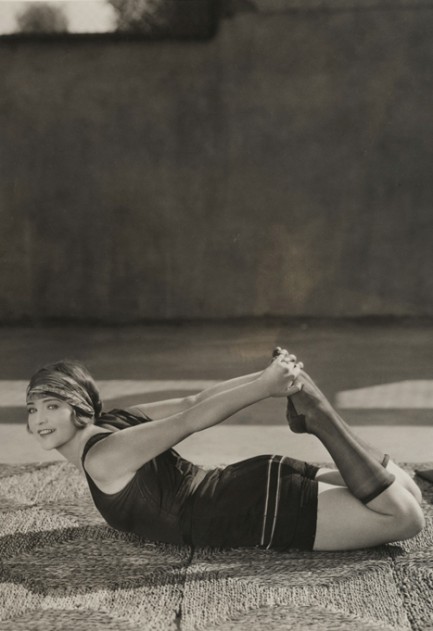
U.S. actress Betty Compson pulls off an uncomfortable looking pose and does it with a winning smile in this Paramount Pictures promo photo from sometime in the 1920s. This is a standard yoga position called Dhanurasana, or the bow, though we doubt yoga was known at all in the U.S. during the ’20s. Instead the text on the rear of the photo describes what Compson is doing this way:
How To Keep Fit. Leg, arm, back and shoulder muscles are developed by this exercise, as demonstrated by Betty Compson. Lie flat on the floor out-stretched. Simultaneously bend the knees and fling the hands back until they can grip the feet. This exercise is more beneficial—likewise more difficult—if executed slowly.
To which we say, no damn way we're trying that.
Anyway, Compson was a major star, appearing in more than one hundred films and shorts, both silent and with sound, between 1914 and 1948. Her highlight was 1928's The Barker, which earned her an Academy Award nomination for Best Actress. We're giving her an award for this nice promo shot. We'll never do the exercise, but we love the image.
 Unknown photo retoucher increases the value of Sterling. 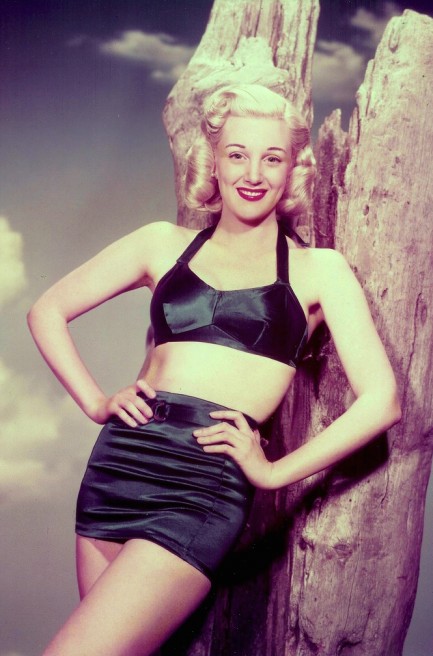
We've seen this photo of U.S. actress Jan Sterling numerous times, but never in color, which leads us to believe it's a colorization. If so, it's a nice, subtle job, as well as a clever choice of model, since Sterling was the subject of one of the iconic black and white photos of the mid-century period. Know the one we mean? Look here. Despite the fame of that particular shot, Sterling was never what you'd call a top tier star. But she appeared in many films, earned a Golden Globe Award as a supporting actress, and was nominated for a supporting actress Oscar. We'll be getting back to her film work a bit later.

|
 |

The headlines that mattered yesteryear.
1945—Mussolini Is Arrested
Italian dictator Benito Mussolini, his mistress Clara Petacci, and fifteen supporters are arrested by Italian partisans in Dongo, Italy while attempting to escape the region in the wake of the collapse of Mussolini's fascist government. The next day, Mussolini and his mistress are both executed, along with most of the members of their group. Their bodies are then trucked to Milan where they are hung upside down on meathooks from the roof of a gas station, then spat upon and stoned until they are unrecognizable. 1933—The Gestapo Is Formed
The Geheime Staatspolizei, aka Gestapo, the official secret police force of Nazi Germany, is established. It begins under the administration of SS leader Heinrich Himmler in his position as Chief of German Police, but by 1939 is administered by the Reichssicherheitshauptamt, or Reich Main Security Office, and is a feared entity in every corner of Germany and beyond. 1937—Guernica Is Bombed
In Spain during the Spanish Civil War, the Basque town of Guernica is bombed by the German Luftwaffe, resulting in widespread destruction and casualties. The Basque government reports 1,654 people killed, while later research suggests far fewer deaths, but regardless, Guernica is viewed as an example of terror bombing and other countries learn that Nazi Germany is committed to that tactic. The bombing also becomes inspiration for Pablo Picasso, resulting in a protest painting that is not only his most famous work, but one the most important pieces of art ever produced. 1939—Batman Debuts
In Detective Comics #27, DC Comics publishes its second major superhero, Batman, who becomes one of the most popular comic book characters of all time, and then a popular camp television series starring Adam West, and lastly a multi-million dollar movie franchise starring Michael Keaton, then George Clooney, and finally Christian Bale. 1953—Crick and Watson Publish DNA Results
British scientists James D Watson and Francis Crick publish an article detailing their discovery of the existence and structure of deoxyribonucleic acid, or DNA, in Nature magazine. Their findings answer one of the oldest and most fundamental questions of biology, that of how living things reproduce themselves.
|

|
|
It's easy. We have an uploader that makes it a snap. Use it to submit your art, text, header, and subhead. Your post can be funny, serious, or anything in between, as long as it's vintage pulp. You'll get a byline and experience the fleeting pride of free authorship. We'll edit your post for typos, but the rest is up to you. Click here to give us your best shot.
|
|