Wheeeee! Nothing compares to a butt-naked bareback ride on the beach! Not sex! Not money! Not anything! 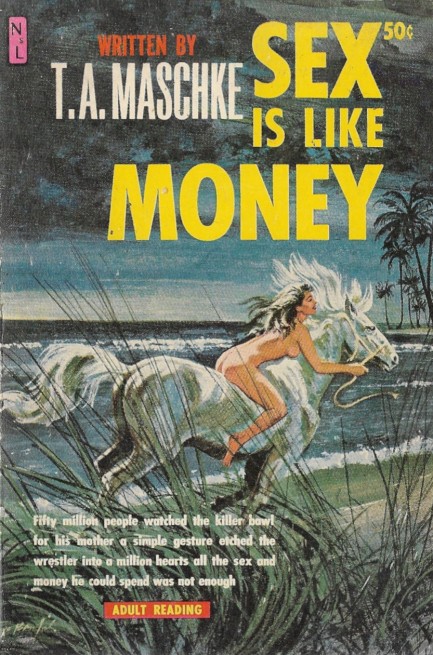
Robert Bonfils did well with this wild cover for T.A. Maschke's 1961 sleazer Sex Is Like Money. His art convinced us to give the book a shot (literaure buffs may notice, by the way, that this title predates John Updike's famous quip from his 1968 book Couples). Maschke tells the story of a Chicago cab driver and former pro wrestler named Mike Turner, who's asked by a mystery woman named Della to swim eight-hundred yards into Lake Michigan and back to retrieve a briefcase of dirty financial records she intends to toss off a yacht and give to tax authorities. Turner wants to get laid, so he goes along with the plan, manages to return to shore with the briefcase, but soon learns that it contains not documents but a million dollars. Oops—duped!
The money belongs to Chi-Town crime kingpin Killer Canasta, and obviously he'll be furious—the guy is known as Killer, after all—so Della plans to flee to South America. She's willing to take Turner along, but he drags his feet, arguing instead that they should give the money to the feds and collect a reward. Dumb, right? Turner then discovers Della has an identical twin sister named Ella and things get weird. The tale eventually ends with a televised wrestling match in Soldier Field between Turner and Canasta. How does Maschke manage to bend the narrative toward that bizarre conclusion? It doesn't matter, because under no circumstances should you read Sex Is Like Money. And you always take our advice, right? Trust us this time—it's terrible. And on we go to the next...
 Possession is nine-tenths of breaking the law. 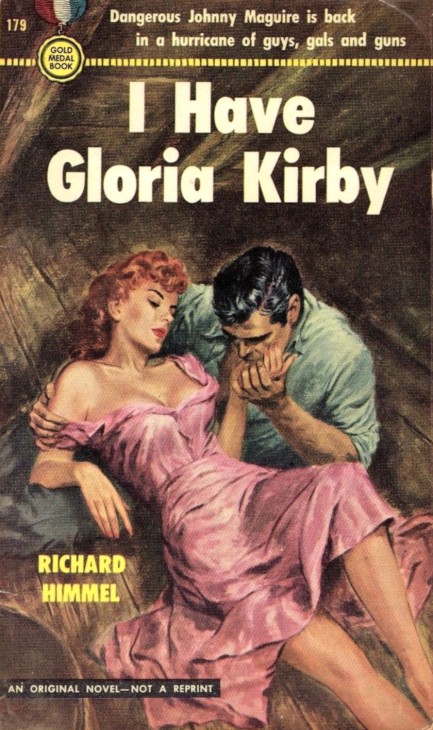
We're back to Richard Himmel today and his franchise character, Chicago tough guy lawyer Johnny Maguire. I Have Gloria Kirby came third in the Maguire series, first appearing as this Gold Medal original edition with uncredited cover art in 1951. As we mentioned before, Maguire is a lawyer, but Himmel basically treats him as a detective, and his narrative follows all the expected forms of private dick novels.
As with the earlier books, there are some good moments here. There's an excellent scene that comes after Maguire and his occasional love Tina, who works in a stenographer's office in Maguire's building, have just narrowly escaped a brutal maiming. Maguire has finished explaining to the confused and terrified Tina why everything has been happening, including why he made her burn a mink coat in the building incinerator a couple of days earlier. It's all about seventy thousand missing dollars:
“Do you know where it is, Johnny?”
“Sure. Sure, I know where it is.”
“Where?”
I dropped my gun on the desk. “You've got it.”
“What did you say?”
“I said you've got it. It's in your office. I put it there myself.”
Tina passed out. She went limp and collapsed to the floor. I let her lie there. She needed the rest. I went into my bottom drawer for the bottle. That bottle had been getting a hell of a workout. Out in the hall I rang for the elevator.
[snip]
When I went back in my office, Tina was sitting up on the floor drinking out of the bottle. “For people that burn mink coats and have seventy thousand dollars lying around, we sure drink cheap liquor,” she said.
That's pretty good. The book isn't at that level all the way through, but it's well written and keeps the tension cranked to high. The final showdown between Maguire and his organized crime nemesis is highly unlikely, but not to the extent that it ruins the tale. As mid-century detective—er, lawyer—novels go, we think I have Gloria Kirby is in the upper half of the distribution.
 Chinese communists try to whip Americans in the nuclear race. 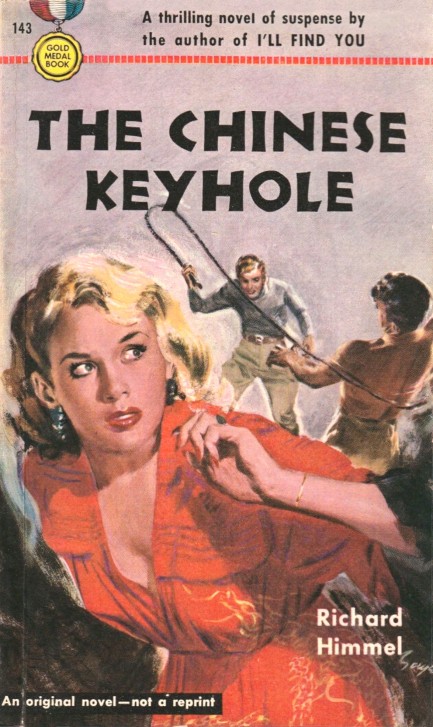
The Chinese Keyhole, Richard Himmel's second novel starring his creation Johnny Maguire, finds the ass kicking lawyer immersed in intrigue in Chicago's Chinatown district, where a mission to deliver a coded message reveals a conspiracy centered in a strip bar. Turns out communists, including a whip wielding psycho, are trying to steal nuclear secrets. Maguire is no longer just a lawyer, but a government agent with his law practice as a front. We don't remember that from the first book, but maybe we missed it.
As in the debut outing Maguire is a guy who takes what he wants, never really asking permission before laying his lips on a nearby woman, and always, of course, he's correct in his assumption that he's sexually desired. Faithful Tina from book one returns to be shabbily treated again, and as before the romantic subplots blossom into full-blown melodrama that would fit perfectly in a Harlequin novel.
We probably don't need to mention that any mid-century book with Asian characters is going to cross some lines, and Maguire doesn't defy expectations on that front, nor does he miss an opportunity to disparage homosexuality. If you haven't read many of these old thrillers you might think that was the norm, but actually it's rare because gay characters don't figure in most of the books. When they did, well, the language got baroque, to say the least. Culturally we've arrived at a better—though still imperfect—place in time.
Flaws aside, we thought The Chinese Keyhole was better written than Himmel's first Maguire novel I'll Find You. Even with this mostly hackneyed commie conspiracy potboiler, he's intrigued us enough to take another ride with his interesting lawyer/lothario/secret agent, so we'll read the third book I Have Gloria Kirby and see where that leaves us. The art on this Gold Medal edition is by Barye Phillips and it dates from 1951.
 1976 was a year that held a lot of promise. 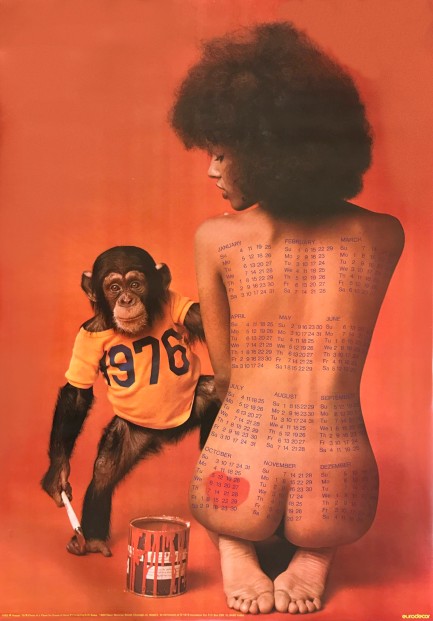
Above is an eye-catching 1976 headshop poster from a Chicago based company called House of Ideas featuring a rearview nude and—bizarrely—a chimp. The image is probably a composite, because while we can maybe imagine a tame chimp in a studio providing a suitable pose—eventually, after banana and mango enticements—we can't imagine a photographer being irresponsible enough to give a creature with outsize strength a pointed implement near a defenseless model. In the emergency room: “Everything seemed fine, then an intern dropped a glass, the noise freaked Bobo, and he shoved a paintbrush clean through her liver.”
Looking more closely at the image, which we did once we were able to focus past the major elements, at lower left is a photographer's credit—H.J. Peyer. Naturally we looked him up and it turns out he, or possibly she, had a cottage industry in headshop posters, though they weren't all this good. He or she did at least a couple of posters of guys flushed halfway down toilets, with the captions, “Problems?” and “Goodbye Cruel World.” We also found one of a chimp—possibly the same chimp—sitting on a toilet. Did we refer to Peyer as, “or possibly she”? When toilets are involved you can be sure a man was the brain behind it. The nudes are definitely more pleasing.
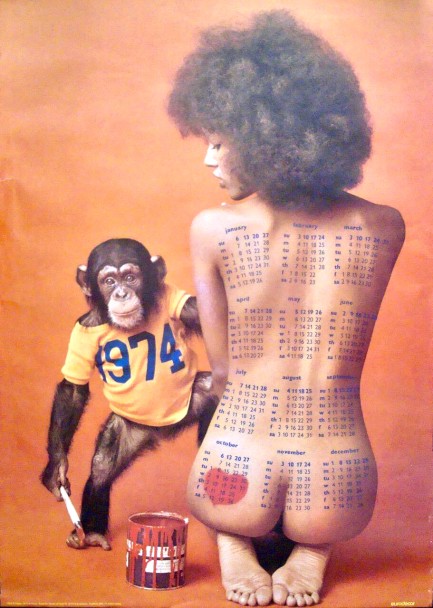 The poster also carries the emblem at bottom right of a company called Eurodecor. Here's why there are two credited entities, we think. Peyer and House of Ideas, who were probably one and the same, produced the original image, then sold the reproduction rights to Eurodecor, which re-released the poster as a calendar in subsequent years as it saw fit. As evidence we have a second image here, which is the same poster but with the year on the chimp's shirt changed and a new calendar on the model's back. The poster also carries the emblem at bottom right of a company called Eurodecor. Here's why there are two credited entities, we think. Peyer and House of Ideas, who were probably one and the same, produced the original image, then sold the reproduction rights to Eurodecor, which re-released the poster as a calendar in subsequent years as it saw fit. As evidence we have a second image here, which is the same poster but with the year on the chimp's shirt changed and a new calendar on the model's back.
Eurodecor wasn't just a fancy name. The company was indeed based in Europe—in Vaduz, Liechtenstein, actually. Why there? No taxes. The language in that alpine enclave is German, and that may explain the typo on the 1976 poster where the month of December reads, “Dezember.” But who has time for proofing when there's so much untaxed profit to spend? Anyway, with its great original photo, unusual concept, dead-eyed chimp, and revealing typo, this poster is a nice historical oddity. The only shame is that the beautiful model is uncredited. But they never were. 
 He kills completely without reservation. 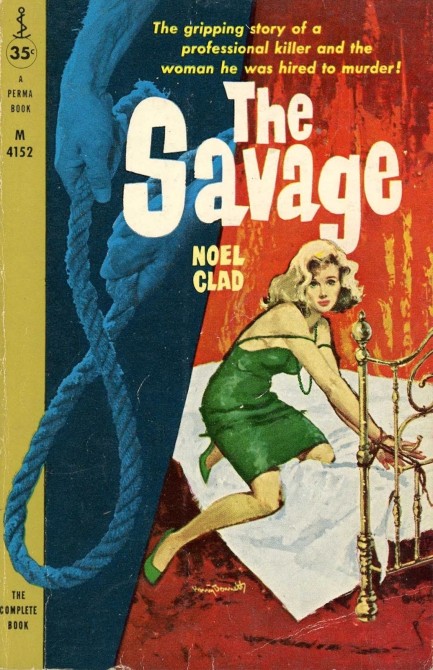
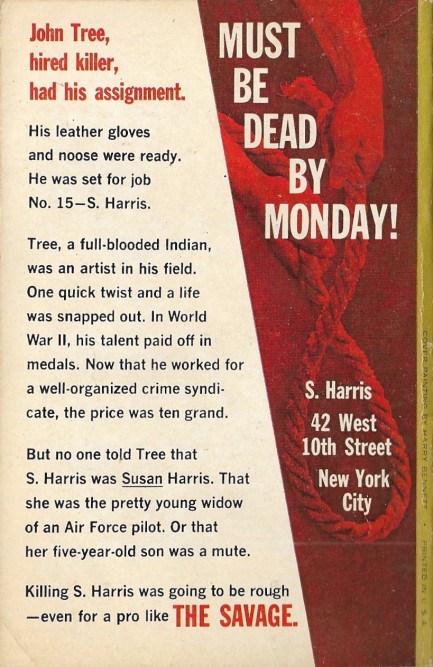
Noel Clad was a promising writer who died in a plane crash when he was thirty-seven. His novel The Savage shows some of that promise. It's about a professional killer named John Tree who's been summoned from his Wyoming ranch by the Chicago syndicate to go to New York City and dispose of an S. Harris. Like many fictional killers Tree has a code: he doesn't kill women. When he arrives in New York he learns that S. Harris is Susan Harris, which dismays him. Then the person who's bought the contract and is calling the shots tells Tree to rape Susan before killing her. Next he finds out she's a single mother with a mute five year-old son. None of it sits well with Tree, but it doesn't cause him to flip sides. He just wants out. He asks to be replaced on the job and be done with the situation. Out of sight, out of mind. His employers agree and send two replacement hired guns to do the job. Tree meets with them and realizes they have no ethics—they will rape their target, and they'll murder her son too.
There are hundreds if not thousands of regular mob hitmen in literature and cinema, so why not do something different? It shouldn't be a controversial idea, but sadly, so many these days consider it to be an assault on territory they own somehow. But diversification isn't a new thing. Clever writers have been doing it all along. Clad does it in The Savage. The killer for hire, the anti-hero John Tree, is full name John Running Tree, member of the Shoshone tribe, Native American by both blood and culture. That simple change takes the book in a different direction than other hitman tales. Here we have a killer who hates to think about his impoverished youth on a reservation, who glorifies Native American tests of manhood, and who sees a stripper wearing a tribal headdress as a prop and is angered. You get interesting passages like this:
Being here made him think of religion and how little he knew and the things that had passed for it when he was little: the spirits and the half-reverent amulets and charms. He remembered as he had not for years the lupine tea they drank for Manhood, remembered the girls on the Station eating mushrooms to see if my true love lies, and his own watching of wood smoke that twisted north when the hunting would be good. Even Tall Kite had no longer really believed in the thousand tribal spirits of the upland and the plain, the grass, the insects, the deer and the hawk. And God, in the Bureau of Indian Affairs, was no more than the price of chocolate milk. But in this hall, he had a pleasant feeling, relaxed, as though he was on a mountain all by himself.
1958 this was written, with loads of identity angst, as if it were published yesterday. John Running Tree moves like a folkloric wraith through New York City and tries to prevent Susan's defilement and death. The transgressiveness of the rape angle surprised us, as did the plot point that Tree kills by wire garrotte (not rope, as shown on the cover), but those added to the stakes of a harrowing and austere tale. Are there negatives? A few. Clad loses his tight control over the narrative from the moment Susan realizes—as she must—that Tree isn't just a nice guy hanging about for fun. Clad later forces the usage of Shoshone pictograms into a scene where the child mutely communicates an important clue. It might have worked under the right conditions, but in this case defied credulity. Other authorial errors accrue. Even so, good book. We'd read Clad again.
 It's you and me, baby, ’til death do us part. What's your name again? 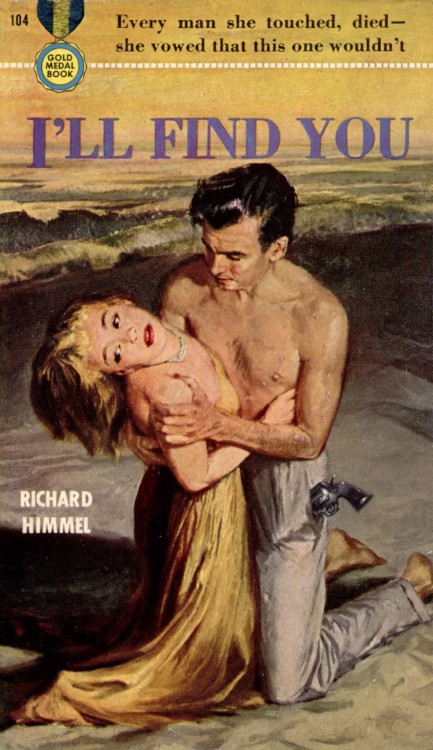
Here's a quick quiz for you. Is the following passage from a crime novel or a romance? There was one truth between us, one truth that would never be untrue. Whatever this animal thing inside me was, there was something inside her that was a mate for it. I felt that nothing could ever change that. It had to be brought alive again. It had to live and burn its own fire and be electric with its own voltage.
Those lines are from Richard Himmel's 1950 thriller I'll Find You, aka It's Murder, Maguire, first in a series of books starring mobbed up Chicago lawyer Johnny Maguire. The passage illustrates something we've noted before—that crime novels and romance novels sometimes intersect. Fictional tough guys occasionally fall head over heels in love, and when they do, the prose describing that love—in some author's hands—can be as overwrought as what you'd find in any romance novel.
In this story, Maguire, who must be one of the dumbest smart characters in crime fiction, falls for a deceased friend's wife who later fakes her own suicide. While the police believe she's dead, he never buys it, and risks his career and safety to locate her. He finds her living under a new identity and refuses to let her get away from him again—which is exactly as stalkerish as it sounds, considering he barely knew her before she vanished. She eventually submits to his overbearing attentions, but sadly, malign actors may ruin their love story.
It's surprising to us that there was a sequel, but Himmel's crime-romance must have struck a nerve with the reading public. It didn't strike one with us, but we didn't dislike it. We felt that it was eye-rollingly saccharine, and we found Himmel's dialogue a bit stilted. On the plus side, Maguire is funny at times, and his friend-with-benefits relationship with a supporting character named Tina has the potential to be engaging, assuming she hangs around. We'll see what develops in book two.
 My examination indicates that you're remarkably healthy. If only my marriage were in the shape you're in. 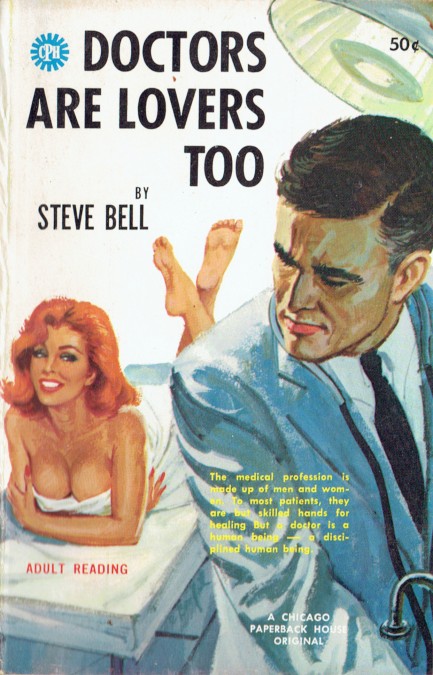
Above: another piece of medical sleaze, Steve Bell's Doctors Are Lovers Too, for Chicago Paperback House, 1962. Bell is also credited with Venus of Lesbos, Swap Road, and a few other books, but we suspect a pseudonym. The cover art on this is by an unknown.
 Obscure men's magazine roars but has no bite 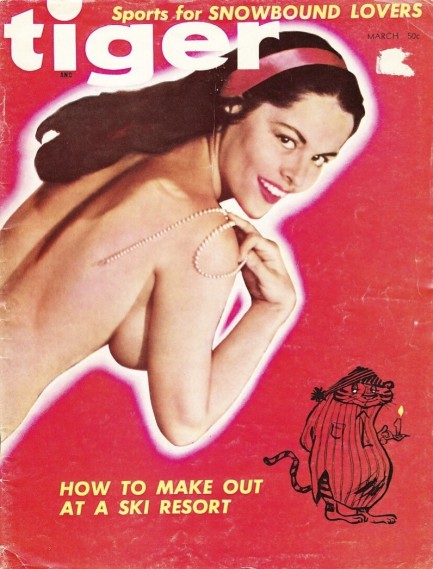
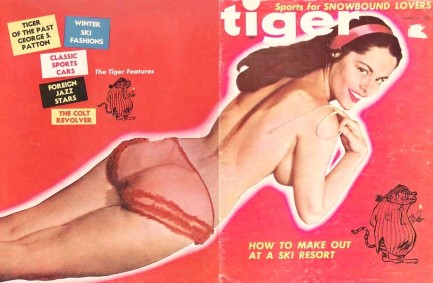
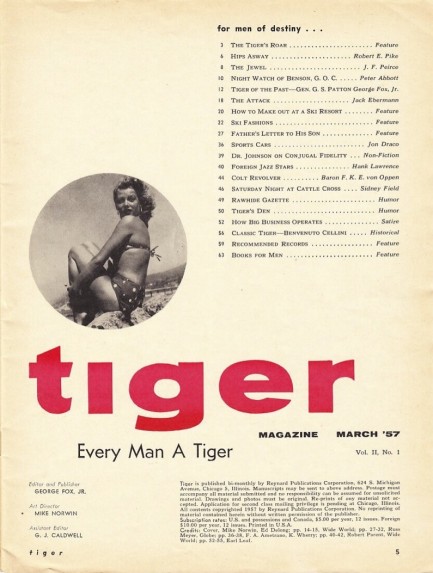
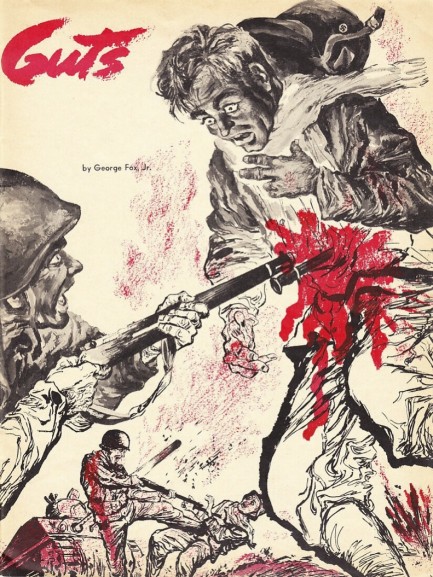
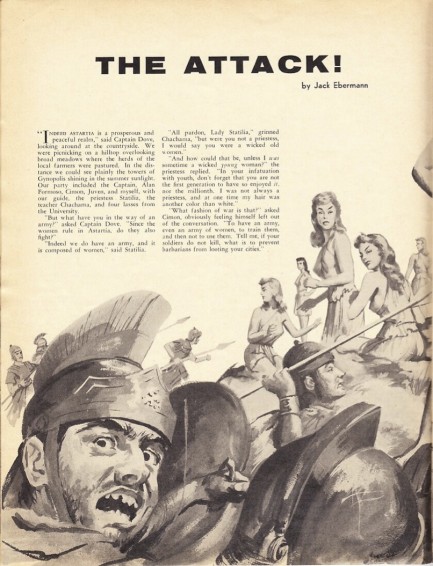
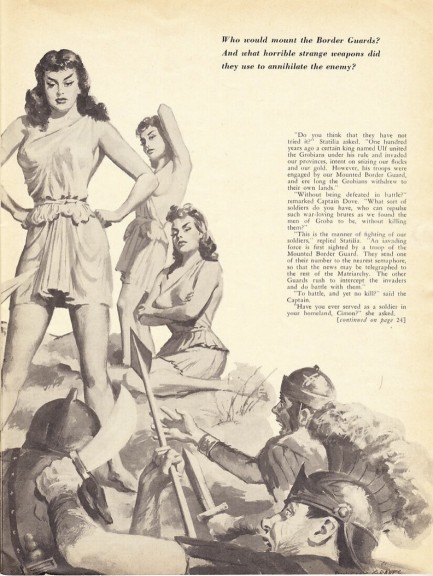
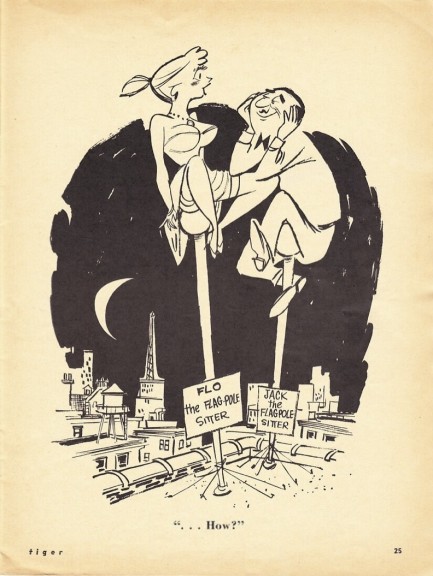
Tiger was a Chicago based men's magazine launched in 1956 by George Fox, Jr. that had as its premise the dubious idea that great men are tigers. It had features on “tigers of the past,” and “modern tigers,” and we suppose this was Fox's attempt at clever branding. Sounds a bit forced, right? It didn't seem to work for the public, because though Wikipedia claims that the publication lasted into the mid-sixties, we found no evidence anywhere that it lived past 1957. But we'll keep an eye out and see if we're wrong about that.
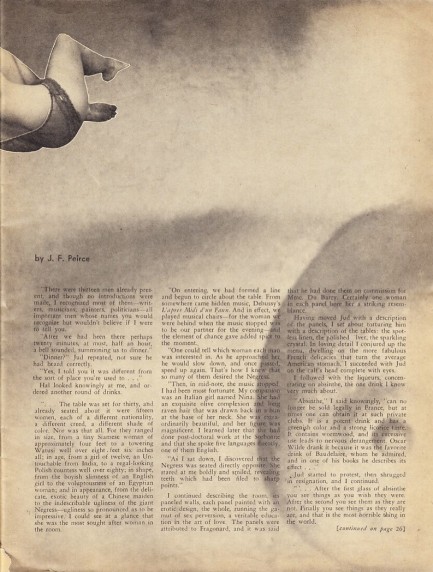
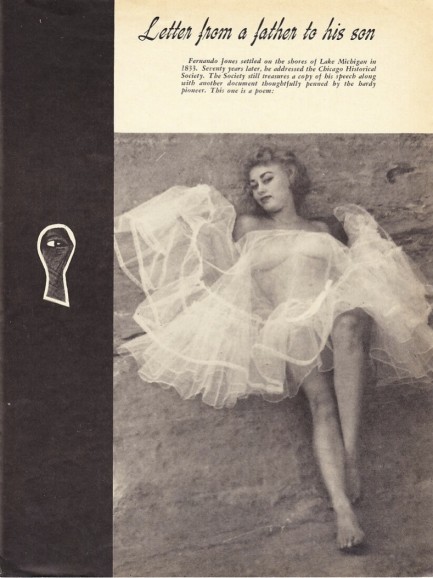
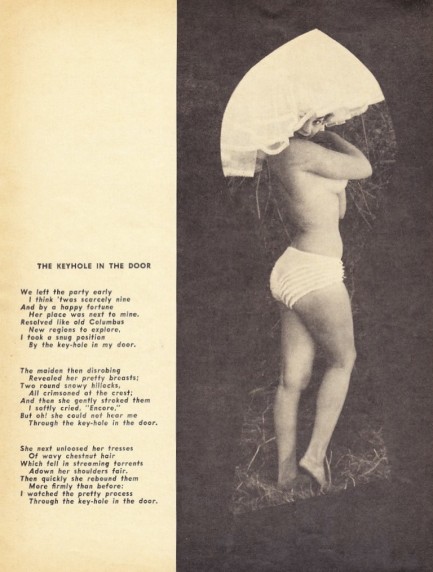
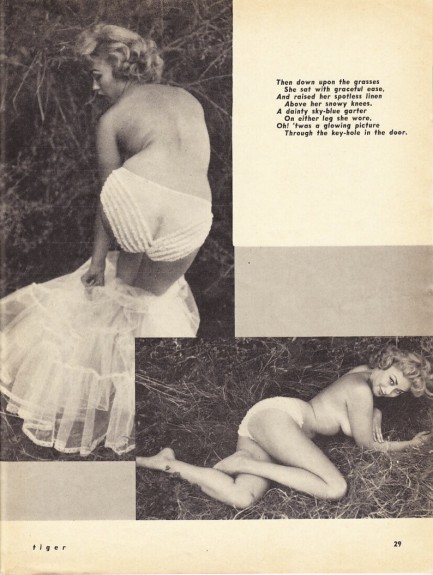
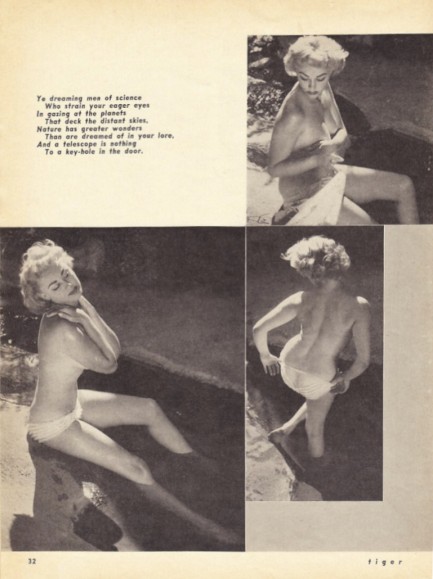
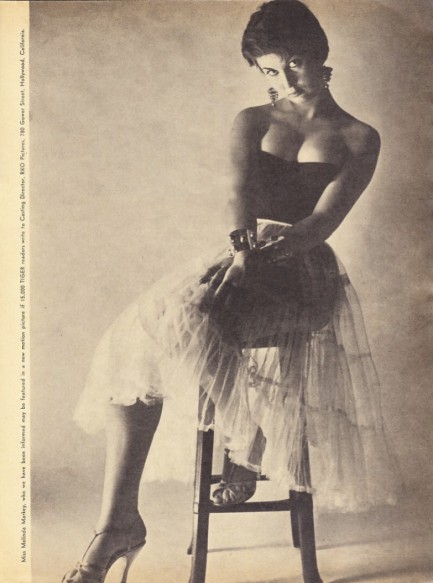
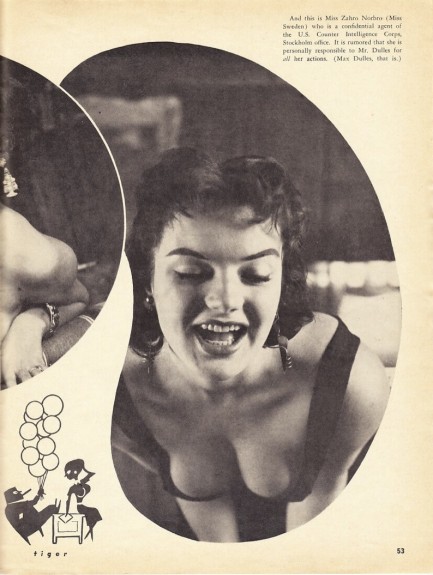
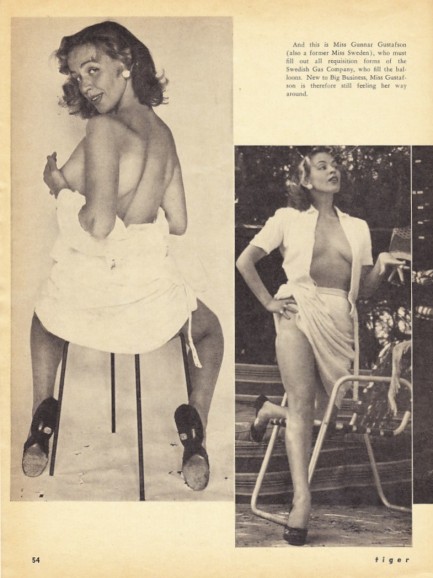
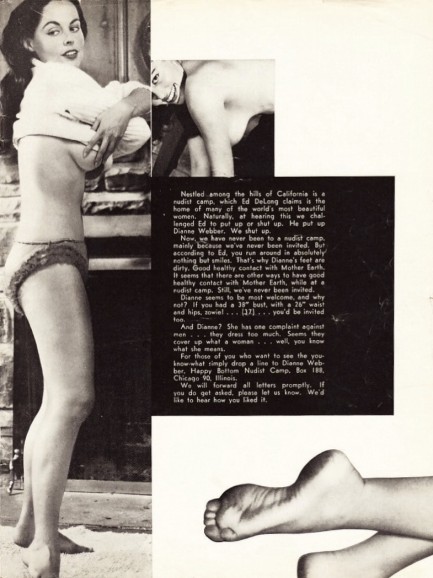
In the meantime, above you see the front of an issue that hit newsstands this month in 1957, and the cover star is famed nudist and model Diane Webber, aka Marguerite Empey, who we've seen a whole lot of around here. She's also featured in four pages at the back of the issue, and along with her are photos of Zahra Norbo, Gunnar Gustafson, obscure actress Melinda Markey, an unknown model lensed by Russ Meyer, and shots of Nona Van Tosh by Earl Leaf.
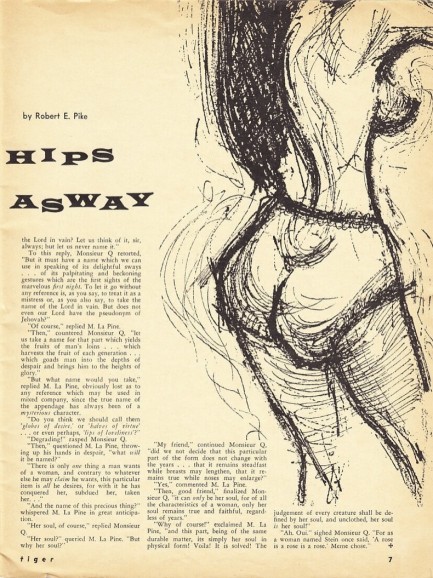
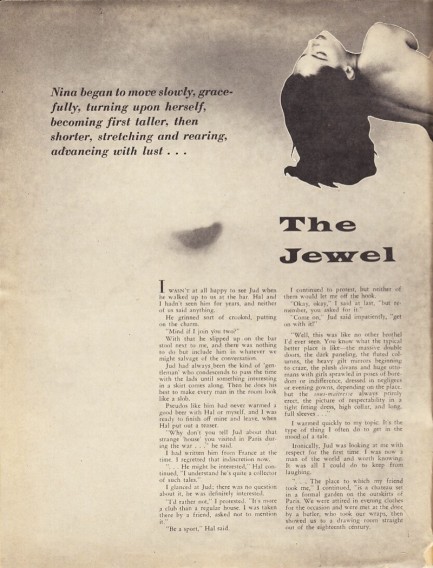
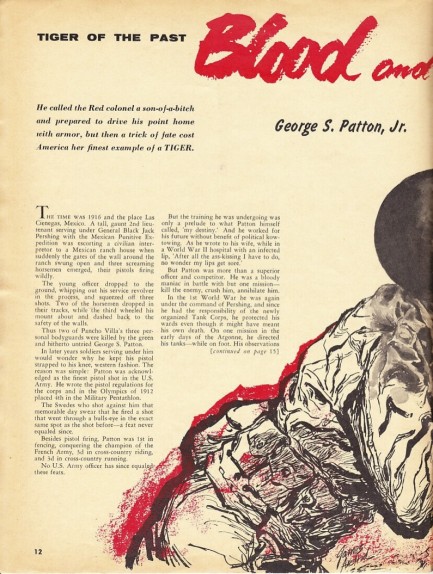
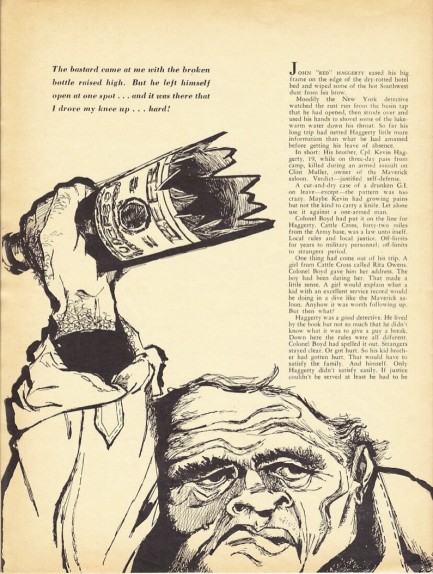
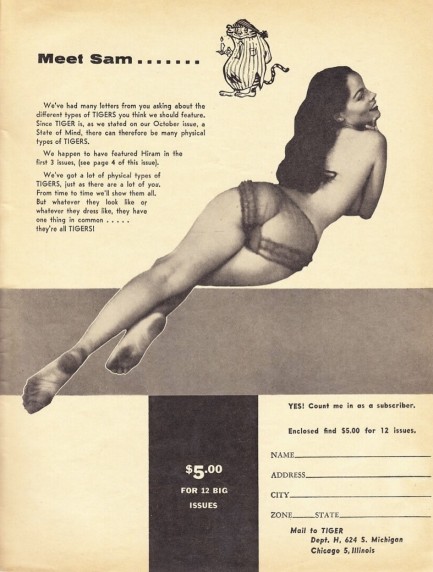
In the writing department, Fox swapped out his editor/publisher hat for a journalist's fedora and contributed a profile on George S. Patton, one of those so-called tigers of the past. If Tiger was anything like the magazine we once ran, Fox probably wrote the story in a panic to fill space after one of his writers torched a deadline. His writing is fine, but overall the magazine doesn't have any spark, literarily, artistically, or pictorially. We hate to say it, but it's a pretty tame tiger. But it's worth a look just because of Webber's presence. You'll find thirty-some scans below.

|
 |

The headlines that mattered yesteryear.
1945—Mussolini Is Arrested
Italian dictator Benito Mussolini, his mistress Clara Petacci, and fifteen supporters are arrested by Italian partisans in Dongo, Italy while attempting to escape the region in the wake of the collapse of Mussolini's fascist government. The next day, Mussolini and his mistress are both executed, along with most of the members of their group. Their bodies are then trucked to Milan where they are hung upside down on meathooks from the roof of a gas station, then spat upon and stoned until they are unrecognizable. 1933—The Gestapo Is Formed
The Geheime Staatspolizei, aka Gestapo, the official secret police force of Nazi Germany, is established. It begins under the administration of SS leader Heinrich Himmler in his position as Chief of German Police, but by 1939 is administered by the Reichssicherheitshauptamt, or Reich Main Security Office, and is a feared entity in every corner of Germany and beyond. 1937—Guernica Is Bombed
In Spain during the Spanish Civil War, the Basque town of Guernica is bombed by the German Luftwaffe, resulting in widespread destruction and casualties. The Basque government reports 1,654 people killed, while later research suggests far fewer deaths, but regardless, Guernica is viewed as an example of terror bombing and other countries learn that Nazi Germany is committed to that tactic. The bombing also becomes inspiration for Pablo Picasso, resulting in a protest painting that is not only his most famous work, but one the most important pieces of art ever produced. 1939—Batman Debuts
In Detective Comics #27, DC Comics publishes its second major superhero, Batman, who becomes one of the most popular comic book characters of all time, and then a popular camp television series starring Adam West, and lastly a multi-million dollar movie franchise starring Michael Keaton, then George Clooney, and finally Christian Bale. 1953—Crick and Watson Publish DNA Results
British scientists James D Watson and Francis Crick publish an article detailing their discovery of the existence and structure of deoxyribonucleic acid, or DNA, in Nature magazine. Their findings answer one of the oldest and most fundamental questions of biology, that of how living things reproduce themselves.
|

|
|
It's easy. We have an uploader that makes it a snap. Use it to submit your art, text, header, and subhead. Your post can be funny, serious, or anything in between, as long as it's vintage pulp. You'll get a byline and experience the fleeting pride of free authorship. We'll edit your post for typos, but the rest is up to you. Click here to give us your best shot.

|
|