Fame may fade but Hollywood never completely forgets. 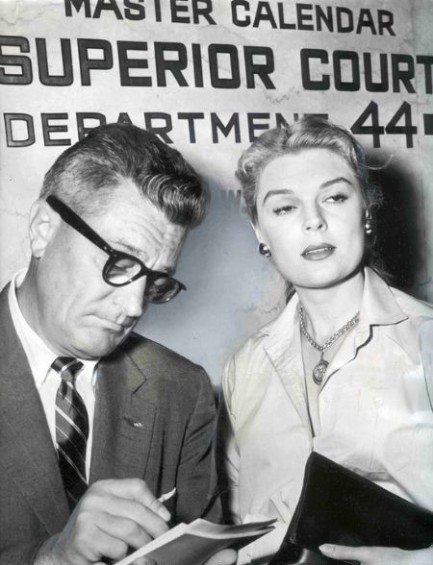
Along with the joys of celebrity are packaged the pains of public life, especially professional failures and personal disasters. Lynn Baggett—sometimes Lynne Baggett—was a rising actress who had accumulated many uncredited roles between 1941 to 1946, had a two year span of no work, then finally scored a major part in the 1949 film noir D.O.A. She was only twenty-six when that occurred, but it didn't put her career on firm ground. She had another speaking role in 1950, and one in 1951, but it was around then that continual domestic problems began to catch up with her.
She had been involved with producer Sam Speigel since 1945, and had married him in ’48, but the relationship was tempestuous. In 1951 Speigel claimed that Baggett trashed the house they shared, and that she deliberately slashed six Picassos. The next year he filed for divorce, claiming that she had cheated multiple times, including with film director John Huston. At that point her show business career was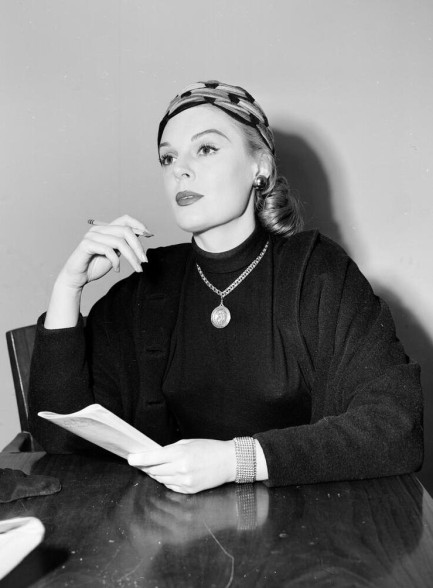 effectively finished, but her celebrity was not. The photo just above is from early 1954 and shows her in Santa Monica Superior Court during her drawn out fight for spousal support. She hadn't acted in three years. effectively finished, but her celebrity was not. The photo just above is from early 1954 and shows her in Santa Monica Superior Court during her drawn out fight for spousal support. She hadn't acted in three years.
Six months later she was driving from a party when she crashed into a car filled with young boys, injuring four and killing nine-year-old Joel Watnick, who'd been ejected entirely from the vehicle. Baggett sped away from the scene, and it took two days for police to find her car at a repair shop, and subsequently track her down. The photo at top shows her on the day of her arrest, which happened to be the same day Watnick was laid to rest. That was today in 1954. It was nationwide news.
Baggett was charged with manslaughter and fleeing the site of an accident, but was convicted only of felony hit-and-run, for which she was sentenced to 60 days in jail and placed on three years of probation. A term that lenient today would cause an uproar audible on Mars. But if Baggett got off light in court, she paid heavily in life. In 1959 she attempted suicide, and in 1960 she was found dead in her apartment from an overdose of barbiturates. Whether her death was suicide is not officially known.
Hollywood, due to its nature of fairy tale successes, tends to produce spectacular falls from grace, disputed facts, and apocrypha. Baggett's story is more clear-cut than most. She'd suffered from depression, marital strife, and career disappointment. Many articles about her suggest that a bad ending was inevitable, and maybe it was. Maybe she even predicted it. When arrested, she said about fleeing the accident, “When I went back and saw the boy lying there, I knew he was dead. I didn’t know which way to turn. You don’t know what something like that does to you. I wish I’d been killed instead of the boy.” 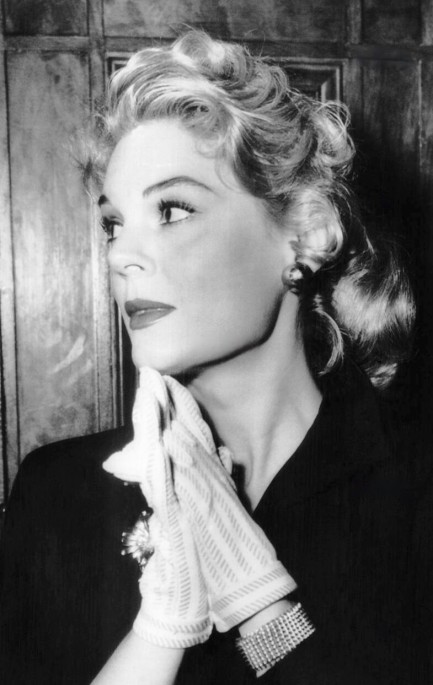
 Authenticity test on horrifying Ecuadorean artifact reveals that it's a horrifying Ecuadorean artifact. 
We ran across a story today that touched on an occasional Pulp Intl. subject—that of shrunken heads, those macabre delights found in the dusty basements of museums and the arcane libraries of mysteriously missing anthropologists. Vintage men's magazines such as this issue of Man to Man often contained features on shrunken heads, usually written by adventurers who claimed to have narrowly escaped losing their own. This occurred mainly in the Amazon regions of Ecuador and Peru where a people called the Jivaro live. When white men weren't available, the Jivaro used the heads of slain enemy warriors, shrinking them via an exacting, multi-step process meant to trap the spirit of the unfortunate victim so that their supernatural power could be utilized. The practice died out decades ago but old shrunken heads are scattered about the world because they were highly sought after curios, a demand that also led to the manufacture of numerous fakes.
Researchers at Mercer University in Macon, Georgia had a shrunken head sitting around that had been acquired by a recently deceased university staffer during a 1942 trip to the Ecuadorean Amazon. They announced Monday that the head is indeed the genuine item. They reached this conclusion by subjecting it to numerous tests, among them CT scans, and of course the angry spirit test, which involves ridiculing the head then waiting to see if your hind quarters wither and fall off. This particular head is especially pulpworthy because it has a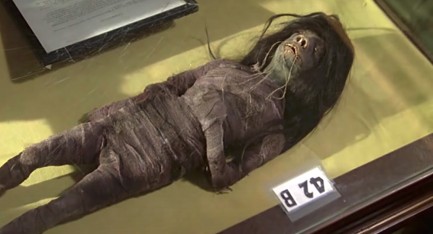 cinema history. It was used as a prop in the 1979 film Wise Blood, John Huston's adaptation of Flannery O'Connor's novel of the same name. In the movie it was placed on a fake body, as you see just above. Mercer University plans to repatriate the head to Ecuador, continuing the recent practice of some museums and universities returning cultural items looted or bought for a pittance by artifact hunters. cinema history. It was used as a prop in the 1979 film Wise Blood, John Huston's adaptation of Flannery O'Connor's novel of the same name. In the movie it was placed on a fake body, as you see just above. Mercer University plans to repatriate the head to Ecuador, continuing the recent practice of some museums and universities returning cultural items looted or bought for a pittance by artifact hunters.
We agree that stolen artifacts should go back to where they came, assuming the original possessors ask for them, which they increasingly have been doing. This means there will be fewer shrunken heads in circulation, which in turn means the process for making them that we shared a few years ago is more timely than ever. Like a Julia Child recipe for boeuf bourguignon, the classics never go out of style. In fact, we think the horrible shrunken head market is about to blow up like Bitcoin. So if you feel the need to shrink the head of... we don't know, anyone ranging from your current boss to the so-called friend who stole your hopeless crush back in college, feel free to get a sense of the process from our post. It's a bit messy, but satisfying and amazingly empowering. So we hear. Just remember that you can't make a shrunken head without a decapitated head, and that's another messy business entirely.
 You're not as clever as you think, Clark. I realized you were muffing your lines on purpose way back on take forty. 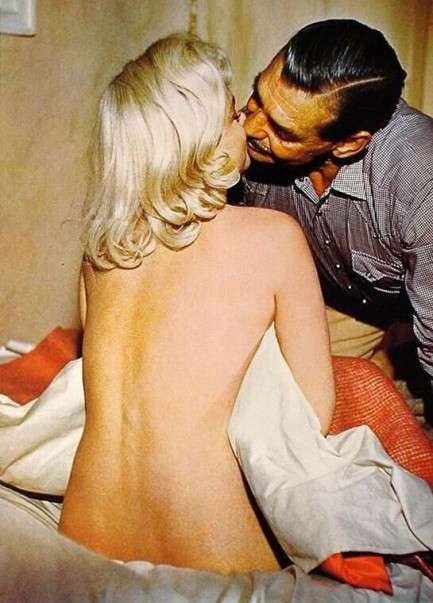
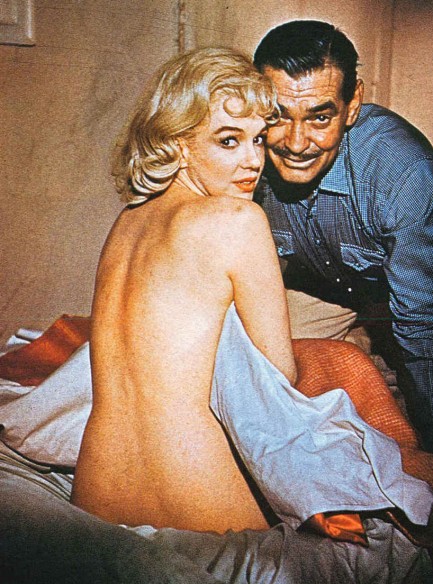
Who's that mystery woman kissing Clark Gable? Why it's Marilyn Monroe. Not really a mystery though, as she's instantly recognizable from any angle. There's almost no such thing as a new Monroe photo, but there are some you don't see often. This one and the one below fall into that category. They were made when she was filming The Misfits, which premiered today in 1961. The scene that provided these shots also featured a Monroe nude flash when she gets out of bed to dress. Director John Huston cut those frames, and they were thought lost, but were rediscovered (though not made public) in 2018.
This was Gable's last movie. He had a heart attack in November 1960, possibly in the middle of this kissing scene, and didn't survive. Just kidding. He had his heart attack two days after filming wrapped. But we bet he was thinking about Monroe when it happened. This was also her last movie. She was filming Something Got To Give in 1962 but died of an overdose before finishing it. The Misfits was a box office disappointment when released, but was considered to be Gable's best film performance, and one of Monroe's best, as well. We don't fully agree, but you might. It's certainly worth a viewing.
 Humphrey is pitch perfect as always but it's Edward who makes this movie sing. 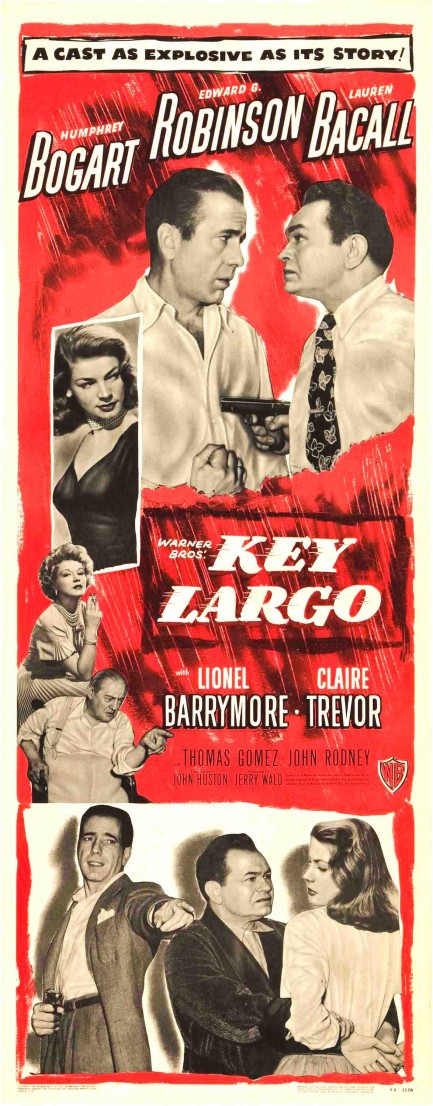
Above, one of many promo posters for the classic drama Key Largo. This movie, as you doubtless know, is great. It hinges on Edward G. Robinson's bravura performance as a washed up gangster trying to make a comeback, but he gets ample onscreen help from co-stars Humphrey Bogart, Lauren Bacall, Lionel Barrymore, Thomas Gomez, Claire Trevor, Dan Seymour, and others. And John Huston in the director's chair is no slouch bringing the foreground drama and hurricane background to life. Key Largo is often called a film noir. Is it though? Hmm... Bogart certainly fits the bill in terms of characterization, but since the movie lacks most other noir elements we're inclined to call it a straight crime drama. But that's just our opinion. It was first seen by the public at a Hollywood preview in mid-July 1948, and went into full national release today. 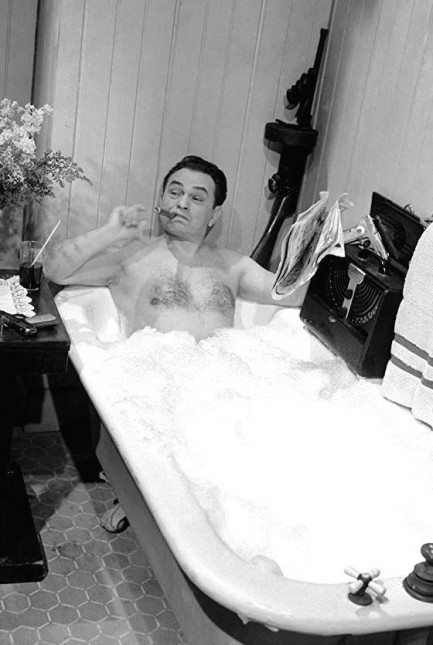
 Bogart finds himself stuck on Key Largo when hurricane Edward blows into town. 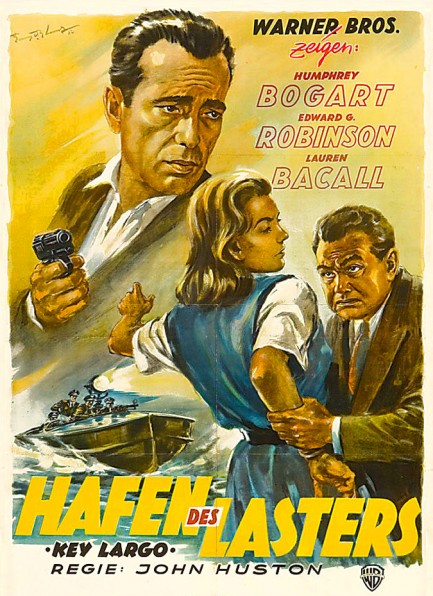
Above is a West German poster for Hafen des Lasters, which translates as “port of vice,” but is better known as Key Largo. We love this piece of art. It's imitative of earlier posters, particularly a Belgian promo from 1949. But that one is by Wik. This one is signed by a different artist, but illegibly, so we can't tell you who painted it. We'll work on that. We've uploaded 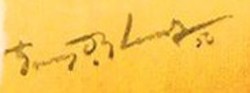 the signature in case you have an idea what this scrawl says. the signature in case you have an idea what this scrawl says.
This is simply a great film, a crime drama set in a hurricane. Many books using the same idea were written later, such as Theodore Pratt's Tropical Disturbance and Russell Trainer's No Way Back. Whether they were inspired by Key Largo or earlier works like W. Somerset Maugham's Rain we can't say, but any writer will tell you never let a good gimmick go to waste. In any case, Key Largo premiered in the U.S. in 1948 and reached West Germany today in 1950.
 Rat-a-tat-tat, all the men fall flat. 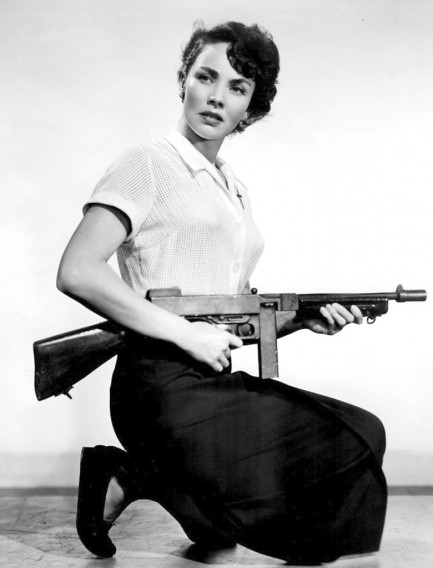
Above is a promo image of the wonderful Jennifer Jones, made for her 1948 Cuba adventure We Were Strangers, in which she played a character with the amazing name China Valdez. Wanna see her use that gun? If you watch the film, which was directed by John Huston, you'll see it happen during one of the most action packed climaxes in ’40s cinema, though the actual movie isn't one of Jones's nor the great Huston's best.
 The greatest trick the Devil ever pulled was convincing the world it was an adventure film. 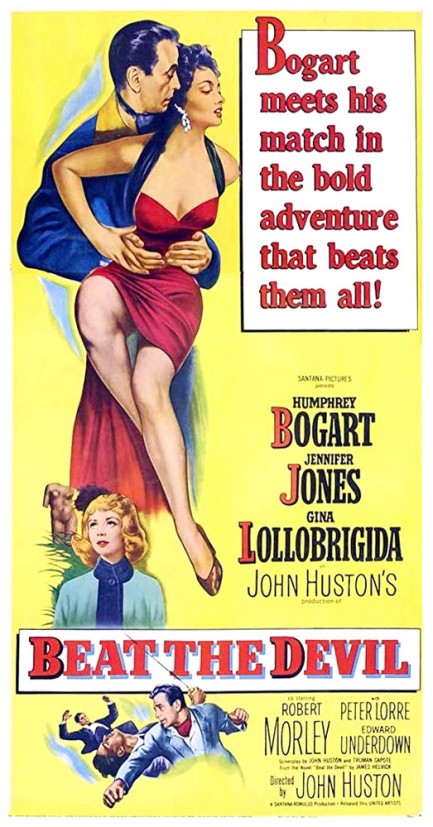
Above, a beautiful poster for John Huston's love-it-or-hate-it comedic African film Beat the Devil, which premiered in the U.S. today in 1954 and starred Humphrey Bogart, Gina Lollobrigida, Jennifer Jones, and Peter Lorre. This poster, while cool, is completely misleading. Beat the Devil is not an adventure. When it was made there was no category for it, but today such movies are called "camp." Only over time have audiences come to understand it. We wrote about it awhile ago and shared a Belgian poster, here.
 Post-noir classic's reputation keeps soaring even as its director's keeps falling. 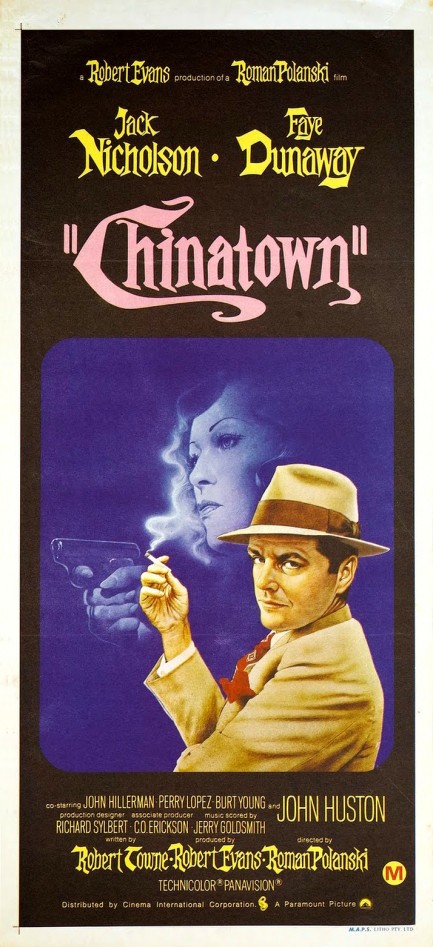
Nearly ten years into this website we've mentioned Chinatown only once—when we wrote a few lines while sharing two Japanese promo posters. The above poster was made for the film's Australian run, which began today in 1975. The film has been discussed everywhere, which means we can't add much, so let's just call it an all-time masterpiece, and one of the most watchable and re-watchable movies ever made, filled with details you notice over time. For example, it didn't strike us until after a few viewings that Jack Nicholson does his own stunt in that culvert scene, the one where the water rushes down the sluiceway and pins him against a chain link fence. You wouldn't see many modern day stars get wet and cold for a moment that lasts five seconds onscreen. We also failed to notice the first few times that the police lieutenant, Escobar, is Mexican-American. It just didn't strike us. But he would have been an extreme rarity in the 1937 L.A. of the film, and the writing and/or casting choice there was certainly deliberate. Other details continue to emerge, and we've seen the movie five or six times.
As far as director Roman Polanski goes, we've talked about him before. But we'll add that art stands on its own, and people stand on their own too. Having created superior art should not absolve someone of crimes; having committed crimes should not serve to denigrate superior art. That's just our opinion. Plus, a director isn't the only one responsible for a film. The hundreds of others involved, including the select group pictured below, and especially the unpictured screenwriter Robert Towne—who is just as responsible for Chinatown as Polanski and won an Oscar for his screenplay—deserve credit. We will always criticize art for being inaccurate when it pretends to be truthful, or for promulgating false or harmful beliefs. Chinatown doesn't do that. Quite the opposite—it offers sharp insights into how and why Los Angeles became what it is. Meanwhile its subplot somewhat foreshadows Polanski's own crime, which makes the film ironic in the extreme. If you haven't seen it you simply must. 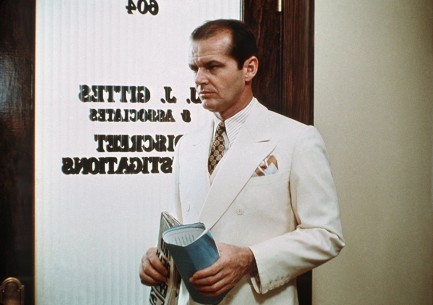 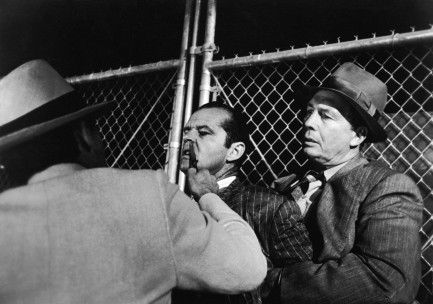 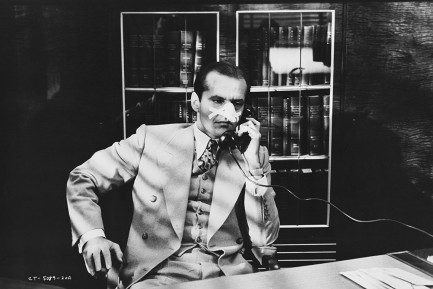 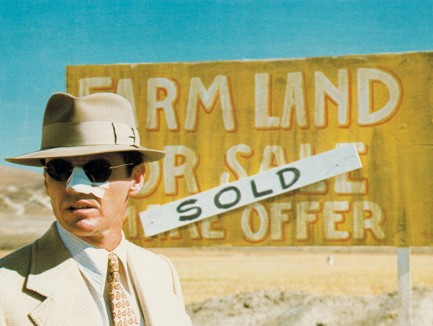 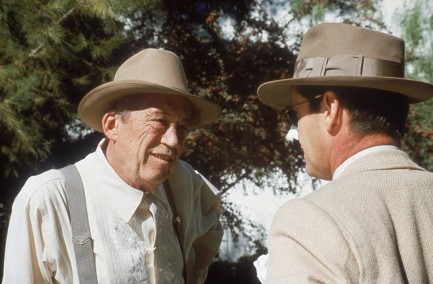 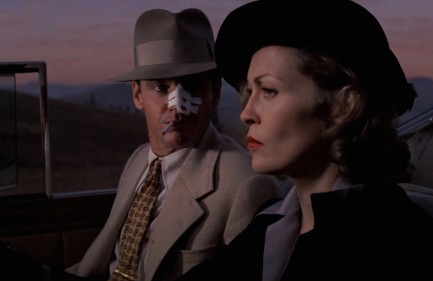 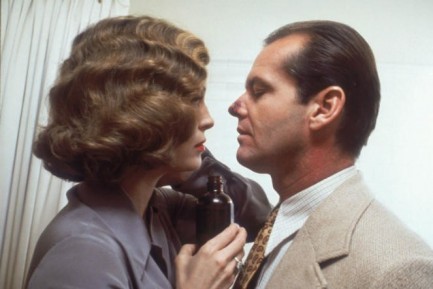 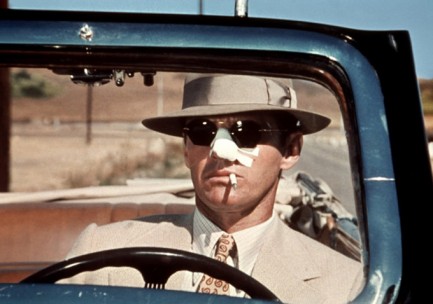
 Gold may fill the pockets but it can also empty the soul. 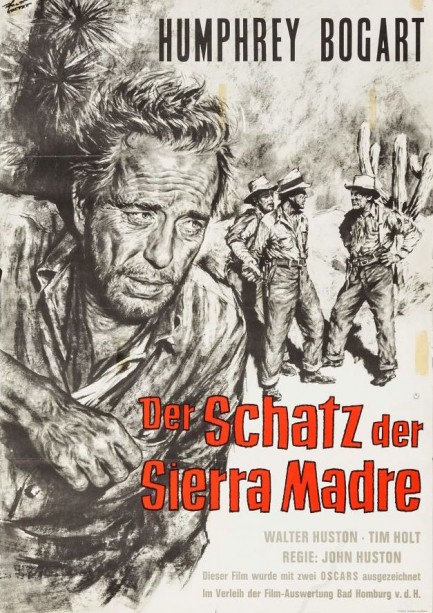
We wanted to show you a bit more work from German artist Rolf Goetze. We settled on this West German poster for the quasi-western drama The Treasure of the Sierra Madre because the film premiered in West Germany today in 1949. This is Goetze at his best. For that matter, it's Humphrey Bogart, Walter Huston, and John Huston at their best too. That isn't just our opinion—Walter Huston won a Best Actor Academy Award for his performance, and John Huston won both Best Director and Best Screenplay. If you're not familiar with the film, we'll just tell you it's a cautionary tale about the lust for riches, and it contains this classic and oft-mangled quote: “Badges? We ain't got no badges. We don't need no badges. I don't have to show you any stinking badges!” More Goetze poster work to be seen here and here.
 It's nobody's Asphalt but their own. 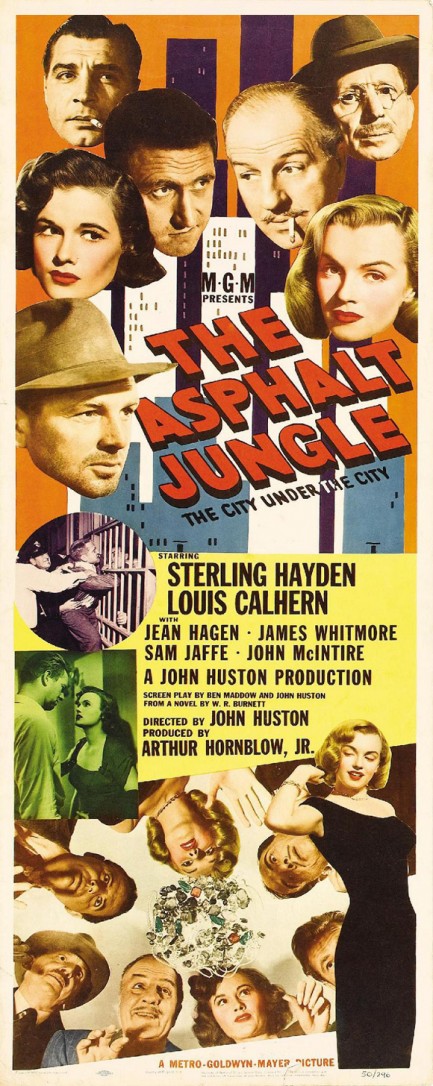
The best poster for the movie The Asphalt Jungle was, beyond doubt, the one we showed you a while back painted by the Italian artist Angelo Cesselon. But that one came a bit later. The above poster was made for the film's initial release in 1950. We think it's very nice as well, if remarkably different from Cesselon's masterpiece. As for the movie, we could tell you it's a top effort, but you already know that. If you haven't seen it, definitely do. It's showing at the Noir City Film Festival tonight, but even at home it's worth a screening.

|
 |

The headlines that mattered yesteryear.
1947—Heyerdahl Embarks on Kon-Tiki
Norwegian ethnographer and adventurer Thor Heyerdahl and his five man crew set out from Peru on a giant balsa wood raft called the Kon-Tiki in order to prove that Peruvian natives could have settled Polynesia. After a 101 day, 4,300 mile (8,000 km) journey, Kon-Tiki smashes into the reef at Raroia in the Tuamotu Islands on August 7, 1947, thus demonstrating that it is possible for a primitive craft to survive a Pacific crossing. 1989—Soviets Acknowledge Chernobyl Accident
After two days of rumors and denials the Soviet Union admits there was an accident at the Chernobyl nuclear power plant in Ukraine. Reactor number four had suffered a meltdown, sending a plume of radioactive fallout into the atmosphere and over an extensive geographical area. Today the abandoned radioactive area surrounding Chernobyl is rife with local wildlife and has been converted into a wildlife sanctuary, one of the largest in Europe. 1945—Mussolini Is Arrested
Italian dictator Benito Mussolini, his mistress Clara Petacci, and fifteen supporters are arrested by Italian partisans in Dongo, Italy while attempting to escape the region in the wake of the collapse of Mussolini's fascist government. The next day, Mussolini and his mistress are both executed, along with most of the members of their group. Their bodies are then trucked to Milan where they are hung upside down on meathooks from the roof of a gas station, then spat upon and stoned until they are unrecognizable. 1933—The Gestapo Is Formed
The Geheime Staatspolizei, aka Gestapo, the official secret police force of Nazi Germany, is established. It begins under the administration of SS leader Heinrich Himmler in his position as Chief of German Police, but by 1939 is administered by the Reichssicherheitshauptamt, or Reich Main Security Office, and is a feared entity in every corner of Germany and beyond. 1937—Guernica Is Bombed
In Spain during the Spanish Civil War, the Basque town of Guernica is bombed by the German Luftwaffe, resulting in widespread destruction and casualties. The Basque government reports 1,654 people killed, while later research suggests far fewer deaths, but regardless, Guernica is viewed as an example of terror bombing and other countries learn that Nazi Germany is committed to that tactic. The bombing also becomes inspiration for Pablo Picasso, resulting in a protest painting that is not only his most famous work, but one the most important pieces of art ever produced.
|

|
|
It's easy. We have an uploader that makes it a snap. Use it to submit your art, text, header, and subhead. Your post can be funny, serious, or anything in between, as long as it's vintage pulp. You'll get a byline and experience the fleeting pride of free authorship. We'll edit your post for typos, but the rest is up to you. Click here to give us your best shot.
|
|