I've run through every bit of fluid in this thing in just a week. Hmm. Maybe I should cut back on my smoking. 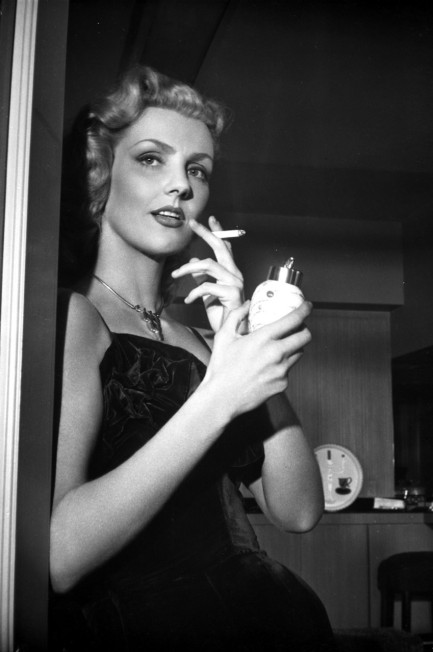
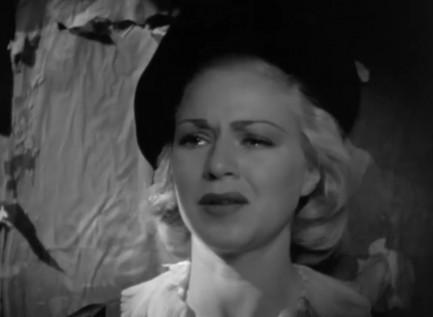
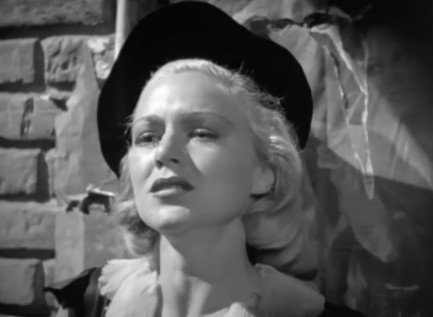
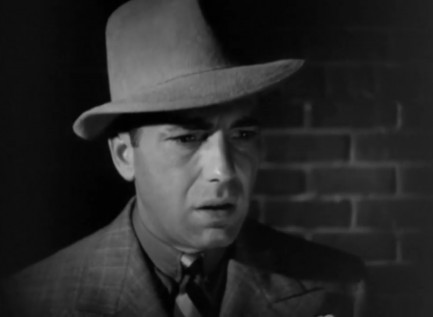
Dolores Moran's film career started with a bang when her first credited role was as the smoldering Hellene de Bursac in the 1944 thriller To Have and Have Not when she was only eighteen. She was the reason Humphrey Bogart tossed off the memorable quip, “I don't understand what kind of a war you guys are fighting. Lugging your wives with you. Don't you get enough of them at home?” It would have been easy to assume nobody would ever get enough of Moran, but after very nearly outshining Lauren Bacall in that film she managed perhaps ten more credited screen roles. Health issues had partly to do with it, and a marriage at age twenty probably curtailed her as well, though her husband was the film producer Benedict Bogeaus. But she wasn't the first flame to fizzle in Hollywood—that's part of the nature of the place. The above shot was made as a promo for her next-to-last film Count the Hours. That was in 1953.
 The fundamental things apply. 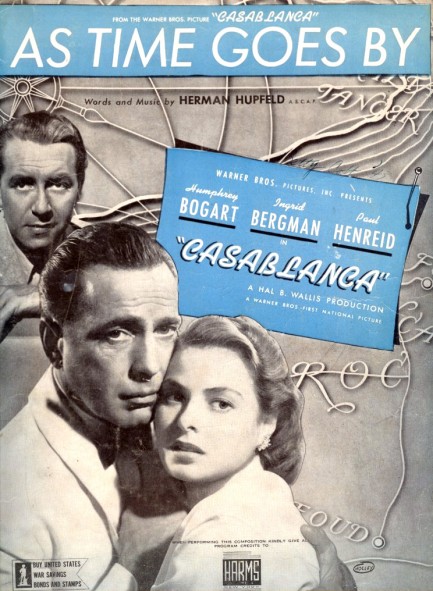
Here’s something nice we ran across on an auction site. It’s a piece of sheet music for “As Time Goes By”, which is a song written by German composer Herman Hupfeld and sung by Dooley Wilson’s character Sam in 1942’s Casablanca. The tune is inextricably identified with the film, but it was actually written for the 1931 Broadway show Everybody’s Welcome, where, in its complete form, it becomes clear the song is just as much about stress as about romance. You wouldn’t know that of course, because you don’t know the lyrics—really, who does? But today’s your lucky Monday—you can brush up on the words here. Just remember these two music fundamentals: if you sing, please do so from the diaphragm; and if you sing badly, blame it on booze.
 There's a new prosecutor in town—and his name is Humphrey. 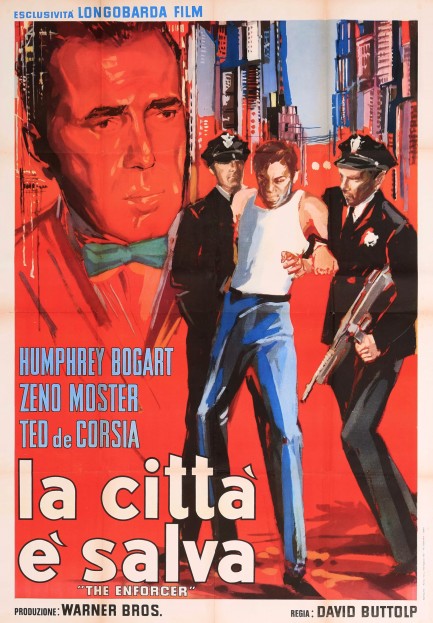
Above: an Italian poster for La città è salva, better known as The Enforcer, starring Humphrey Bogart as a prosecutor tasked with cleaning up rampant corrutpion in the big city. The movie is middle tier for Bogart, but that means it's still very good. The poster is uncredited, but spectacular, with its abstract skyscraperscape and elongated figures. If we ever find out who painted it we'll updated this post. La città è salva premiered in Italy today in 1951.
 With Bogart and Bacall in the starring roles an unusual fugitive movie takes flight. 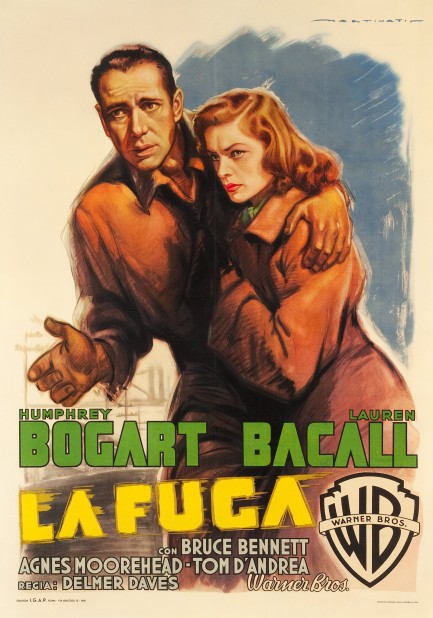
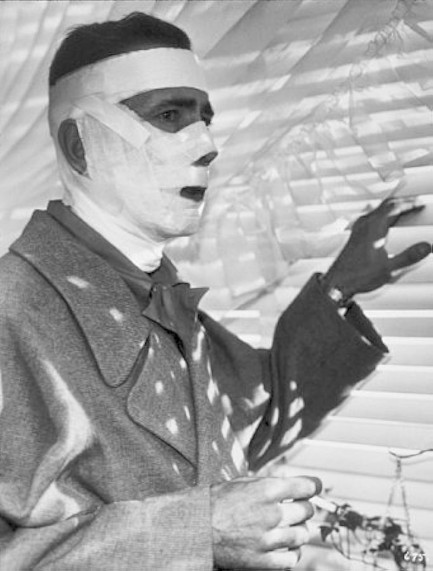
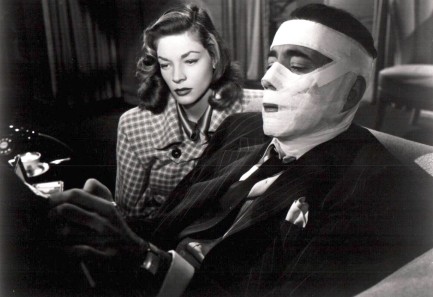
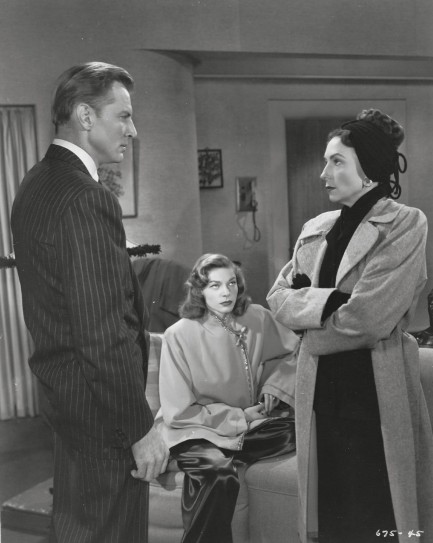
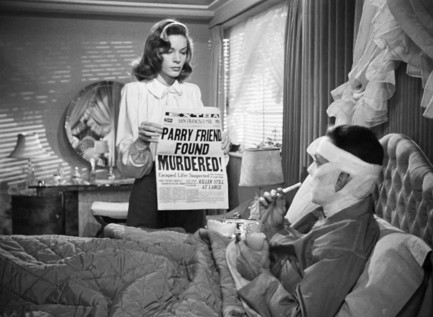
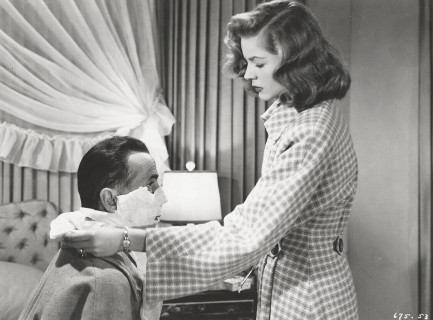
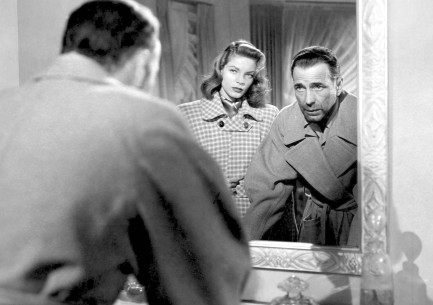
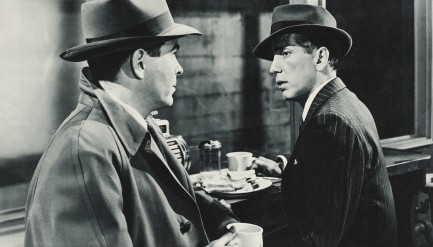
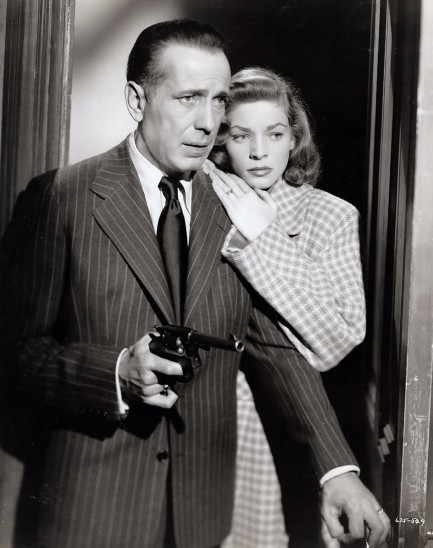
This beautiful poster for La fuga was painted by Italian artist Luigi Martinati, and you doubtless recognize Humphrey Bogart and Lauren Bacall. They starred in four movies together and had a dual cameo in a fifth. This promo was made for their fourth outing Dark Passage, retitled to “the escape” in Italy. And therein lies the plot. Bogart breaks prison and undergoes a backalley cosmetic surgery procedure on his face in order to evade the cops and have a chance to solve the crime for which he was unjustly sent up the river. The filmmakers decided to use the gimmick of having the first section of the film in Bogart-vision—i.e. first person pov until he gets his new face. It makes sense. Otherwise they'd have needed to have another actor play pre-surgery Bogart, or have resorted to clunky make-up and prosthetics. Bacall co-stars as unlikely shelter and succor, plus the prospect of love—if Bogie can survive. It's a good movie.
But we're going to tack upwind at this point and suggest that Dark Passage, while good, isn't as scintillating as its reputation. Certainly it isn't in the class of To Have and Have Not, Key Largo, or The Big Sleep. But hey—it stars B&B, and that's all audiences of the era really cared about. Three years into her film career Bacall had grown into superstardom—or stardom as it was called back then—and dished out a performance here that did plenty with a thin script and a belief defying scenario. The other star here is San Francisco, where most of the movie was shot. The city appeared in many period productions, but we can't think of it ever being used to such an extent as in Dark Passage. Since we lived across the Bay in Berkeley for a couple of years, we got to know San Fran well and it's fun to see it as it once was. Dark Passage—slightly overrated and all—is fun too. It premiered in the U.S. in 1947 and reached Italy today in 1948.
           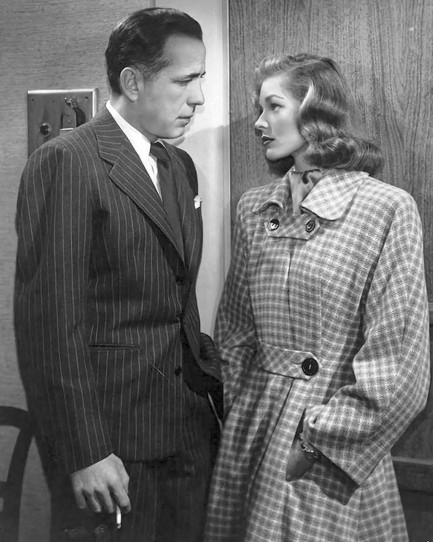 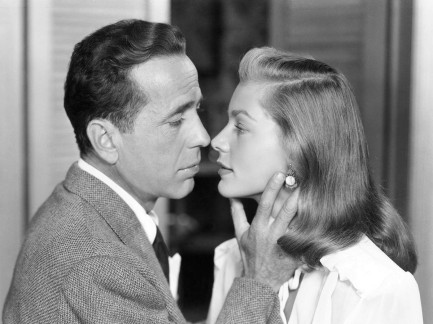
 Bogart may own the café, but Bergman owns the room. 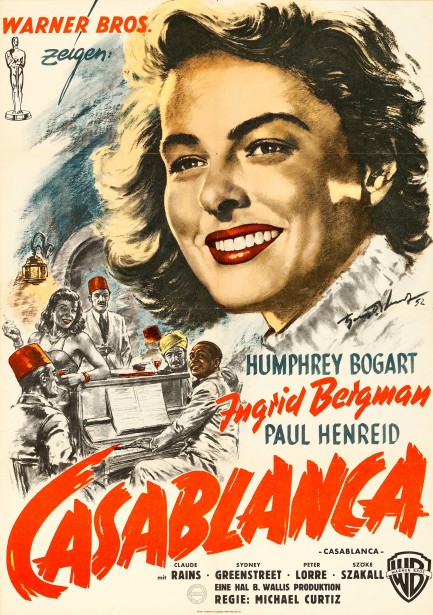
Since we're checking out European poster art today, above is a nice West German promo for the classic wartime drama Casablanca, with Humphrey Bogart and Ingrid Bergman. We've covered just about all the nice promos for this film: Japanese, Spanish, Italian, and of course the classic U.S. version. Plus we wrote a post about the movie's brilliant set design. But this additional poster is worth sharing because it's the first time we've featured artist Hans Otto Wendt, a well regarded figure who worked during his youth as a draftsman in the newspaper industry, before taking his talents afield and collaborating with Deutsche London Film, Warner Bros., Twentieth Century Fox, and other major studios. He worked until 1969, at which point he retired due to poor health, and finally died in Berlin in 1979. For the above effort, note that he not only made Bergman the star of the poster, but the star of his handpainted lettering too. Casablanca premiered in West Germany today in 1952.
 Who needs a piano player when you have Maxell? 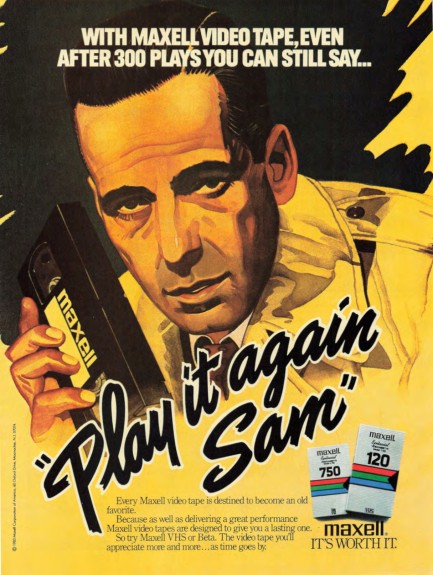
We've never quite been able to wrap our heads around the idea that dead stars can be made to advertise products, but hey, capitalism. Above is an advertisement we ran across featuring Humphrey Bogart in his role as Rick from Casablanca, shilling Hitachi's Maxell videocassettes. This is from 1983. We'd have put this in our pulp advertising feature in the sidebar, but that gadget froze us out years ago. Due to some coding glitches we can neither add nor subtract from there. It's yet another reason for the long promised site redesign that's still tops on the list of things to do (except for traveling, hitting bars and beaches, and hanging with PI-1 & PI-2). Maybe in 2023 it'll actually happen. Hell, if Bogie can embrace the new, so can we.
 The future is a dead Issue. 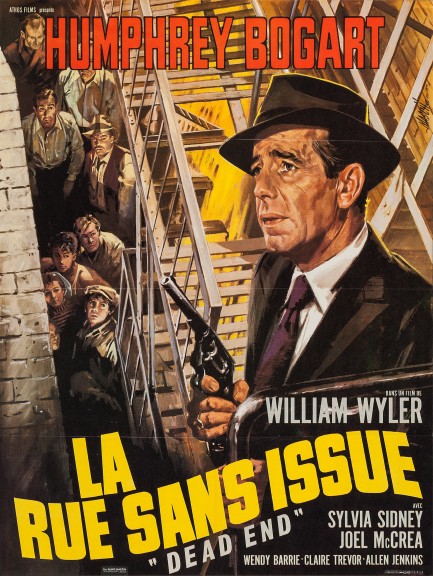
Once again we've chosen what we think is the best poster for a vintage film. In this case it's the urban drama Dead End with Humphrey Bogart, and the poster is one painted by Jean Mascii for the French release as La rue sans issue. Bogart features prominently in both the art and film, but the rest of cast includes Sylvia Sidney, Joel McCrea, Claire Trevor, and Wendy Barrie. We're talking good, solid actors—two of them future Academy Award winners—and they make Dead End an excellent movie. In addition it was based on a play by Sidney Kingsley, with the script penned by Lillian Hellman, more top talent. Kingsley had already won a Pulitzer Prize, and Hellman had written many hit plays. The plot of Dead End covers a day on a slummy dead end street in Manhattan on the East River, and the characters that interact there. The area is in the midst of gentrification, with fancy townhouses displacing longtime residents mired by the effects of the Great Depression. Because of construction on the next block the cosseted owners of a luxury home must for several days use their back entrance, which opens onto the dead end street. Thus you get interaction between all levels of society. There are the lowliest streets punks, an educated architect who can't find work, a woman who intends to marry for security instead of love, a gangster who's returned to his old neighborhood hoping to reconnect with his first love, and the rich man and his family.
There's plenty going on in the film, but as always we like to keep our write-ups short, so for our purposes we'll focus on the gangster, Humphrey Bogart, and his former girl, Claire Trevor. Bogart has risen to the top ranks of crime through smarts and ruthlessness, but to him Trevor represents a cleaner past and possibly a better future. He waits on the street for a glimpse of her, and when that finally happens he's thrilled. Trevor is less so, but there's no doubt she still loves Bogie. When he says he'll take her away from the slum she balks. It soon dawns on Bogie that she doesn't intend to leave, and he's devastated and confused. Trevor is evasive at first, then, pressured by Bogart, finally shouts, “I'm tired! I'm sick! Can't you see it! Look at me good! You're looking at me the way I used to be!” With that she moves from shadow:
Into light: Bogart takes a good look, from bottom to top:
And he realizes she is sick. Though it's unspoken, he realizes she has syphilis. All his dreams come crashing down in that devastating moment. He's disgusted, and it leads to an astonishing exchange of dialogue.
Bogart: Why didn't you get a job?
Trevor: They don't grow on trees.
Bogart: Why didn't you starve first?
Trevor: Why didn't you? Well? What did you expect?
Bogart escaped the poverty of that dead end street through organized crime, and killed on his rise to riches. Trevor had to survive through prostitution. Bogart thinks he's better than her; she tells him he's not. In his toxic male world, murder is less offensive than sex. He's the one who's twisted—not her. In addition to a great film moment, it's a clever Hays Code workaround. Nothing about sex, prostitution, or venereal disease could be stated, but through clever writing, acting, context, and direction—by William Wyler—the facts were clear to audiences. The rest of the story arcs are just as involving, and the movie on the whole is a mandatory drama. Dead End premiered in the U.S. in 1937, and in France today in 1938.
 Rare Maltese bird migrates to Asia. 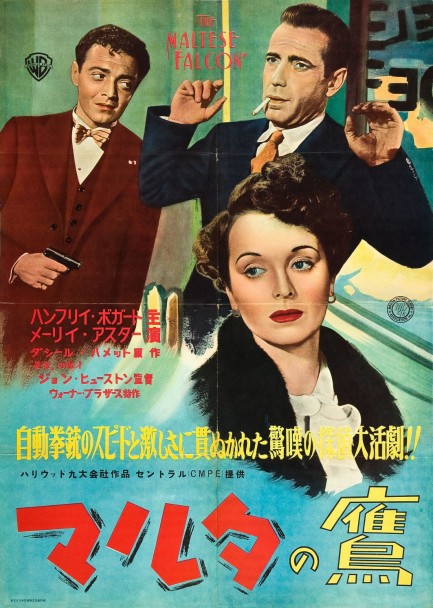
Above: a very nice Japanese poster for the classic early film noir The Maltese Falcon, with Humphrey Bogart, Mary Astor, and Peter Lorre. The movie was titled in Japanese, “colors of Malta,” which we can't see as any better than the original, but whatever. It's a great piece of art. We've talked about the film only briefly, because what more can we offer than the numerous film experts who've reviewed it? However, we do have a lot of associated poster and book art, some of which you may not have seen. We suggest looking here, here, here, and here.
 Minuit puts the country's hospitable reputation to the test. 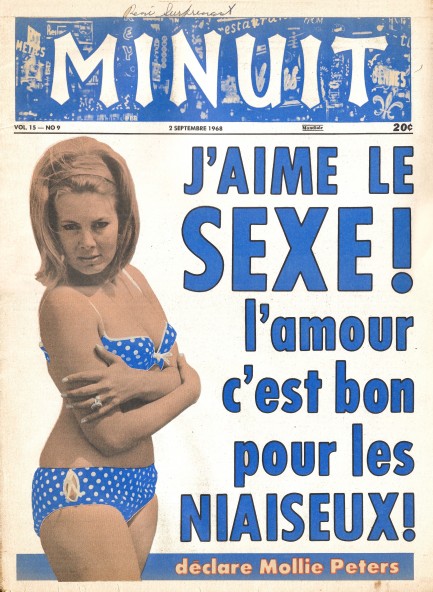
Ever since we discovered a while back that the U.S. tabloid Midnight was actually a spin-off of Montreal based Minuit we've been looking around for issues. We finally had some luck. This example hit Canadian newsstands today in 1968, and on the cover is British actress Mollie Peters, or Molly Peters. Inside, various Hollywood stars are spotlighted in unflattering ways. Edy Williams was allegedly attacked by a lesbian; Paul Newman resorted to transcendental meditation to cut down on his drinking; Jason Robards, Jr. broke everything Humphrey Bogart related in Lauren Bacall's house; Robert Vaughn paid off his extensive gambling debts and cancelled his credit cards; Janet Margolin allegedly ate a pound of ground beef every day for health reasons; and Ursula Andress attacked Anita Ekberg in a Paris restaurant for making eyes at Andress's boyfriend Jean-Paul Belmondo.
There's also a note on Babsi Zimmermann, who Minuit claims just refused a nude role in a French film. We noticed the blurb because of her name, which seems too good to be true, and familiar too. We looked her up and she did exist. It turns out she was better known as Barbara Zimmermann. She changed her stage name after the release of her first film, a counter-culture sexploitation romp called Heißer Sand auf Sylt, aka The New Life Style (Just to Be Love). Maybe she wanted a fresh start because the movie was such a stinker. We know it was bad because we wrote about it, which is why her name sounded familiar. She's naked as a donskoy cat in it, so Minuit's claim that she refused the French movie makes sense if she wanted to rebrand herself. The change still has people confused. Currently IMDB has separate entries for Babsi and Barbara.
Minuit reserves special attention for U.S. actor George Hamilton, who had been generally targeted by tabloids for avoiding military service in Vietnam. Why him? We wrote about the reason a long while back, and if you're curious you can check. Minuit wryly informs readers that, “George Hamilton somehow managed to break his toe the day after he received a notice to report to the U.S. Army recruiting center. This gives him an interesting three-month [deferral]. It's clever, isn't it?” Obviously, toes heal. Hamilton eventually received a full deferral for other reasons.
Also in this issue, Minuit editors treat readers to a story about a man cut in half by a train. We feel like it's urban folklore, but there are photos—for any who might be convinced by those—and a long story explaining how a man named Regerio Estrada caught his wife Lucia in bed with another man, beat him unconscious, and tied him to a train track to await the next express. Do we buy it? Not really. The internet contains only a fraction of all knowledge and history, but we think this tawdry tale is so bizarre that it would have found its way online. There's nothing. Or maybe we're just the first to upload it. Anything is possible. We have additional colorful Canadian tabloids we'll be sharing in the months ahead. You'll find eighteen scans below. 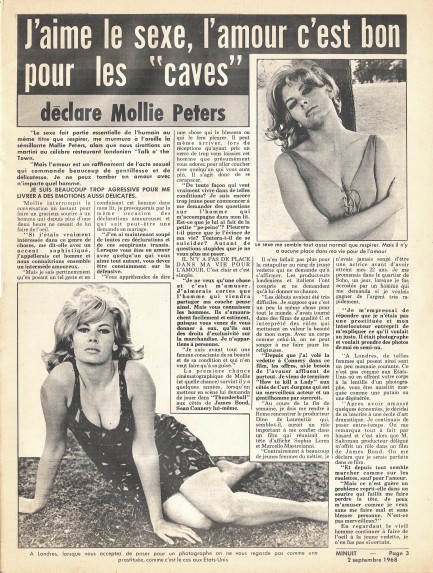 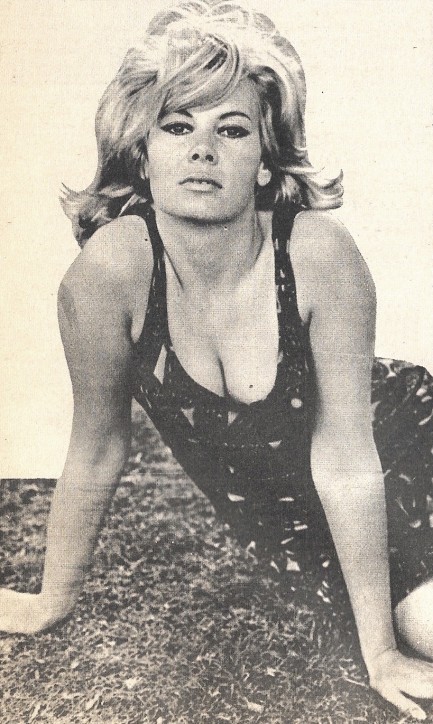 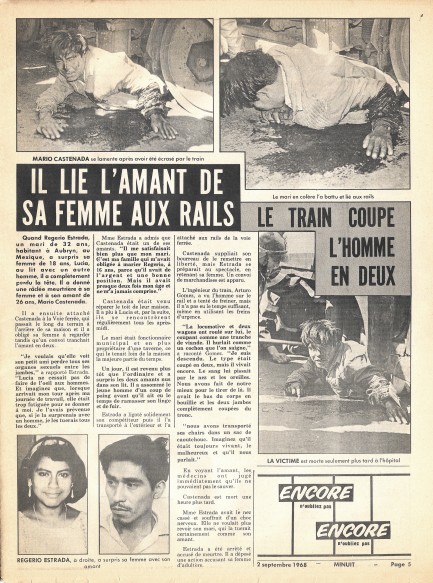 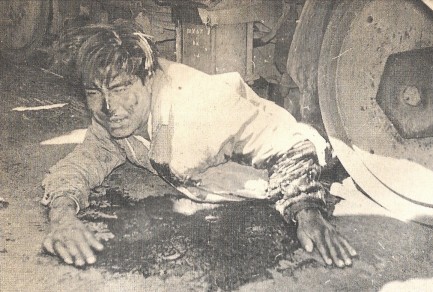 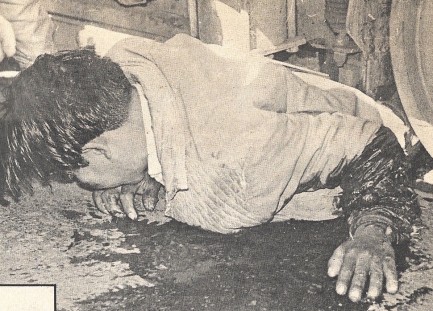  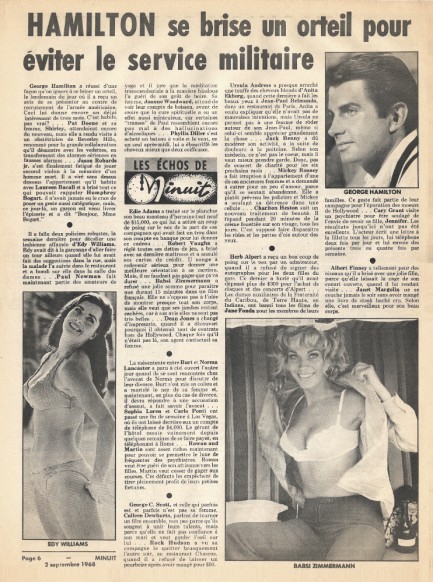  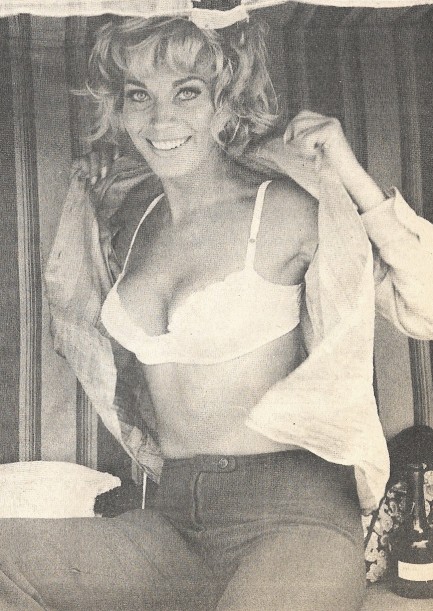 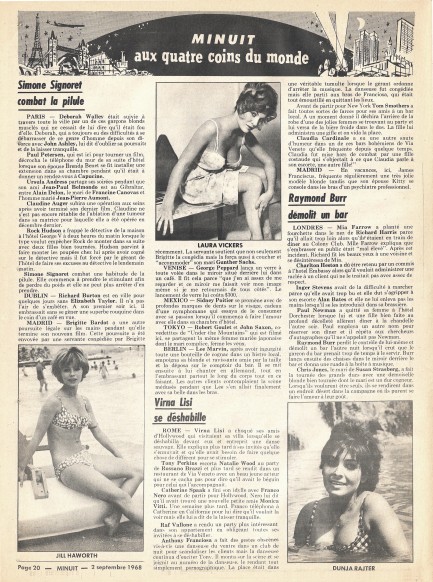 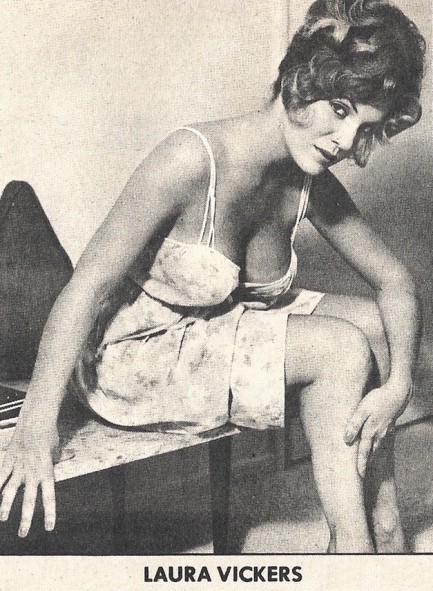  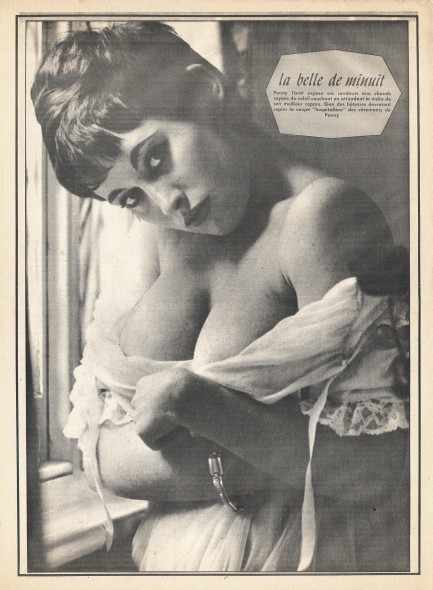 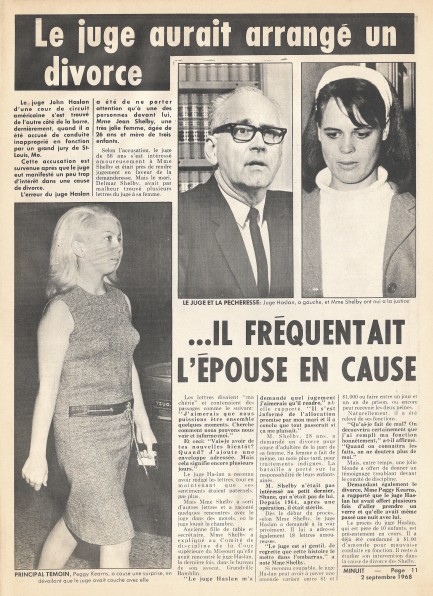 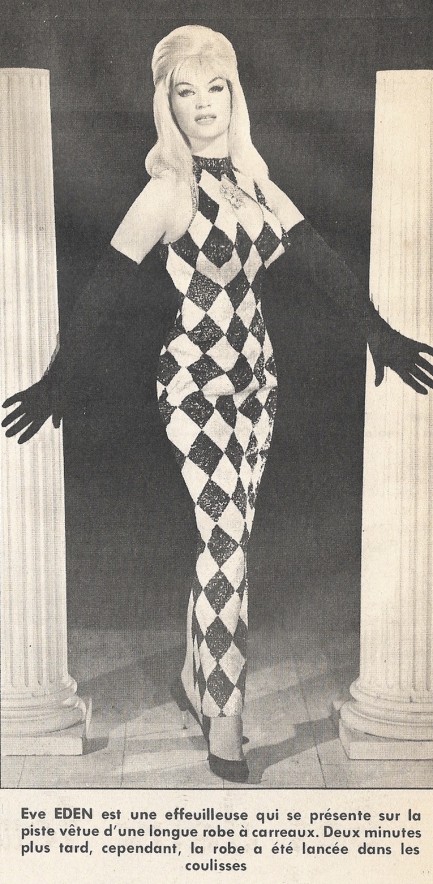 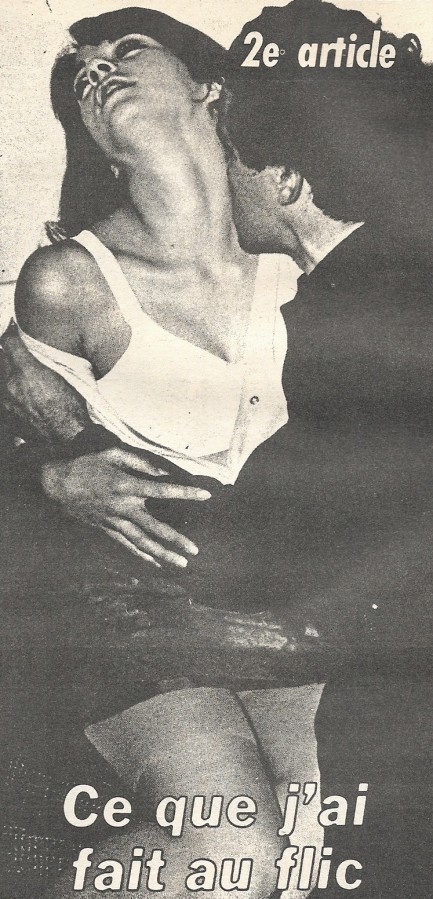 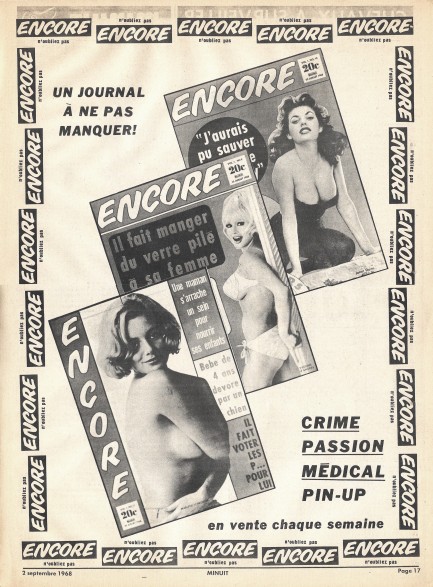
 What evil lurks in the hearts of men? The psychologist knows! 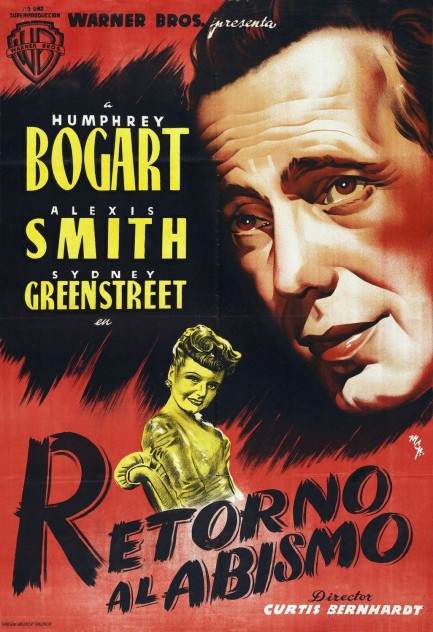
We wanted to highlight once again the interesting output of Estudio MCP, which was the marquee under which Spanish artists Ramón Martí, Josep Clavé, and Hernán Pico worked. They created this poster for Retorno al abismo, known in English as Conflict, starring Humphrey Bogart. The movie was made during the height of public interest in psychology and attempts to portray a situation in which a man's subconscious distress manifests in unpredictable ways. The result is pretty hamfisted, but Bogart makes it work anyway because he's Bogart. We talk about the movie a bit more here. After opening in the U.S. in 1947, Conflict premiered in Spain today in 1947.

|
 |

The headlines that mattered yesteryear.
1945—Mussolini Is Arrested
Italian dictator Benito Mussolini, his mistress Clara Petacci, and fifteen supporters are arrested by Italian partisans in Dongo, Italy while attempting to escape the region in the wake of the collapse of Mussolini's fascist government. The next day, Mussolini and his mistress are both executed, along with most of the members of their group. Their bodies are then trucked to Milan where they are hung upside down on meathooks from the roof of a gas station, then spat upon and stoned until they are unrecognizable. 1933—The Gestapo Is Formed
The Geheime Staatspolizei, aka Gestapo, the official secret police force of Nazi Germany, is established. It begins under the administration of SS leader Heinrich Himmler in his position as Chief of German Police, but by 1939 is administered by the Reichssicherheitshauptamt, or Reich Main Security Office, and is a feared entity in every corner of Germany and beyond. 1937—Guernica Is Bombed
In Spain during the Spanish Civil War, the Basque town of Guernica is bombed by the German Luftwaffe, resulting in widespread destruction and casualties. The Basque government reports 1,654 people killed, while later research suggests far fewer deaths, but regardless, Guernica is viewed as an example of terror bombing and other countries learn that Nazi Germany is committed to that tactic. The bombing also becomes inspiration for Pablo Picasso, resulting in a protest painting that is not only his most famous work, but one the most important pieces of art ever produced. 1939—Batman Debuts
In Detective Comics #27, DC Comics publishes its second major superhero, Batman, who becomes one of the most popular comic book characters of all time, and then a popular camp television series starring Adam West, and lastly a multi-million dollar movie franchise starring Michael Keaton, then George Clooney, and finally Christian Bale. 1953—Crick and Watson Publish DNA Results
British scientists James D Watson and Francis Crick publish an article detailing their discovery of the existence and structure of deoxyribonucleic acid, or DNA, in Nature magazine. Their findings answer one of the oldest and most fundamental questions of biology, that of how living things reproduce themselves.
|

|
|
It's easy. We have an uploader that makes it a snap. Use it to submit your art, text, header, and subhead. Your post can be funny, serious, or anything in between, as long as it's vintage pulp. You'll get a byline and experience the fleeting pride of free authorship. We'll edit your post for typos, but the rest is up to you. Click here to give us your best shot.
|
|