You’re nobody ’til somebody loves you. 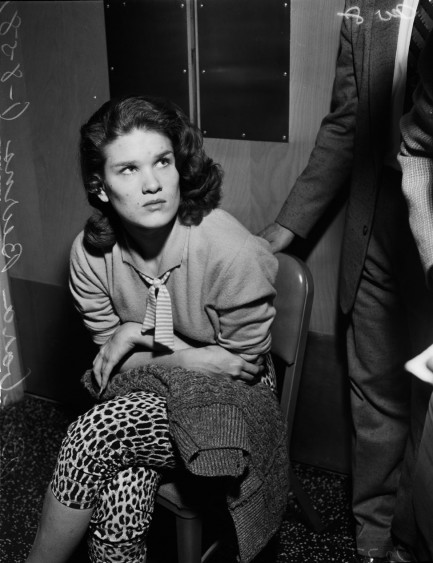 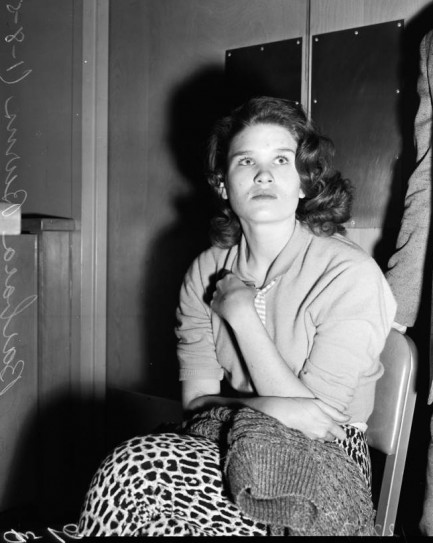
The above photos show Barbara Burns when she was busted for drugs today in 1958 after LAPD officers found track marks on her arms. Burns was the well-to-do daughter of famed comedian Bob Burns, but her father had died of kidney cancer in 1956. Barbara Burns was sentenced to probation after the arrest, and the story got some play in national newspapers, with several calling her probation sentence a storybook opportunity at a second chance. But she didn’t cooperate in the role. She managed to cobble together some behind-the-cameras television work, but was arrested for heroin possession in 1959. That time she served ninety days in jail and admitted in an interview, “I’m really hooked. I had nothing else to do, and my mother wouldn’t talk to me. I wanted to be a singer but I was too heavy and they told me it would help me lose weight.” Burns had always called herself an ugly duckling, compared herself unfavorably to her siblings, and felt she could never live up to family expectations. But even though her own words told the world that low self esteem was the root of her problems, a dead father and an estrangement from her mother probably didn't help things. The downward spiral continued. She was arrested for marijuana possession in early 1960 and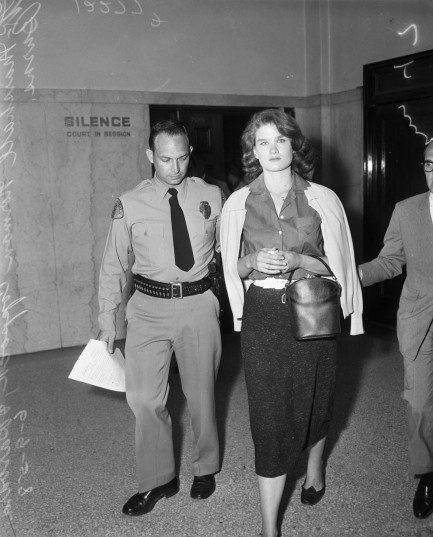 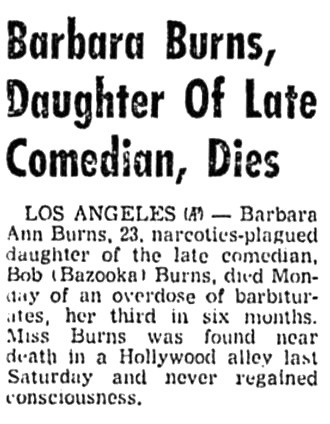 earned ninety days in Camarillo State Hospital. In November 1960 she was snared in another weed bust, but that time she walked after a jury acquitted her. When she was arrested for heroin possession again in June 1961, she lamented what had probably been true for longer than she admitted—that she had doomed her chance to have a career in show business. earned ninety days in Camarillo State Hospital. In November 1960 she was snared in another weed bust, but that time she walked after a jury acquitted her. When she was arrested for heroin possession again in June 1961, she lamented what had probably been true for longer than she admitted—that she had doomed her chance to have a career in show business.
At some point she sought medical treatment for an eye problem and was told by a doctor that she was losing her vision in her right eye. In both August and September of 1961 she attempted suicide, and in January 1962 while awaiting trial on one of her narcotics busts she was found overdosed and unconscious on a Hollywood street, and died a few days later in the hospital. Her suicide note said all she wanted was to be loved but everyone hated her. Many of her obituaries, ironically, described her as “tall and beautiful,” which she certainly would not have believed. They also noted her advantages in life—how she had won the crucial lottery of being born to wealth. But Barbara Burns didn’t see it that way. She once said, “I wish I had been born in some poor, obscure family that nobody knew. Then maybe I would have tried to become somebody.”
 She had nothing left to hang onto. 
Arabella Árbenz, née Arabella Árbenz Vilanova, was born and raised in our former (and still beloved) home Guatemala, moved to Canada for college, and became a fashion model in France. She also tried acting and had one credited role, playing the lead in the 1965 drama Un alma pura, which was made in Mexico. We've seen it, and she's decent in it, enough so that we suspect she'd have had a future on the screen. But nothing having to do with Guatemala is ever simple, therefore Arabella's life had many twists and turns. She was the daughter of Jacobo Árbenz, who was elected president of Guatemala in 1951, but was overthrown in a CIA sponsored coup lobbied for by the United Fruit Company. Under the collaborationist dictator Jorge Ubico Castañeda, United Fruit had been given 99-year leases on millions of acres of land amounting to 42% of the country's total area, and was exempted from taxes. Arabella didn't weather her family's subsequent exile well, and after problems in romance and with drugs, in 1965 shot herself dead in front of her paramour, Mexican bullfighter Jaime Bravo Arciga, in Colombia, at age twenty-five.
 Everyone said they always did everything together. 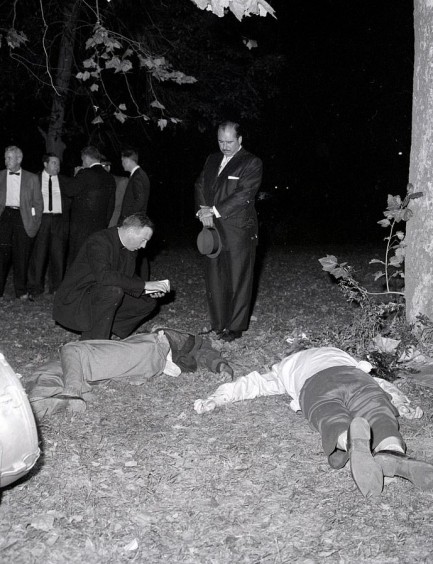
More random midcentury aftermath. This photo shows a kneeling priest about to do his thing over the bodies of Thomas J. Hogan and Fred Romer, who together were a murder-suicide. Hogan shot Romer before turning the gun on himself. There's no information about the exact circumstances behind the event. Cops being cops, they probably ruled out the idea of this scene being any sort of willing pact. Romantics being romantics, we at least wonder about it. But alas, we'll never know. Usually these vintage crime photos come from Los Angeles, but lately we've been sharing examples from New York City. This is another one, and it happened today in 1961.
 If at first you don't succeed, try to die again. 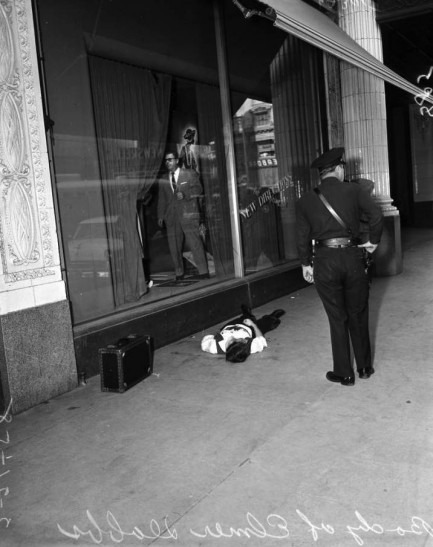 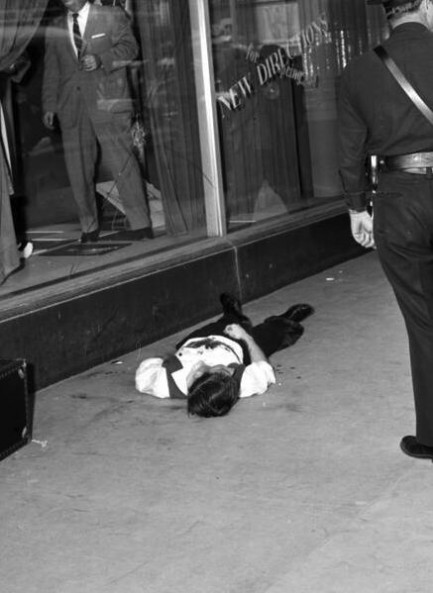
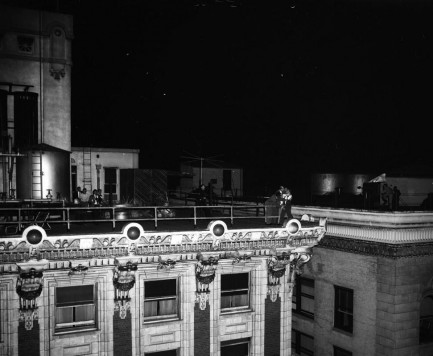
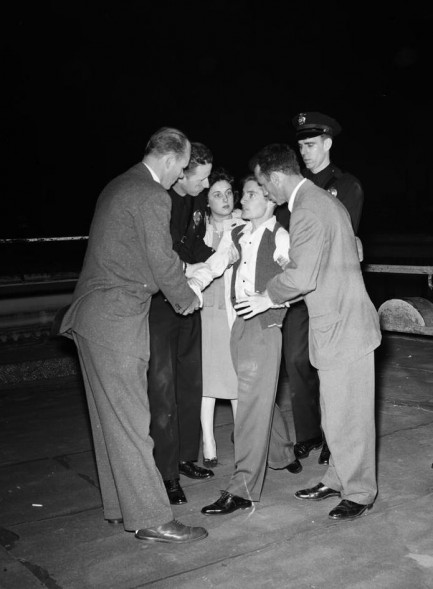
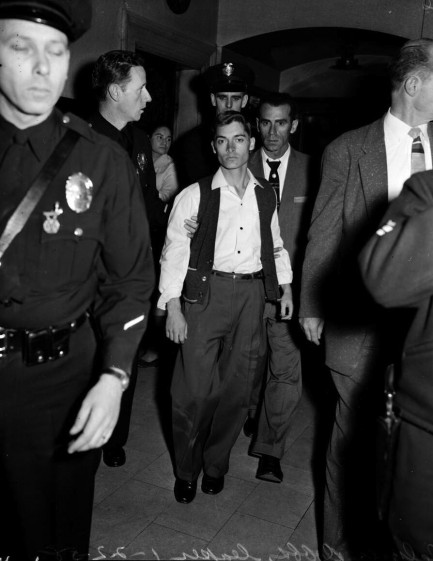
Saturday grimness for you, with a photo of a suicide that took place in Los Angeles today in 1958. There's an interesting story behind this. The man's name was Delmer Dobbs and he shot himself in the stomach on a Los Angeles street. A month earlier he had attempted suicide too. On that occasion he had gone to the top of the Hotel Rosslyn Annex on Main Street and perched on the edge, preparing himself to leap. The buildup was lengthy, and soon hundreds of observers had gathered below. In case you think humanity wasn't always bloodthirsty, think again—mob mentality set in, and a chant started in the crowd: “Jump! Jump! Jump!” and, “Chicken, chicken, chicken!”
After hours on the rooftop, with cops trying to talk him down, Dobbs demanded that they contact Bonnie La Ross, a cashier working at the Rialto Theatre a couple of blocks away on Broadway. She was brought in and convinced Dobbs to give up. Reading between the lines here, it's possible Dobbs, who—as you see in photos below—was a tiny guy only about five feet tall, had been been unsuccessful with women and had turned his attentions to La Ross, who was fifteen years old. That's just specualtion, but consider this: Before being taken away Dobbs told La Ross that he was going to get a gun and try again. A month later when he shot himself, it was across the street from the Rialto as La Ross watched.
   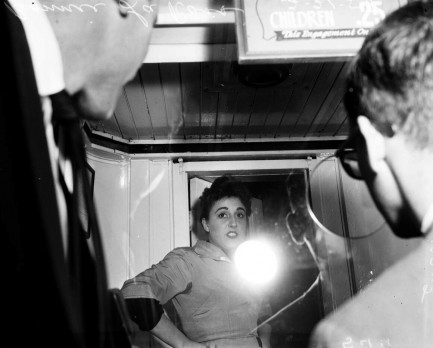
 L.A. manhunt ends not with a bang, but with a whimper. 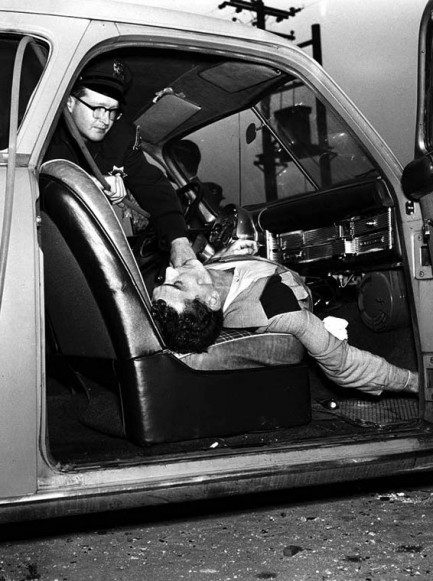
You see here three photos of Albert Schier, who committed suicide in Los Angeles today in 1954 by running a hose from the tailpipe of his car to its window and inhaling carbon monoxide fumes. What was bothering him? Hard to say, but earlier in the day he had stabbed an LAPD cop seven times and fled, so he probably wasn't going to live much longer anyway, considering he'd left his wallet in the cop's possession and every uniform in L.A. was searching for him and his car. We know what you're thinking. Maybe they got to him and made it look like murder. But we don't think cops would bother to run a hose from a tailpipe, nor to scratch a message in the dashboard with a knife. The message said: “Mom, life isn't worth the struggle.” 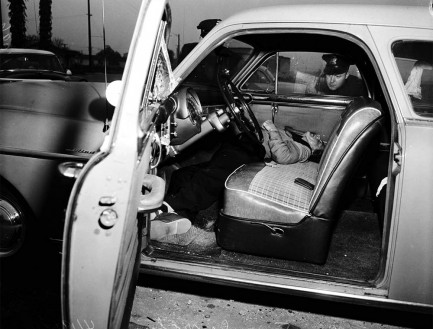 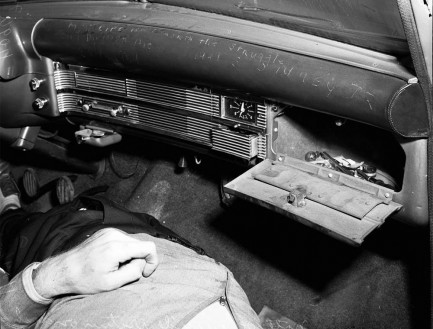
 If heaven were like this it would get crowded mighty fast. 
We don't believe in angels, but if we did this is pretty much what we'd want them to look like. This photo shows heavenly adult film actress Shauna Grant, who, like several other ’70s and ’80s adult film actresses, we've featured before. One reason we do it is because we see a line that extends from pulp all the way into porn via the former's focus on sex. Though authors were not generally able to write explicitly about it at the time, sexual gratification was the prime motivator for many pulp characters. You also see it where pulp intersects film noir, but serious legal risk prevented filmmakers of the ’40s and ’50s from exploring the themes deeply. The pulp influenced literature of the ’50s, and the films of the ’60s pushed the envelope more, but were still constrained by censors.
Around the time Grant was making her debut in porn in 1982, directors en masse were beginning to rework pulp and film classics into thrillers with sex centrally placed. 1981's Body Heat and The Postman Always Rings Twice, 1982's I, the Jury and Cat People, 1984's Against All Odds, and 1987's No Way Out, are just a few examples. The trend continued through 1990's The Grifters, 1994's The Getaway, and beyond, with all these films making clear what was only hinted in source material dating back to the 1930s, ’40s and ’50s—guys will go to almost any length for sex. For real world proof of that, scroll down to yesterday's Barcelona orgy story.
But usually it isn't just sex that gets fictional males in trouble—it's amazing sex. If it were just vanilla sex they wouldn't lie, cheat, steal, and murder. No, it's sex that blew their fuses. So that thread weaves neatly into porn, because porn was designed to implant concepts of sex that average people had never experienced—even if the experiences shown were not reality, but something more like performance art. Grant was one of the art's most popular practitioners. And she fits with our ideas about pulp for another reason too—she's freighted with pulp-like tragedy due to dying early via suicide today in 1984, two days after shooting herself in the head. We have a couple of other Grant items that might interest you, here and here.
 The nap that turned into an unsolved mystery. 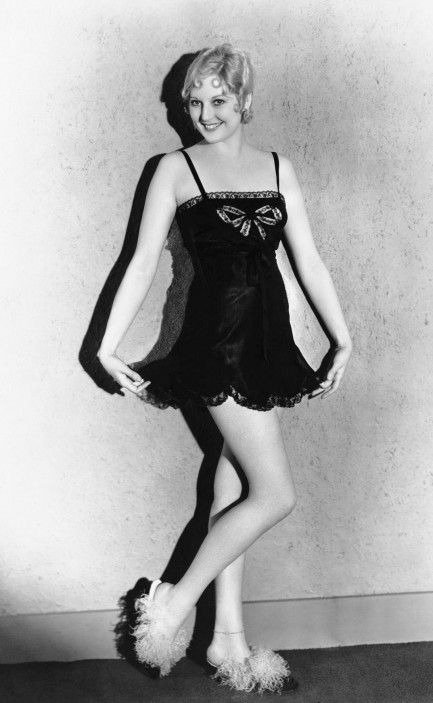
This 1931 photo is probably the most famous image of actress Thelma Todd, who appeared in more than fifty films between 1926 and 1936, before meeting an early demise in her car thanks to carbon monoxide poisoning. While her death was ruled an accident—said by police to have occurred as she waited in her car, ran the engine in order to use the heater, and fell asleep either before or while succumbing to noxious fumes—others claim she was murdered. The official police report also suggested suicide, which means Todd's demise came about for three possible reasons, none of them conclusive. It's an eternal Hollywood mystery, one of hundreds. She died today in 1935 when she was twenty-nine.
 Can there ever be too much of a good thing? 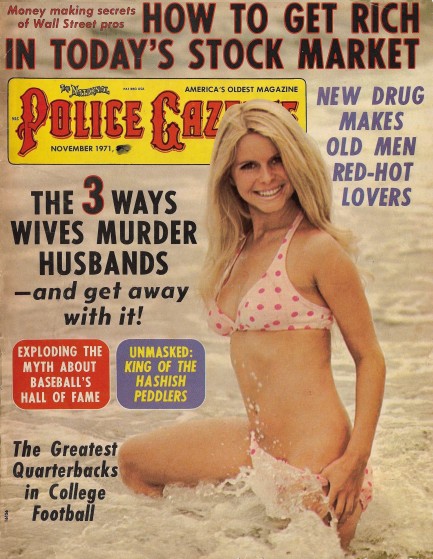
We're still cleaning out that pulp closet, so above you see some random scans from another National Police Gazette. We have an excess of this magazine, and since these late stage editions aren't as interesting as the ones from the ’50s and ’60s, they have to go. And speaking of overabundance, our favorite story in this issue is, “The 3 Ways Wives Murder Their Husbands.” What are they? Apparently, food, aggravation, and sexual excess. We're guessing very few husbands receive number three on that list. But the good news is now you can tell your significant other that one of the world's oldest tabloids, a magazine established in 1845 and full of wisdom, says you should be killed with sex. Good luck with that.
Elsewhere in the issue you get Jacqueline Bisset, Gene Tunney, Jean Harlow, and the strange death of Paul Bern. The Bern incident is part of Hollywood lore. He was married to Jean Harlow for four months when he committed suicide by shooting himself. He left a note behind that apologized for a “frightful wrong" he had done Harlow, and referred to the previous night as “only a comedy.” It led observers to believe Bern had a sexual problem that he tried to solve by artificial means, only to fail. A strap-on, was the inference made by tabloids. But the truth never emerged, certainly not from Harlow herself. There's more to the story, and maybe we'll get into it later. Scans below, and more issues of Gazette here. 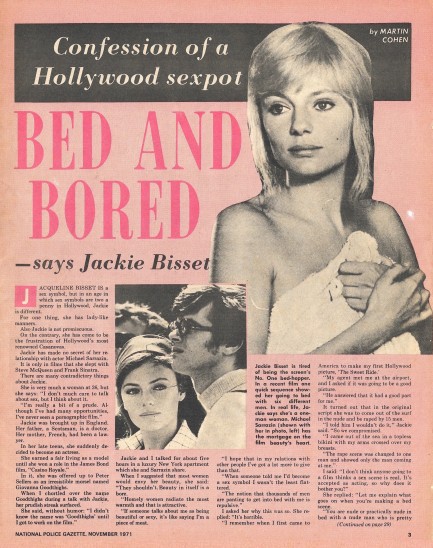 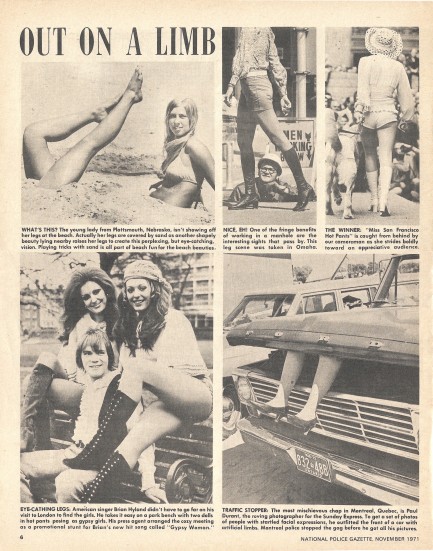  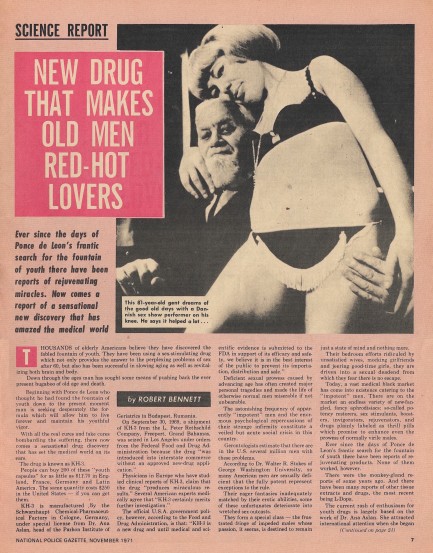 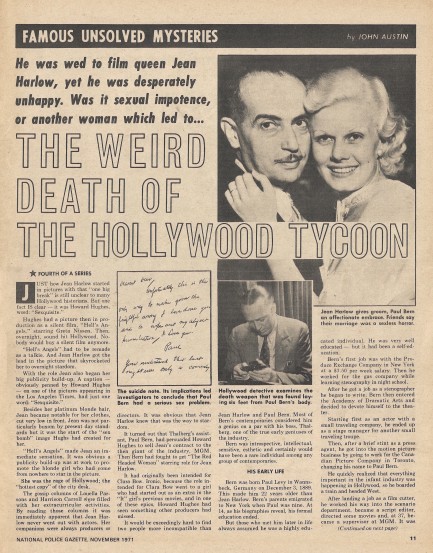 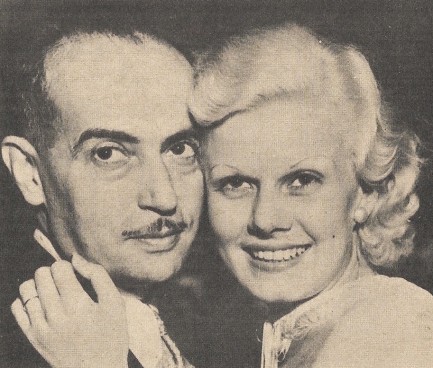 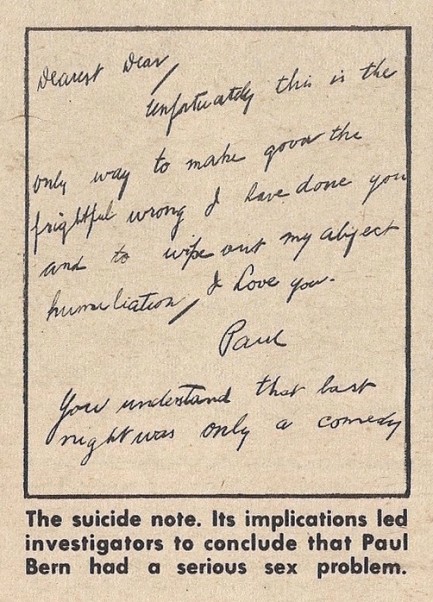 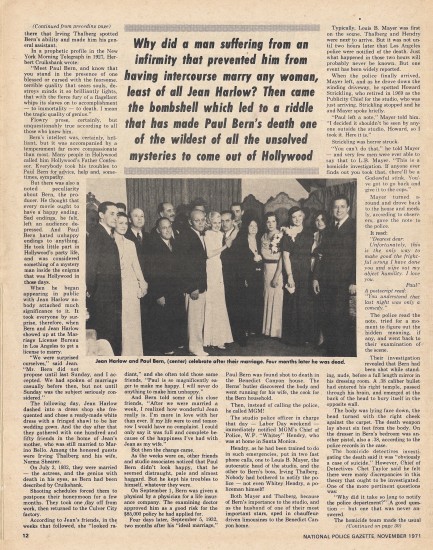 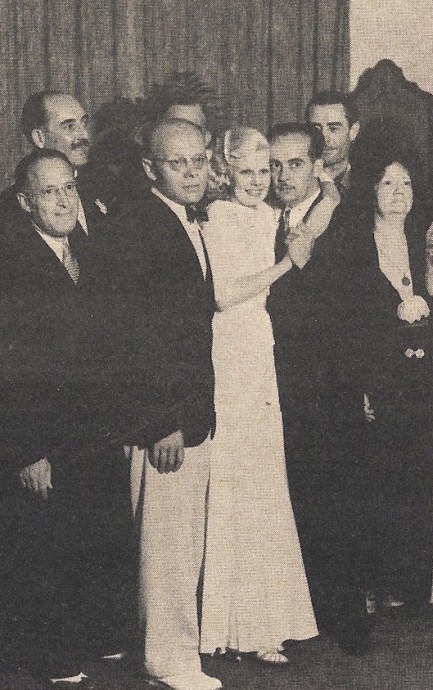 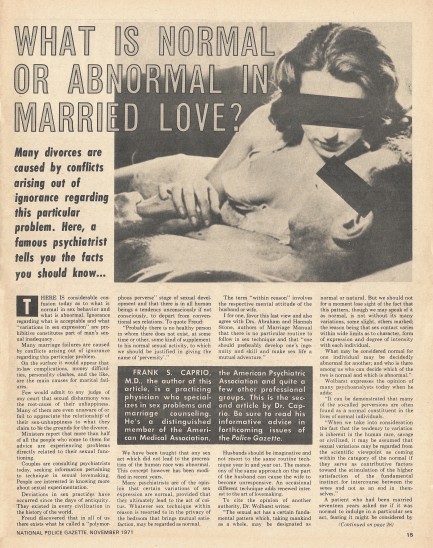 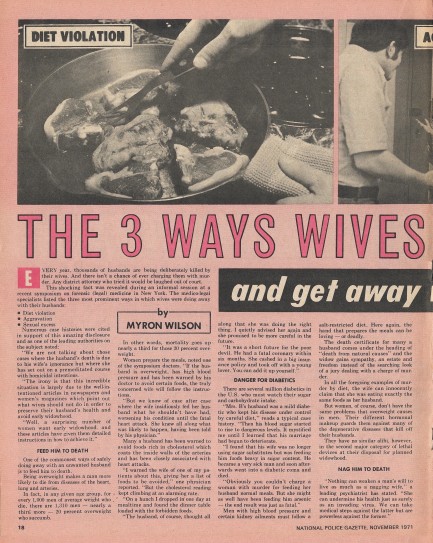 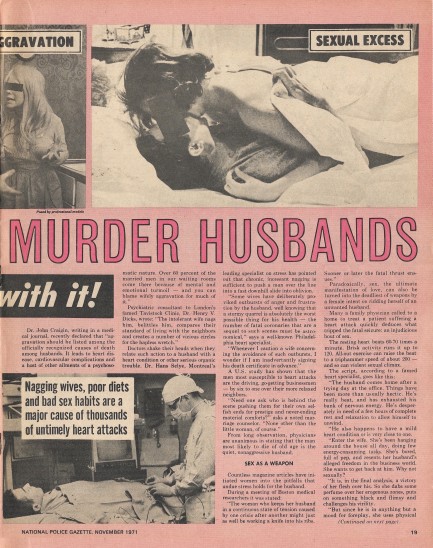 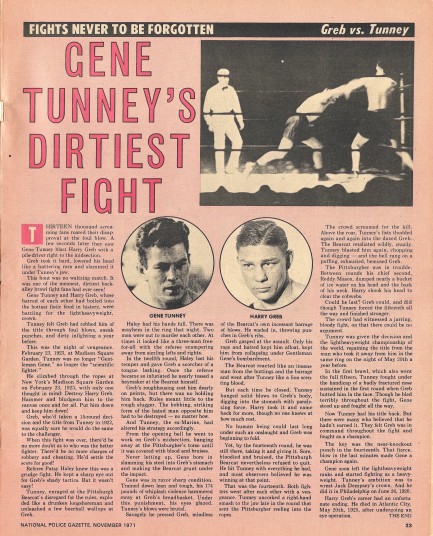 
 Pageant winner fulfilled show business and personal ambitions. Then things went wrong. 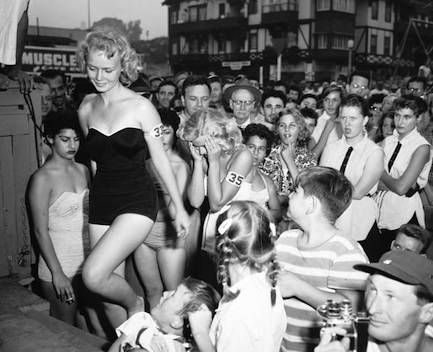 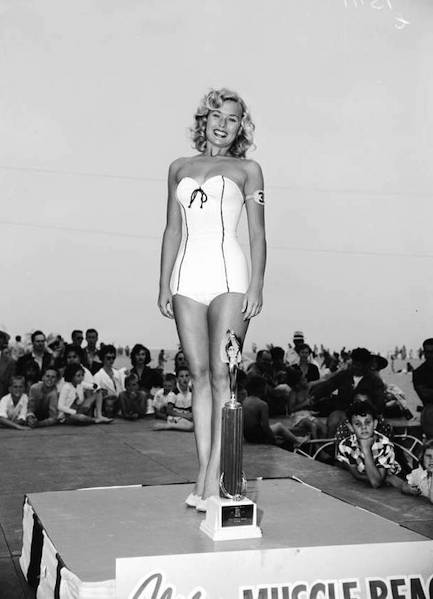 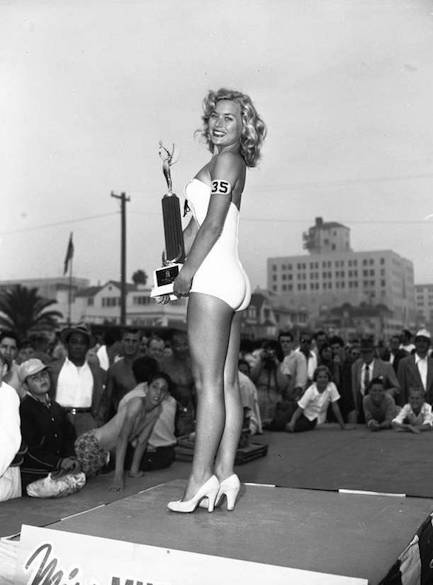
Beauty pageants are a bit silly, perhaps, but the participants are generally ambitious people who see them as stepping stones to show business or modeling. And in mid-century Los Angeles in particular, even minor pageants occasionally led to stardom. In the above photos high school student Barbara Thomason wins the crown of Miss Muscle Beach 1954. Listed at 5 foot 3 inches and 110 pounds, she was a body-building enthusiast, and in the shot just below she celebrates her hard fought win by pumping a bit of iron while photographers click away and a crowd watches.
Did Thomason's victory lead to bigger things? Maybe not directly, but it probably helped. She was a habitual pageant participant who also won Miss Huntington Beach, Miss Van Ness, Miss Bay Beach, Miss Southwest Los Angeles, Miss Pacific Coast, Queen of Southern California,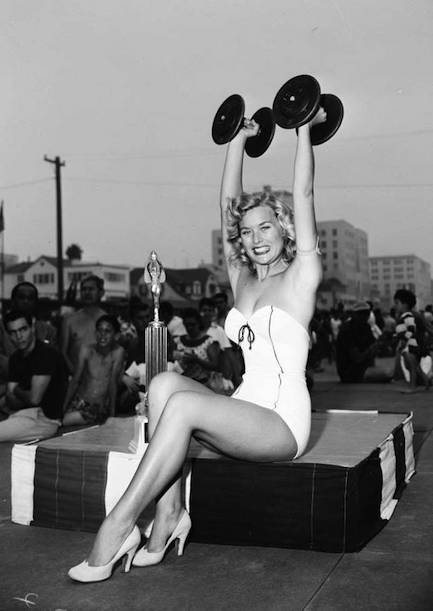 and ten other titles. All that winning finally got her noticed by Hollywood movers and shakers. In 1955, performing under the name Carolyn Mitchell, she made her acting debut on the television show Crossroads, and in 1958 co-starred in two Roger Corman b-movies, The Crybaby Killer and Dragstrip Riot. and ten other titles. All that winning finally got her noticed by Hollywood movers and shakers. In 1955, performing under the name Carolyn Mitchell, she made her acting debut on the television show Crossroads, and in 1958 co-starred in two Roger Corman b-movies, The Crybaby Killer and Dragstrip Riot. But she put her career on hold when she met and married a star—Mickey Rooney, who was nearly seventeen years her senior and nearly two inches her junior. Their union had problems from the beginning. The couple married secretly in Mexico because Rooney was still awaiting a divorce from actress Elaine Mahnken. They would have to wait almost two years before the law allowed them to wed in the U.S. Legalities, though doubtless bothersome, were the least of their problems. During the next six years, during which Thomason bore four children, Rooney indulged in numerous affairs.
It should probably be noted here that Thomason was Rooney's fifth wife. Among the predecessors were goddesses like Ava Gardner and Martha Vickers. We don't know what Thomason's expectations of marriage were, but clearly Rooney didn't know the meaning of the phrase “for better or worse.” The affairs continued, and eventually Thomason did the same with a temperamental Yugoslavian actor named Milos Milosevic, who performed under the name Milos Milos. But what was good for goose was not 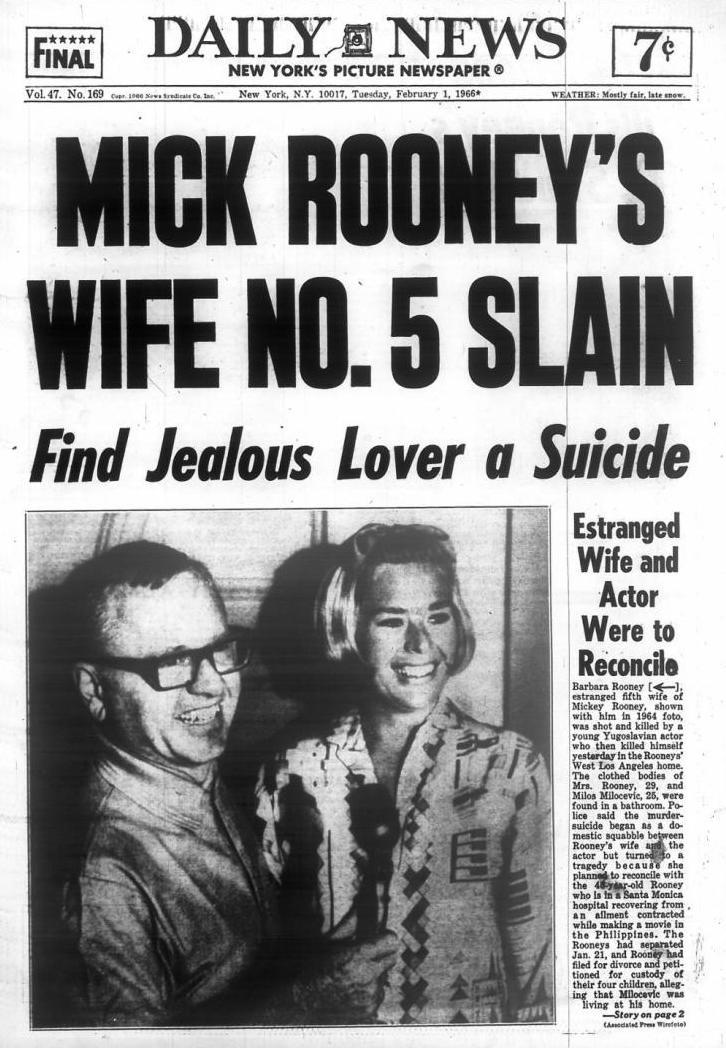 good for the gander—Rooney found out about these international relations, moved out of the Brentwood house he shared with Thomason, and filed for divorce, charging mental cruelty. The nerve, right? good for the gander—Rooney found out about these international relations, moved out of the Brentwood house he shared with Thomason, and filed for divorce, charging mental cruelty. The nerve, right?
On the morning of January 31, 1966, while Rooney was in St. John's Hospital recovering from an intestinal infection he'd picked up in the Philippines, Thomason and Milosevic were found together on the bathroom floor of the Brentwood house, dead. Milosevic had shot Thomason under the chin and killed himself with a temple shot using a chrome-plated .38 Rooney had bought in 1964. The consensus is Thomason had decided to dump Milosevic and he flipped out.
The photos below show Thomason on Muscle Beach during her halcyon years there, a mere teenager, frolicking in the sun, filled with youthful hopes for a good life. She won beauty titles, acted in films, married an icon, and had four children. Any of those accomplishments would have been good legacies. Instead her death at twenty-nine overshadowed all the rest, and she's remembered as another celebrity murder victim, Hollywood style, which is always somehow both sensational and banal. 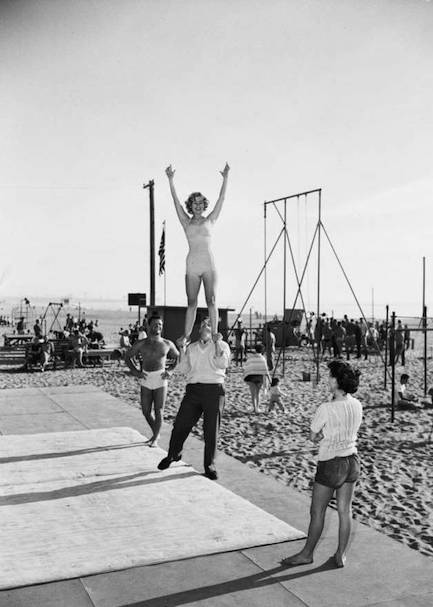 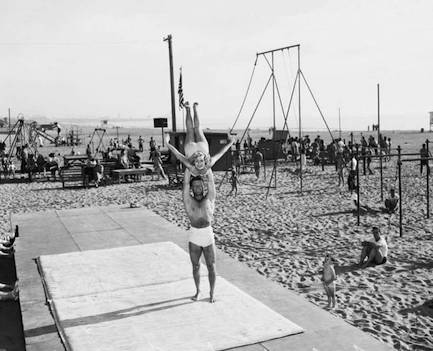 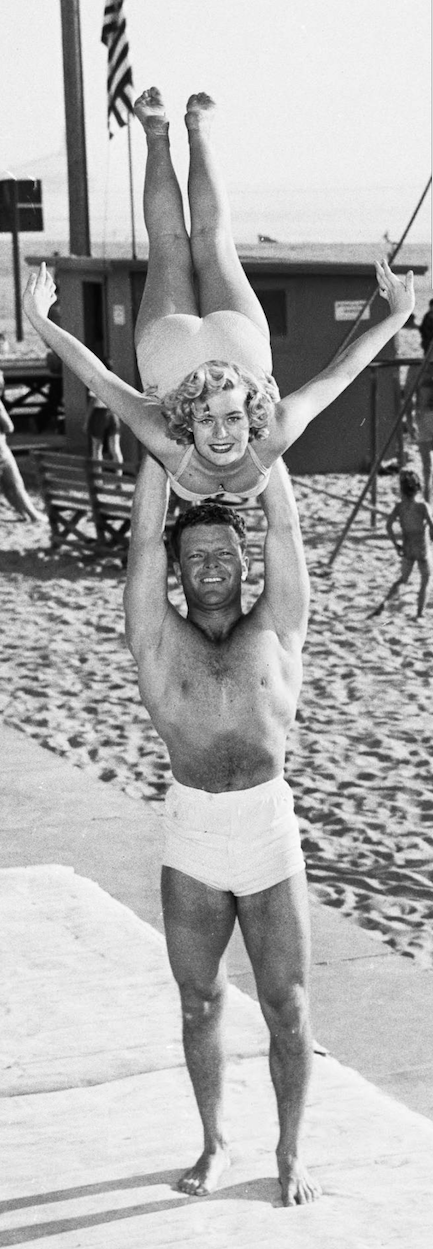
 Yep, this guy's dead as hell. Too bad. He could sue the beer company for false advertising. 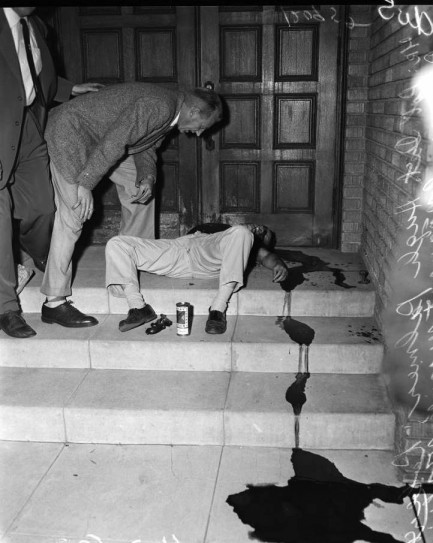
This photo, which is part of the archive of mid-century Los Angeles Herald press shots maintained by the University of Southern California, shows a suicide at the front entrance of Temple M.E. Church at 14th and Union in Los Angeles. The man was named Robert Palmer, and you can see that the poor guy shot himself in the middle of the forehead. You can also see that he bled profusely, which suggests his heart pumped for a bit before he finally died. L.A.P.D. detective Hugh Palmer (no relation) stands over him. Like many suicides Robert Palmer had a final drink before doing the deed. His choice? As you see in the zoom below, it was Lucky Lager, which conferred no benefits whatsoever. Maybe a rabbit's foot or a horseshoe would have been more effective. Or not. The photo is from today in 1957. 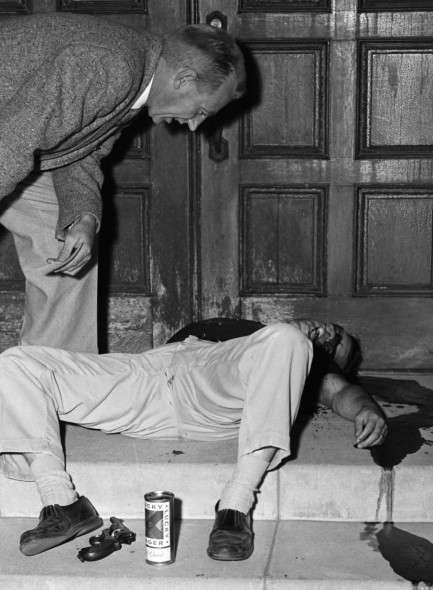 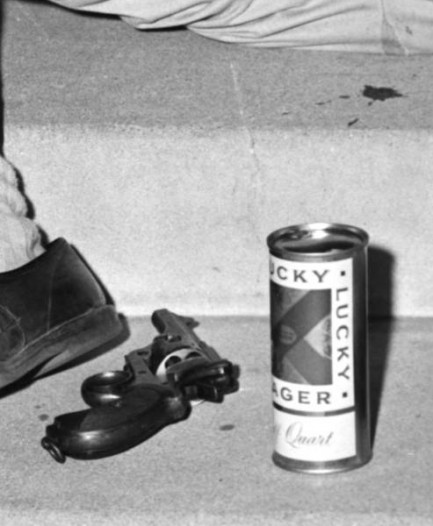

|
 |

The headlines that mattered yesteryear.
1945—Mussolini Is Arrested
Italian dictator Benito Mussolini, his mistress Clara Petacci, and fifteen supporters are arrested by Italian partisans in Dongo, Italy while attempting to escape the region in the wake of the collapse of Mussolini's fascist government. The next day, Mussolini and his mistress are both executed, along with most of the members of their group. Their bodies are then trucked to Milan where they are hung upside down on meathooks from the roof of a gas station, then spat upon and stoned until they are unrecognizable. 1933—The Gestapo Is Formed
The Geheime Staatspolizei, aka Gestapo, the official secret police force of Nazi Germany, is established. It begins under the administration of SS leader Heinrich Himmler in his position as Chief of German Police, but by 1939 is administered by the Reichssicherheitshauptamt, or Reich Main Security Office, and is a feared entity in every corner of Germany and beyond. 1937—Guernica Is Bombed
In Spain during the Spanish Civil War, the Basque town of Guernica is bombed by the German Luftwaffe, resulting in widespread destruction and casualties. The Basque government reports 1,654 people killed, while later research suggests far fewer deaths, but regardless, Guernica is viewed as an example of terror bombing and other countries learn that Nazi Germany is committed to that tactic. The bombing also becomes inspiration for Pablo Picasso, resulting in a protest painting that is not only his most famous work, but one the most important pieces of art ever produced. 1939—Batman Debuts
In Detective Comics #27, DC Comics publishes its second major superhero, Batman, who becomes one of the most popular comic book characters of all time, and then a popular camp television series starring Adam West, and lastly a multi-million dollar movie franchise starring Michael Keaton, then George Clooney, and finally Christian Bale. 1953—Crick and Watson Publish DNA Results
British scientists James D Watson and Francis Crick publish an article detailing their discovery of the existence and structure of deoxyribonucleic acid, or DNA, in Nature magazine. Their findings answer one of the oldest and most fundamental questions of biology, that of how living things reproduce themselves.
|

|
|
It's easy. We have an uploader that makes it a snap. Use it to submit your art, text, header, and subhead. Your post can be funny, serious, or anything in between, as long as it's vintage pulp. You'll get a byline and experience the fleeting pride of free authorship. We'll edit your post for typos, but the rest is up to you. Click here to give us your best shot.
|
|