 Every top notch private investigator knows the best clues are found in bed. 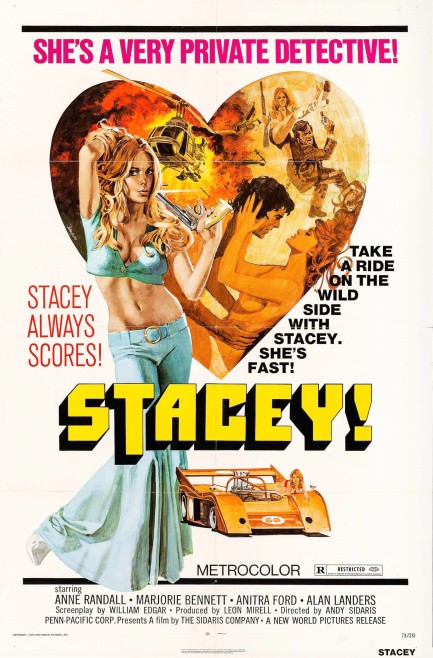
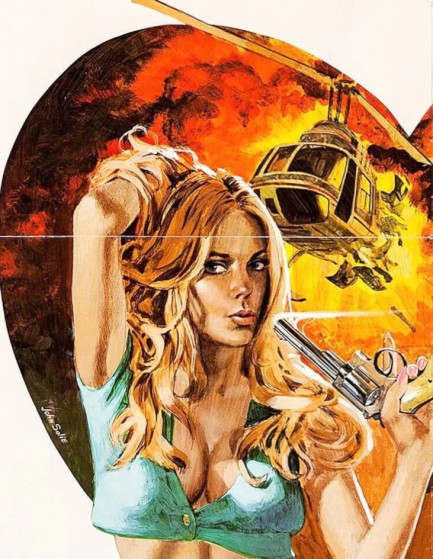
We wanted to show you another poster painted by John Solie, who was responsible for numerous blaxploitation, sexploitation, and action promos, all executed at the extremely high level you see here with his one sheet for Stacey. His other notable efforts include those for The Arena, Star Crash, Hit Man, and Hollywood Boulevard. You can click his keywords at bottom to see everything we've shared from him.
Naturally we watched Stacey and it's a cheesy detective tale starring erstwhile Playboy centerfold Anne Randall, who plays a model-turned-private dick hired to investigate a rich woman's extended family before any of them are allowed to be included in her will. Randall arrives just in time for intrigue and murder. Private investigators need to possess a Class C license in order to legally take on clients. The C on Randall's license probably stands for “casual sex.”
Even so, there's not much here. The detective elements are uninspiring despite a noir style voiceover, and the sexual elements, even with Randall and co-star Anitra Ford in occasional undress, are not going to blow your skirt up. To put the overall nothingness of the movie in perspective, consider the fact that we couldn't find a copy with sharp enough resolution to make screenshots worthwhile, nor enough official production photos to make them worth sharing. That's how much of a historical afterthought it is.
In lieu of imagery you could use your imagination, but we recommend not bothering. Stacey resides at the low end of grindhouse cinema characterized by numerous bold and outrageous entries. In our opinion it's notable only for being the first exploitation effort by director Andy Sidaris, who would go on to helm boobalicious ’80s throwaways such as Malibu Express, Hard Ticket to Hawaii, and Savage Beach. Stacey premiered in the U.S. this month in 1973.
 The exact opposite of buttoned up tight. 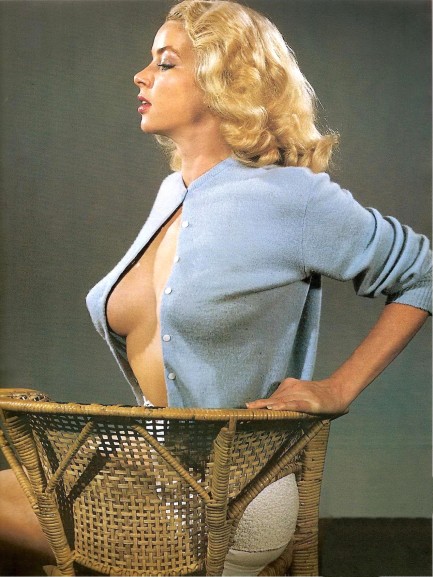
Eve Meyer, who was Eve Turner before marrying filmmaker Russ Meyer, is seen here in a photo made when she was a Playboy centerfold in 1955. A black and white version of the photo was included in that layout. After a few years modeling, Meyer appeared in several films, then produced fifteen movies, including Cherry, Harry & Raquel, Motorpsycho, and Beyond the Valley of the Dolls, all of which are schlock classics. We think this shot of her is classic too.
 A new twist on a classic art form. 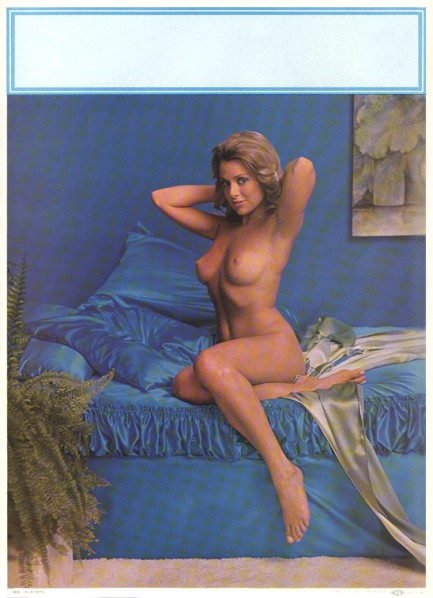 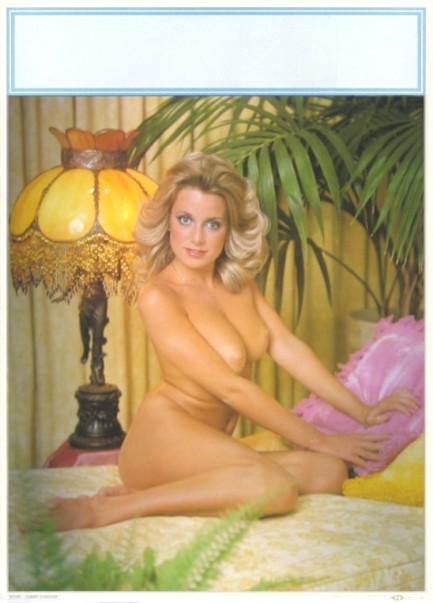
The two items above serve as interesting examples of how long Technicolor lithographs were manufactured in the U.S. We've seen and shared examples from as far back as 1952, but the two above feature Pamela Zinszer, who modeled and acted during the early 1970s and was a Playboy centerfold in March 1974. We've gotten used to calling these Technicolor lithos because of the printing process, but we can't be sure ones as late as these used that method. We'll stick with the terminology, though. See plenty more Technicolor lithos by clicking the keywords just below.
 No, she's not gold. She's something far better. 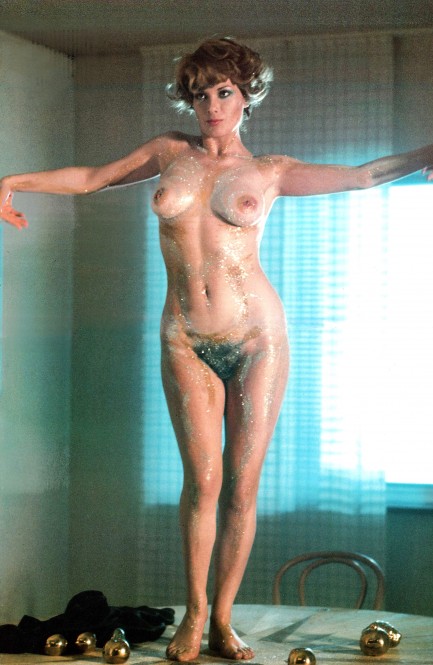
This Christmas themed image of Algerian born Italian star Edwige Fenech was made in 1976 while she was filming the comedy Cattivi pensieri, known in English as Evil Thoughts. She actually does in the film exactly what you see here, posing and dancing on a table while covered in holiday glitter, before being whisked off to bed by co-star Luc Merenda for some hazy focus softcore sex. Don't let that entice you into watching the movie, though. Fenech is a wonder, but she's done far better stuff.
 If she was fishing for compliments she probably got them. 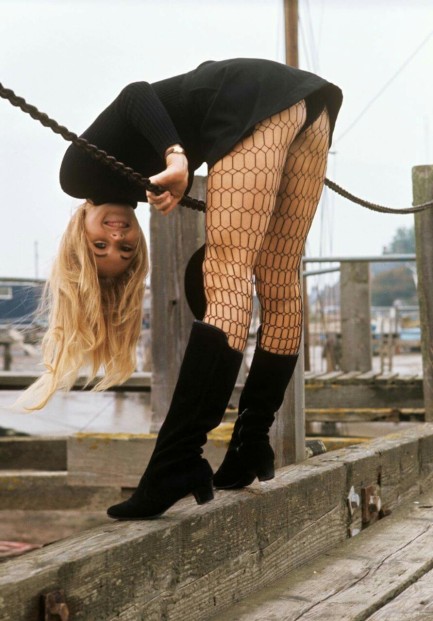
Danish actress Kirsten Lindholm strikes an interesting pose in this promo image made around 1970. Acting under her own name and as Kirsten Betts, she had small roles in seven movies, including The Love Factor, Crescendo, Twins of Evil, The Vampire Lovers, and Lust for a Vampire. Four of those were horror flicks made by Hammer Studios, which is why she's remembered by cult movie fans as a “Hammer horror babe,” which is like being a James Bond girl but with more blood and screaming. She was also a model, and turned up at one point in Playboy, which made occasional use of this pose, as we've seen previously with Dolores Donlon. We've not yet screened a Lindholm/Betts movie during our long pulp project, but that's probably inevitable. Expect to see her again.
 The most eco-friendly way to boil water. 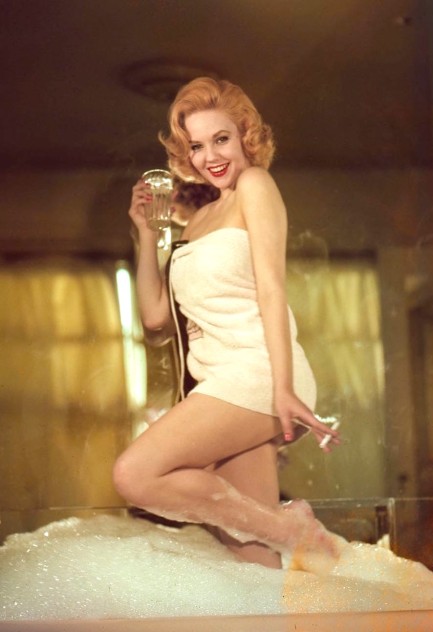
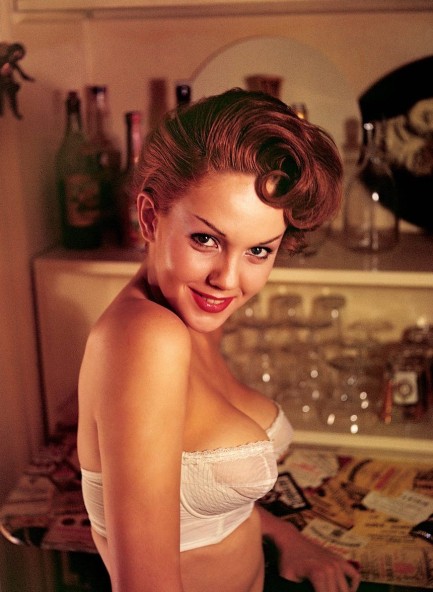
The above photo and those below show the lovely U.S. model and singer Colleen Farrington, who we saw on a paperback cover not long ago. There are many frames from this session floating around online, and over time we developed a narrative about them. In our heads Farrington was a little nervous at first, and was like, “Maybe a drink and a smoke will relax me.” Ten minutes later: “Let's show it all!” She even went so far as to give a glimpse of what was most assuredly a massive bush. Farrington became Playboy's October 1957 centerfold—which was around the time these images were made—and about eight years later brought into the world Diane Lane, whose movie The Big Town we discussed last year.
Publishing nude actresses brings criticism our way occasionally. We received such an e-mail a while back when we mentioned feminist themes in Leslie Ford's fiction and posted a Reiko Ike nude on the same day, a juxtaposition which we admit invites scrutiny. The e-mail, which actually was mostly positive, suggested that female nudity is exploitative unless, perhaps, shot by other women. We disagree with that perspective, but it at least tacitly acknowledges the validity of erotic photography. There are some out there who see female nudity as exploitative no matter who shoots it, and believe that the concept of artistic nudity is just a fig leaf for the same old gender repression. But as we've said before, when artful nudity becomes taboo, control over what constitutes normal sex is ceded to the porn industry. How's that working out?
We think whether a nude female image is exploitative depends on myriad considerations: who made it and when; who financed it and what was paid, if anything; who appeared in it and why; whether they appeared willingly (even if it was only for money); what the art was trying to depict or say; the context in which it was disseminated or displayed;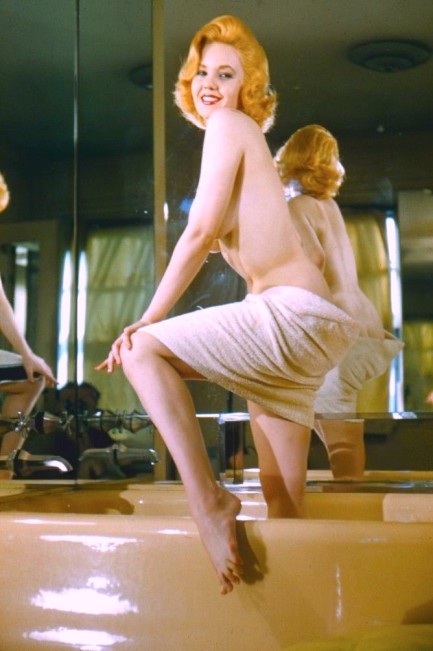 and whether it succeeded purely as a discrete piece of art. With all those factors in play, it's easier to just condemn everything. The final consideration, though, is key: the successful execution of the piece. Good art, as long as it was never intended to harm or subjugate, immediately or eventually sheds cultural criticisms like a duck sheds water. and whether it succeeded purely as a discrete piece of art. With all those factors in play, it's easier to just condemn everything. The final consideration, though, is key: the successful execution of the piece. Good art, as long as it was never intended to harm or subjugate, immediately or eventually sheds cultural criticisms like a duck sheds water.
Sexual desire is encoded in our DNA. Erotic art will rebound from the new puritanism and will always exist, but with the inclusion of fresh points of view. Arguably, it's already happening. Art is an appropriate realm for exploring sexual ideas. Erotic photography is pulp-related due to the sexual subtext of so much pulp literature and film noir, the evolution of men's adventure magazines into nudie mags, and the popularity of cheesecake pin-ups. The relationship between sexual subtext and a nude is exactly the same as the relationship between a word, and a definition of that word. We offer some definitions here at Pulp Intl. and will continue making the connection between what is hinted at versus what can shown, even if for the time being sharing nudes means we're swimming upstream.  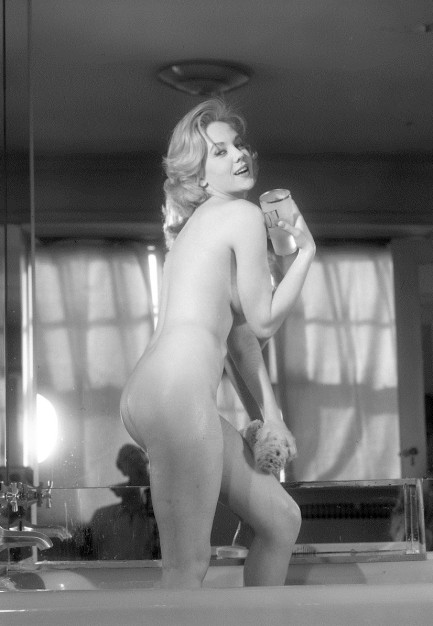 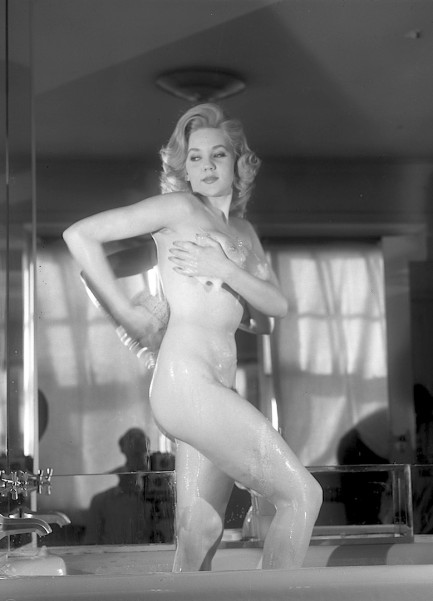 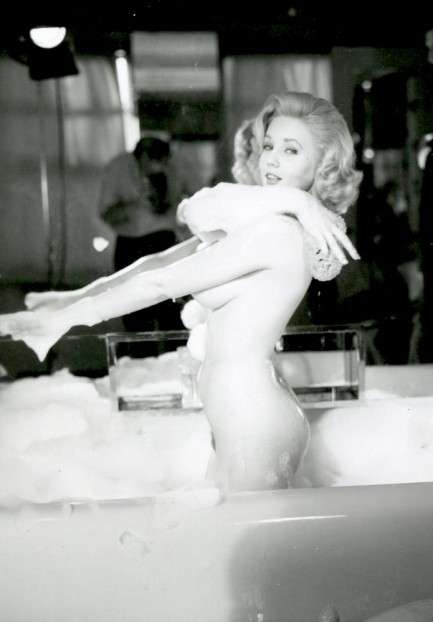
 She shot an arrow into the air, it fell to Earth— Well, nobody knows where because they weren't watching the arrow. 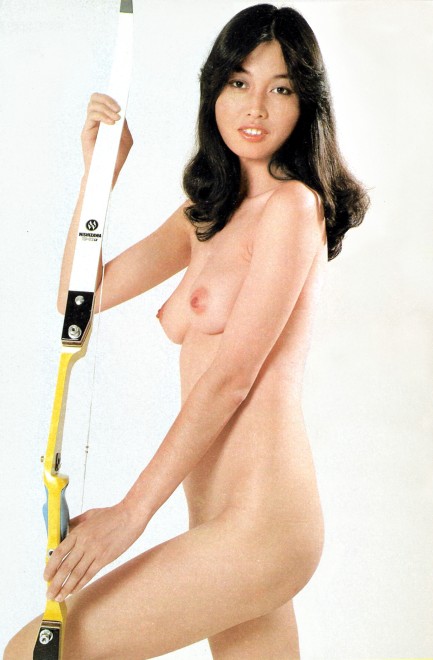
Japanese actress Maria Mari poses with a fancy Nishizawa recurved archery bow, which like the arrow she shot nobody is bothering to pay an iota of attention to. It's understandable. Mari looks quite beautiful and slender here in this photo from 1980. The image is part of a series of seven published in Weekly Playboy featuring different actresses posed with sports and recreation gear. You'll be seeing the other shots as the months roll onward. In the meantime you can see a bit more Mari here and here.
 Abracadabra! Bim-skala-bim! Wherever my clothes were sent, return them from where they went! 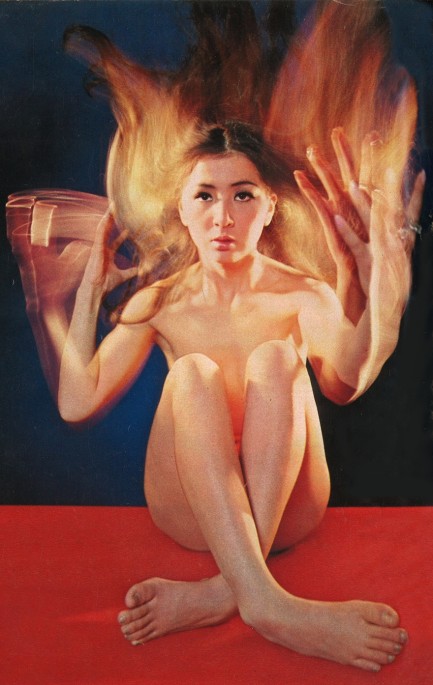
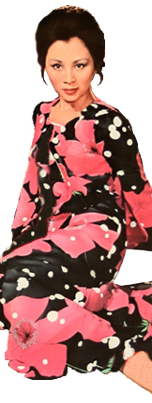
This photo from an issue of Weekly Playboy features Japanese model Yuko Sugiyama looking a bit witchy, which fits for this time of year, if you happen to celebrate Halloween. Normally we only feature shots of actresses, which she never was as far as we know, but we like the image so much we thought we'd use it anyway. It's from 1968.
 Horwitz Publications perfectly red the paperback market. 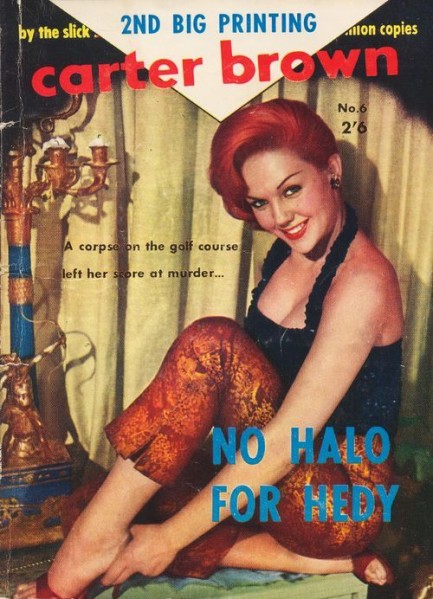
 For a while we were tracking the possibly unlicensed usage by Australian imprint Horwitz Publications of celebrities on its paperback covers. We fell down on the job a bit. The last one we looked at was two years ago. For a while we were tracking the possibly unlicensed usage by Australian imprint Horwitz Publications of celebrities on its paperback covers. We fell down on the job a bit. The last one we looked at was two years ago. The red-haired model used above on Carter Brown's thriller No Halo for Hedy is Playboy centerfold and nightclub performer Colleen Farrington, who was the mother of actress Diane Lane. The book originally appeared in 1956, and the above reprint came in 1959. This photo used for the cover is rare. We've seen no other shot of Farrington in these capri pants. Presumably, at one point multiple frames from the session existed, but time disposes of such items. However, it can't diminish the beauty of this cover. You can see all of our Horwitz celeb covers by clicking here.
 She always wanted people to think of her as sizzling hot. 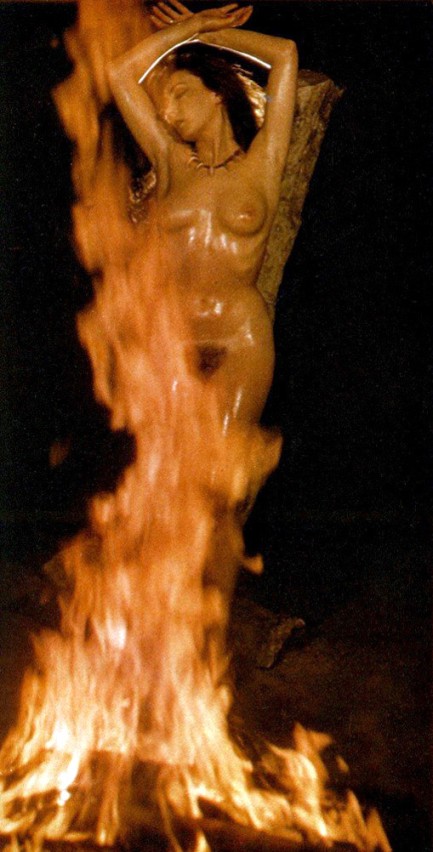 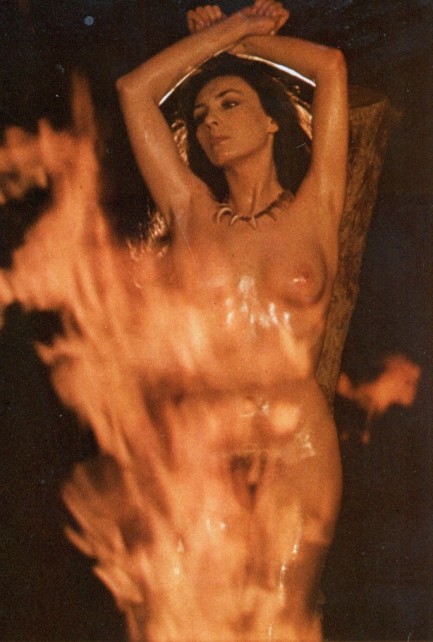
You don't see many photos like these. They were published in Playboy Italy in 1980, and feature Italian actress Maria Rosaria Omaggio, who appeared in such films as Roma a mano armata, aka The Tough Ones, and Squadra antiscippo, aka The Cop in Blue Jeans. These images are yet more imaginativeness from famed photographer Angelo Frontoni. This time he took his cue from Omaggio when she said she collected writings on witches and the occult. Playboy shared an example: The candelabrum: go at night to the place reputed to hide a treasure, carefully watching the oscillations of the flame. When the flame goes out, it will be a sign that you have the coveted treasure under your feet. Groovy.
The text goes on to note that during the Italian Renaissance, and later during the Counter-Reformation, contraception, birth control, and infertility came to be defined as witchcraft. So the eclectic Frontoni, in collaboration with Omaggio, took all that info onboard came up with this immolative concept. Don't forget, this was during an era when photographers and models generally saw nudity as an expression of freedom and power. In other words, Frontoni and Omaggio, by using nude-witch-at-the-stake imagery, were saying, “Strip away all the excuses and this is what many men really hate and fear most: women.” Heavy handed? Maybe. But very much on target, we think.

|
 |

The headlines that mattered yesteryear.
1945—Mussolini Is Arrested
Italian dictator Benito Mussolini, his mistress Clara Petacci, and fifteen supporters are arrested by Italian partisans in Dongo, Italy while attempting to escape the region in the wake of the collapse of Mussolini's fascist government. The next day, Mussolini and his mistress are both executed, along with most of the members of their group. Their bodies are then trucked to Milan where they are hung upside down on meathooks from the roof of a gas station, then spat upon and stoned until they are unrecognizable. 1933—The Gestapo Is Formed
The Geheime Staatspolizei, aka Gestapo, the official secret police force of Nazi Germany, is established. It begins under the administration of SS leader Heinrich Himmler in his position as Chief of German Police, but by 1939 is administered by the Reichssicherheitshauptamt, or Reich Main Security Office, and is a feared entity in every corner of Germany and beyond. 1937—Guernica Is Bombed
In Spain during the Spanish Civil War, the Basque town of Guernica is bombed by the German Luftwaffe, resulting in widespread destruction and casualties. The Basque government reports 1,654 people killed, while later research suggests far fewer deaths, but regardless, Guernica is viewed as an example of terror bombing and other countries learn that Nazi Germany is committed to that tactic. The bombing also becomes inspiration for Pablo Picasso, resulting in a protest painting that is not only his most famous work, but one the most important pieces of art ever produced. 1939—Batman Debuts
In Detective Comics #27, DC Comics publishes its second major superhero, Batman, who becomes one of the most popular comic book characters of all time, and then a popular camp television series starring Adam West, and lastly a multi-million dollar movie franchise starring Michael Keaton, then George Clooney, and finally Christian Bale. 1953—Crick and Watson Publish DNA Results
British scientists James D Watson and Francis Crick publish an article detailing their discovery of the existence and structure of deoxyribonucleic acid, or DNA, in Nature magazine. Their findings answer one of the oldest and most fundamental questions of biology, that of how living things reproduce themselves.
|
|
|
It's easy. We have an uploader that makes it a snap. Use it to submit your art, text, header, and subhead. Your post can be funny, serious, or anything in between, as long as it's vintage pulp. You'll get a byline and experience the fleeting pride of free authorship. We'll edit your post for typos, but the rest is up to you. Click here to give us your best shot.
|
|