| Hollywoodland | Oct 11 2016 |

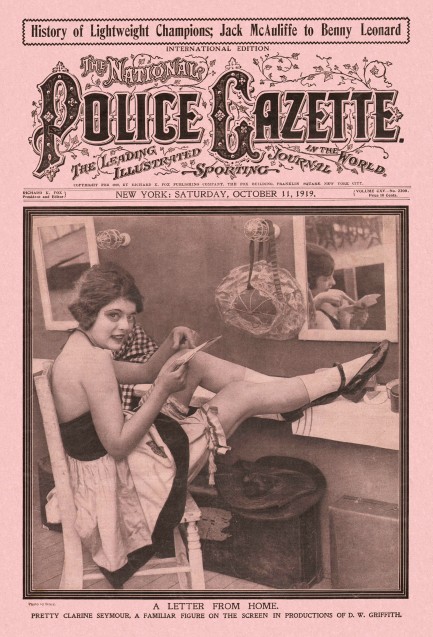
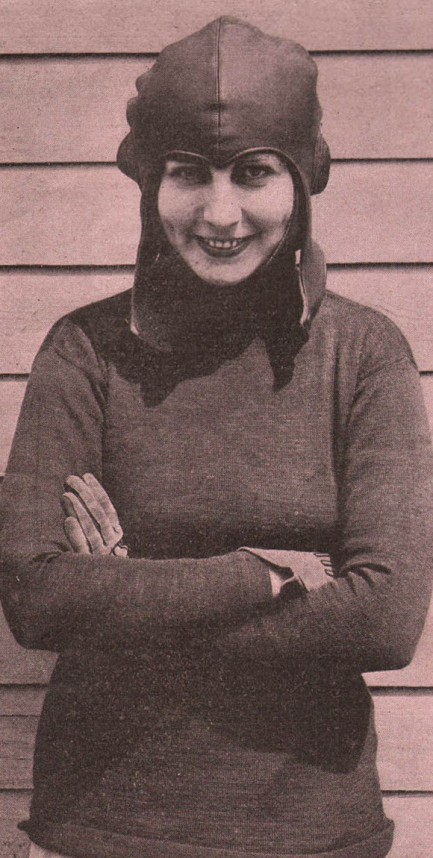
It's been a while since we checked in with The National Police Gazette, that most venerable of U.S. magazines, launched all the way back in 1845. Today we venture to the year 1919, one of its famed pink issues, with cover star Clarine Seymour. She's described as pretty by the editors, but before you smirk and say beauty standards have really changed in a hundred years, check out the inset photo. 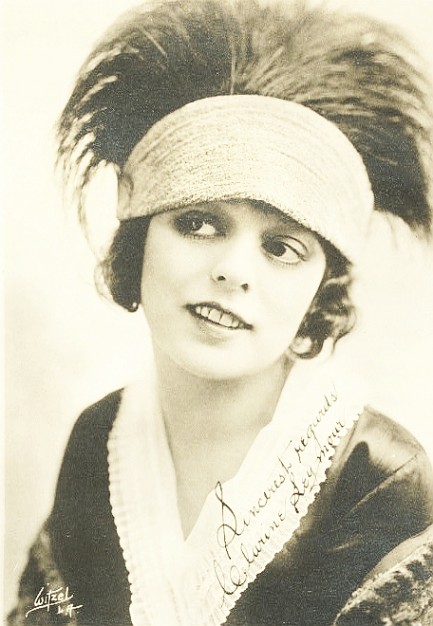 So you see, Gazette's cover doesn't capture Seymour at her best.
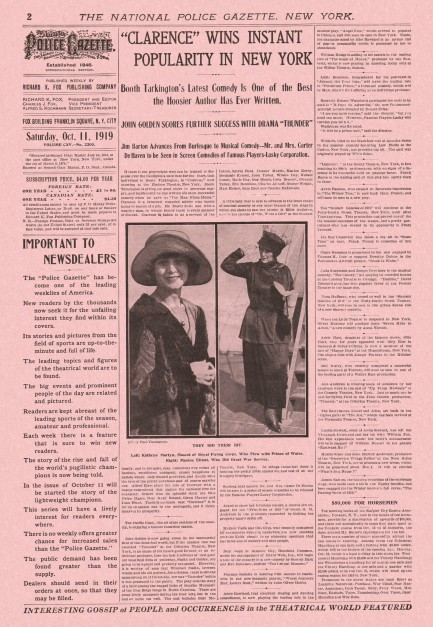
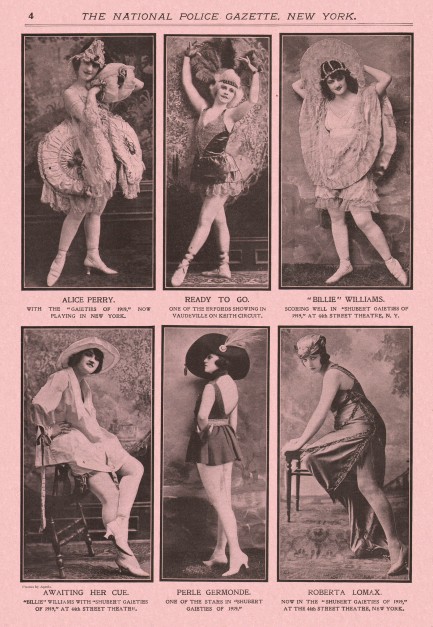
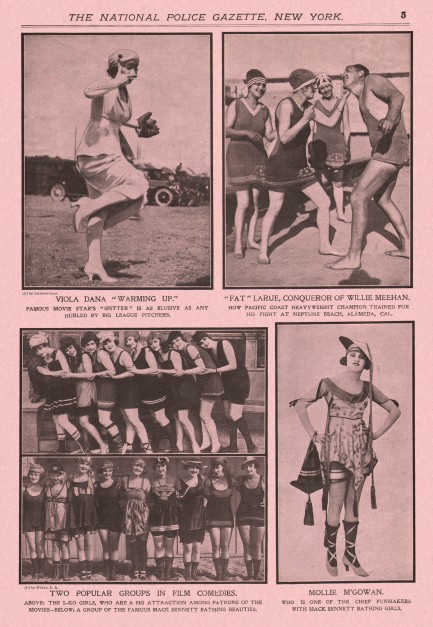
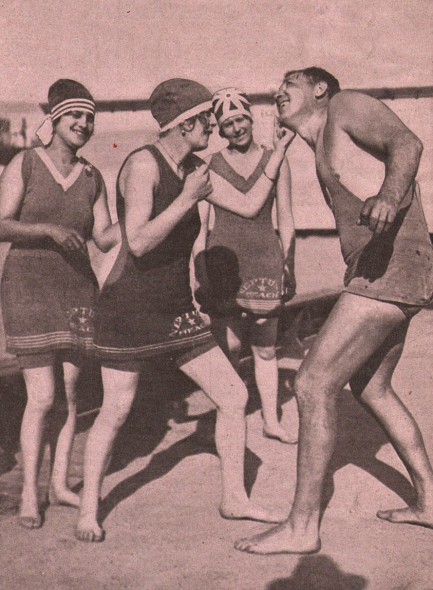
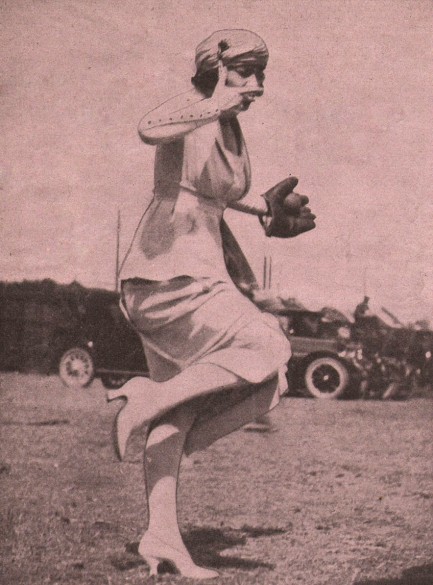
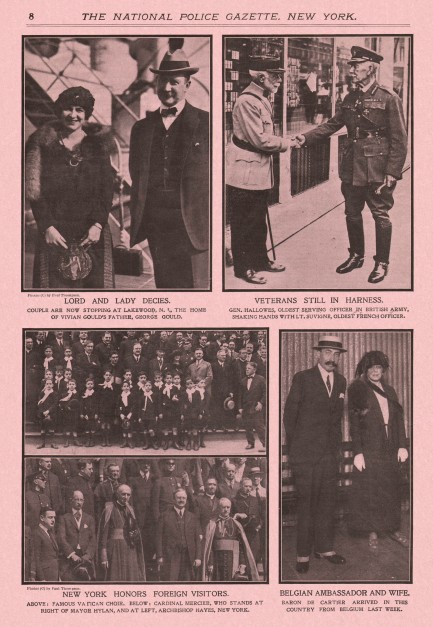
Beauty standards may be different but the human body hasn't changed in a hundred years. A lot of what beauty is has to do with clothing, hair, etc. As proof, we have some nude images from around 1920 that could have been made yesterday. We may post one of those later, just for the fun of it. Elsewhere in the Gazette you get the usual celebs, boxers, and news briefs, all offering a fascinating view onto what the U.S. looked like during the heyday of the pulp era, which according to most scholars began in the last few years of the 19th century. The society, the people, the pulp, and the Gazette would all become more recognizably modern in a few more decades.


| Vintage Pulp | May 16 2016 |


| Sportswire | May 11 2016 |


| Sportswire | Apr 2 2016 |


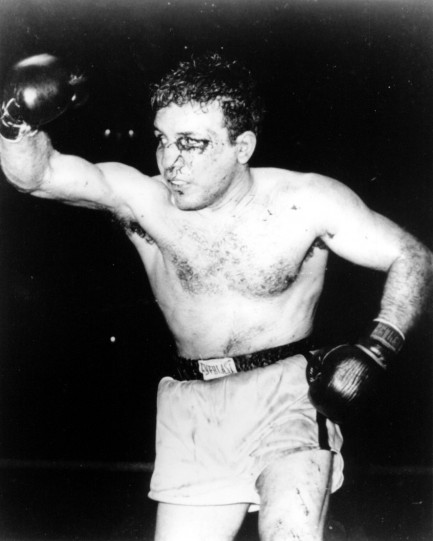
How much beating can a fighter take? National Police Gazette asks that burning question on the front of this issue that hit newsstands this month in 1950. The cover star is Jake LaMotta, the Bronx Bull, who was famous for being able to take a punch—or fifty—and his unseen opponent is French fighter Robert Villemain. The photo was made during their December 1949 bout, a match LaMotta lost by unanimous decision. But his reputation as someone who could take a punch grew even when he lost, and eventually reached legendary proportions. His most serious beating occurred in February 1951 during a bout with Sugar Ray Robinson that was dubbed the Saint Valentine's Day Massacre. By the end the fight had become an epic of human destruction, and almost certainly caused permanent damage to La Motta. But in ninety-five professional matches to that point he had never been knocked to the canvas and he didn't fall that night either, even during a vicious final-round barrage that had LaMotta staggering around the ring. So the answer to Gazette's question—How much beating can a fighter take?—is simple. If you're LaMotta, you can take plenty.

| Sportswire | Sep 23 2015 |


| Sportswire | Sep 1 2015 |

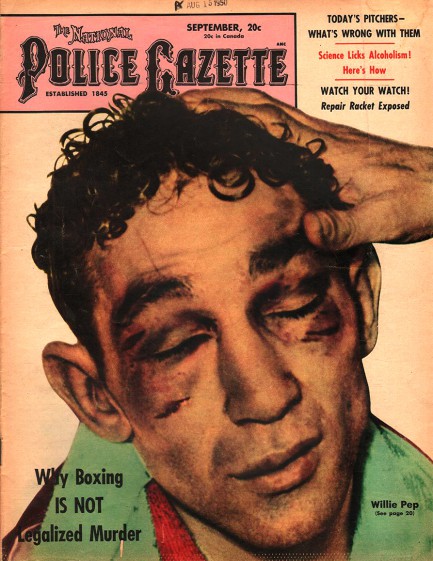
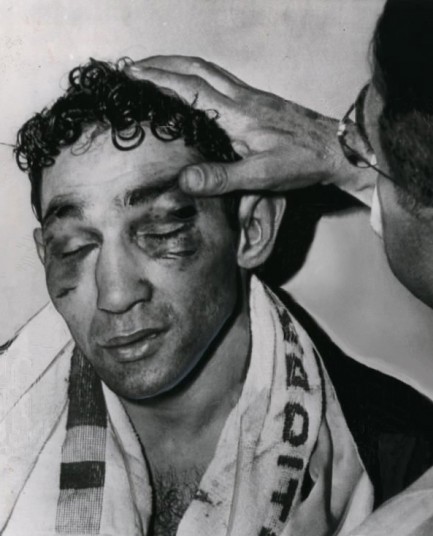
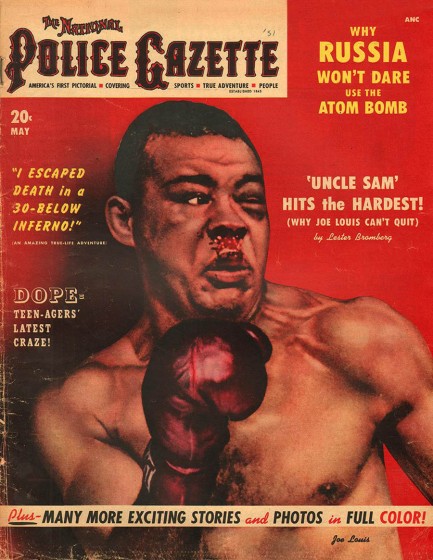
The cover of this National Police Gazette published today in 1950 shows boxer Willie Pep being assessed by Dr. Vincent Nardiello after a February 1949 bout with archnemesis Sandy Saddler. Below the cover is another image from the same sequence. Saddler really put a hurting on Pep, as you can see from the severity of his injuries, but that was normal for the two fighters. They met four times, trading the lightweight championship three times in those battles, with the last fight considered even today one of the dirtiest of all time. You can see more from Police Gazette by clicking its keywords below.

| Vintage Pulp | Aug 5 2015 |

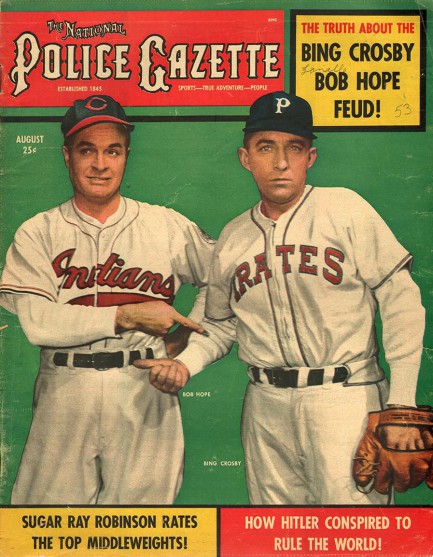
This awesome August 1953 National Police Gazette featuring Bob Hope and Bing Crosby cut-and-pasted into baseball uniforms came from the website Ephemera Forever, which we had no idea existed until today. It’s a nice spot, and claims to have more than 22,000 rare items. The prices? Well, those are high. But you can always browse, at least. As far as the Hope/Crosby feud mentioned on the cover, different sources make claims of everything from full blown mutual hatred to the two using rumors of discord as a publicity stunt. However Hope did once reveal that Crosby never once invited him and his wife over for dinner, which seems like a pretty strong clue. See much more from Police Gazette in our tabloid index.

| Intl. Notebook | Jun 8 2015 |

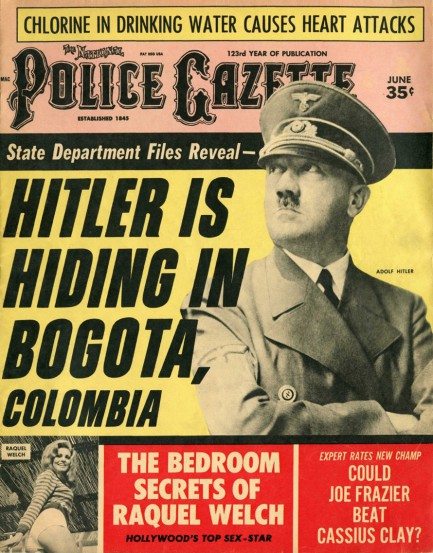
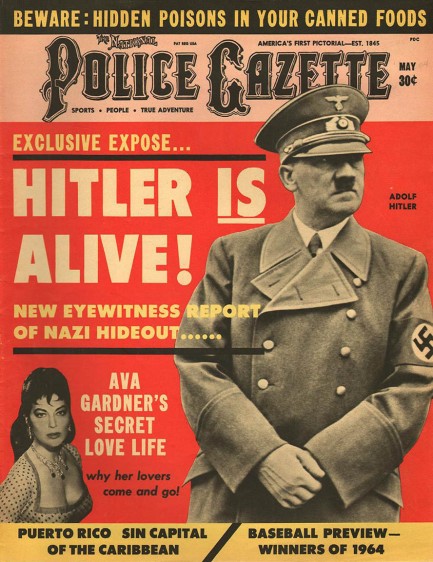
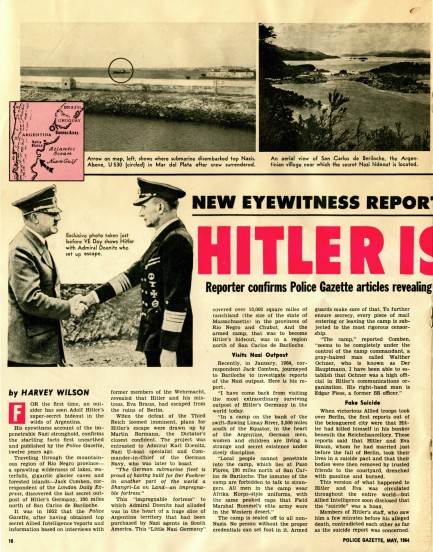
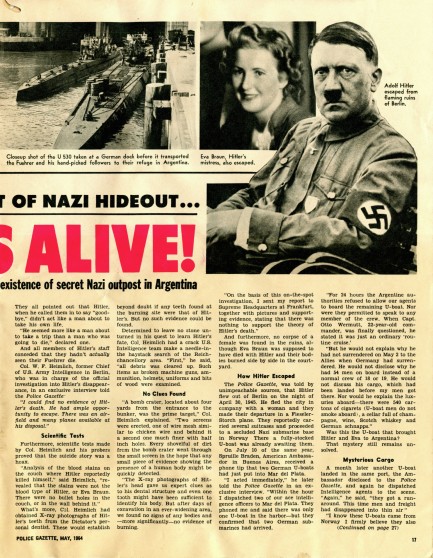
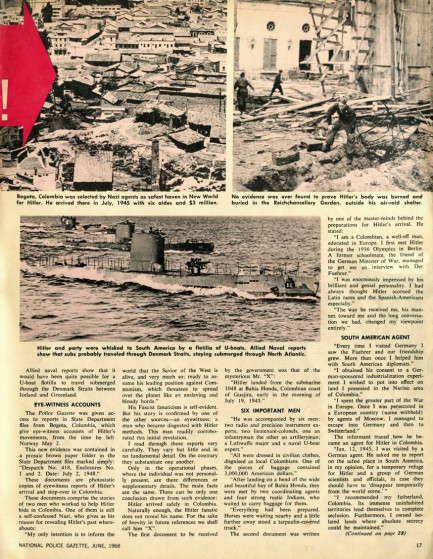
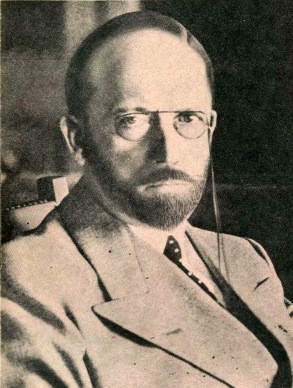 We’re back to Hitler today, as The National Police Gazette finally stops beating up poor Argentina in this June 1968 issue and decides the Führer is instead alive and well Colombia. Nowhere is Argentina mentioned, although the magazine had claimed at least twenty times previously that Hitler was there. Antarctica isn’t mentioned either, though Gazette had also told readers Hitler was plotting a new Reich from those icy reaches. Instead, Hitler’s u-boat is said to have landed in Bahia Honda on Colombia’s lush Caribbean coast, whereupon, garbed as a peasant, he was conducted by “rustic Indians” to a jungle ranch. Bogotá, by the way, also doesn’t enter into the story, despite its mention in the cover text.
In previous Gazette tales Eva Braun also made it to South America, but this time she died aboard the u-boat of a brain hemorrhage and was buried at sea. The story, which by the way is once more the work of Hitler-obsessive journo George McGrath, ends with this: “Only his closest German servants knew his real identity. The ranch hands thought him a mine operator. He wore a beard and eyeglasses. It was a complete disguise.” We see the disguise just above, in a photo supposedly taken at a u-boat base in Norway prior to his long submarine journey. We assume Gazette will have more on Hitler’s South American adventures in other issues. After all, this is the twenty-seventh Hitler Gazette we’ve found, and we have no expectation that it’s the last. Stay tuned.

| Sportswire | Apr 21 2015 |

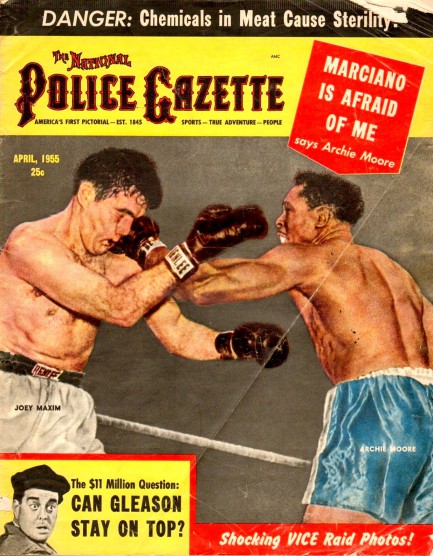
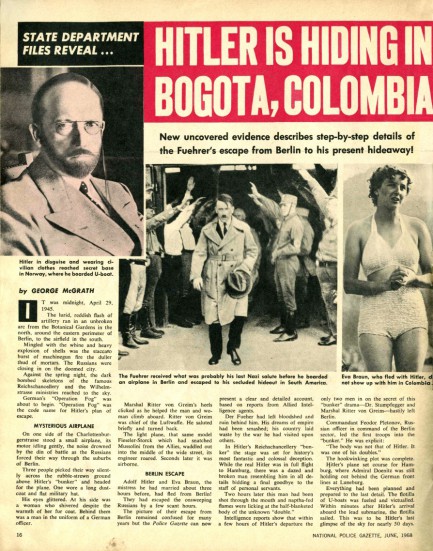
This cover of The National Police Gazette from April 1955 shows light-heavyweight champion Archie Moore putting a hurting on Joey Maxim. Gazette was hyping an upcoming title bout between Moore and Rocky Marciano, then and now considered one of the top three boxers to ever lace up a pair of gloves. We doubt that Marciano was afraid, as Moore claims on the cover, but maybe he should have been. The night of the bout Moore amazed/dismayed the crowd by landing a right counter and knocking Marciano to his knees. It was only the second time in Marciano's storied career that he had hit the canvas. He received a count from the ref. Under boxing rules the count should have stopped when Marciano rose—which he did after two seconds—and Moore should have been free to pummel his presumably dazed opponent. But referee Harry Kessler interposed himself between the two fighters.
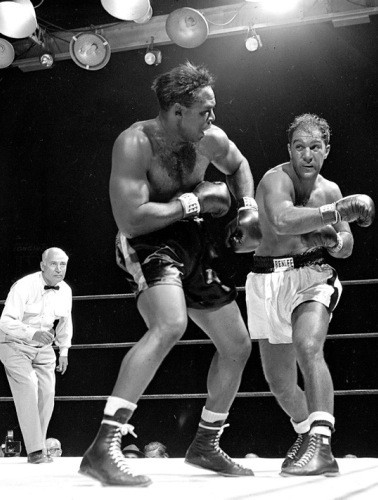 Moore tells it this way: “The referee saw me stepping toward Marciano, and [put] his butt in my stomach and kept me off Marciano. He grabbed Marciano’s hands and wiped off his gloves while my corner yelled, ‘Hit him! Hit him!’ All of a sudden, Kessler jerked [Marciano’s] hands, and Marciano’s head jerked and [that] brought him to.”
Moore eventually lost the fight. But you have to give him credit—rather than thinking Kessler acted maliciously, he believes the ref was so amazed to see the champ down that he simply forgot his duties under the rules. Still, Moore makes no bones about it—in his view, Kessler cost him the fight. In the end though, Moore had to be proud. He had jumped up a weight class for the bout, and, at forty-one, was a decade older than Marciano. For those reasons and others a Moore victory would have been the greatest upset in boxing history, but it was not to be.

| Vintage Pulp | Feb 9 2015 |

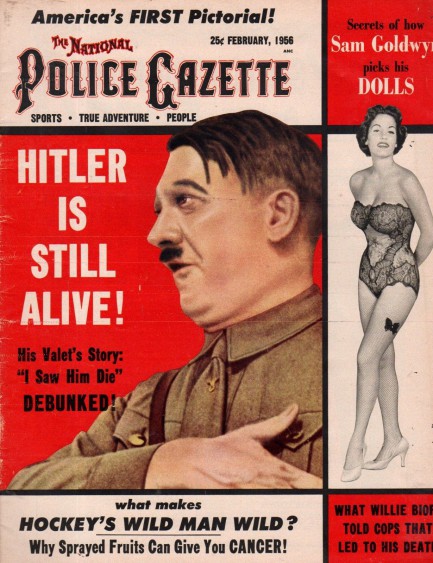
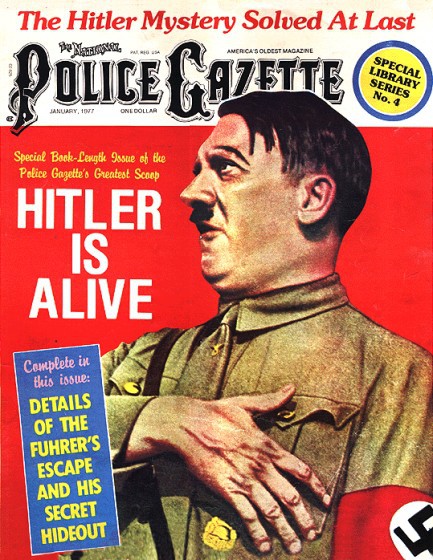
Police Gazette sometimes faced a need for Adolf Hitler to star on their covers that surpassed available supplies of art. The February 1956 cover you see above was the first time that particular image was used, but they dug it out again for their January 1977 issue, which you see below, and which we showed you in larger size here. By now you know the Gazette’s mission post-World War II was to prove Hitler didn’t die in Berlin. In this issue George McGrath—the same writer who usually penned these stories—offers a list of reasons why Hitler was still alive as of 1956. Among them:
 • The only eyewitness to Hitler’s suicide—his valet Heinz Linge—later recanted his testimony and admitted he never saw the Führer shoot himself.
 In short—and this seems especially appropriate to point out with American news anchor Brian Williams in hot water for alleged on-air lies, and Fox News being laughed at for echoing an obviously fake story about the King of Jordan flying combat missions against ISIS—sloppy or false reporting in America’s most popular media outlets has always been a problem. The old tabloids fashioned themselves as maverick truthtellers, and that label, along with some flashy visuals, was enough to attract eyeballs. For today's cable news, the same self-labeling and eye candy visuals work the same way. We will have plenty more from the Police Gazette later.

 |
 |