The king of tabloids sets its sights on the Queen of Greece. 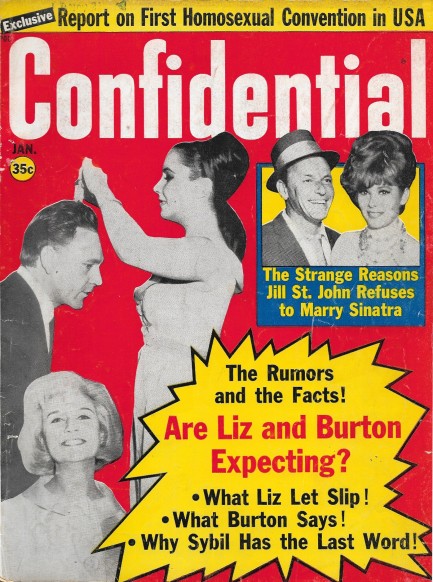
Every month when Confidential magazine hit newsstands, we imagine Hollywood celebrities receiving the bad news that they'd made the cover, and going, “Shit.” This issue published in January 1964 features Elizabeth Taylor, Richard Burton, Frank Sinatra, and Jill St. John. The first three members of that group probably took the news in stride, since they were all tabloid staples by then. St. John wasn't quite at their level, but her links with Sinatra kept her in the scandal sheets for a while too.
A person who wasn't used to Confidential's attentions was Frederica of Hanover, who at the time was Queen Consort of Greece—which is just a fancy way of saying she was married to the King of Greece. Confidential says she was a Nazi, a pretty serious charge, needless to say. Was she? Well, her grandfather was Kaiser Wilhelm II, as a girl she was a member of Bund Deutscher Mädel, which was a branch of the Hitler Youth, and she had brothers in the SS. Also, back in 1934 Adolf Hitler wanted to link the British and German royal houses, and tried to pressure Frederica's parents into arranging for the seventeen-year-old girl to marry the Prince of Wales, Edward VIII. And as Queen Consort she made a habit of meddling in Greek politics in ways that made clear she was not a fan of democracy. None of that is a particularly good look.
She had defenders, though, who believed that for a person in her position it would have been impossible not to have been a member of certain groups and to have socialized with Nazis. It's interesting, isn't it, how the rich and powerful always benefit from a special set of excuses? People can't really expect her to have made a stand, can they? But the excuse is hollow. As a high ranking royal she could have avoided anything she wished. Membership in organizations when she was a little girl is one thing, but as an adult she could have denounced Nazism with damage to her reputation the only potential result. A damaged reputation is no small thing, but if we expect resistance from people who'd have been imprisoned or shot for doing so, we should probably expect the same from people who would have suffered mostly dirty looks.
Confidential focuses on Frederica's July 1963 visit to England. The visit was no big surprise—Frederica, her husband King Paul of Greece, Queen Elizabeth, and her husband Prince Philip, were all related. They were all direct descendants of Queen Victoria. Monarchy is a funny thing, isn't it? The visit triggered a protest of about three thousand British leftists that was violently broken up by five thousand police. The protestors carried banners that said, “Down with the Nazi Queen.” After mentioning this fiasco, Confidential delves into Frederica's history, some of which we've outlined above, then loops back to the protests, which she blamed on the British press. But she had already reached a level of notoriety that usually brought out protestors who loudly booed her, particularly in Greece. She eventually retreated from public life, became a Buddhist, and died early at age sixty-three.
Confidential's unexpected exposé on Frederica wasn't out of character for the magazine. It was the top tabloid dog in a very large kennel. It had an expansive staff, serious reporters, hundreds of informers spread across the U.S. and Britain, and published stories about heavy hitters from all sectors of society. It had a regressive political agenda, as its article filled with terrible slander against gays and lesbians makes clear, but even with its rightward slant it took pains to keep its reporting framework factual. That makes it a priceless source of contemporaneous info about public figures, particularly of the Hollywood variety. We doubt we'll ever stop buying it, because we never know who we'll find inside. Twenty-plus scans below.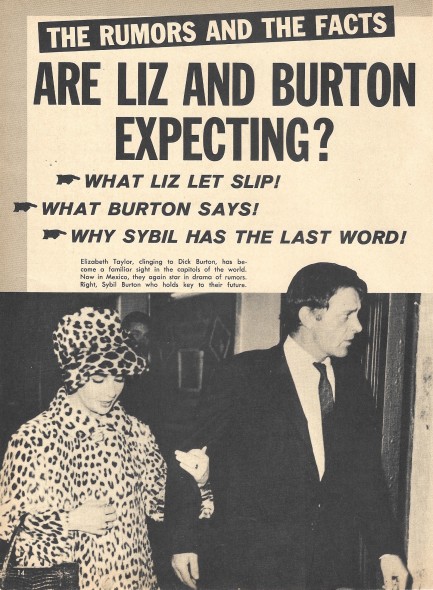 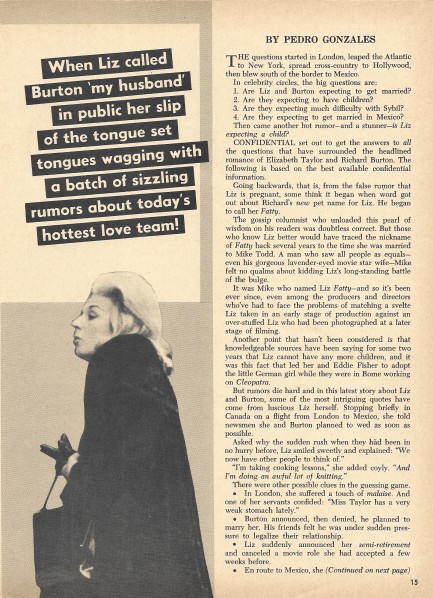 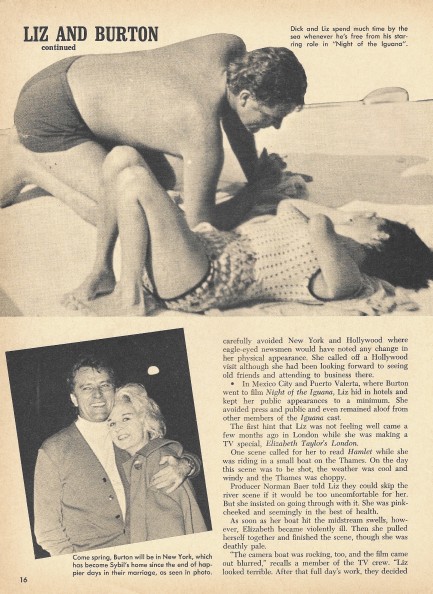  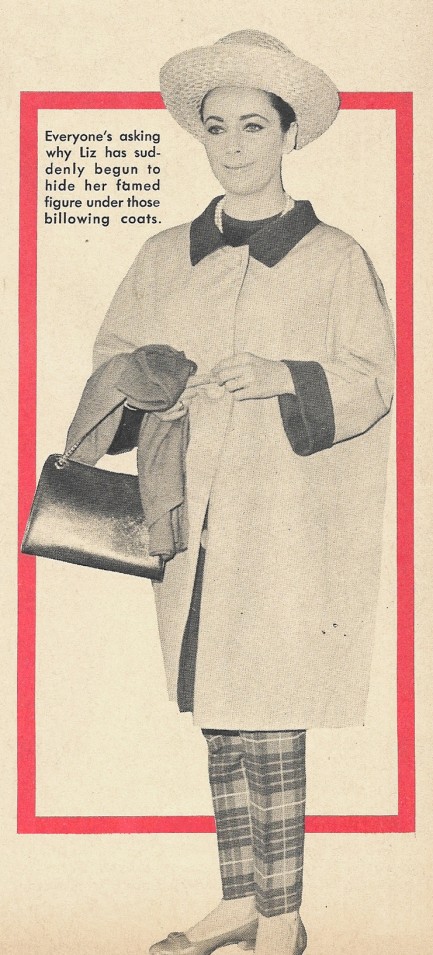  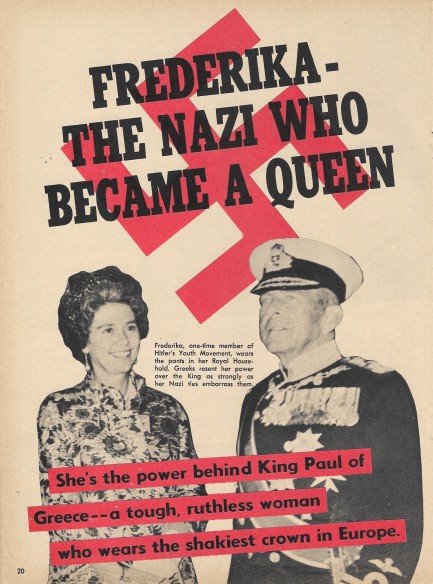 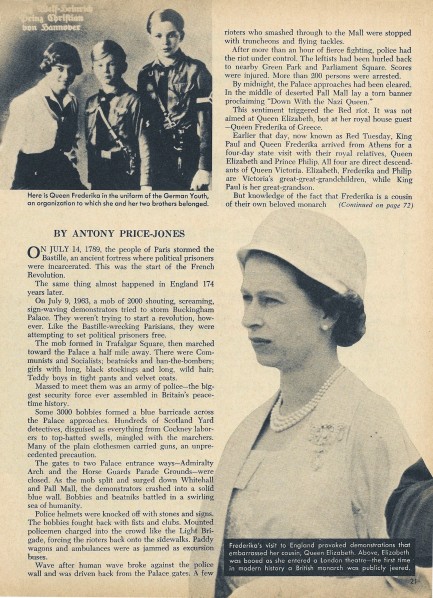 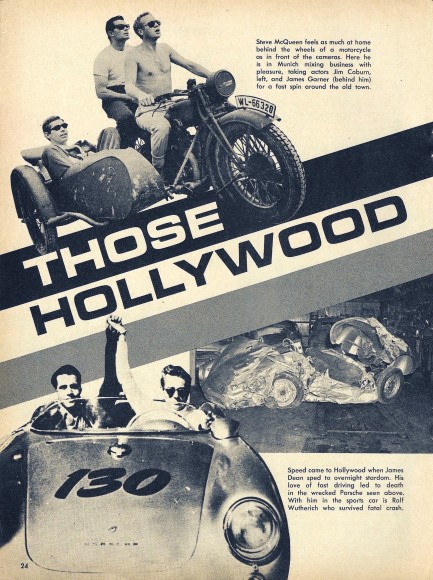 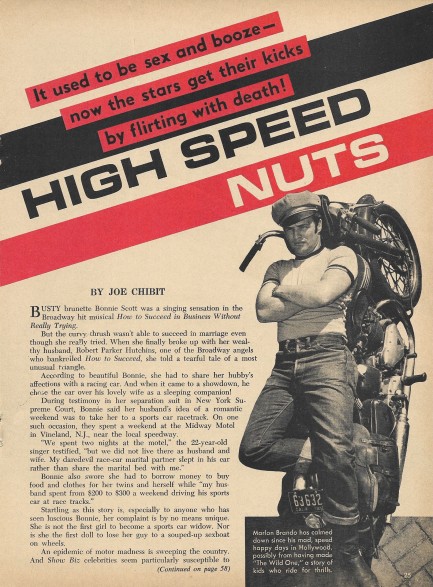 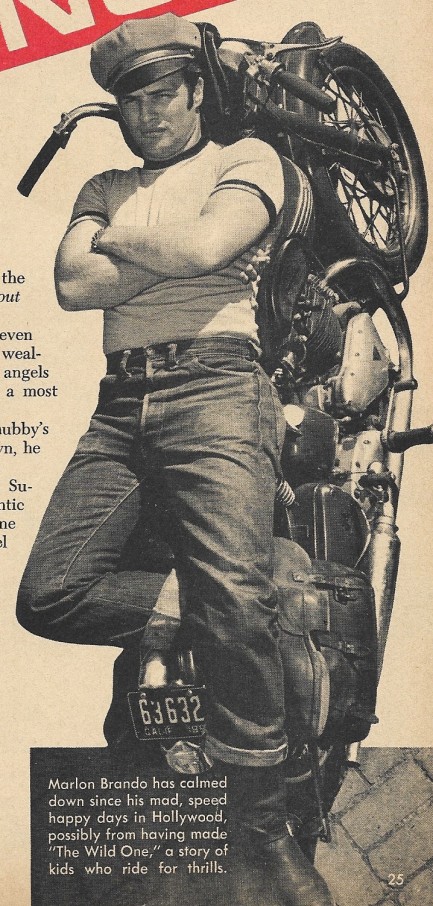 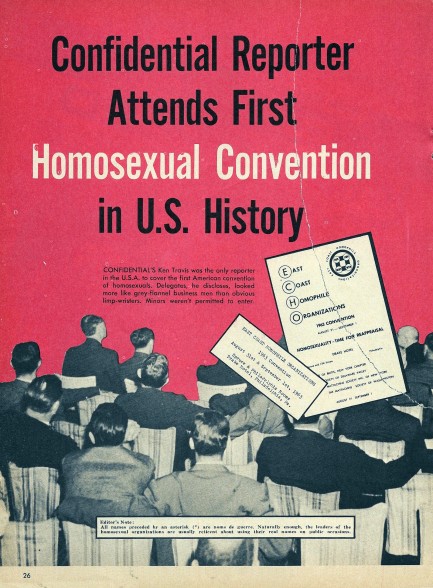 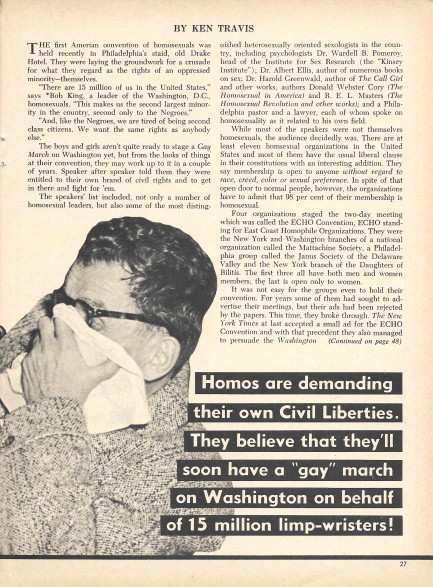  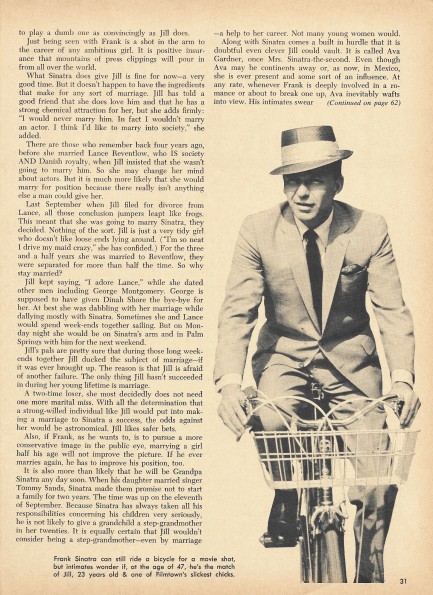 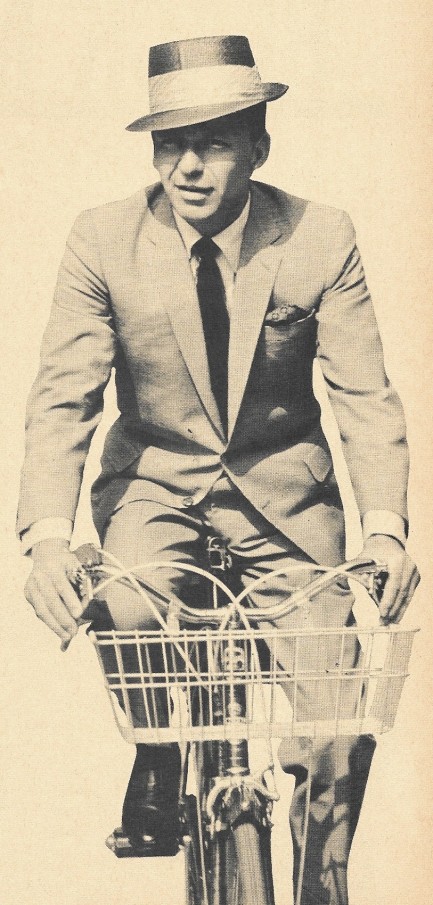 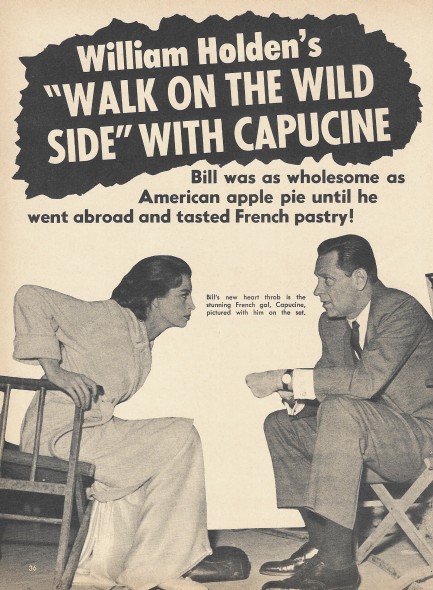 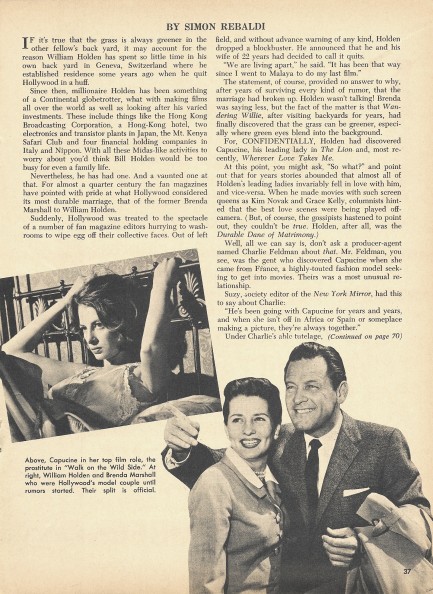 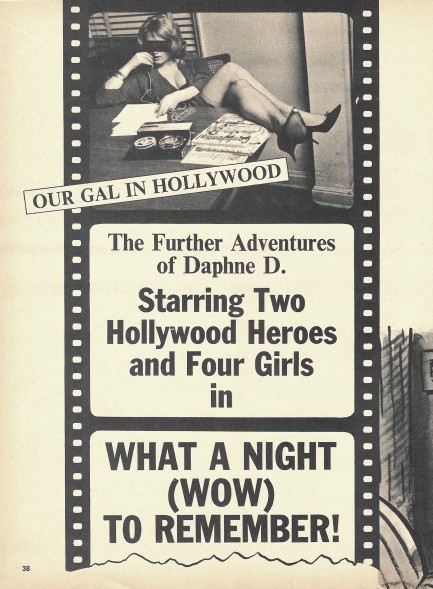 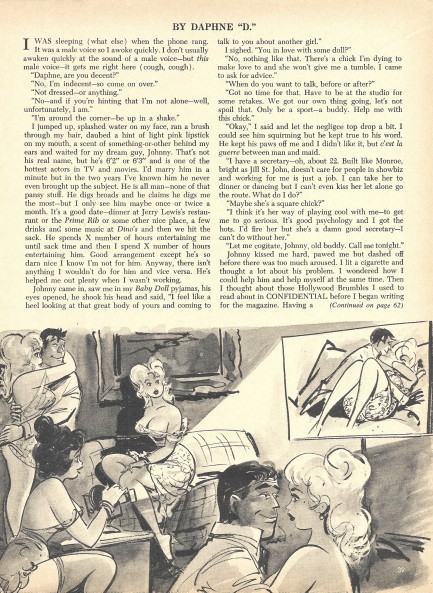  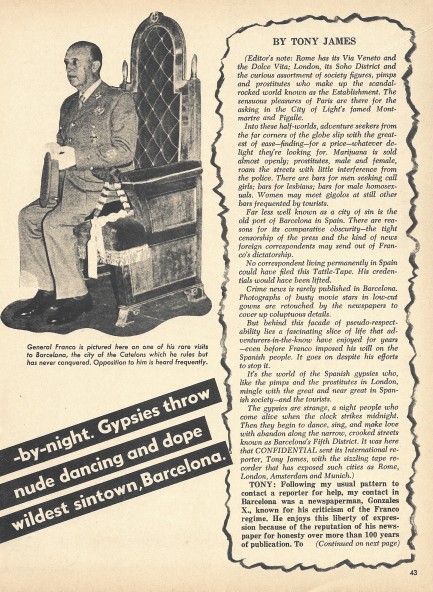 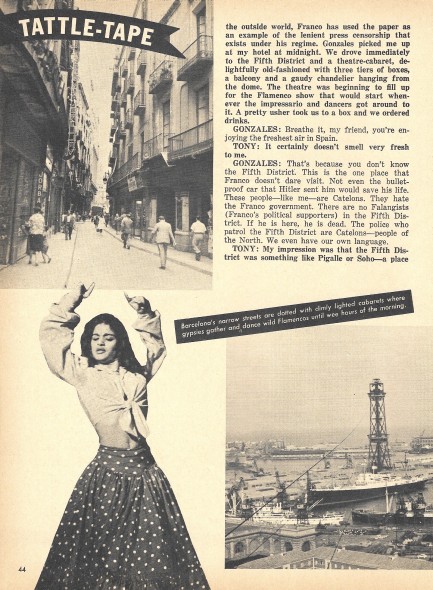
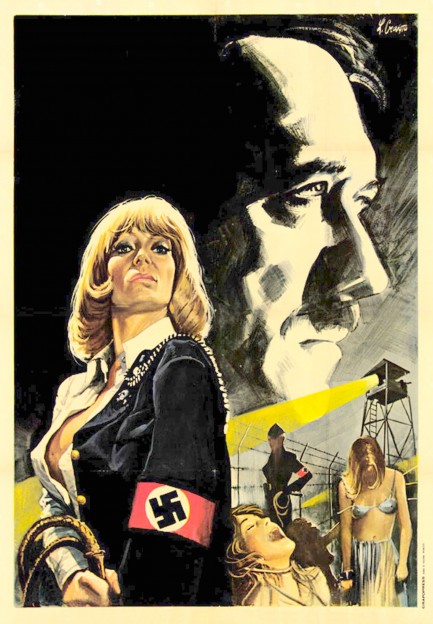
 Once upon a time in the Reich there was a sadist named Ilsa. 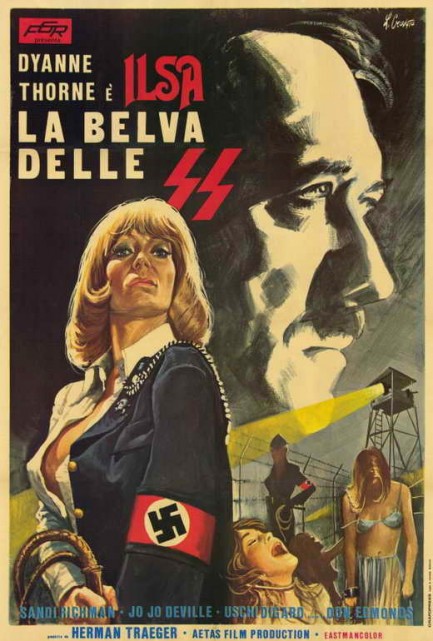
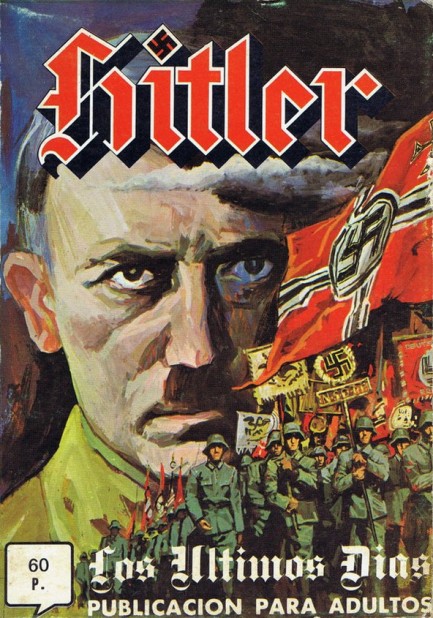
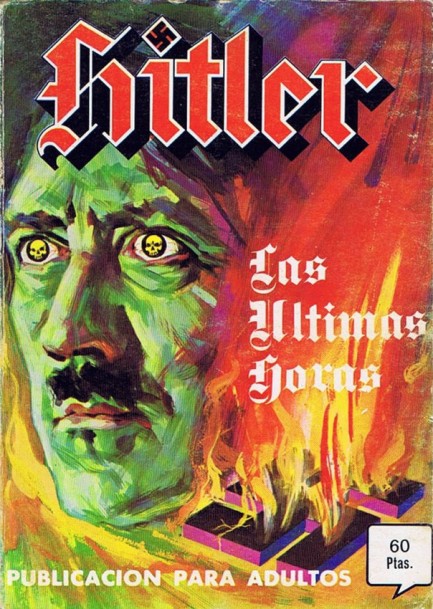
Ilsa la belva delle SS, as it was called in Italy, is better known as Ilsa: She Wolf of the SS, and it's not hyperbole to describe this naziploitation effort as one of the most widely reviled movies ever released. And for good reason. It's significant as an example of just how out there and taboo shattering the sexploitation genre got during the 1970s. The poster was painted by Luciano Crovato, who produced a number of iconic movie promos, including the second and third pieces in this post. We'll get back to him. If you want to know more about Ilsa: She Wolf of the SS look here. If you dare.
 Which one liked to wallow in crap more? National Examiner or Adolf Hitler? 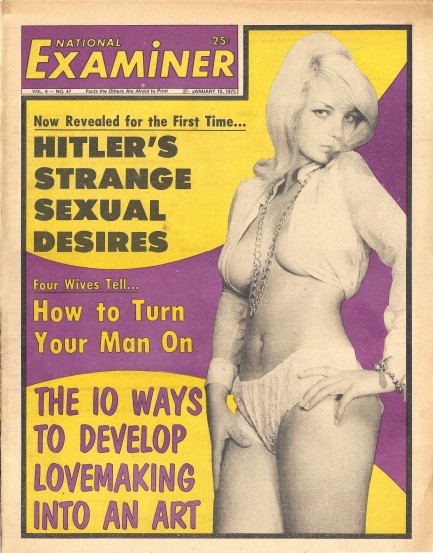
National Examiner offers up a provocative cover on this issue that hit newsstands today in 1973, with an unidentified blonde model and the promise of expert lovemaking tips. Nothing new there. What's different is this issue takes Adolf Hitler's corpse for a gallop around a well-traveled track. The article “Hitler's Strange Desires” digs into der Führer's toilet training, his family background, his private writings and public statements, and comes to the conclusion: sexual pervert! The piece discusses Hitler's “sexual inadequacy and impotence, frail body and softness that was almost effeminate,” and reveals how he doted on his mother but eventually felt betrayed by her, stating, “This sudden indignation with his mother could have been caused if he saw his parents having intercourse.” The ultimate conclusion is no surprise: “[Because of] his extreme form of masochism [he derived] sexual gratification from the act of having a woman urinate or defecate on him.”
As psychological disturbances go, you can take your pick here. Like beer in a Berlin rathskeller, Hitler allegedly had multiple flavors on tap, and they culminated in turning him into a shit freak. That's amusing to consider, but was it anything other than pure bullshit itself? Labeling Hitler a disturbed child-turned sexual deviant was a mini-industry in the decades after his death, and the rumors started by these reports are still prevalent today. We get it—by making him into a non-human it's easy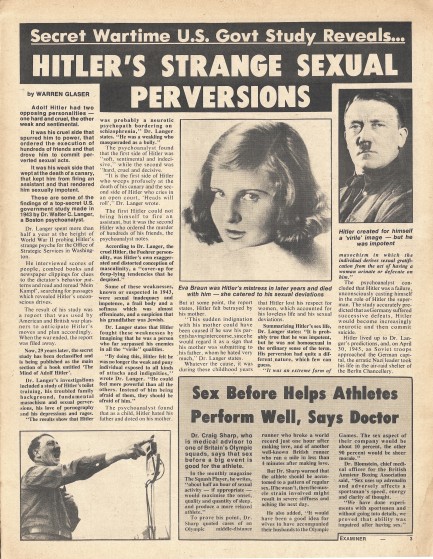  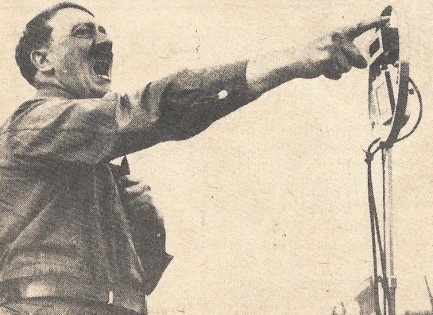 to distance him from the rest of us, but as far as we know there's no evidence he was anything other than a heterosexual who had run-of-the-mill sex, or for that matter that he was anything other than a run-of-the-mill human. Many people would love for the stories to be true, but they're just too easy. We don't blame Examiner for beating that Hitler horse, though. Everybody did it—it sold piles of papers. to distance him from the rest of us, but as far as we know there's no evidence he was anything other than a heterosexual who had run-of-the-mill sex, or for that matter that he was anything other than a run-of-the-mill human. Many people would love for the stories to be true, but they're just too easy. We don't blame Examiner for beating that Hitler horse, though. Everybody did it—it sold piles of papers.
Examiner goes for lighter material elsewhere in the issue, with an update on the whereabouts of Canadian actress Ruby Keeler, a story about a wife who makes her husband take her to a swingers club so she can get some strange dick, and a pervy advertisement for instant peepholes we know would be illegal to use today, and which we suspect were illegal to use back then too. Other celebrities who make appearances include Maria LaTour and Monika Zinnenberg. In fact, on closer examination that unidentified cover model might be Zinnenberg. She made the usual slate of bad West German comedies and exploitation flicks during the ’60s and ’70s before leveraging her front-of-the-camera work into a directing career which she sustained all the way up until 2012. And finally there's a centerspread on the benefits of yoga, featuring stars like Cary Grant, Geraldine Chaplain, and Barbara Parkins touting its benefits. That's about it for this Examiner. Scans below, and more here and here.     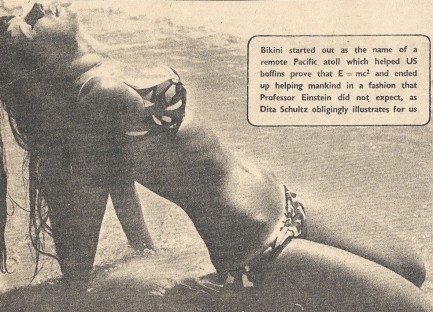  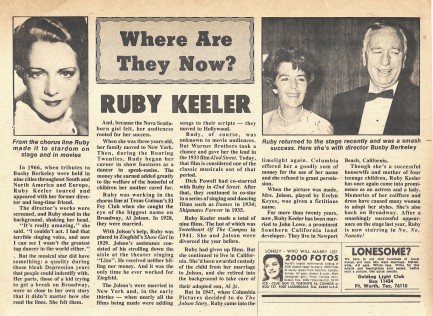 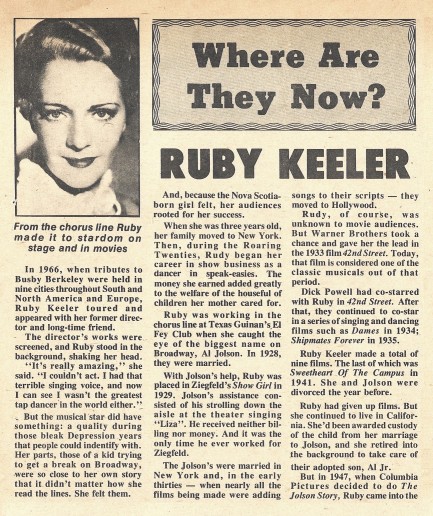 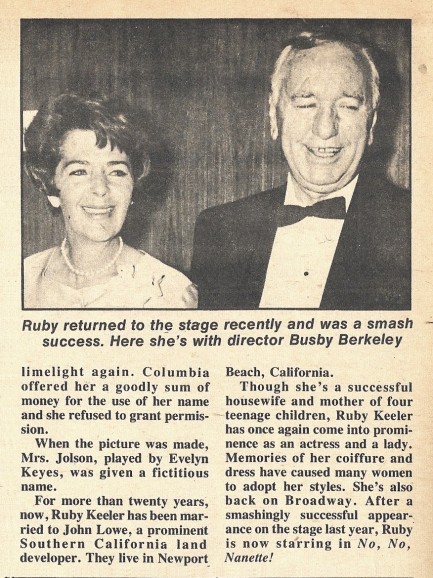 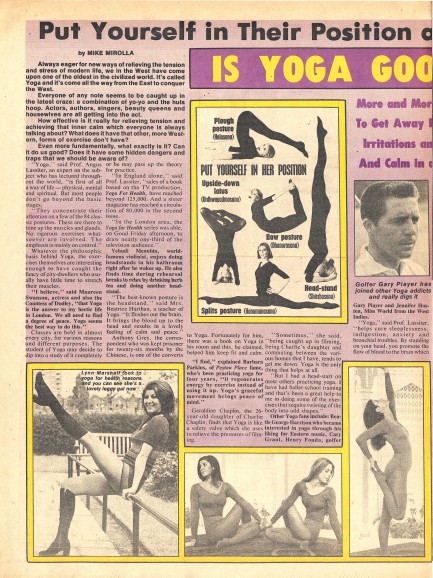 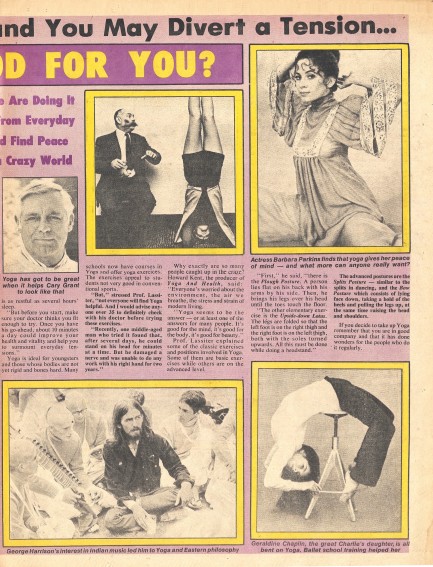 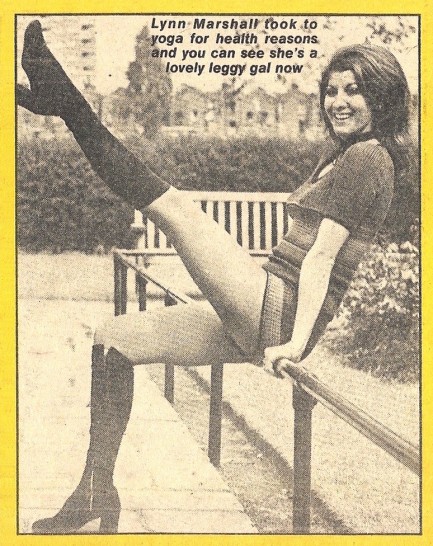 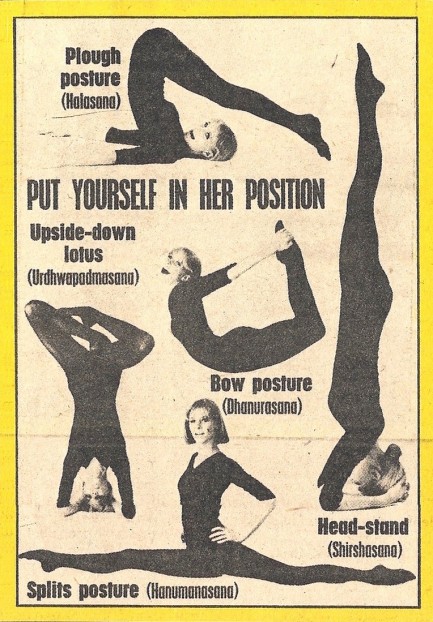 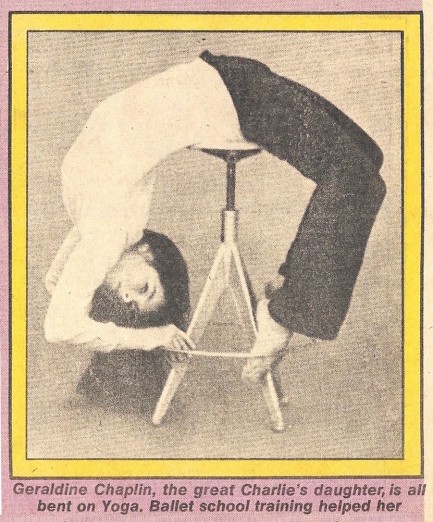 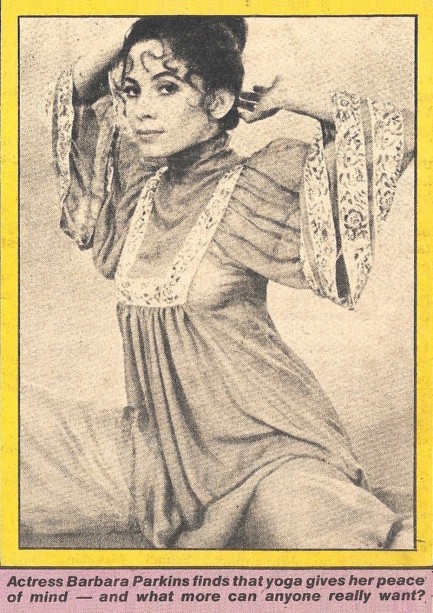 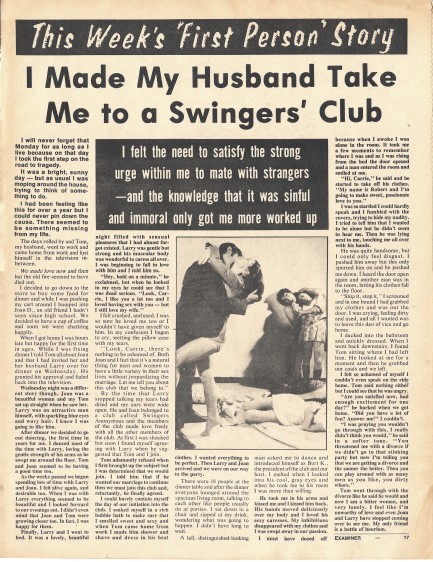 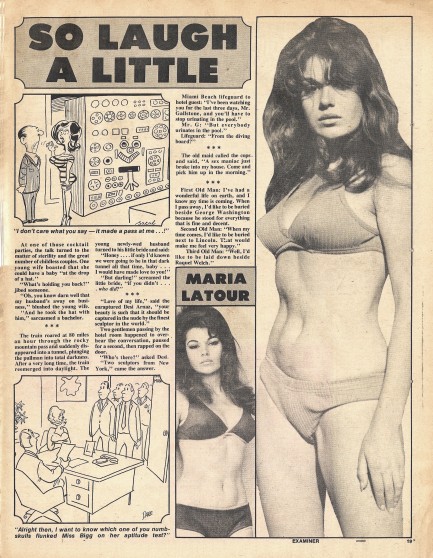  
 She was one Man's ray of light. 
This is a fantastic shot. One reason it caught our eye is that we've seen other photos with lacy shadows substituting for lingerie, but this one from 1930 may be the originator of the illusion. The person you see is Lee Miller. She was born in 1907 and became a fashion model in New York City during the late 1920s, before traveling to Paris with the intent of meeting the legendary photographer Man Ray. She succeeded and became his muse, lover, and frequent subject, as evidenced by this photo, which is his work.
Miller was widely acknowledged as one of the great beauties of her era, but modeling was not her career goal. Her plan had always been to become a photographer. Thus in addition to the other facets of her relationship with Ray, she also apprenticed for him. After absorbing what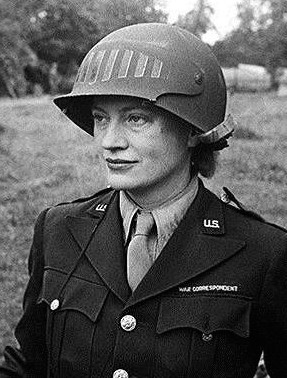 he had to share she eventually went on to shoot acclaimed World War II photos, some of them during perilous live combat, and documented the liberation of the Buchenwald and Dachau concentration camps, helping expose Nazi atrocities to the world. he had to share she eventually went on to shoot acclaimed World War II photos, some of them during perilous live combat, and documented the liberation of the Buchenwald and Dachau concentration camps, helping expose Nazi atrocities to the world.
In mid-1945 she was in Munich shooting images of the immediate aftermath of the war and posed for a nude shot in Adolf Hitler's bathtub. Yeah—Hitler. Her son, Antony Penrose, later said of the shot, “I think she was sticking two fingers up at Hitler. On the floor are her boots, covered with the filth of Dachau, which she has trodden all over Hitler’s bathroom floor. She is saying she is the victor.” The photo was of course controversial, but Miller was a pure artist, always willing to make observers see the world in a new way—through her trained eye. So while the shot at top could be seen as reductive of a complex and accomplished personality, it actually reveals an important aspect of who she was—a daring, multi-faceted woman to whom convention was merely a challenge. And it's an overwhelmingly beautiful shot besides.
 Unexplainable interest in Eva Braun artifacts maybe not such a mystery after all. 
Once again demonstrating that people with an overabundance of money will buy anything, a private bidder yesterday purchased a pair of Eva Braun's panties at auction. Yes—Eva Braun. Yes—panties. The sale took place in the English town of Malvern, at Philip Serrell Auctioneers & Valuers, and along with the monogrammed fascist frillies, which you see above, were sold a gold ring, a red lipstick, and a silver lipstick holder, all once possessed by Braun. But it was the undies that fetched the top price, going for £2,900, or about $3,600. That's a lot of money for panties. But according to a representative of the auction house, “an array” of prospective buyers offered bids on the item, pushing the price more than seven times higher than expected.  Now that the buyer has the undies, you're doubtless wondering what he plans to do with them (and you just know it's a "he" we're dealing with, by the way). He could display them at home, maybe frame them. Or he could tuck them safely away for later resale at a profit. He could even donate them to Munich's Pinakothek art museums, which collect such items. But he'll do none of those things. Nope. He's going to wear them. Now that the buyer has the undies, you're doubtless wondering what he plans to do with them (and you just know it's a "he" we're dealing with, by the way). He could display them at home, maybe frame them. Or he could tuck them safely away for later resale at a profit. He could even donate them to Munich's Pinakothek art museums, which collect such items. But he'll do none of those things. Nope. He's going to wear them. You're thinking that's crazy. You're thinking, okay, it may be a good way to appreciate a pair of fine panties, but doesn't rapid depreciation generally follow getting nutsack on a historical artifact? And you'd be right, normally. But the buyer knows something about Eva Braun's panties you don't. In fact, all the rich auction attendees who bid on them knew the same thing, which is why they competed with each other. Eva's panties are magic.
Once you wear them—and you must wear them for the magic to work—you instantly possess the ability to see worth in anyone. Which means the winner of the auction will have something special to help him navigate the fraught world of one percenters in which he moves. When he meets up with Martin Shkreli, instead of dismissing pharma bro as an obvious genetic misfire, he'll say, “Oh, he's really a teddybear once you get to know him.” Rupert Murdoch? “That guy's actually okay. He's a cheeky one, ole Murdo.” Bill Cosby? “Oh, he's harmless. You should see his soft jazz collection.” Eva's panties magically let the wearer see the worst monsters in the world as not all bad, which could be useful on election day. They even work when you look in a mirror. Suddenly your sad rationalizations seem totally sound.
But there's more. If the wearer combines the panties with the lipstick and ring he or she will actually have sex with and marry the absolute worst person in the world. And he or she will do it even if it means utter isolation from friends, family, and anything that even resembles real life. And they'll stay loyal even after it becomes obvious their mate is dragging them straight to doom. Unfortunately, said doom could destroy the valuable panties along with the wearer, but guess what? There are other pairs. One turned up in Ohio just last year. And another was sold in Maryland. Others surely exist, so if you want to waltz blithely through the rarefied world of vulture capitalists, sexual predators, and corrupt politicians, now you know how to do it. And if you navigate this world cleverly and maybe even thrive in it, in time maybe one day people will need Eva's panties just to tolerate you. straight to doom. Unfortunately, said doom could destroy the valuable panties along with the wearer, but guess what? There are other pairs. One turned up in Ohio just last year. And another was sold in Maryland. Others surely exist, so if you want to waltz blithely through the rarefied world of vulture capitalists, sexual predators, and corrupt politicians, now you know how to do it. And if you navigate this world cleverly and maybe even thrive in it, in time maybe one day people will need Eva's panties just to tolerate you.
 Nazis bite off more than they can chew in the bitter Arctic. 
The Nazis got around. We've already talked about their forays to the South Pole. Why not the other end of the Earth too? Last week Russian scientists stumbled across a secret Nazi military base in the Arctic that had been constructed in 1942, subsequently abandoned, and forgotten.
The base is located on the island of Alexandra Land, 600 miles from the North Pole, and was codenamed Schatzgraber, which in German means “treasure hunter” or "treasure trove.” It was a tactical weather station used for the crucial task of planning troop movements during the German invasion of Russia, which began in 1941 but quickly turned from an invasion into a military quagmire that cost Germany four million dead and any chance to win the war.
The occupants of the base were evacuated by submarine in 1944 after they ate undercooked polar bear meat and contracted trichinosis, a very nasty illness that can cause uncontrollable diarrhea, inflammation in the whites of the eyes, and swelling of the heart. Considering Russia's symbol is the bear, it's a bit ironic. According to reports, more than 500 historically significant items have been found at Schatzgraber, including documents that may shed light on yet another dark corner of the Nazi empire.  
 My father is tougher than your father. 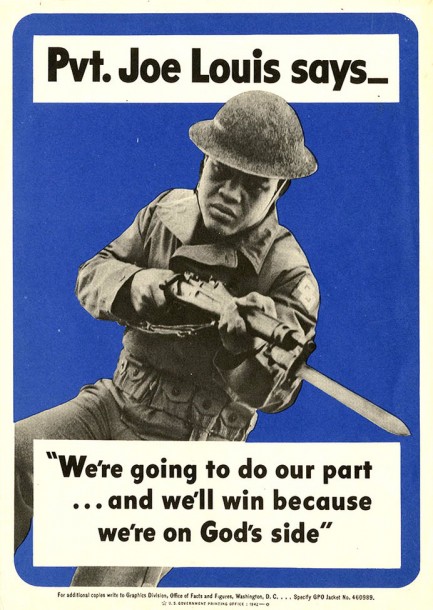
This bit of World War II propaganda, which was created by the Graphics Division of the U.S. government's Office of Facts and Figures in 1942, caught our eye for a couple of reasons. It features champion boxer Joe Louis, which is interesting enough, but it also features a quote he had uttered while taking part in a military charity event: “We’re going to do our part… and we’ll win because we’re on God’s side.” This is an interesting turn of phrase because of its inversion of "our" and "God." The way Louis formulates the idea suggests God desired the war and the U.S. was just helping out. Usually you hear the sentiment expressed as, “God is on our side,” but Louis's quote has more power loaded into it than the standard iteration. It casts Japan as not just battling an enemy nation that has God's help, but battling the natural order of the cosmos. desired the war and the U.S. was just helping out. Usually you hear the sentiment expressed as, “God is on our side,” but Louis's quote has more power loaded into it than the standard iteration. It casts Japan as not just battling an enemy nation that has God's help, but battling the natural order of the cosmos. Of course, the Japanese also thought they were divinely guided, and over in Europe where Germany was fighting several countries at once, the opportunistic Adolf Hitler, though a skeptic in private, declared himself a Christian in public and busily used religious sentiment in his devoutly Catholic nation to whip up support for his rule. Thus God was presumably rooting for both sides. We have a sizable collection of World War II propaganda inside Pulp Intl., originating from many countries, which we think is worth a look. You can see some of it here, here, here, here, here, and here.
 An American crime story. 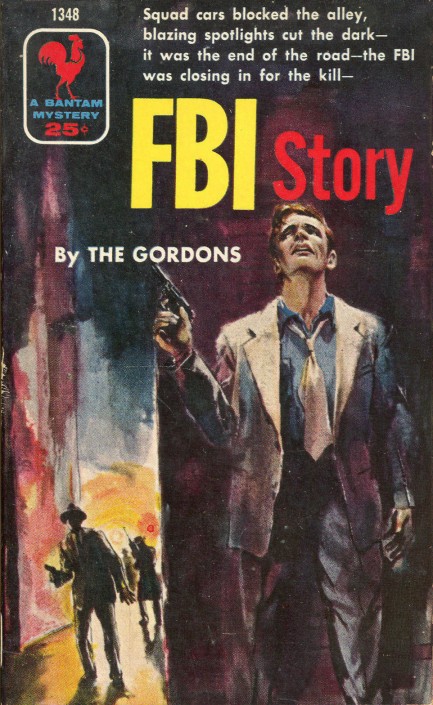 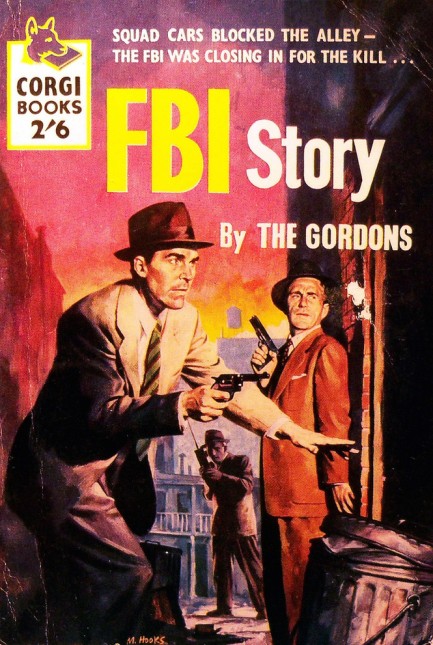
Written by The Gordons, who were the tandem of spouses Gordon Gordon and Mildred Gordon, FBI Story follows Agent John Ripley as he investigates the disappearance of a woman named Genie. She's wanted for theft by the FBI, and by the Los Angeles police as a person of interest in a murder case. Ripley finds that he and the missing woman have a lot in common, a fact revealed by his perusal of her bookshelf and diary. Is she really a criminal or just a desperate woman in deep trouble? As the investigation unfolds and the search spans the entire United States, we learn that other people are after her, including a millionaire American fascist who looks like Hitler and rants about the master race. Eventually Ripley uncovers jewel thievery, treason, and the mysterious Genie herself. Originally published in hardback on the heels of World War II in 1950, FBI Story delves deeply into the weariness and cynicism of combat vets, of which Ripley is one, yet all the agents are unswervingly dutiful and honest. Considering the fact that the novel is dedicated to J. Edgar Hoover, one could be excused for branding it propaganda. In fact, Gordon Gordon was an ex-FBI agent and had J. Edgar Hoover approve his work. Even so, FBI Story is generally considered a good read. It was later turned into a movie starring James Stewart and Vera Miles. The Bantam edition of the book is from 1955 with uncredited art, and the Corgi one appeared in 1957 with Mitchell Hooks on the cover chores.
 Hitler makes a mad dash from the Arctic Circle to the bottom of the world. 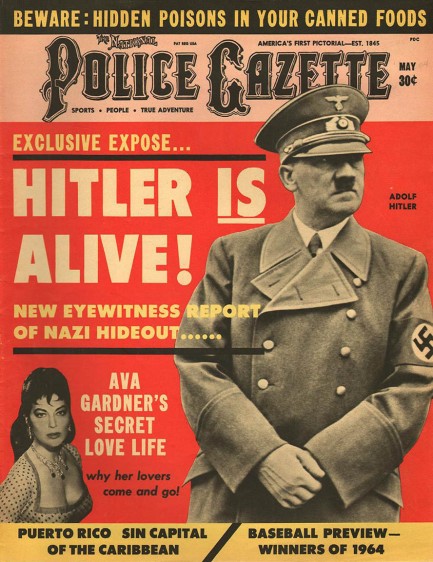
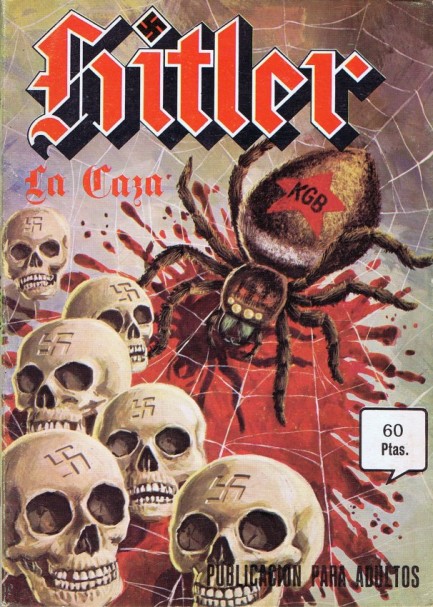
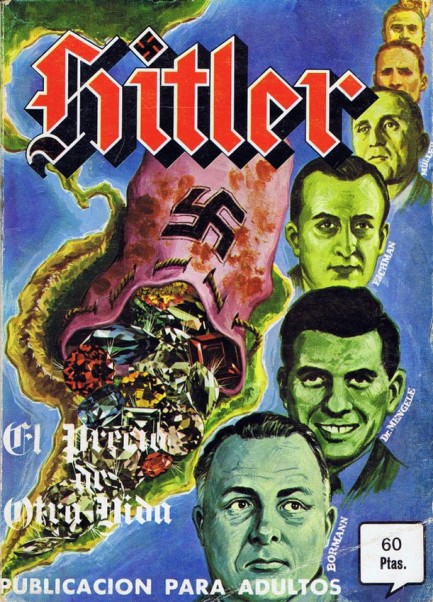
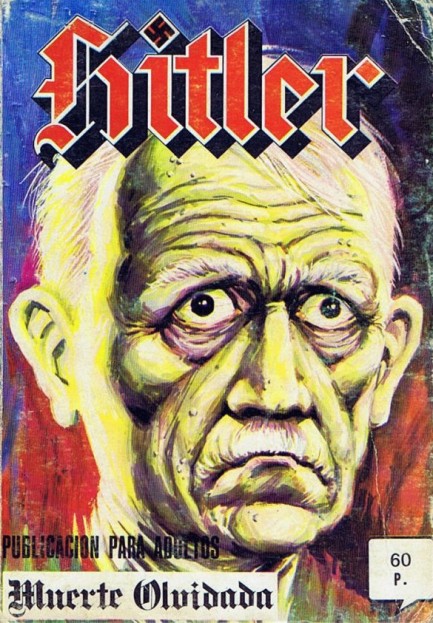
Has it really been nearly a year since our last Hitler Police Gazette cover? A look back through the website confirms the lull, but we haven't run out of Adolfs yet. This is the twenty-eighth Gazette we've found with him as the star, a May 1961 issue proclaiming, of course, that he's alive. Inside, journo Harvey Wilson reiterates the Argentina claims that had been well flogged in previous issues, telling readers Hitler's “super secret” hideout is located in Rio Negro province at the edge of wild Patagonia. Wilson writes: “Hitler flew out of Berlin on the night of April 30, 1945. He fled the city in company with a woman and they made their departure in a Fieseler-Storch plane. They carried several suitcases and proceeded to a Nazi submarine base in Norway.” According to Wilson, the u-boat chugged across the ocean and docked at Mar de Plata, Argentina.
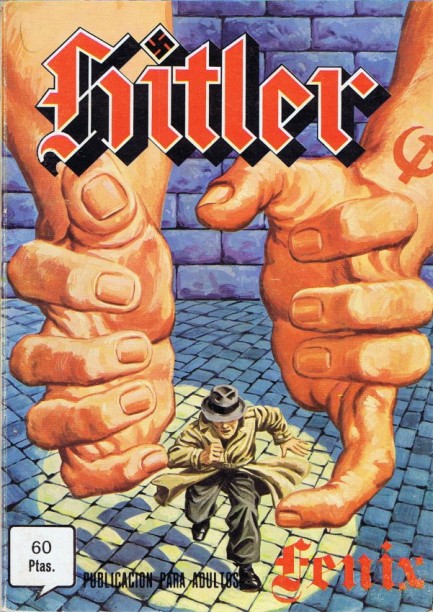
It's easy to understand Gazette's (and its readers') interest in Hitler. He was a titanic figure who died a tawdry little death—suicide by self-inflicted gunshot. It must have felt to the World War II generation like an anti-climax, or even a cheat. So Gazette instead assures those readers that Hitler escaped, and makes his flight sound like adventure fiction. This formula, which must have both titillated and terrified those who believed, not only furnished material for twenty-eight covers, but the story was also told numerous times in issues that didn't feature Hitler on the front, such as this one focusing on JFK, and this one that shines a spotlight on Eva Braun. But we may have finally reached the end. We know of only one other Hitler cover. We'll share that a little later. 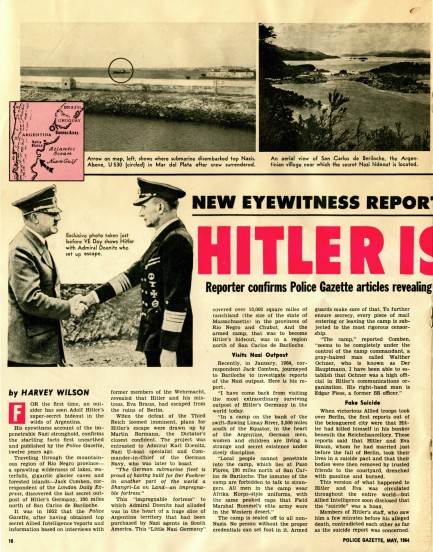 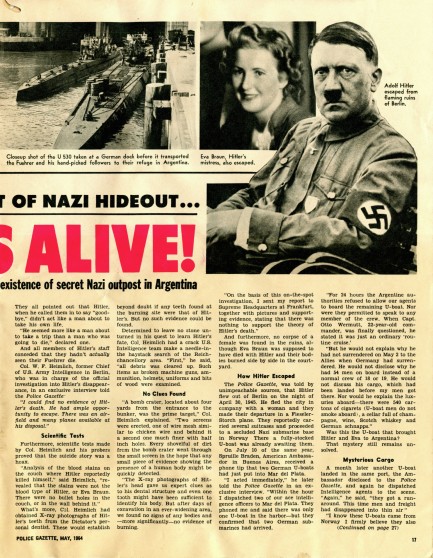

|
 |

The headlines that mattered yesteryear.
1945—Mussolini Is Arrested
Italian dictator Benito Mussolini, his mistress Clara Petacci, and fifteen supporters are arrested by Italian partisans in Dongo, Italy while attempting to escape the region in the wake of the collapse of Mussolini's fascist government. The next day, Mussolini and his mistress are both executed, along with most of the members of their group. Their bodies are then trucked to Milan where they are hung upside down on meathooks from the roof of a gas station, then spat upon and stoned until they are unrecognizable. 1933—The Gestapo Is Formed
The Geheime Staatspolizei, aka Gestapo, the official secret police force of Nazi Germany, is established. It begins under the administration of SS leader Heinrich Himmler in his position as Chief of German Police, but by 1939 is administered by the Reichssicherheitshauptamt, or Reich Main Security Office, and is a feared entity in every corner of Germany and beyond. 1937—Guernica Is Bombed
In Spain during the Spanish Civil War, the Basque town of Guernica is bombed by the German Luftwaffe, resulting in widespread destruction and casualties. The Basque government reports 1,654 people killed, while later research suggests far fewer deaths, but regardless, Guernica is viewed as an example of terror bombing and other countries learn that Nazi Germany is committed to that tactic. The bombing also becomes inspiration for Pablo Picasso, resulting in a protest painting that is not only his most famous work, but one the most important pieces of art ever produced. 1939—Batman Debuts
In Detective Comics #27, DC Comics publishes its second major superhero, Batman, who becomes one of the most popular comic book characters of all time, and then a popular camp television series starring Adam West, and lastly a multi-million dollar movie franchise starring Michael Keaton, then George Clooney, and finally Christian Bale. 1953—Crick and Watson Publish DNA Results
British scientists James D Watson and Francis Crick publish an article detailing their discovery of the existence and structure of deoxyribonucleic acid, or DNA, in Nature magazine. Their findings answer one of the oldest and most fundamental questions of biology, that of how living things reproduce themselves.
|

|
|
It's easy. We have an uploader that makes it a snap. Use it to submit your art, text, header, and subhead. Your post can be funny, serious, or anything in between, as long as it's vintage pulp. You'll get a byline and experience the fleeting pride of free authorship. We'll edit your post for typos, but the rest is up to you. Click here to give us your best shot.
|
|