Gun goes bang-bang, problem goes bye-bye. 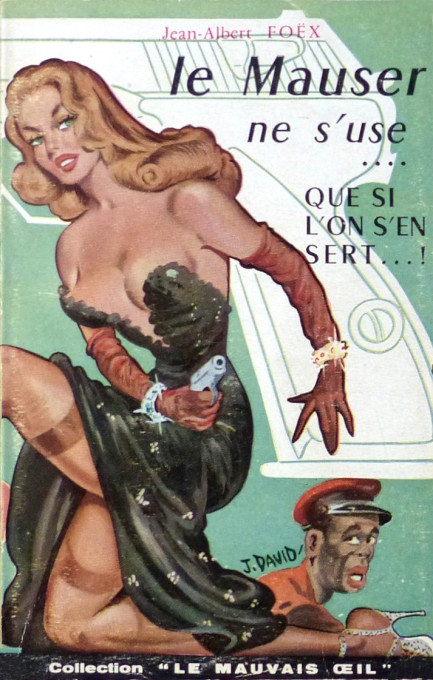
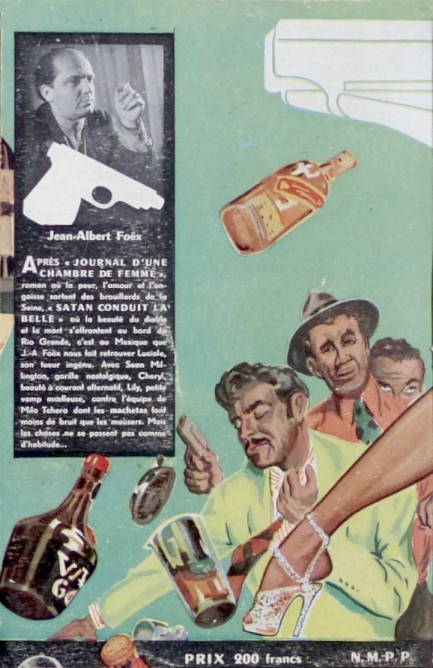
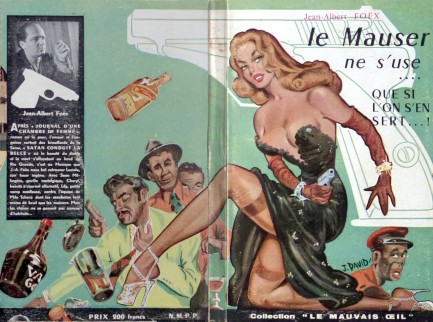
Above is a cover for Jean-Albert Foëx's 1954 crime novel Le Mauser ne s'use que si l'on s'en sert..! painted by French illustrator Jean David, whose work we've shown you before, notably here and at the bottom of this collection. We aren't happy with David's visual treatment of the black character at the lower right, but you can't doubt his technical proficiency. This book, the title of which translates to, “the Mauser only wears out if you use it,” deals with a supervillain named Luciole who gets up to no good in Mexico and is soon pitted against protagonist Milo Tchero and his crack team of sidekicks. We gather these are recurring characters but we don't know how many appearances they made. The publisher here, E.D.I.C.A., liked wraparound covers, as you can see on an example we shared a while back. Jean David will return.
 Before we go in, I should warn you that Isa might jump out from somewhere. Act surprised. She'll leave you alone after that. 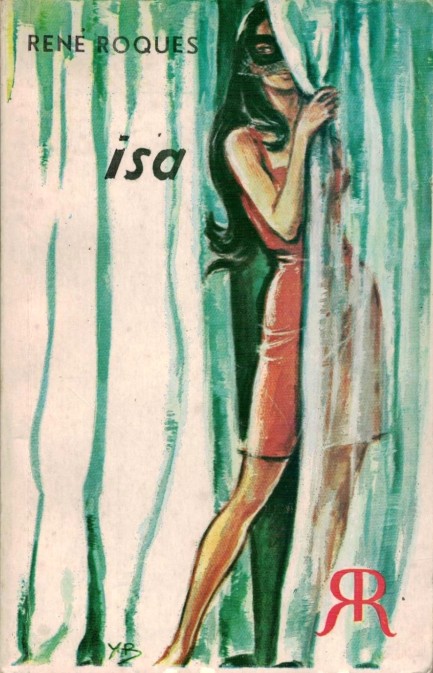
Above: a cover for the 1953 adventure Isa, written by René Roques and published by his Paris-based company Éditions R.R. Their cover art was often by Jef de Wulf, but this one is signed YB. We have no idea who that is, nor have we ever seen his or her work elsewhere, but it's an interesting effort. R.R. produced attractive covers even in collaboration with obscure artists, so some of the credit for their consistency probably goes to the company's art director—René Roques himself. Click his keywords below to see more.
 If you jump without looking you might get swept away. 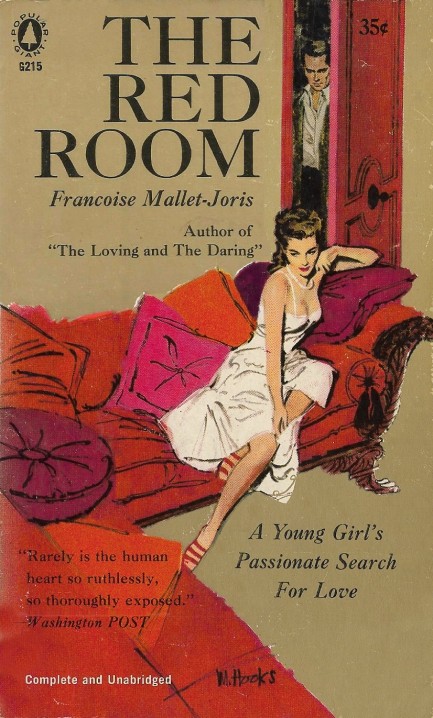
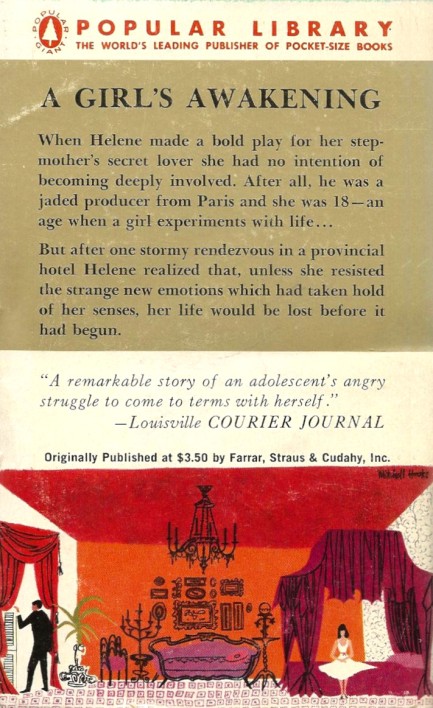
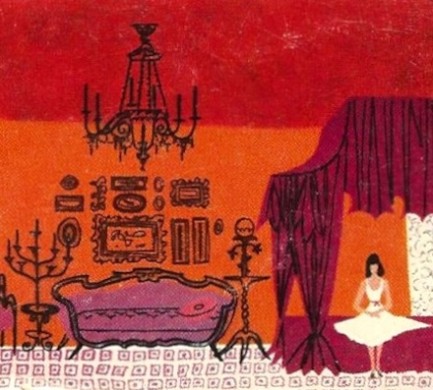
The book you see above, a 1958 Popular Library edition of The Red Room by Belgian author Françoise Mallet-Joris, was picked up for us by a friend who thought he was buying a pulp novel. He was attracted by the cover, and it's indeed fine work, from the skilled brush (and possibly ink quill and charcoal pencil) of Mitchell Hooks. As for the novel, it was originally published in 1955 as La chambre rouge and was a sequel to 1951's Le rempart des Béguines.
When someone buys us a book we always read it out of appreciation and respect, even romance novels, and in reading The Red Room we were reminded once again of the skill gap between literary and crime fiction. There are obviously excellent, transcendent crime writers (and literary fiction that misses the mark), but Mallet-Joris—even translated—spins evocative phrases as deftly as a weaver with a loom. Like this one:
The presence of winter—vulgar winter, befurred and jangling her crystal adornments—was scarcely felt in the small white and gold drawing room.
Isn't that nice? It's not Hammett describing a gangster popping off shots in a crowded bar, but it's still fun to read. The tale is a coming of age breast-beater set in Gers, France in which the main character, eighteen-year-old Hélène Noris decides to steal the dashing young film director her hated stepmother Tamara has earmarked for extra-marital games. That actually sounds kind of pulp, doesn't it? Well, just wait.
At some point it becomes clear that Hélène had been Tamara's young lover (probably this is the central plot of the previous book). Tamara and Hélène had been carrying on, but in order to secure for herself a stable existence Tamara decided to marry Hélène's father. Thus, The Red Room charts Hélène as she impulsively steals her stepmother's crush, only to find herself getting in too deep with someone who's more experienced and decisive than any man she's known.
Needless to say, that plot sounds like some of the sleaze novels we highlight here, which would make you wonder, in terms of public perception, at which point the lowbrow becomes highbrow. And the easy answer to that is: when you can write like Mallet-Joris and critics adore you. Overall, The Red Room is probably a little too genteel and interiorized for most pulp readers, but we liked it. Consider that less a recommendation than an acknowledgment of talent.
 The question is—a shot of what? 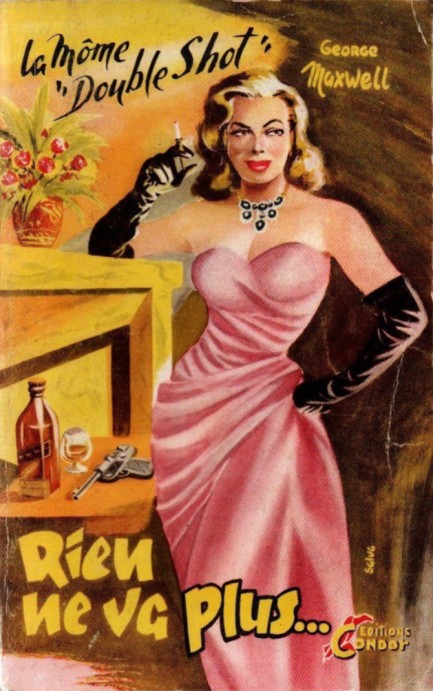
You've seen previous examples from Éditions le Condor's series La Môme Double-Shot. This entry was written by George Maxwell, aka Georges Esposito, and is called Rien ne va plus, which means “nothing is going well.” But this cover went pretty well. Its creator Jean Salvetti, who signed as “Salva,” painted a visual pun in which “double-shot” becomes a choice between a shot of liquor and a shot of lead. We'll take the booze. Every time. More from Salvetti at his keywords below.
 Since you ask, no, I've never had a haircut. Though many have offered. 
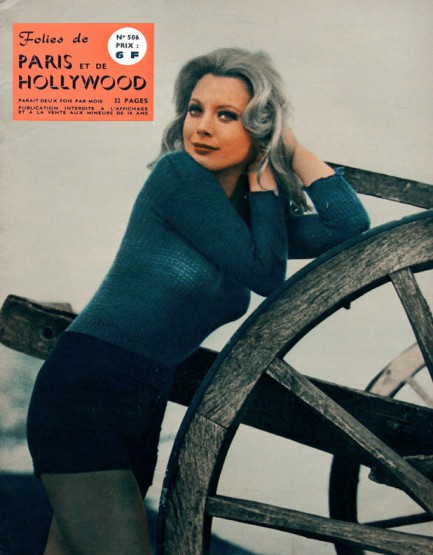
This image shows French/Dominican actress Tina Aumont, aka Tina Marquand, who we've seen around these parts a couple of times, most recently in the 1966 movie Modesty Blaise. We also shared a 1975 photo of her from Playboy Italy. This shot was conceived (or maybe copied from Erna Schürer) by Angelo Frontoni and dates from 1969.
 It may seem harsh, but it's the only way I know of to quiet a roomful of men. 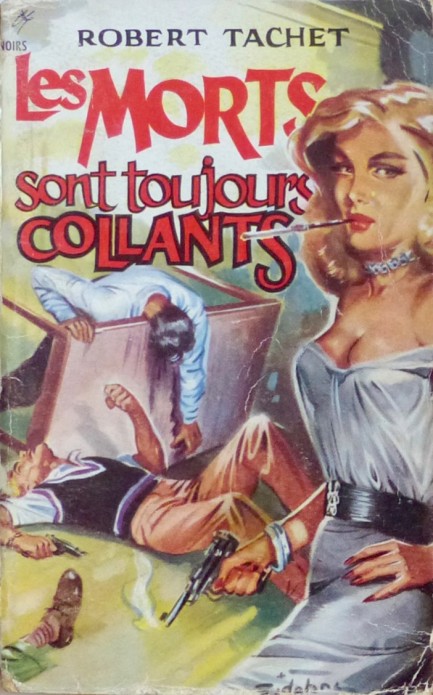
We have another new name for the website today, French illustrator Jean Sidobre, who put together this piece for Robert Tachet's 1952 novel Les morts sont toujours collants and signed it at bottom right. The title means “the dead are always sticky,” which is a typical title from that particular paperback industry—i.e. a bit baffling. But we get the idea we think. We've seen Tachet before. Have a look here.
 A little moisture makes love even better. 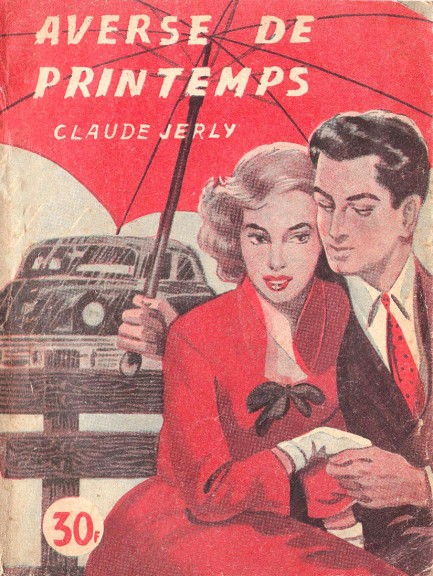
Rarely—as in today—we come across a book cover for which we can dig up no information. Averse de printemps, or “spring shower,” is credited to Claude Jerly, about whom we found nothing, came from a publishing company we can't pinpoint, and bears a cover by an artist we can't identify. Nice work, though, right? Maybe some nice person out there with more knowledge will send us a bit of info.
 La Muse de l’existentialisme et Miles. 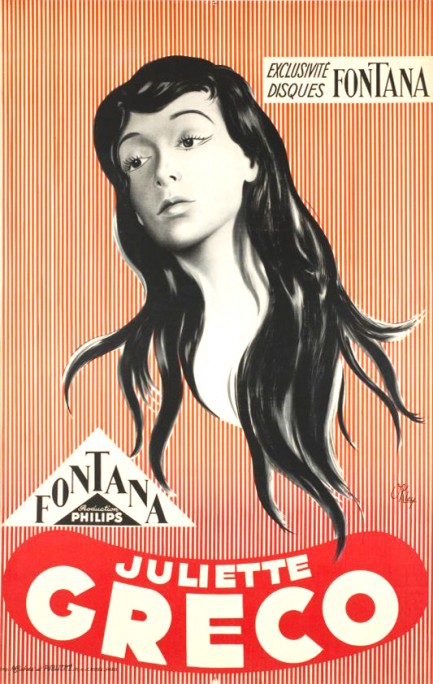
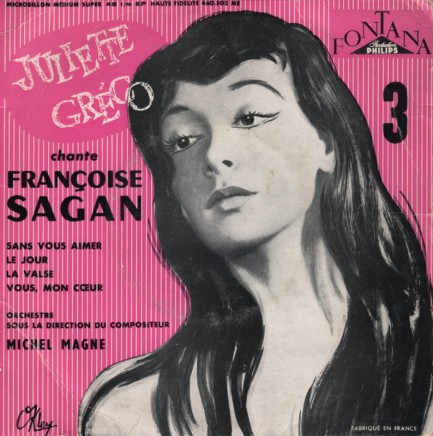
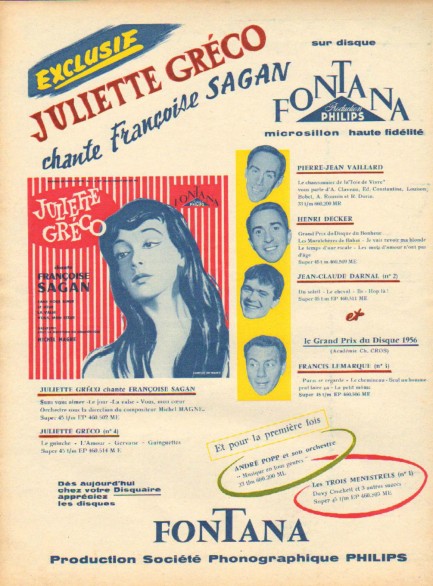
 This striking music brochure promo art for French singer Juliette Gréco and Disques Fontana (a subsidiary of the Dutch label Philips Records) was created by the famous illustrator O’Kley in 1956. The art was reused for record covers, as you see below. This striking music brochure promo art for French singer Juliette Gréco and Disques Fontana (a subsidiary of the Dutch label Philips Records) was created by the famous illustrator O’Kley in 1956. The art was reused for record covers, as you see below.
Gréco, an actress as well as singer, was a fixture in the Saint-Germain-des-Prés area of Paris, and her acquaintanceships with such figures as Jean-Paul Sartre and Maurice Merleau-Ponty earned her the nickname La Muse de l’existentialisme—the existentialists’ muse. She was also, according to Miles Davis, one of the great loves of his life, and the feeling was reciprocated, so that wins major points right there because Miles was the bomb.
Moving on to the art, O’Kley was a pseudonym for Nantes-born Pierre Gilardeau, the man behind some of the most collectable Folies Bergère posters. He also illustrated many book covers and movie posters, and after a long career died in 2007. We’ve seen some good examples of his art, so we’ll try to get back to him a bit later—but we make no guarantees. You can see another Fontana post here.
 The fundamental things apply. 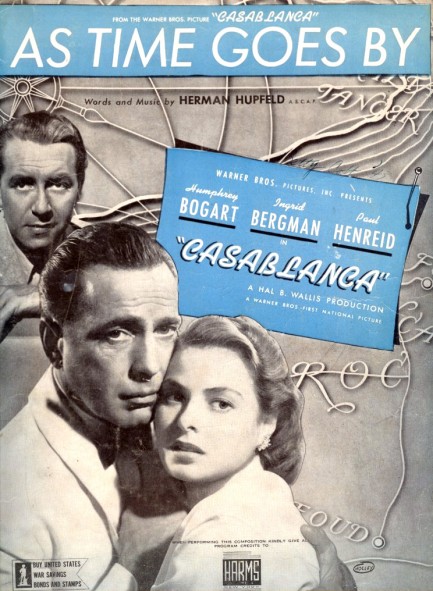
Here’s something nice we ran across on an auction site. It’s a piece of sheet music for “As Time Goes By”, which is a song written by German composer Herman Hupfeld and sung by Dooley Wilson’s character Sam in 1942’s Casablanca. The tune is inextricably identified with the film, but it was actually written for the 1931 Broadway show Everybody’s Welcome, where, in its complete form, it becomes clear the song is just as much about stress as about romance. You wouldn’t know that of course, because you don’t know the lyrics—really, who does? But today’s your lucky Monday—you can brush up on the words here. Just remember these two music fundamentals: if you sing, please do so from the diaphragm; and if you sing badly, blame it on booze.

|
 |

The headlines that mattered yesteryear.
1945—Mussolini Is Arrested
Italian dictator Benito Mussolini, his mistress Clara Petacci, and fifteen supporters are arrested by Italian partisans in Dongo, Italy while attempting to escape the region in the wake of the collapse of Mussolini's fascist government. The next day, Mussolini and his mistress are both executed, along with most of the members of their group. Their bodies are then trucked to Milan where they are hung upside down on meathooks from the roof of a gas station, then spat upon and stoned until they are unrecognizable. 1933—The Gestapo Is Formed
The Geheime Staatspolizei, aka Gestapo, the official secret police force of Nazi Germany, is established. It begins under the administration of SS leader Heinrich Himmler in his position as Chief of German Police, but by 1939 is administered by the Reichssicherheitshauptamt, or Reich Main Security Office, and is a feared entity in every corner of Germany and beyond. 1937—Guernica Is Bombed
In Spain during the Spanish Civil War, the Basque town of Guernica is bombed by the German Luftwaffe, resulting in widespread destruction and casualties. The Basque government reports 1,654 people killed, while later research suggests far fewer deaths, but regardless, Guernica is viewed as an example of terror bombing and other countries learn that Nazi Germany is committed to that tactic. The bombing also becomes inspiration for Pablo Picasso, resulting in a protest painting that is not only his most famous work, but one the most important pieces of art ever produced. 1939—Batman Debuts
In Detective Comics #27, DC Comics publishes its second major superhero, Batman, who becomes one of the most popular comic book characters of all time, and then a popular camp television series starring Adam West, and lastly a multi-million dollar movie franchise starring Michael Keaton, then George Clooney, and finally Christian Bale. 1953—Crick and Watson Publish DNA Results
British scientists James D Watson and Francis Crick publish an article detailing their discovery of the existence and structure of deoxyribonucleic acid, or DNA, in Nature magazine. Their findings answer one of the oldest and most fundamental questions of biology, that of how living things reproduce themselves.
|

|
|
It's easy. We have an uploader that makes it a snap. Use it to submit your art, text, header, and subhead. Your post can be funny, serious, or anything in between, as long as it's vintage pulp. You'll get a byline and experience the fleeting pride of free authorship. We'll edit your post for typos, but the rest is up to you. Click here to give us your best shot.

|
|