You're upset I betrayed your trust. But if I hadn't, all the publishers calling about your scandals would have been even more upset. 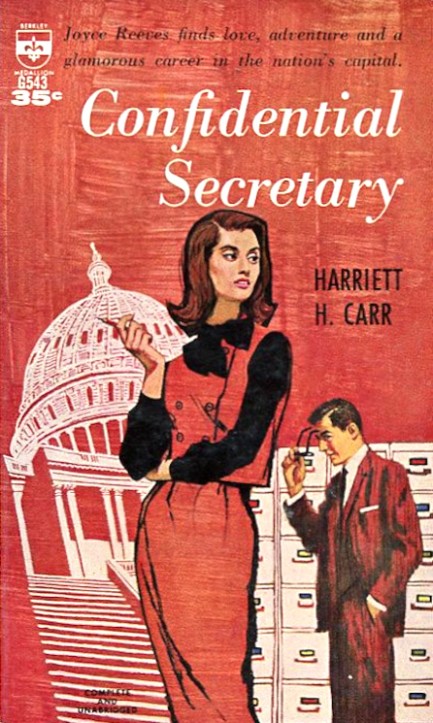
It's election season in the U.S., so above we have a cover for Harriett H. Carr's Confidential Secretary, originally published in 1958, with this Berkley paperback arriving in 1961. It's about a woman who takes a job in a Washington, D.C. corporation and is drawn into congressional intrigue, over the course of which she finds true love. This isn't one we'd read, but it does fit into our cover collection featuring the U.S. Capitol building—soon to be belching smoke and flames, the way things are going over there. The art is uncredited.
 Powell shoots for a comedic mystery but doesn't have Hammett's perfect aim. 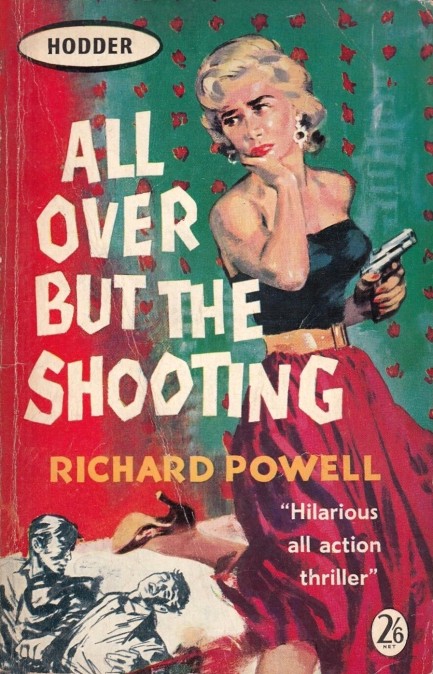
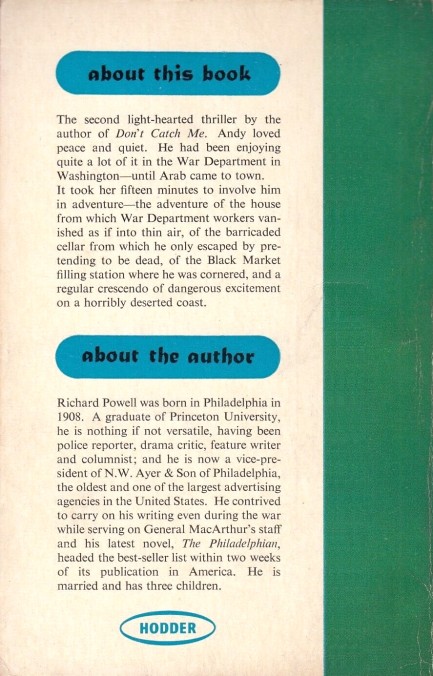
What is a "hilarious all-action thriller" like? That's the question that went through our minds when we impulsively ordered Richard Powell's 1946 novel All Over but the Shooting, though we were also drawn by the cover. The book was originally published by Popular Library, but the striking version you see above with art that's unfortunately uncredited came from the British imprint Hodder & Stoughton in 1952. Powell weaves a tale set in 1942 about Richard Blake and his danger-magnet wife Arabella—Arab for short—who believes she's stumbled across a spy plot centered around a Washington, D.C. women's boarding house. Determined to delve for answers—and to her husband's chagrin—she pretends to be a single woman, takes a room, and starts poking around. Her suspicions are of course correct. The place is a den of Nazis.
Powell thinks outside the box about every aspect of his story: how the conspiracy is uncovered, how the investigation proceeds, what clues are found, and what leaps of intuition keep the intrepid Arabella moving toward a solution. But the entire story is preposterous. Example: when Arab seems likely to be connected to a raincoat she lost while fleeing for her life, her hubby manages to sneak into the room where it's being kept—while its occupant is just upstairs—and have it altered in five minutes by a conveniently situated maid. That way the coat won't fit Arab when the villain tries to say it's hers.
That and about two dozen other moments are silly. Powell achieved, we think, exactly what he set out to do as an author, but we didn't find the book to be exactly scintillating. It was no Thin Man, for example, Dashiell Hammett's smashingly successful amalgam of humor and danger. But in the same way Arab erodes her husband's disbelief and finally gets him to buy into her wacky ideas, she wore us down too. She's a fun character, and makes the book worth a read. We won't seek out Powell again, but one spin around wartime D.C.? Sure, okay.
 Fredi was ready for Hollywood but Hollywood wasn't ready for equality. 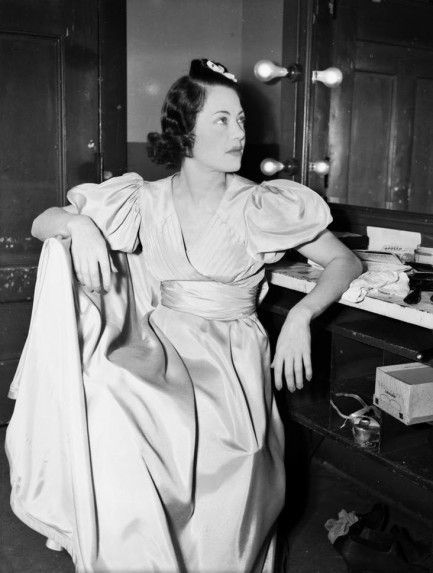
U.S. actress Fredi Washington, née Fredericka Washington, who you see here in a candid style backstage shot, had only six credited motion picture roles despite her talent, which makes her a prime example of what black performers endured during the long apartheid era in Hollywood. Her most notable film was 1934's Imitation of Life, a rare integrated drama in which she co-starred with Claudette Colbert, Rochelle Hudson, and Alan Hale. Her limited cinematic choices were one reason why in 1937 she became a founding member of the Negro Actor's Guild, and tirelessly advocated for equality in film and the theatre. Today Washington is remembered for her activism, but also as a pioneer in a field that barely acknowledged her existence, while Imitation of Life is considered a groundbreaking achievement. This photo is undated, and though some sources say it's from 1940, that would be after her film career ended, so we suspect it's from around 1935.
 I came up with it all by myself. Totally groovy, right?  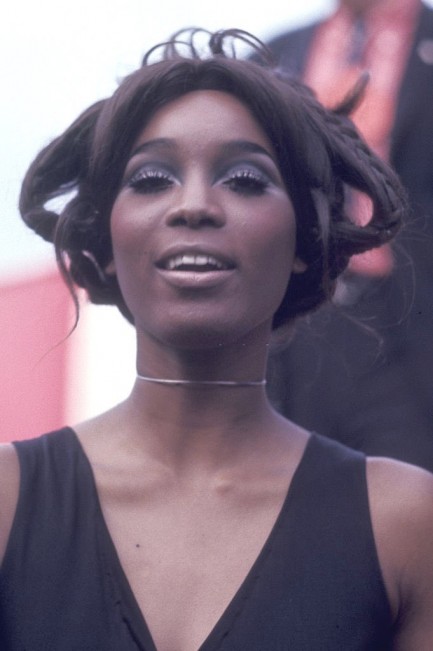 
These shots show U.S. actress Teresa Graves today in 1970, and despite the fact that her bizarro hairdo makes her look counterculture, she was in Washington, D.C. attending the Honor America Day celebration. If you've never heard of Honor America Day, that's because it was a one-off, hastily cobbled together by then-president Richard Nixon, who was under pressure due to his decision to send U.S. troops into Cambodia during the Vietnam War, a move which precipitated a protest at Kent State University at which Ohio National Guard troops shot and killed students. Graves was a minor television star at the time, a recurring guest on the show Rowan & Martin's Laugh-In, however she was a natural for the D.C. event because she had built her career partly by touring Southeast Asia as a singer with Bob Hope's USO show. She would eventually become a major star on the police drama Get Christie Love! By then she'd ditched the hairdo that looked like it picked up signals from space for something conventional, as you can see at this link. But whatever shape her hair took, she was quite beautiful.
 Don't fool around on Donna Mae. 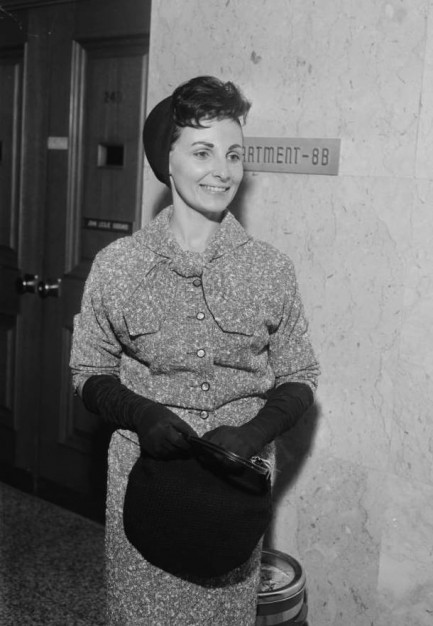
We're back in Los Angeles County divorce court, a place that got so much celebrity usage during the mid-century period it probably could have benefitted from a VIP section. Above you see famed burlesque dancer and model Donna Mae Brown, aka Busty Brown, attending a spousal support hearing today in 1960. Brown performed throughout the U.S. but was based in L.A., headlining at the New Follies, Strip City, and other popular nightspots. Busty wasn't her only alias. The era was all about unwieldy nicknames meant to generate free publicity, therefore she was also known for a while as “Miss Shape of Things To Come,” and “Miss Anatomy.”
In this case, what was to come was monthly support. She was seeking funds from her second ex-husband Maynard Sloate, a high powered agent whose clients included Count Basie, Ella Fitzgerald, Sarah Vaughn, and Dinah Washington, and who later went into club ownership—including the aforementioned Strip City—through which he trafficked such stars as Anita O’Day and Redd Foxx. At the end of the day Brown, who had initiated divorce proceedings due to Sloate's various infidelities, won fifty dollars monthly, and twenty percent of her ex's gross earnings as support for herself and her children.
The notably slender Brown, who's a brunette above and below, but earned her fame as a platinum blonde, was one of the bolder models of her era, going topless in magazines, baring all for nudie film loops, and getting truly revealing for underground photo club shoots. The latter practice even got her arrested in 1953. The trio of poolside shots below give you a sense of how far she was willing to go, but they're not among her most explicit photos, because there's only so far we're willing to go. If you poke around online you might find those images. She's also fifth in a collection of photos we uploaded a few years ago. 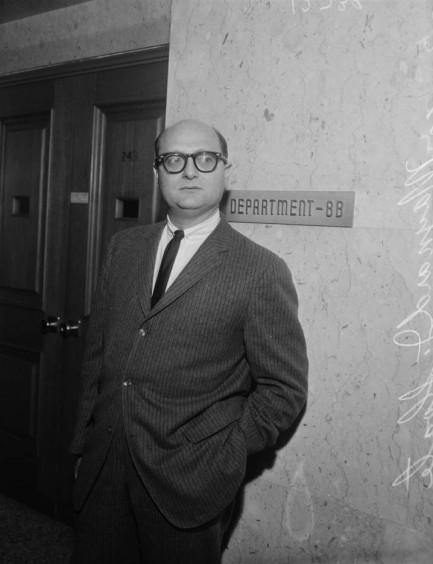 I'll admit there are a couple of aspects of marriage to Donna that I'll really miss. I'll admit there are a couple of aspects of marriage to Donna that I'll really miss.
 I'm going to reach the top and I'll do it by using the most American method of all—buying my way there. 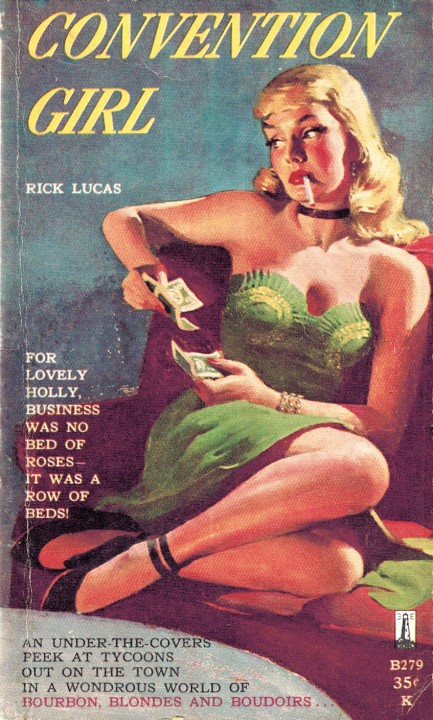 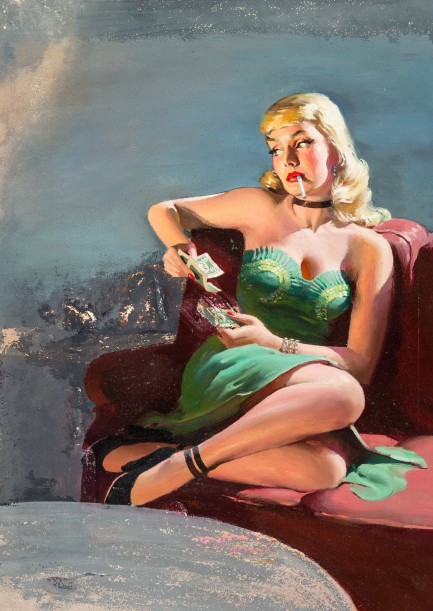
Above are the cover and original uncredited art for the sleaze novel Convention Girl, written by Rick Lucas for Beacon Signal and published in 1954. This was a one-day read. Basically, at a yearly Washington, D.C. convention staged by the Association of Young Executives, oil tycoon Holly Carroll and beer baron James Barton are both convinced by AYE string-pullers to run for the position of association president. Both are promised the inside track to victory by means not solely involving how many votes they actually get. As ex-lovers, the complications soon pile up between them, as well as between other highly sexed characters. The reasons they were asked to run for president are obscure, but they eventually boil down to a vast communist plot to undermine the free enterprise system. Commie scare fiction mixed with sleaze? What a concept! Sadly, as usual with these anti-commie books, the political aspects are laughably simple-minded. But we expected that. The hurdle that can't be overcome is the tepid eroticism. There's just not much heat—and this in a book with so many reds. We don't think we'll be reading Mr. Lucas again.
 Blaxploitation flick goes slapstick and the result is bold but bad. 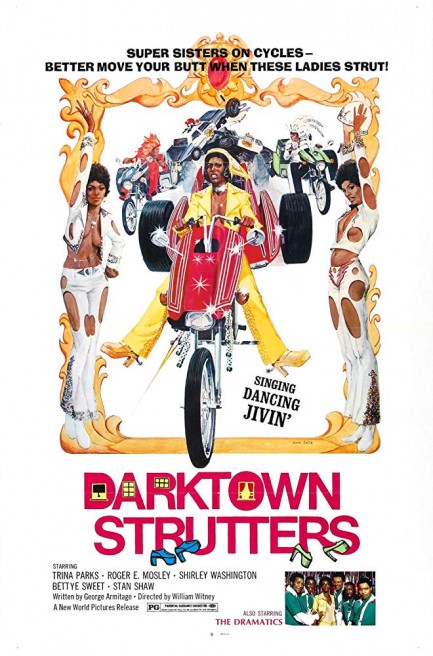
This poster for the blaxploitation flick Darktown Strutters, aka Get Down and Boogie, was painted by top talent John Solie and is a high quality piece of art. The movie it promotes, conversely, is a low quality piece of art, one of those efforts any rational assessment concludes is an utter disaster, but which has advocates, among them Quentin Tarantino. The advocates are wrong. Tarantino—and it pains us to say this—is wrong. This musical-alleged-comedy about a female motorcycle gang in L.A. battling the owner of a fried chicken franchise is about as entertaining as watching a circus clown punch himself repeatedly in the nose. If you watch it with your Vaudevillian cortex activated you might get a few bemused laughs. And if you dig into it with a pickaxe and mining helmet you might find commentary upon cultural appropriation, feminism, capitalism, and law enforcement. But if you examine it from a technical point of view you'll simply cringe, even factoring in its highly limiting three-day shooting schedule. Since when does lofty intent stand in for basic execution? We missed that memo. But we do love the poster, and we like the promo image below. It shows Edna Richardson, Bettye Sweet, Shirley Washington and, front and center, Trina Parks, who thankfully had other opportunities to show her actual talent. Darktown Strutters premiered in the U.S. today in 1975. 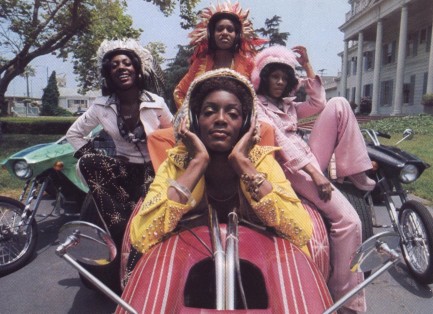 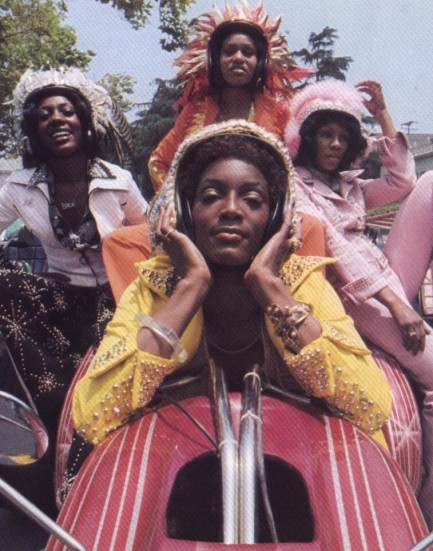
 She was more than just a movie star.
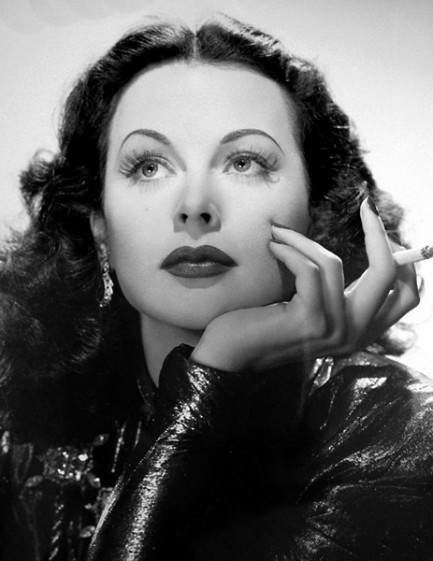 Smithsonian.com published an in-depth story yesterday about Austria-Hungary born Hollywood icon Hedy Lamarr, and how her technical genius helped bring the world Wi-Fi, Bluetooth, GPS, and cell phones. Hah! Get with it Smithsonian. We talked about this under-discussed aspect of her life years ago. Smithsonian.com published an in-depth story yesterday about Austria-Hungary born Hollywood icon Hedy Lamarr, and how her technical genius helped bring the world Wi-Fi, Bluetooth, GPS, and cell phones. Hah! Get with it Smithsonian. We talked about this under-discussed aspect of her life years ago. It's curious that no matter how many times people write about Lamarr's technological exploits it never seems to become a generally known aspect of her personality. Maybe people want to see her as a beautiful actress, and much of the interest stops there. The Smithsonian piece will probably help change that a bit, and it's well written also (though considering what digital technology has wrought we'd probably add the phrase "for better and worse").
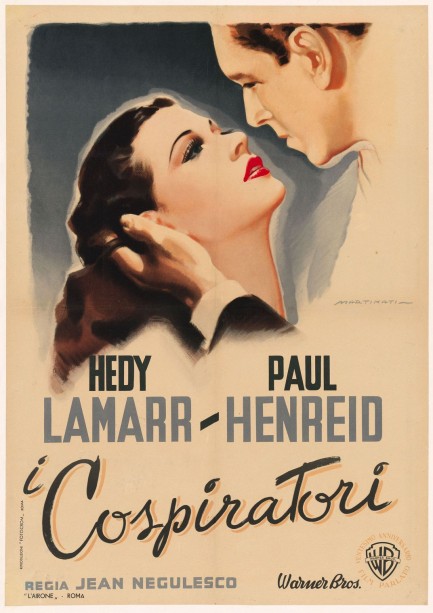
Yesterday's piece comes in tandem with the Smithsonian's Washington D.C. based National Portrait Gallery acquiring a rare original Luigi Martinati poster painted to promote Lamarr's 1944 thriller The Conspirators. We have no idea what it cost, but certainly a pile of money, since Martinati was not just a great artist, but one who tended to focus more on portraiture in his promos. You can see what we mean just below, and by clicking here and scrolling. As for Lamarr, we'll doubtless get back to her—and all her interesting facets—later.
 He always manages to insert himself into the most private places. 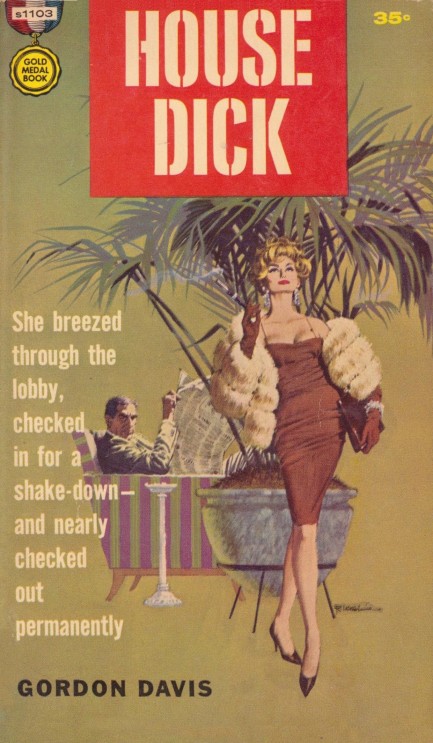
When one of the Pulp Intl. girlfriends saw this book, she said, “I could use some house dick right now.” That's a true story. But moving on, think you have a right to privacy in your hotel room? Think again. In House Dick the detective main character has the run of a 340-room Washington, D.C. hotel, and he liberally uses his master keys to go where he wishes whenever on the flimsiest of pretexts. This is highly ironic considering author Gordon Davis was in reality E. Howard Hunt and, as a member of Richard M. Nixon's black bag squad, arranged the world's most famous hotel break-in at the Watergate Hotel. He probably never should have gotten into politics—not only because his name is associated with one of the more shameful episodes in domestic American history (please, no obtuse e-mails, authoritarians), but also because Hunt could actually write. He's no Faulkner, but as genre fiction goes he's better than many. The main character in House Dick, tough guy Pete Novak, is drawn by a beautiful femme fatale into a scheme involving stolen jewels that—naturally—goes all kinds of sideways. There's less D.C. feel than we'd have liked, but the narrative works well overall. Gordon/Hunt wrote something like seventy books and we're encouraged to try a few more. This Gold Medal edition is from 1961 with Robert McGinnis cover art.

|
 |

The headlines that mattered yesteryear.
1927—First Prints Are Left at Grauman's
Hollywood power couple Douglas Fairbanks and Mary Pickford, who co-founded the movie studio United Artists with Charlie Chaplin and D.W. Griffith, become the first celebrities to leave their impressions in concrete at Grauman's Chinese Theater in Hollywood, located along the stretch where the historic Hollywood Walk of Fame would later be established. 1945—Hitler Marries Braun
During the last days of the Third Reich, as Russia's Red Army closes in from the east, Adolf Hitler marries his long-time partner Eva Braun in a Berlin bunker during a brief civil ceremony witnessed by Joseph Goebbels and Martin Bormann. Both Hitler and Braun commit suicide the next day, and their corpses are burned in the Reich Chancellery garden. 1967—Ali Is Stripped of His Title
After refusing induction into the United States Army the day before due to religious reasons, Muhammad Ali is stripped of his heavyweight boxing title. He is found guilty of a felony in refusing to be drafted for service in Vietnam, but he does not serve prison time, and on June 28, 1971, the U.S. Supreme Court reverses his conviction. His stand against the war had made him a hated figure in mainstream America, but in the black community and the rest of the world he had become an icon. 1947—Heyerdahl Embarks on Kon-Tiki
Norwegian ethnographer and adventurer Thor Heyerdahl and his five man crew set out from Peru on a giant balsa wood raft called the Kon-Tiki in order to prove that Peruvian natives could have settled Polynesia. After a 101 day, 4,300 mile (8,000 km) journey, Kon-Tiki smashes into the reef at Raroia in the Tuamotu Islands on August 7, 1947, thus demonstrating that it is possible for a primitive craft to survive a Pacific crossing. 1989—Soviets Acknowledge Chernobyl Accident
After two days of rumors and denials the Soviet Union admits there was an accident at the Chernobyl nuclear power plant in Ukraine. Reactor number four had suffered a meltdown, sending a plume of radioactive fallout into the atmosphere and over an extensive geographical area. Today the abandoned radioactive area surrounding Chernobyl is rife with local wildlife and has been converted into a wildlife sanctuary, one of the largest in Europe.
|

|
|
It's easy. We have an uploader that makes it a snap. Use it to submit your art, text, header, and subhead. Your post can be funny, serious, or anything in between, as long as it's vintage pulp. You'll get a byline and experience the fleeting pride of free authorship. We'll edit your post for typos, but the rest is up to you. Click here to give us your best shot.
|
|