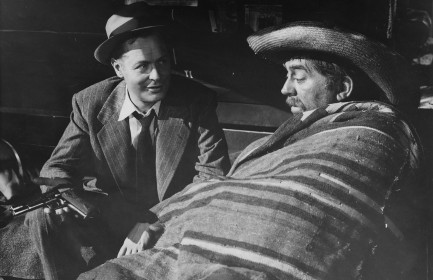
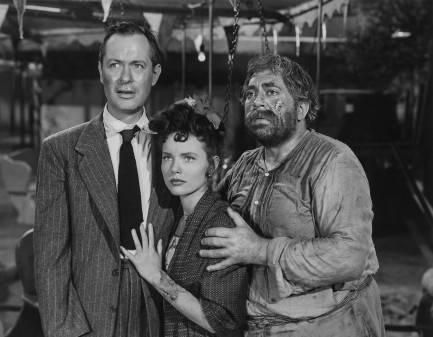
 Robert Montgomery rides into town and trouble soon follows. 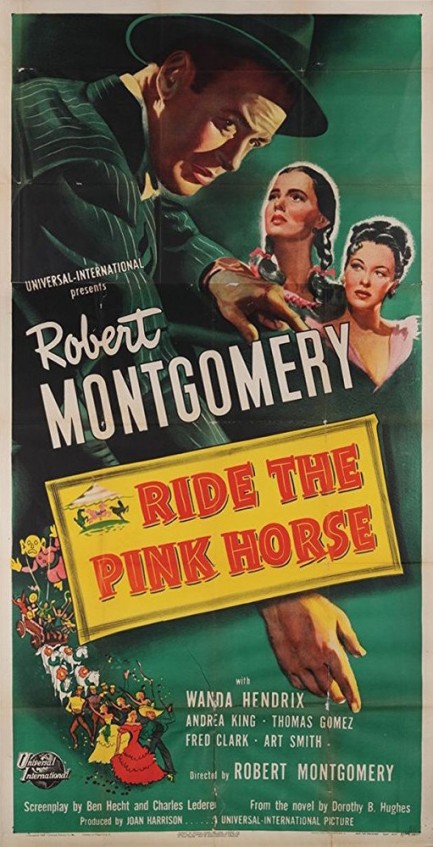
We'd seen the movie adaptation of Dorothy B. Hughes' novel Ride the Pink Horse before, more than once, but decided to watch it again because its premiere date was today in 1947. It differs from the book, of course—it's more streamlined, the real life town of Santa Fe becomes fictional San Pablo, the villains are more proactive, the heartless anti-hero Sailor becomes the not-so-bad Lucky Gagin, and the Mexican girl Pila is an adult instead of a fourteen-year-old. All these changes work fine. The most striking addition is the movie's use of Spanish dialogue, five or six lines worth, untranslated and unsubtitled. It adds authenticity, plus a touch of bonus material for Spanish speakers. Robert Montgomery directs and stars, handling the dual chores solidly. In the end Ride the Pink Horse is a good film noir that has increased in stature over the years. It's always been one of our favorites, but we admit that after seeing so many rote entries it's the quirky ones that tend to stand out. We wouldn't recommend this to novices as their first noir, but if you've seen many and are looking for something that surprises, Ride the Pink Horse will do the job. You can learn more about the movie by reading our detailed write-up about the novel here.
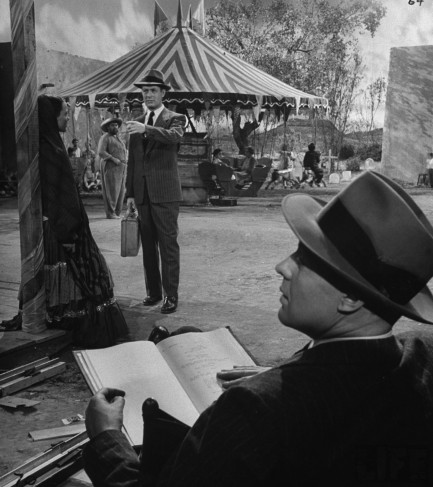 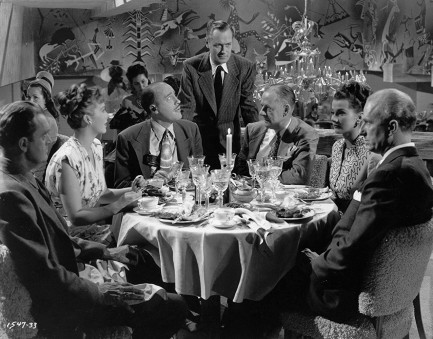 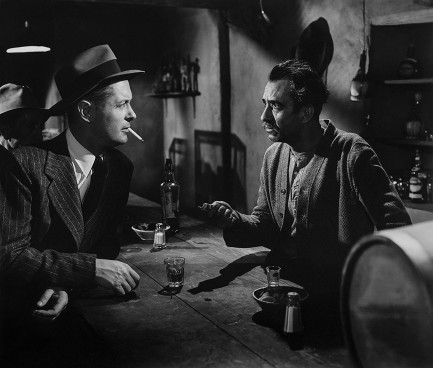 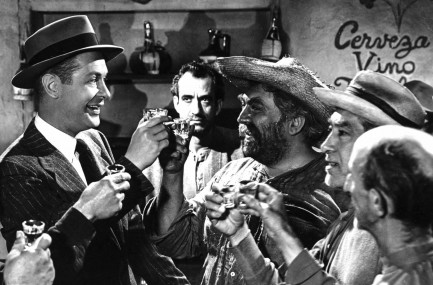   
 Hallucinatory southwestern noir takes readers to a land of saints and sinners. 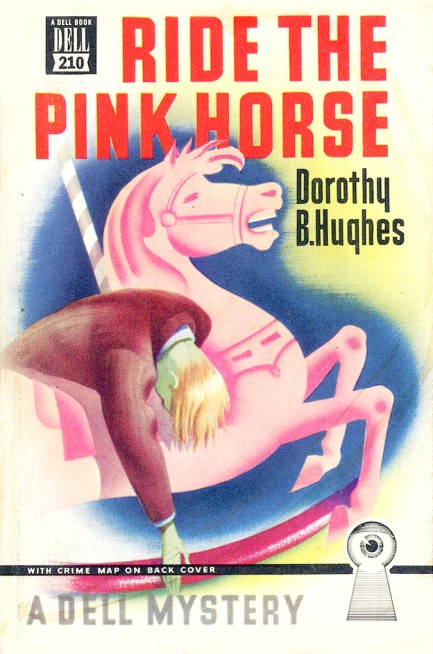
It's said that a good book teaches you how to read it. The author instructs while building the story. Dorothy B. Hughes' 1946 crime novel Ride the Pink Horse, which was the source material for the 1947 film noir starring Robert Montgomery, falls into that category. In the story a man wanders around the southwestern U.S. town of Santa Fe, New Mexico, searching for someone he calls the Sen, which is short for the Senator. We suspect the shortening of his title is designed to make it a heterograph with “sin,” because this Illinois senator-turned-crime boss rather sinfully hired out the murder of his wife then shorted the murderer part of his fee. That's why the main character, named Sailor, is adrift in this town. He's followed the Sen there from Chicago to get his money. He plans to find him, confront him, collect payment, then scurry away to Mexico.
But this comes out in trickles. Initially Sailor merely criss-crosses the town, unable to find a hotel room because it's fiesta weekend, with crowds everywhere and processions filling the streets. He sleeps under the canopy of a merry-go-round which features a pink horse. As he keeps going in circles around town more characters emerge—the cop 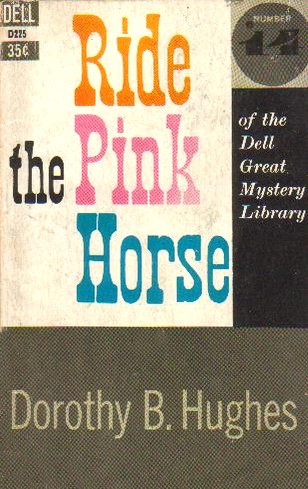 who's trying to solve murder of the senator's wife, the carousel owner who appeals to Sailor's sense of honor, the girl who recalls an innocence he can barely remember, and the beautiful Iris Towers, the focus of his wishes for a better life. who's trying to solve murder of the senator's wife, the carousel owner who appeals to Sailor's sense of honor, the girl who recalls an innocence he can barely remember, and the beautiful Iris Towers, the focus of his wishes for a better life.
Hughes loves symbolic names: there's the Sen, as we already mentioned; there's Iris Towers, dressed in ivory colors and pale of skin; and there's the girl Pila, whose name is the Spanish word for a laundry trough, a place of cleansing. The book is composed of encounters rather than events, hallucinatory meanderings punctuated by tense verbal standoffs. Each tête-à-tête clarifies matters a bit more for the reader. Did Sailor really kill the Sen's wife? Did he ever intend to? Was she ever to be the actual target? Were others involved?
When Sailor goes from seeing the town's Mexican and Native American inhabitants as something other than sub-human, maybe, we think, he isn't irredeemable. But even if he grows in some ways his hatred continues to drive him. He thinks the Sen is vermin. He wonders how such an abomination can even walk upon the Earth. When he follows the Sen into the cathedral this thought passes through his mind: He didn’t know why the dim perfumed cathedral didn’t belch the Sen out of its holy portals.
Hughes is a good writer, a unique stylist, and she gives Ride the Pink Horse the disorienting feeling of taking place in purgatory. It's a fever dream, an acid trip across a constantly shifting landscape, literary rather than pulp in approach, as much Faulkner as it is Chandler, with nothing quite solid or real apart from Sailor's hatred, which is so intense it seems as if it will consume him and leave nothing behind but a cinder. Sailor's racism is appalling, but he's not supposed to be a good man. This town filled with people that frighten and confuse him could be his salvation or his doom. He's the one who has to decide whether to step back from the precipice. Every wise character sees that he's headed for destruction. But the future isn't set. He has a chance for redemption—small, but real. Top marks for this one. 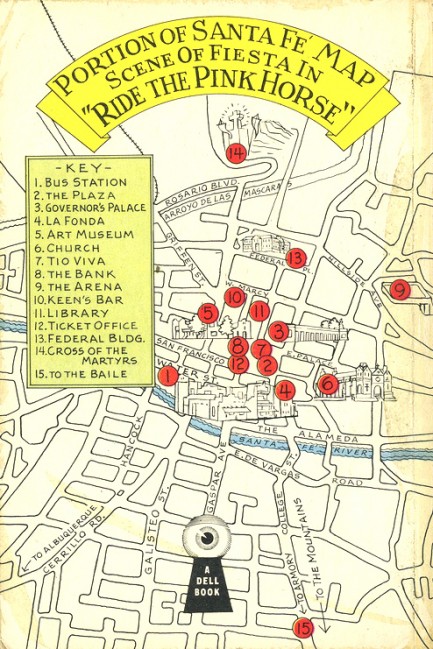
 Say hello to my little agent. 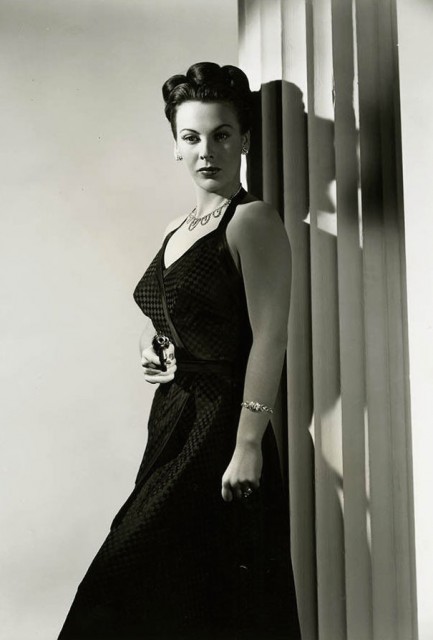
This film noir style Universal Pictures promo image shows Paris born Andrea King, whose given name was Georgette André Barry, but who lived only briefly in France before her mother brought her to the U.S. We just saw her in Mr. Peabody and the Mermaid, but we really remember her best for her role in a great but obscure film noir called Ride the Pink Horse. She also appeared in Shadow of a Woman, Dial 1119, Southside 1-1000, and—we love this last one—Blackenstein. The above shot showing her in take charge mode is from 1949.
 Only the good go to sleep at night. 
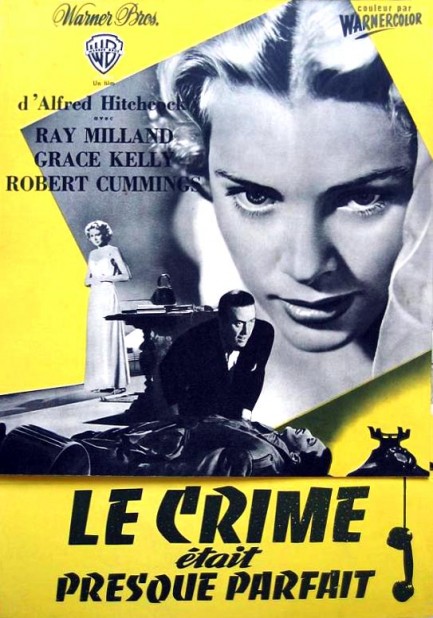
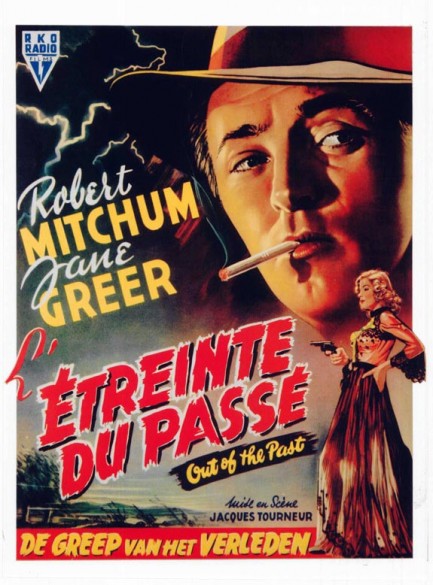
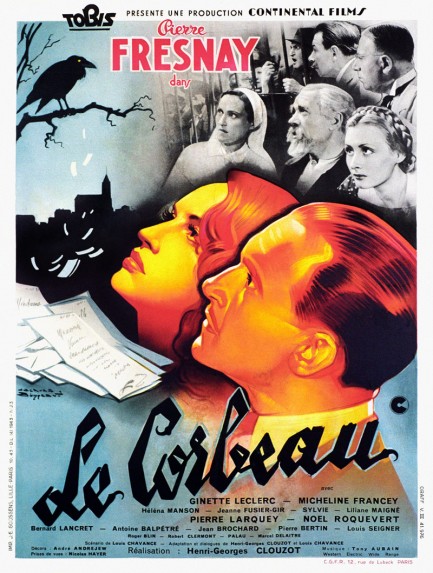
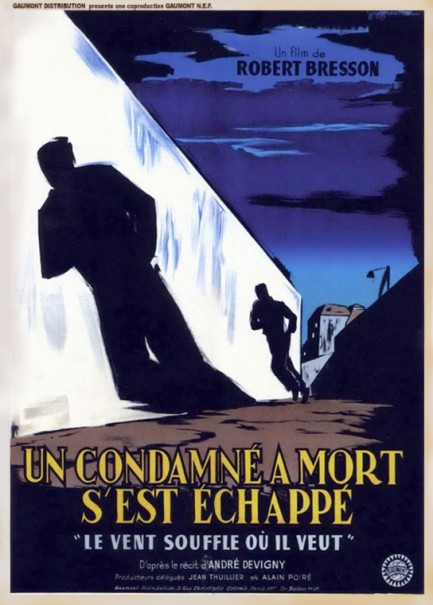
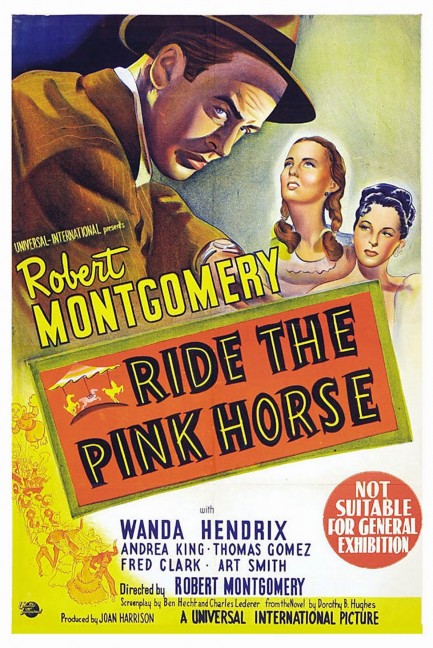
The French coined the term film noir, so it seems only fitting to feature a collection of French posters celebrating the genre. Above and below are fifteen examples promoting films noir from France, Britain, and the U.S., representing some of the best ever produced within the art form, as well as some less celebrated examples that we happen to love. Of those, we highly recommend seeing Le salaire de la peur, for which you see the poster above, and Ride the Pink Horse, below, which played as Et tournent les chevaux de bois in France. Just a word about those films (and feel free to skip ahead to the art, because really, who has time these days to listen to a couple of anonymous internet scribes ramble on about old movies?). 1953’s Le salaire de la peur is about a group of men stranded in an oil company town in the mountains of Latin America. In order to earn the wages to get out, four of them agree to drive two trucks filled with nitroglycerine over many miles of dangerous terrain. The idea is to use the chemicals to put out a raging oil well fire that is consuming company profits by the second, but of course the film is really about whether the men can even get there alive. Le salaire de la peur was critically praised when released in Europe, but in the U.S., political factions raised their ugly heads and got censors to crudely re-edit the prints so as to reduce the movie’s anti-capitalist (and by extension anti-American) subtext. The movie was later remade by Hollywood twice—once in 1958 as Hell’s Highway, and again in 1977 as Sorcerer. The original is by far the best.
1947’s Ride the Pink Horse is an obscure noir, but a quintessential one, in our opinion. If many noirs feature embittered World War II vets as their anti-heroes, Robert Montgomery’s Lucky Gagin is the bitterest of them all. He arrives in a New Mexico border town on a quest to avenge the death of a friend. The plot is thin—or perhaps stripped down would be a better description—but Montgomery’s atmospheric direction makes up for that. Like a lot of mid-century films featuring ethnic characters, the most important one is played by a white actor (Wanda Hendrix, in a coating of what looks like brown shoe polish). It's racist, for sure, but within the universe of the film Lucky Gagin sees everyone around him only as obstacles or allies—i.e., equals within his own distinct worldview. So that makes up for it. Or maybe not. In any case, we think Ride the Pink Horse is worth a look. Thirteen more posters below.
 Strangers when we meet. 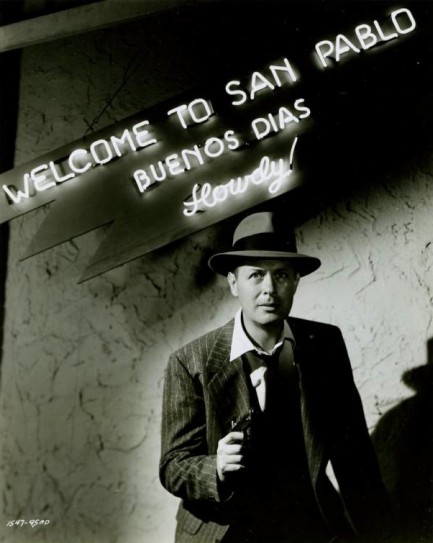
Above, a promo shot of Robert Montgomery from the underappreciated film noir Ride the Pink Horse, 1947.
 Hitchcock spy caper may be improbable, but Grant and Bergman make it a winner. 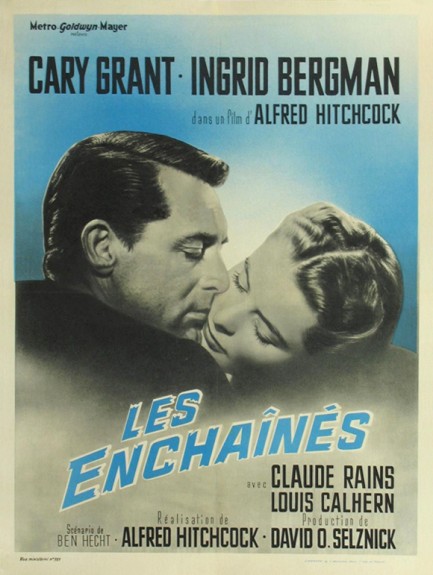 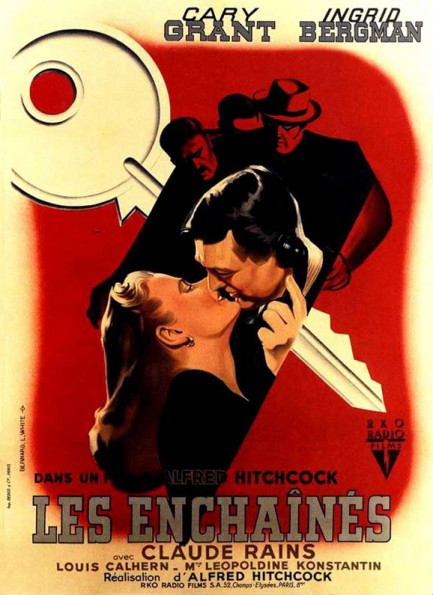 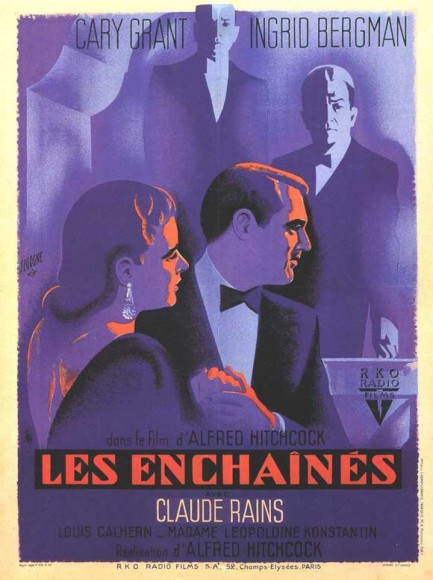
Above, we have three beautiful French posters for Alfred Hitchcock’s spy thriller Les Enchaînés, aka Notorious, starring Cary Grant and Ingrid Bergman. In Brazil, just after WWII, Bergman vies with Nazis who are smuggling uranium ore inside wine bottles. Seems like they could think of a better way, but you can’t really quibble with screenwriter Ben Hecht, who wrote Spellbound, the original Kiss of Death, the original Scarface, the brilliant but underappreciated Ride the Pink Horse, and was a script doctor on Laura, Rope, Cry of the City and Strangers on a Train. Besides, there’s something seriously metaphorical going on with these bottles. We ain’t saying what—you’ll just have to watch the film. Les Enchaînés premiered in France today in 1948
|
 |

The headlines that mattered yesteryear.
1947—Heyerdahl Embarks on Kon-Tiki
Norwegian ethnographer and adventurer Thor Heyerdahl and his five man crew set out from Peru on a giant balsa wood raft called the Kon-Tiki in order to prove that Peruvian natives could have settled Polynesia. After a 101 day, 4,300 mile (8,000 km) journey, Kon-Tiki smashes into the reef at Raroia in the Tuamotu Islands on August 7, 1947, thus demonstrating that it is possible for a primitive craft to survive a Pacific crossing. 1989—Soviets Acknowledge Chernobyl Accident
After two days of rumors and denials the Soviet Union admits there was an accident at the Chernobyl nuclear power plant in Ukraine. Reactor number four had suffered a meltdown, sending a plume of radioactive fallout into the atmosphere and over an extensive geographical area. Today the abandoned radioactive area surrounding Chernobyl is rife with local wildlife and has been converted into a wildlife sanctuary, one of the largest in Europe. 1945—Mussolini Is Arrested
Italian dictator Benito Mussolini, his mistress Clara Petacci, and fifteen supporters are arrested by Italian partisans in Dongo, Italy while attempting to escape the region in the wake of the collapse of Mussolini's fascist government. The next day, Mussolini and his mistress are both executed, along with most of the members of their group. Their bodies are then trucked to Milan where they are hung upside down on meathooks from the roof of a gas station, then spat upon and stoned until they are unrecognizable. 1933—The Gestapo Is Formed
The Geheime Staatspolizei, aka Gestapo, the official secret police force of Nazi Germany, is established. It begins under the administration of SS leader Heinrich Himmler in his position as Chief of German Police, but by 1939 is administered by the Reichssicherheitshauptamt, or Reich Main Security Office, and is a feared entity in every corner of Germany and beyond. 1937—Guernica Is Bombed
In Spain during the Spanish Civil War, the Basque town of Guernica is bombed by the German Luftwaffe, resulting in widespread destruction and casualties. The Basque government reports 1,654 people killed, while later research suggests far fewer deaths, but regardless, Guernica is viewed as an example of terror bombing and other countries learn that Nazi Germany is committed to that tactic. The bombing also becomes inspiration for Pablo Picasso, resulting in a protest painting that is not only his most famous work, but one the most important pieces of art ever produced.
|

|
|
It's easy. We have an uploader that makes it a snap. Use it to submit your art, text, header, and subhead. Your post can be funny, serious, or anything in between, as long as it's vintage pulp. You'll get a byline and experience the fleeting pride of free authorship. We'll edit your post for typos, but the rest is up to you. Click here to give us your best shot.
|
|