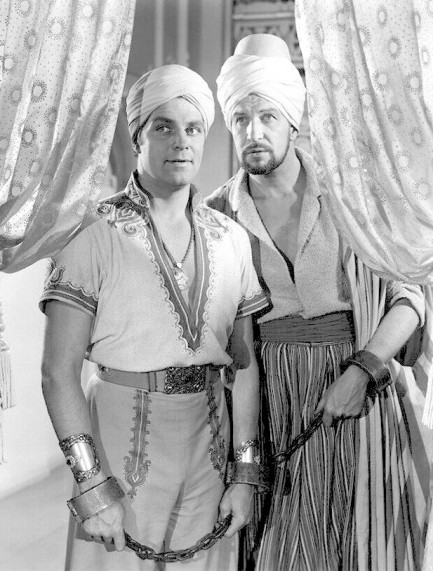
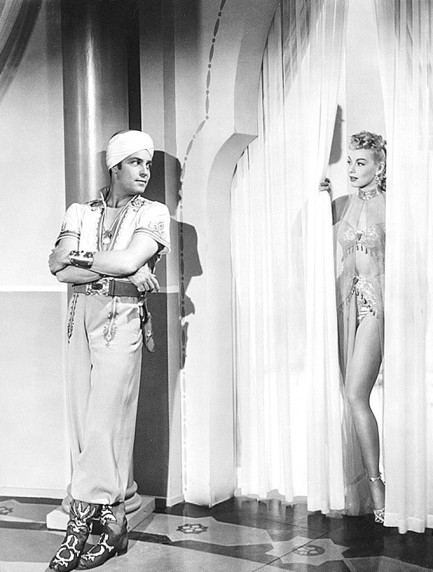
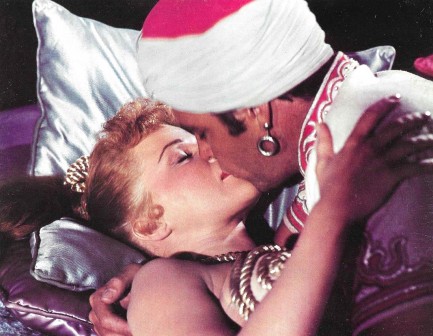
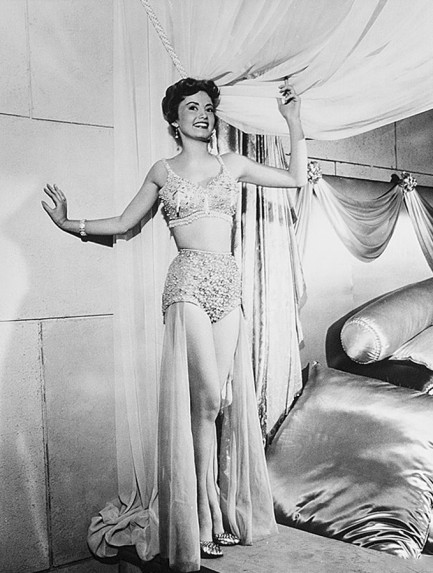
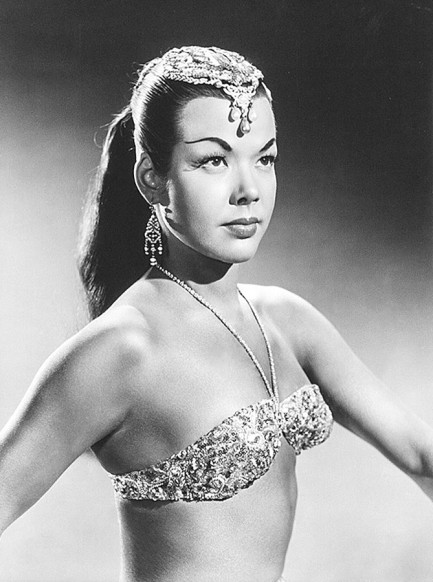
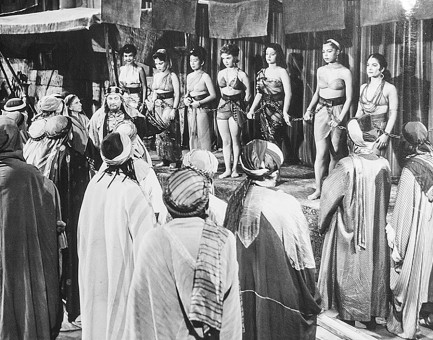
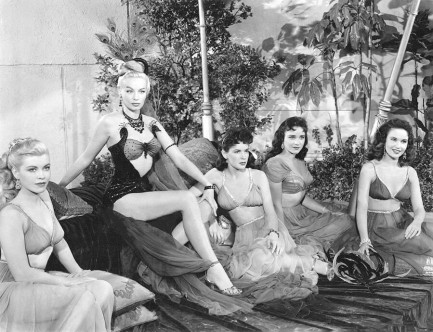
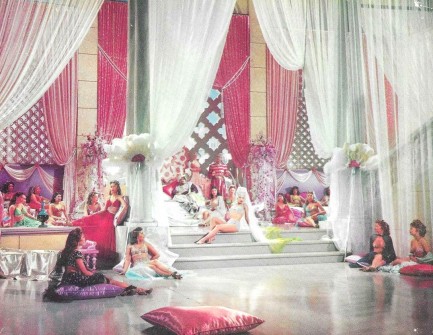
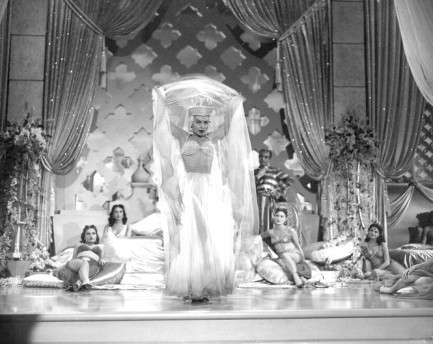
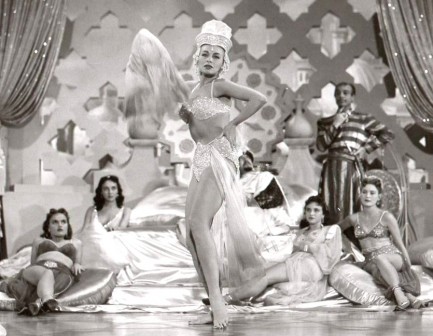
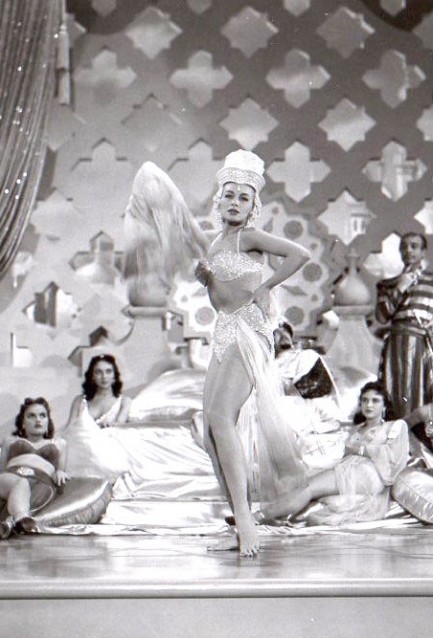
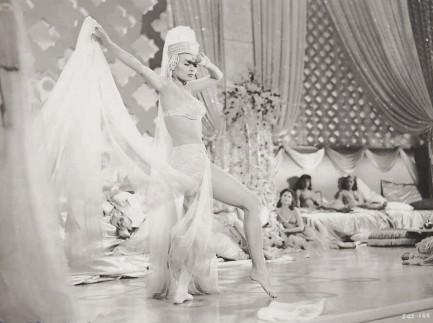
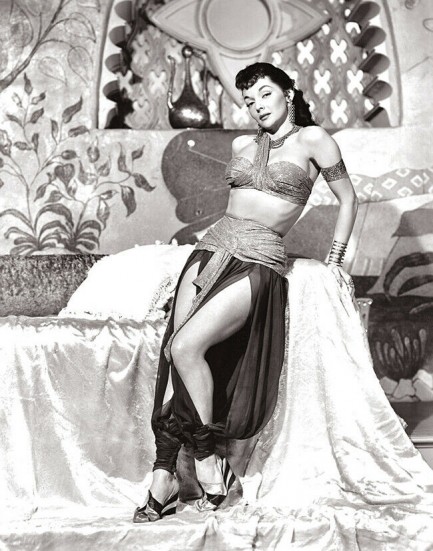
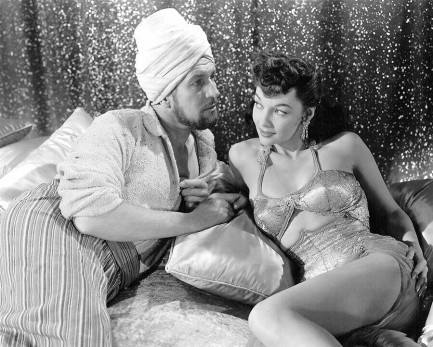
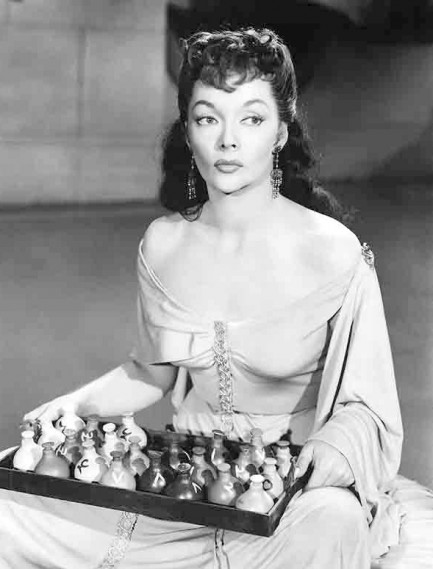
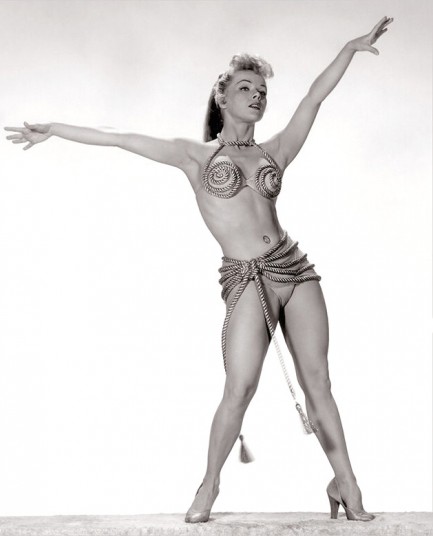
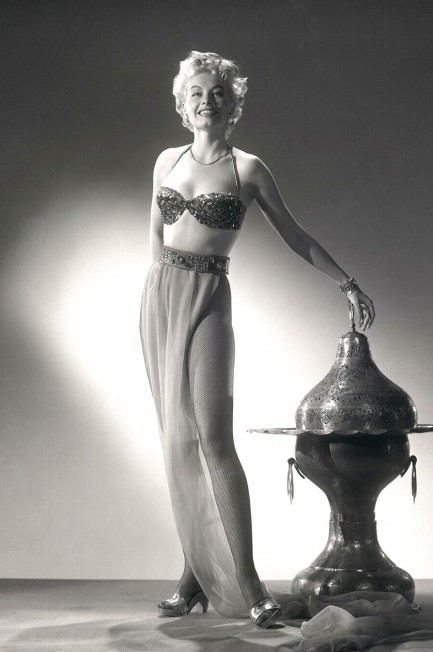
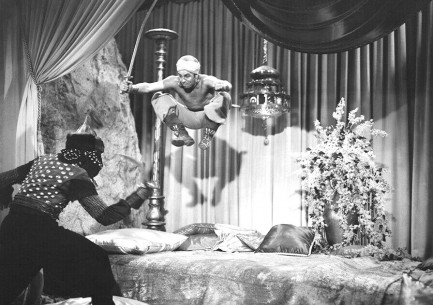
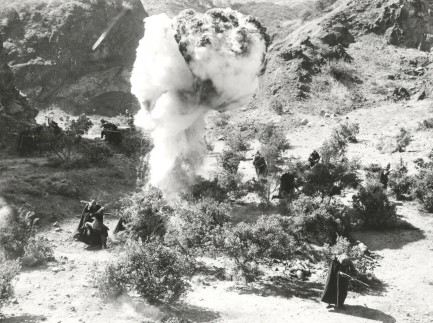
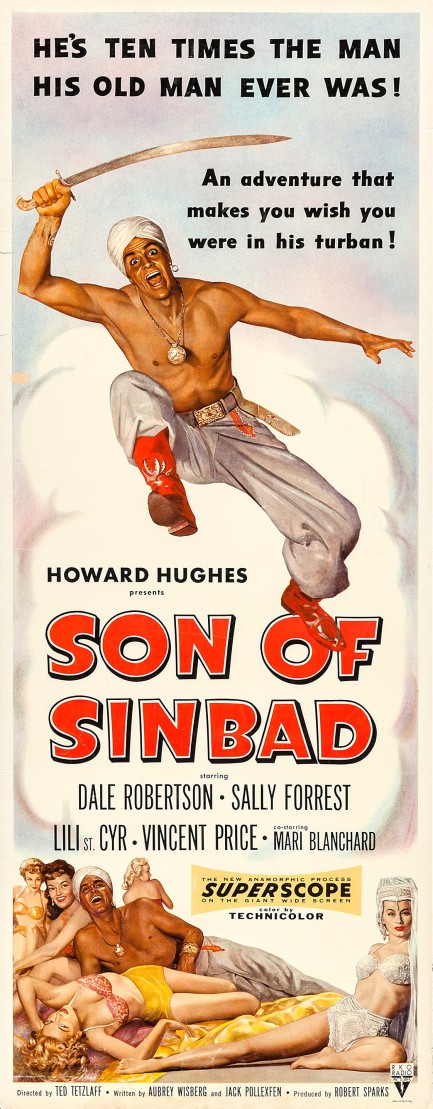
Sinbad may be the star but it's the dancers who shine brightest. 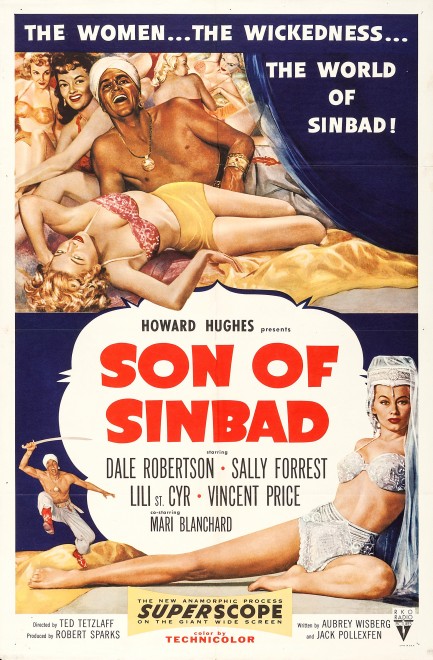
Howard Hughes had an entire slate of personal flaws, not least of which was that he was a frothing racist, but in terms of filmmaking he understood the concept of value-added cinema. He often battled censors, because if he had a beautiful actress on hand he'd build something around her that was as provocative as the market would bear. Jane Russell is his most famous protégée, but he shaped projects for Jean Harlow, Gina Lollobrigida, Faith Domergue, and others. In Son of Sinbad he wanted to show Lili St. Cyr to great advantage, and along the way, in typical fashion, added more, more, and more. He brought aboard MGM dancer-actress Sally Forrest and famed peelers Nejla Ates and Kalantan to compliment St. Cyr, made them all ornately clad harem girls, and ended up with a movie that was nearly banned.
The stars of Son of Sinbad are Dale Robertson as the fictional Sinbad's son and Vincent Price as the historical figure Omar Khayyám, and in the story, which is set in Baghdad, horny Sinbad is busted making time with one of the Sultan's harem girls and is imprisoned along with Omar. In exchange for his freedom Sinbad reveals the existence of Greek fire, a dynamite-like explosive, which could come in handy because the Sultanate is at war with the Tatars. Sinbad doesn't actually have the secret to this weapon himself—it's locked inside the head of his friend Kristina, who can only reveal the process for making it while hypnotized. The Sultan is suitably impressed after a demonstration and agrees to free Sinbad and friends, but due to some palace spying third parties have learned about the weapon, and from that point forward more complications ensue.
While Son of Sinbad is a fantasy adventure with elements of comedy, audiences also knew to expect titillation from RKO Radio Pictures, and the movie leans into that expectation with its sexy costumed dance numbers. Any movie that offers St. Cyr in motion is automatically recommended, and you'll get a sense of why she was probably the most famous burlesque dancer in America, though neither she nor the other dancers remove much clothing. Even so, it's a nice showcase of the burlesque arts, and the dancing offers reason enough to watch the film, and would even if the movie were terrible.
However, the bonus here is that the movie isn't terrible. The lavish sets, beautifully painted backdrops, and colorful costumes transport the viewer—not to ancient Baghdad, but to a magical, soundstage-bound, Technicolor realm similar to that from old Bible flicks. Robertson is fine as Sinbad Jr., but Price, as he tended to do, excels in his second banana role. The man was a born star, and a born ham. As long as you don't expect a masterpiece you'll be entertained. And as a point of added interest, Kim Novak makes a quick and uncredited appearance as a Tatar woman. It was her first screen role, but because the movie was delayed—like many Hughes projects—it was not the first time audiences had seen her. Son of Sinbad did eventually hit cinemas, though, premiering after more than a year of delays, today in 1955.
 Forget it, Jake. It's Tinseltown. 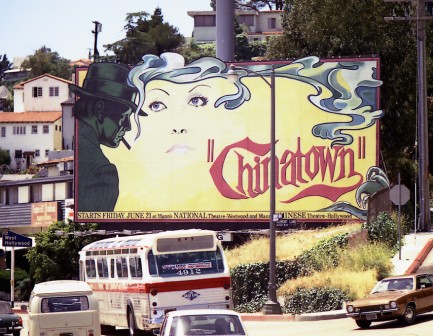
We were poking around the architecture forum skyscraperpage.com and ran across this interesting photo of a billboard advertising the film Chinatown. This was located in Los Angeles at the intersection of Sunset Boulevard and Marmont Lane, and as you can see it touts the opening of the film today in 1974. We lived on the west side of L.A. for four years, and used to pass this spot occasionally. Marmont Lane winds to the right toward the famed Chateau Marmont Hotel, where luminaries such as Howard Hughes, Natalie Wood, Elizabeth Taylor, and James Dean once made the scene, and a couple met their ends, including Helmut Newton and John Belushi.
We knew the intersection was one of the city's most important billboard spots and wondered what else had been advertised there. So we had a look. 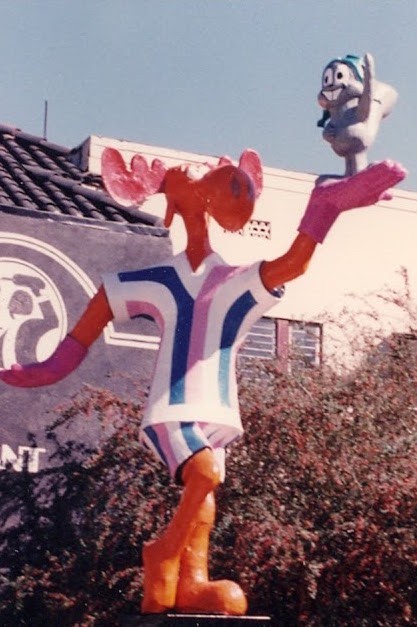 We expected to find an assortment of examples, but it turns out the locale was so coveted a relative few companies monopolized it. The first was the Sahara Hotel in Las Vegas, which erected a sign there in 1957, complete with a rotating showgirl and an illuminated marquee listing the headlining acts. We expected to find an assortment of examples, but it turns out the locale was so coveted a relative few companies monopolized it. The first was the Sahara Hotel in Las Vegas, which erected a sign there in 1957, complete with a rotating showgirl and an illuminated marquee listing the headlining acts.
The sheer novelty of the sign helped establish the heavily trafficked intersection as one of L.A.'s go-to spots for promotion, and the sign itself became a landmark. In fact, in 1961 Jayne Mansfield unveiled a Rocky and Bullwinkle statue across the street that was inspired by the Sahara showgirl. It was commissioned by Jay Ward, producer of the television series Rocky and His Friends, for the opening of his office complex.
After the Sahara moved on in 1966 the location was divided into two-tiered advertising. For almost three decades the iconic Marlboro Man towered above the intersection on the higher billboard, first on a horse, and later sans mount. During the time Chinatown was advertised Mr. Marlboro was standing vigil above. The lower location hosted ads for Stroh's and numerous other products, but was a particularly popular home for movie billboards. We found shots of billboards for Looking for Mr. Goodbar, Black Sunday, and other popular films of the 1970s.
Tens of thousands of billboards dot the Los Angeles landscape, especially around Hollywood. An uptick of political billboards has some Angelenos considering whether these objects are more akin to visual pollution. They're already illegal in entire U.S. states, including Hawaii and Maine. We always thought they further cluttered an already chaotic landscape, but we imagine they will survive in Los Angeles longer than almost anywhere else in the U.S. Tinseltown is a place where you don't get people's attention unless you scream for it. Nothing screams better than a well placed billboard. 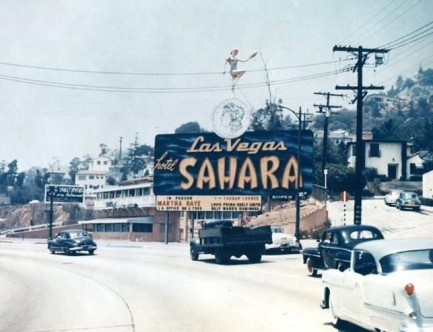 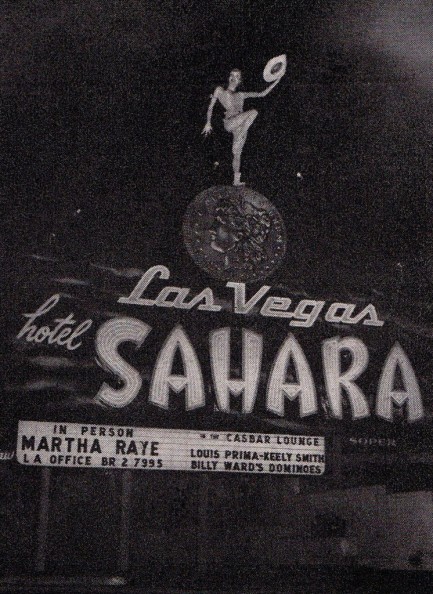 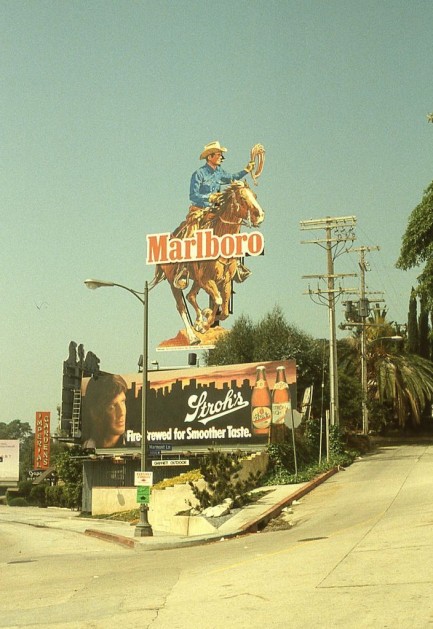
 We suspect what was outlawed was Howard Hughes' directorial career. 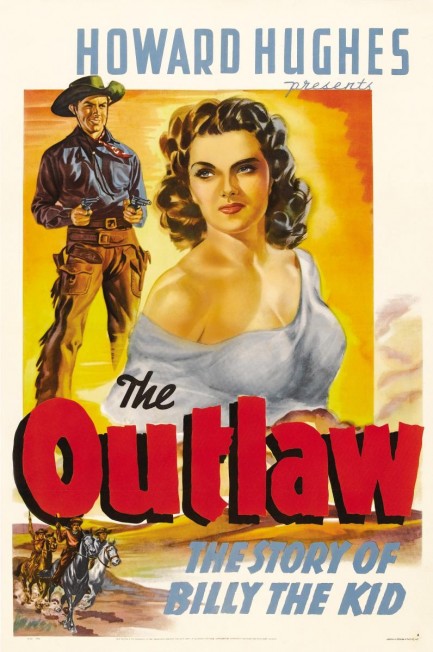
The Outlaw is reputed to be a terrible movie. Since it premiered today in 1943 we thought we'd give it a glance, and guess what? It's terrible. Howard Hughes directed it when he still fancied himself a man with artistic talent, and the main takeaway is that the Dunning-Kruger Effect is more than just a theory. His adoration of Jane Russell radiates from each of her scenes, but in overall execution the movie flops in every area except infuriating the era's movie censors. It's accidentally funny, though.
Billy the Kid: “Doc, if you're not already fixed up you can bunk with me tonight.”
Doc Holliday: “No thanks, Billy. I've got a girl. She and her aunt just moved in town. You got a girl, Billy?”
Billy the Kid: “Naw. I ain't got nothin'. Except that horse.”
On the other hand, the film is also terribly unfunny. Wikipedia says it's implied that Billy rapes Jane Russell's character Rio McDonald in a barn. We're here to tell you it may be implied visually and in the dialogue that drifts out of those obscuring shadows, but as a matter of plot it's a dead certainty that's what happens. And she's his friend's lady, the one discussed in the above dialogue exchange. Billy's a truly terrible guy. But you know exactly what happens next, right? Rio falls in love with him. But he remains a dick:
Rio McDonald: “What are you waiting for? Go ahead.”
Billy the Kid: “Say that sounds real nice. I like to hear you ask for it. Beg some more.”
Rio McDonald: “What would you like me to say?”
Billy the Kid: “Well you might say please very sweetly.”
Rio McDonald: “Please.”
Billy the Kid: “Will you keep your eyes open?”
Rio McDonald: “Yes.”
Billy the Kid: “Will you look right at me while I do it?”
The music alone during that scene could drive you from the room. And what does Billy do to Rio after he's had his way with her yet again? Ties her by her wrists and ankles and leaves her in the hot sun to roast to death. Holliday rescues her and opines that Billy must really be in love with her to do something so cruel. Um... okay. This is another great exchange:
Billy the Kid: “I think I'd rather have that cuckoo clock do the counting for me.”
Doc Holliday: “Yeah that's good enough. It's gonna strike in a minute.”
Billy the Kid: “Shall we pull on the last cuckoo? We're pretty sure Hughes was pulling on his cuckoo when he made this, but luckily he never directed again. Amazingly, even though the film is awful, everything associated with it is collectible, including the promo poster above, which if you wanted to buy would cost you $56,000. Not the original painting. An original print. At least that's what one ambitious soul is asking for it. We suspect the separation between the quality of The Outlaw and the cost of its memorabilia is the largest of any film in American history. Watch it if you dare. 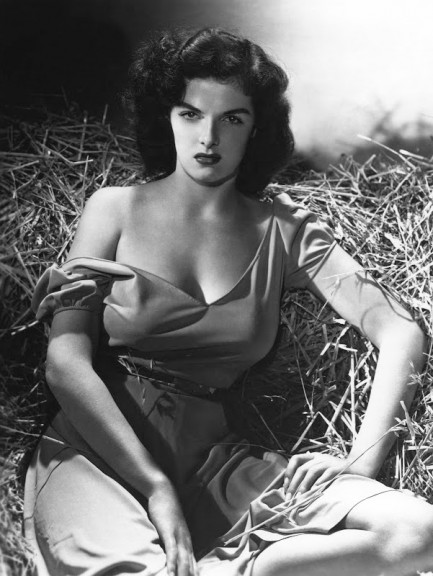
 She's not just another brick in the wall. 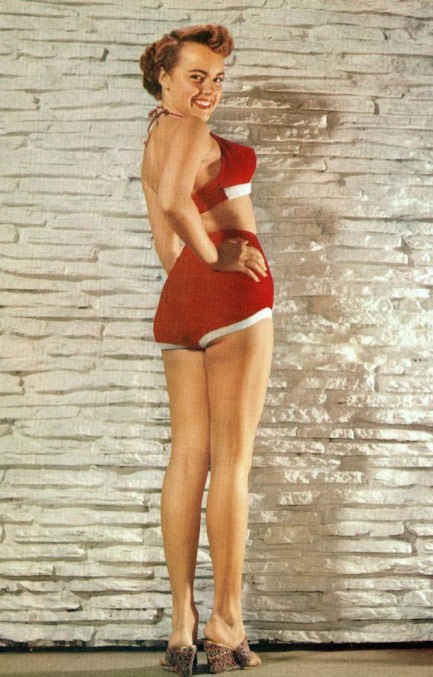
Above, Los Angeles born actress Helen Luella Kofor, known professionally as Terry Moore, who first appeared on a movie screen in 1940 and has been active ever since, most recently in Merrily, slated to open in late 2017. She also appeared in 1944's Gaslight, 1949's Mighty Joe Young, and dozens of other films. Along the way she was nominated for an Academy Award, became secret spouse to Howard Hughes, and posed for Playboy at age fifty-five, looking just fine, too. All in all, Moore is a unique character. The above shot of her is from around 1955.
 But I only want to kill my stepmom and take her money. What’s the big deal? 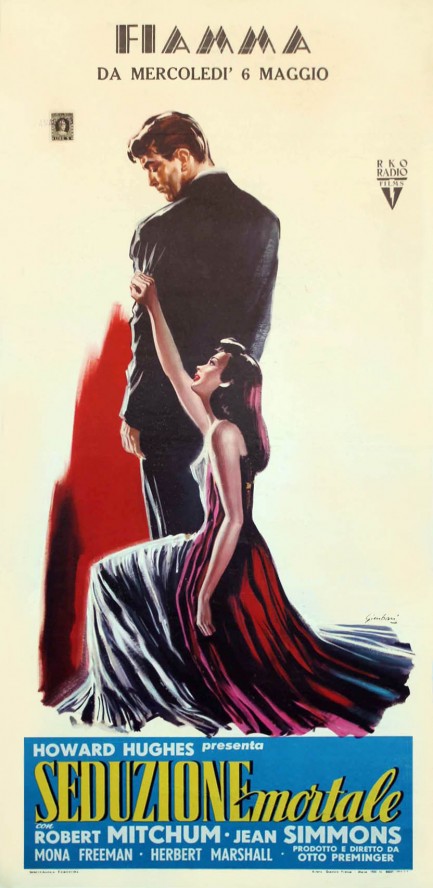
First things first—this poster was painted by Nicola Simbari, yet another genius from the ranks of Italian illustrators, someone who today is thought of as one of Italy’s most important modern artists and has pieces hanging in museums all over the world. He painted the above masterpiece for the Howard Hughes produced Seduzione mortale, known in the U.S. as Angel Face. It's the story of a man who tries to trade up to a richer, flashier girlfriend and ends up entangled in a murder plot. Robert Mitchum stars as the fickle hero, Jean Simmons co-stars as the femme fatale, Mona Freeman is the loyal girlfriend, and Jim Backus—aka Mr. Howell from Gilligan’s Island—is a tough district attorney. This one is worth watching for the cringe-inducing central killing alone, which ranks top five in the annals of film noir for sheer brutality. Mitchum is good as always, Simmons less so due to her occasional tendency to act! rather than act, but that’s a minor issue. The movie works. It's well scripted by a trio of writers with an assist from Ben Hecht, and nicely directed by Otto Preminger. Best line in the film: “Is rigging a car like he says a very complicated thing? Or could anyone do it? Even a woman?” Ah yes, film noir—sexy and sexist. But there’s a real lesson there—never teach a femme fatale how a car’s transmission works. You’ll regret it.
Angel Face opened in the U.S. in late 1952 and premiered, according to all the sources we checked, in Italy today in 1953. But the poster at top advertises a premiere at a Rome cinema called the Fiamma on 6 May, 1953. Which date is right? Possibly both. April 18, 1953 was a Saturday, which would be a typical day for a film’s run to commence. May 6 was a Wednesday—not typical for launching a wide release. We suspect the poster was made for a special engagement, probably one night only. But we’re only guessing. We may have to slot this question in the unanswered file. There are only so many things you can figure out from a computer terminal after all. We have another poster below, plus two nice promos. 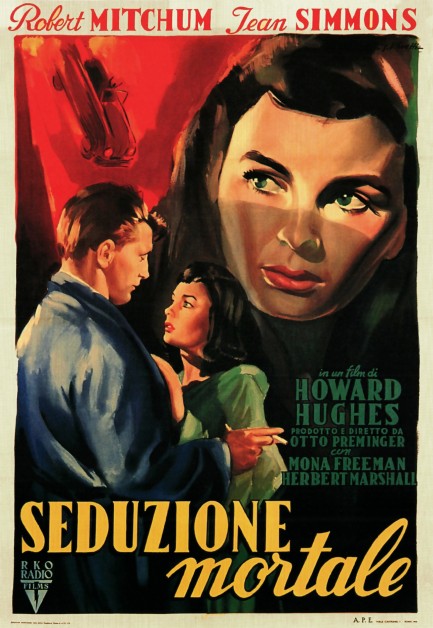 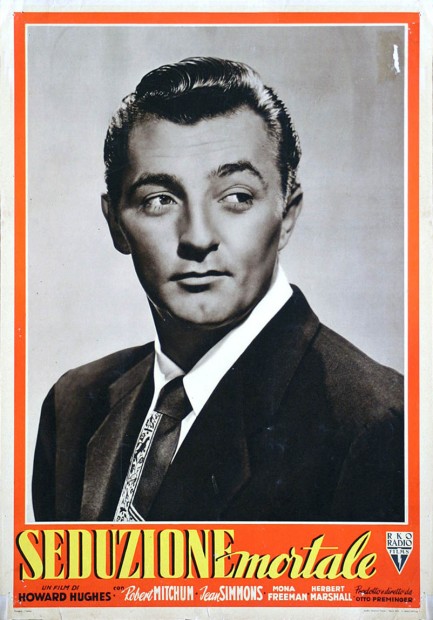 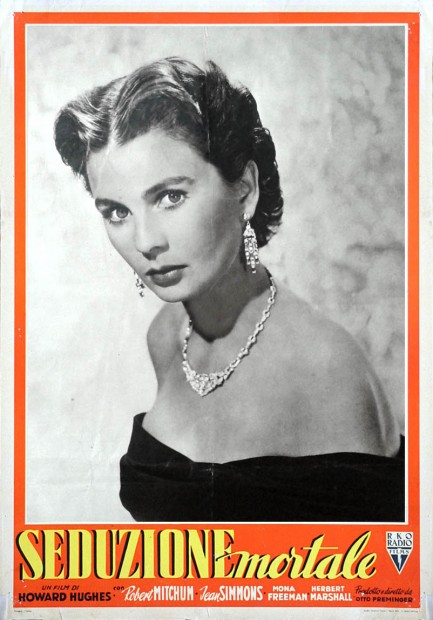
 You’re a spoiled boy, Tommy. You want things and you’re not content until you get them. 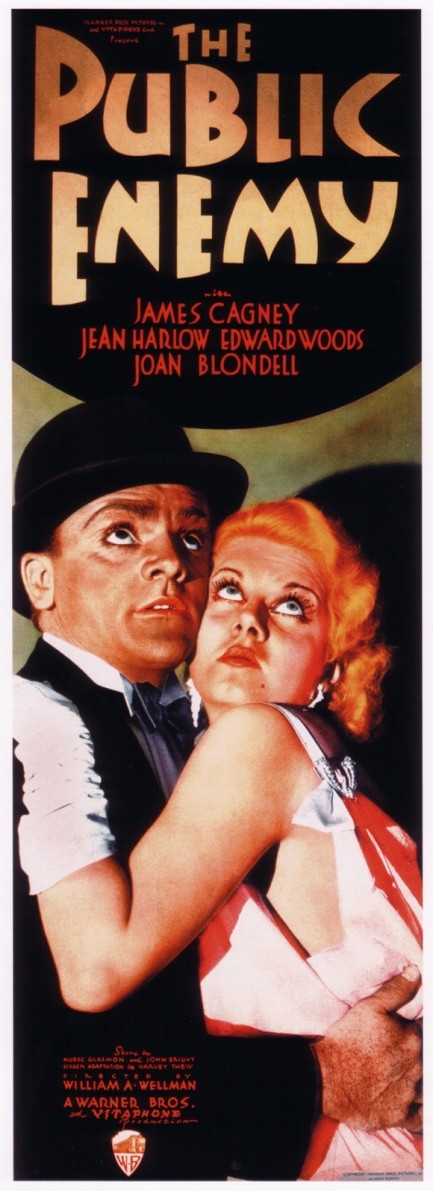 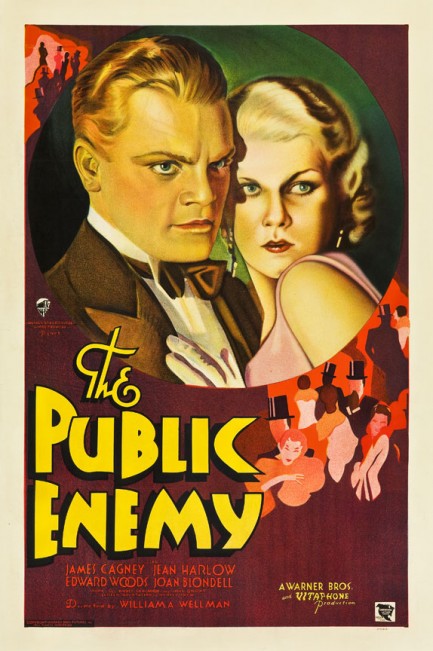 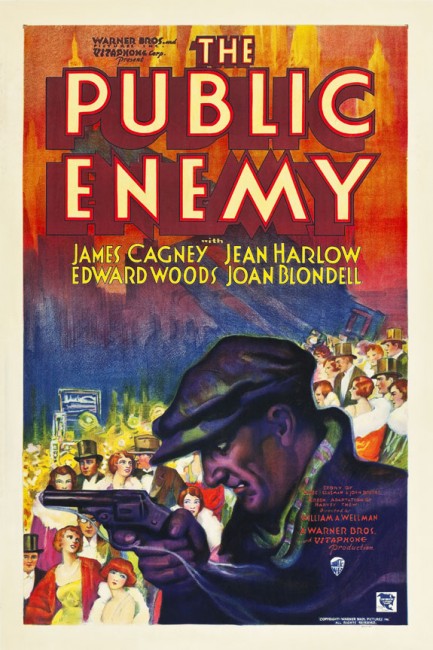
One thing about writing Pulp Intl. is it gives us an excuse to fill in blanks in our movie résumé. The Public Enemy, starring James Cagney, Jean Harlow, Edward Woods, and Joan Blondell, was one such blank—until last night. A rags-to-riches-to-ruin story, it was one of the earliest gangster flicks, one that was a big hit but which had suffered the scissors of Hays Code censors. It’s always interesting to note the scenes cut from a post-Code movie, because those say the most about attitudes of the times. For example, the scene in which Cagney is measured for a suit by a gay tailor differs in no discernable way from such scenes in today’s movies. There’s macho discomfort by the lead and effeminate fussing by the tailor that leads to the inevitable inseam measuring, all played for cheap humor. We don’t condemn or endorse this sort of thing—it’s just fascinating to see how little has changed in eighty some years. Two other scenes were cut due to sexual suggestiveness, and those are also quite interesting to watch. But what’s most important of course is James Cagney, and he is indeed amazing as Tom Powers, a kid whose ambition propels him toward the big cash and high risk of the Chicago bootlegging underworld. Not only was The Public Enemy a career-solidifying role for Cagney; it brought Jean Harlow to the notice of a much wider audience than she had reached up to that point. Her true breakout would come months later in The Platinum Blonde, but to be blunt, it’s lucky for her she had Howard Hughes molding her career, because her performance in The Public Enemy could have killed her chances to land a starring role. To a certain extent, she’s supposed to be damaged goods, someone who isn’t ever particularly fazed or impressed or emotive, but the scenes she should ignite—like the one in which she tells Cagney he’s just a spoiled boy—feel like rehearsals for later, better work. Contemporary reviewers agreed, panning her performance, but Harlow doesn’t damage the film. She isn’t really given much to work with, so watch this for Cagney, who scorches. The Public Enemy premiered in the U.S. today in 1931. 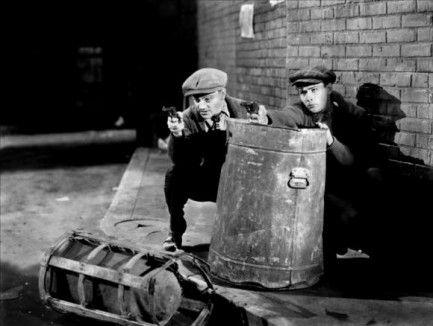 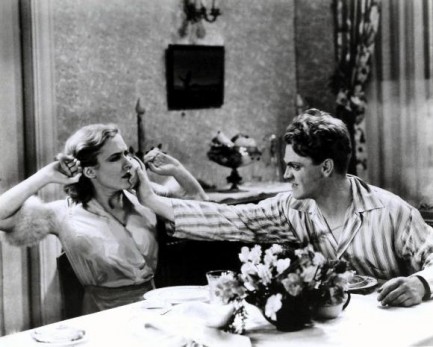 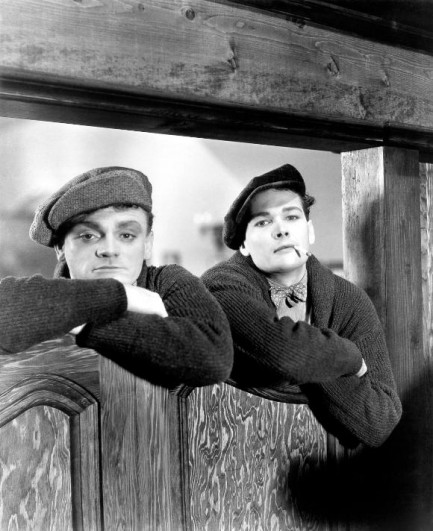 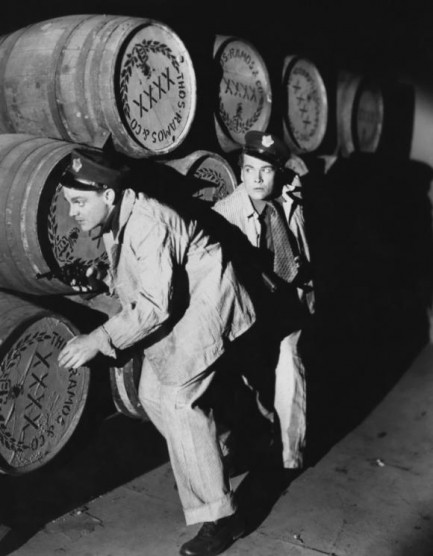
 The case of the missing voodoo sex fiends. 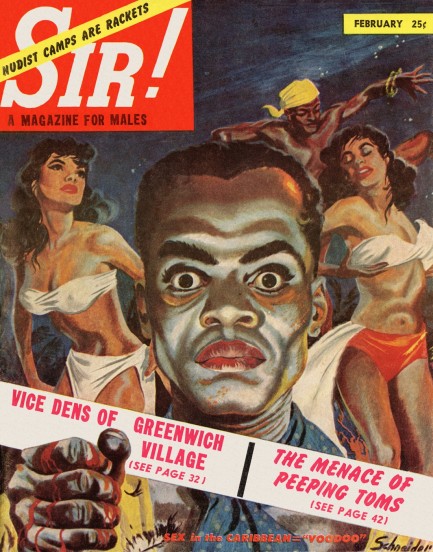
Above and below, the mix of fiction, fact, hysteria, photos, and art that is NYC-based Volitant Publishing’s Sir! This February 1954 issue has a great portrait of Gina Lollobrigida, along with articles on the danger of Peeping Toms, “Hungarian” dancer Yvonne Davis, and how to spot frigid women. The promised story on sex in the Caribbean, which the cover art is supposed to illustrate, does not appear in the magazine. We’ve never seen that happen with a tabloid. Maybe the writer had a Eureka! moment during his field research: Wait—I'm having sex in the Caribbean. Why would I ever go back to New York? In any case, the story is MIA. Sir! had a few different looks over the years, but the 1953 and 1954 issues, with covers painted by Mark Schneider, were particularly interesting. After 1954 Sir! mixed in photographed covers, which it had already done during earlier years. The post-1954 paintings were mostly by other artists, though Schneider’s work appeared on at least three post-1954 Sir! annuals. The quality of his covers varies, but all had a uniquely lurid mood that many supposedly better artists couldn’t touch. He sure had us looking forward to that Caribbean voodoo sex story. Anyway, we’ll put up a collection of Schneider’s work later so you can see what we mean. In other news, we recently bought a stack of fifty mid-century tabloids from the U.S., and assuming the international mails work as they should, we will have those in hand soonish. We got the lot for fifty bucks, which was really exciting, since we’ve seen some individual issues from the stack being auctioned elsewhere for as much as $100.00. There’s no thrill quite like finding a great bargain. Wait—did we really just say that? God, we’re starting to sound like our girlfriends.  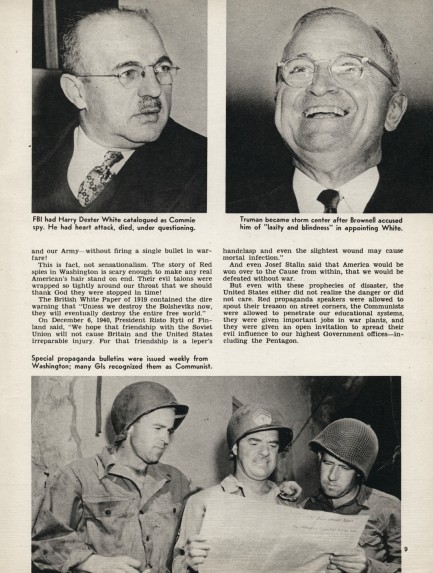 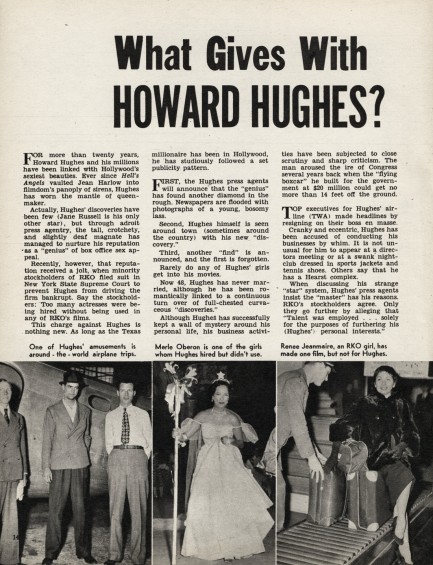 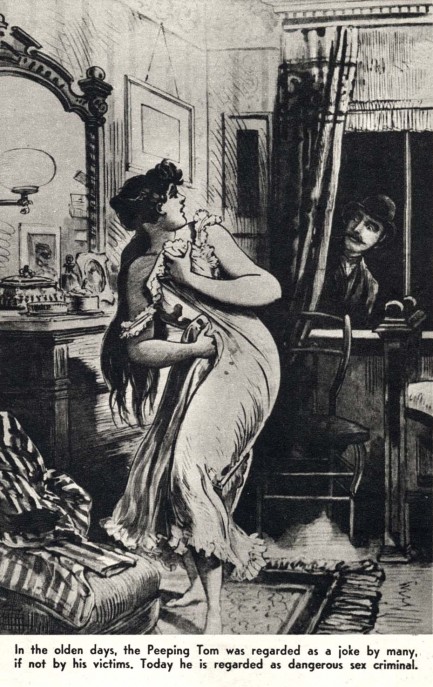 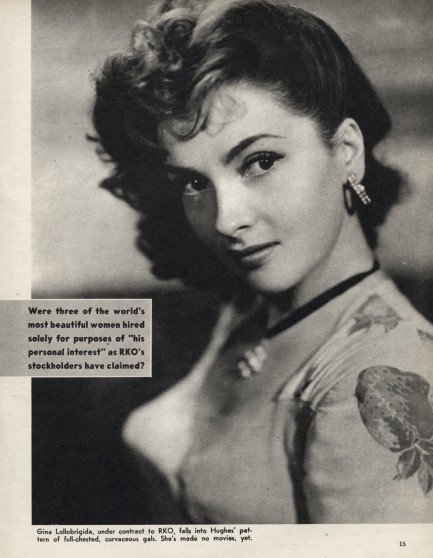     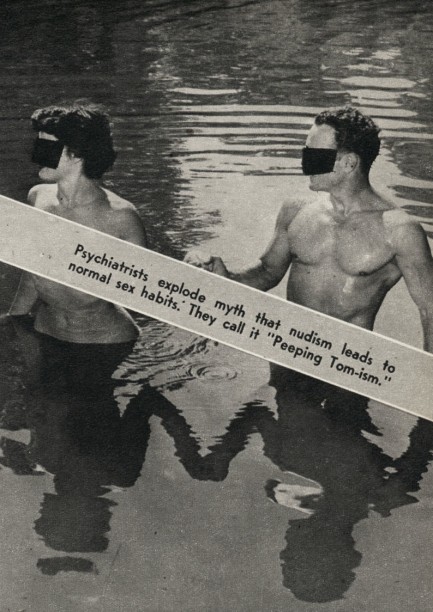 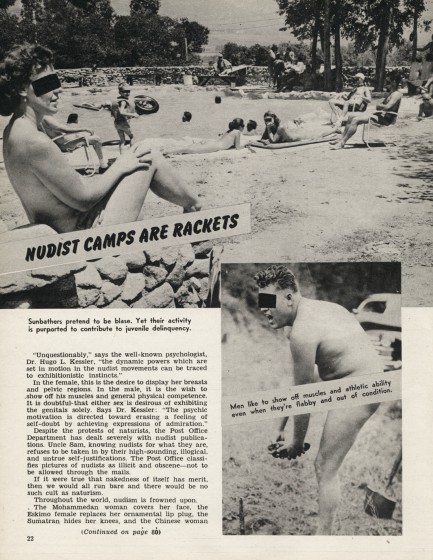 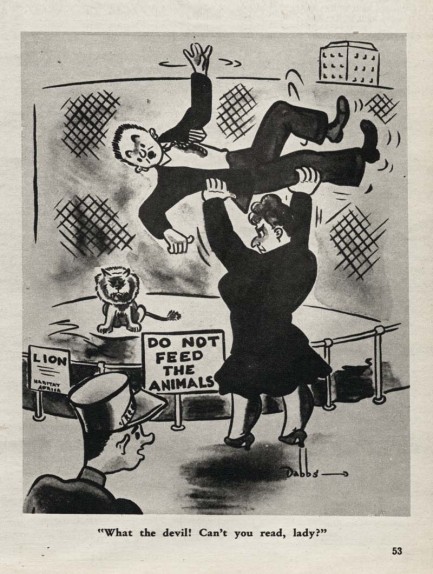 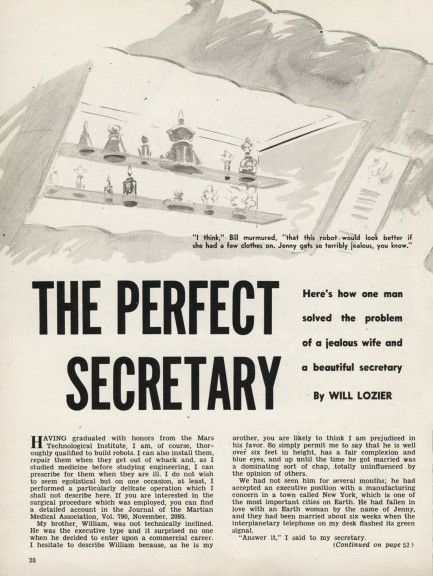    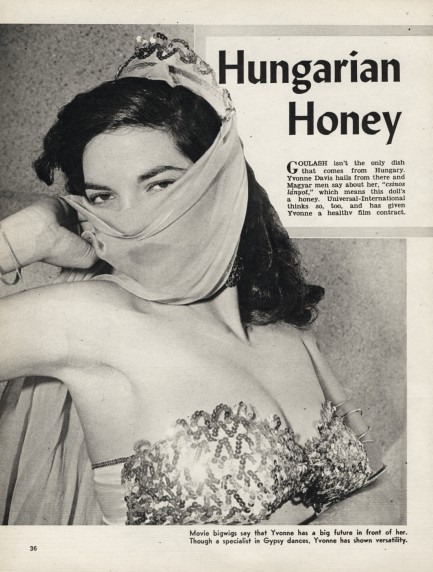 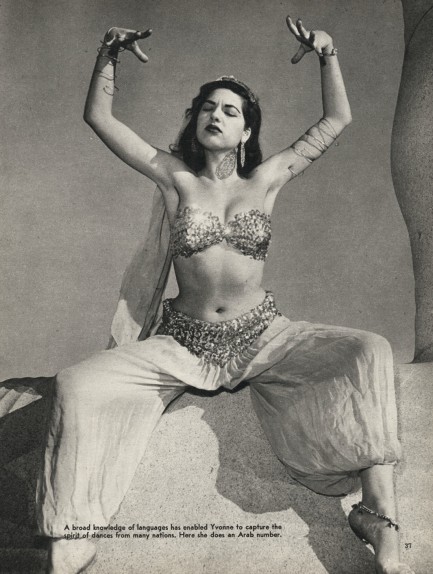 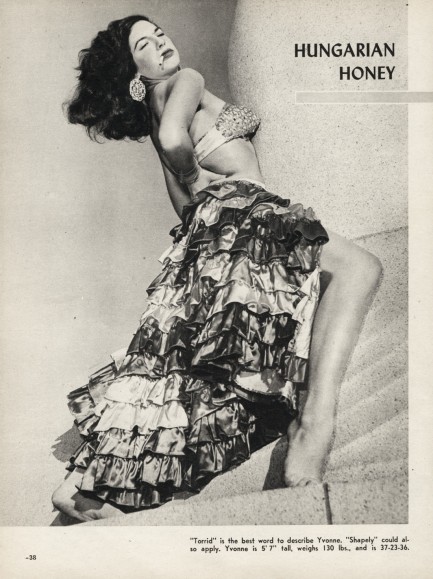 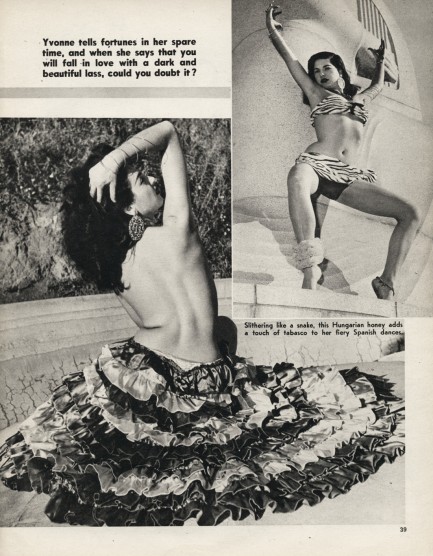 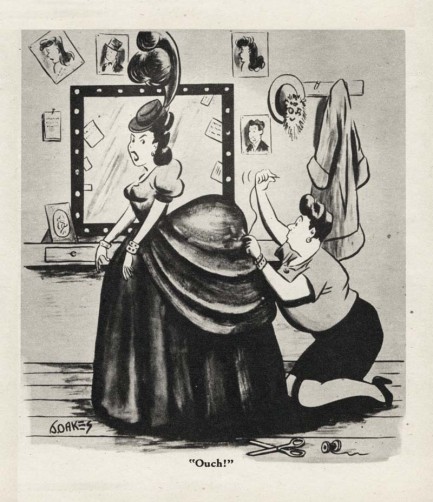 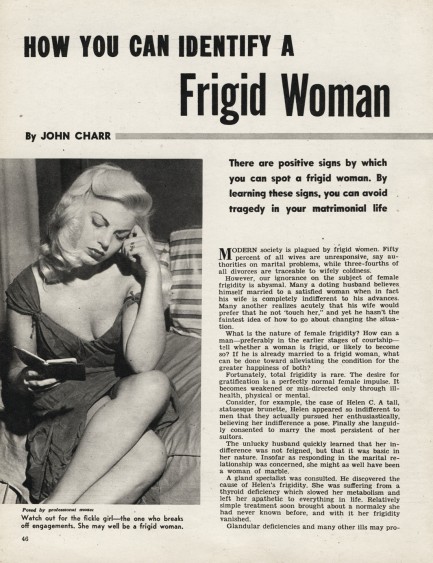 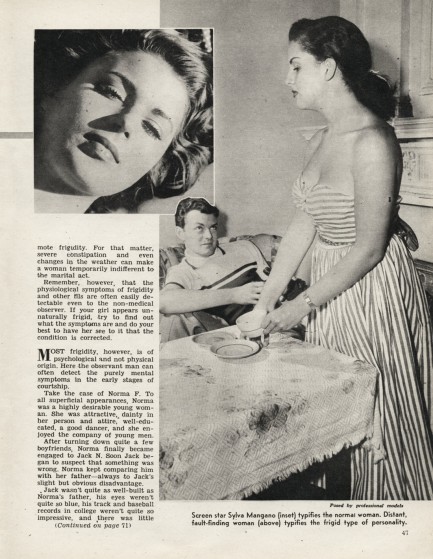 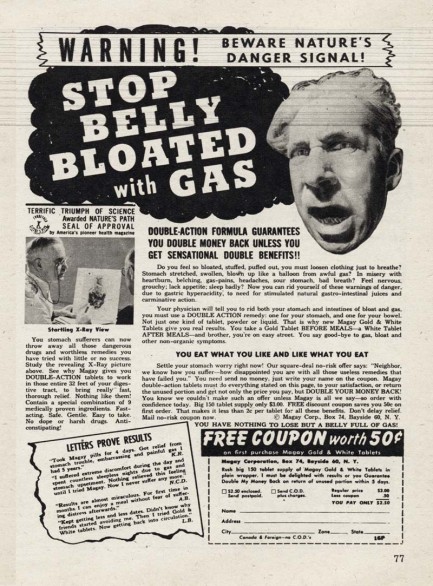
 A leopard can't change its spots. 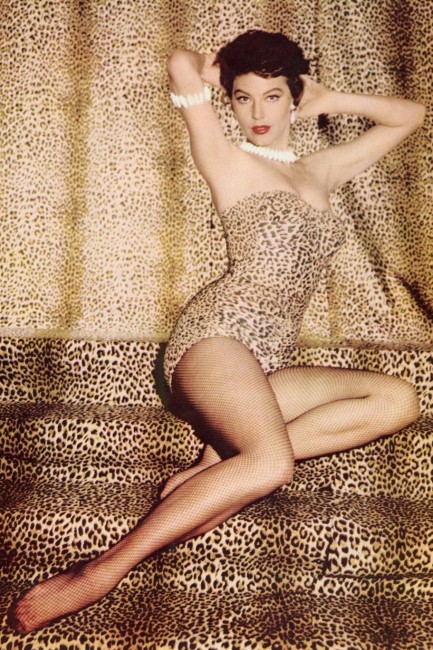
Actually, referring to Ava Gardner as a man eater is a bit sexist, but the term matched her outfit, so we went with it. It's fairer to say that she went after what she wanted. She wanted and got Frank Sinatra, Howard Hughes, Artie Shaw, Luis Miguel Dominguín, and a string of lucky others stretching from Hollywood to Madrid. This shot, from a famous session that produced many images, dates from the mid-1950s.
 Mid-1970s tabloid covers were dominated by a trio of distinct personalities. 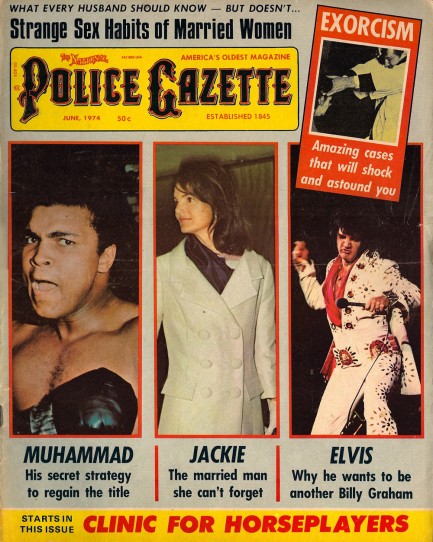
The National Police Gazette didn’t become America’s longest running publication by not knowing which celebrities people wanted to read about. We see that at work on the cover of this issue published in June 1974, which features a triptych of the era’s most tabloid-worthy icons in the fields of sports, politics and music. Muhammad Ali at thirty-three was just past his prime, but was still a great boxer with two of his most memorable bouts still ahead of him; Jacqueline Kennedy Onassis was one of the richest women in the world and a full time obsession for an American public who remembered her mainly as a presidential widow; Elvis Presley was no longer a force on the pop charts, yet his albums were still selling millions of copies and his persona and lifestyle ensured that he remained the best known music star in the world. We’re told by editors that Ali had a master plan to regain the heavyweight title (which he did), that Onassis couldn’t forget a past love named Sir David Ormsby-Gore (unconfirmed), and that Presley wanted to be a preacher (we all know how that turned out). The Gazette also makes room for stories on Howard Hughes, the Oakland A’s, and Jack Dempsey, but they’re all just bit players to the Big Three. We’ve scanned some pages below, and we’ll have much more from The National Police Gazette later. 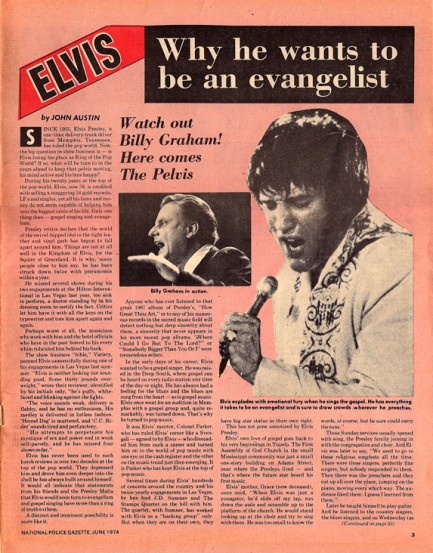 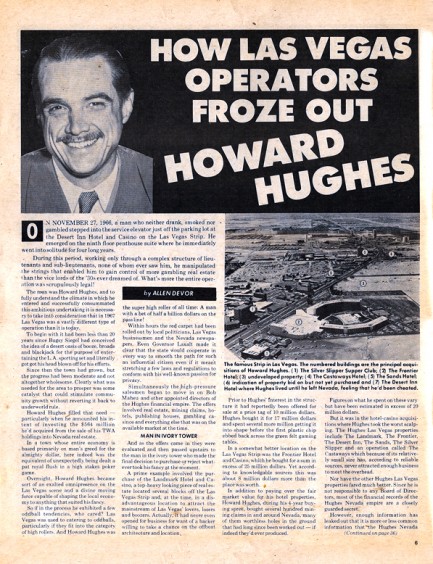 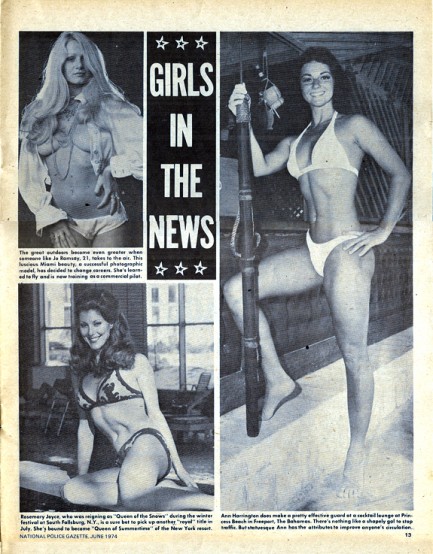 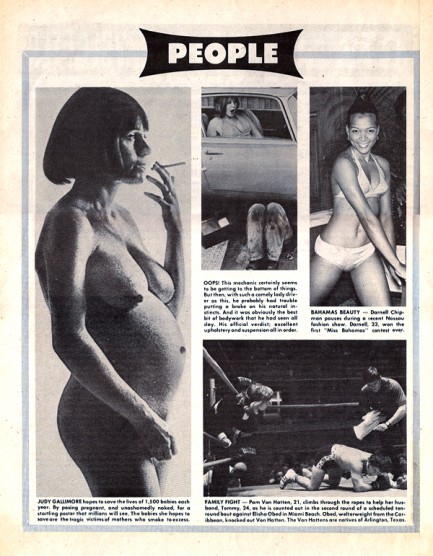 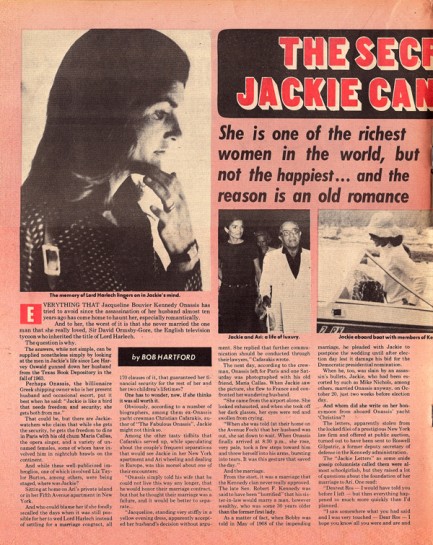 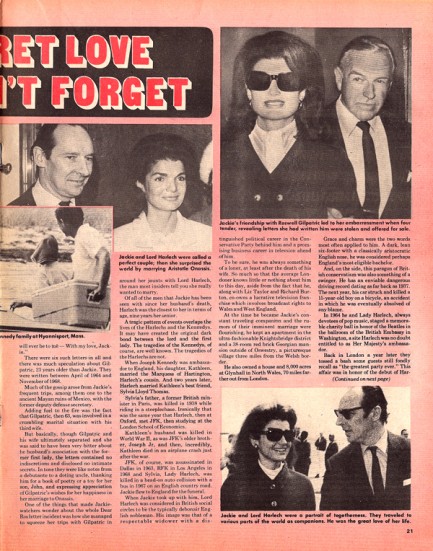 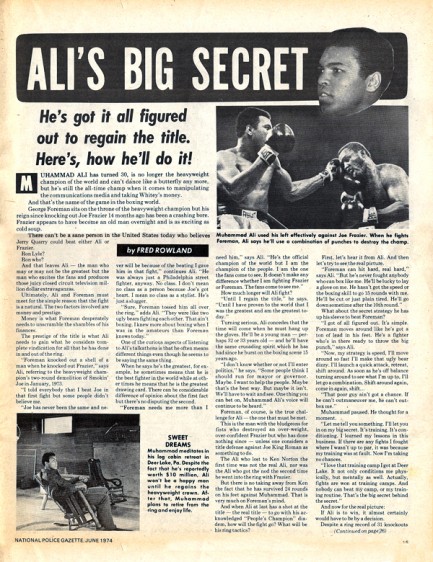 
 Two ships passing in the night. 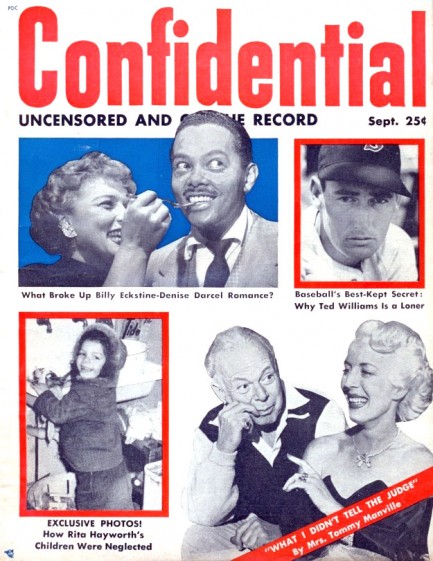
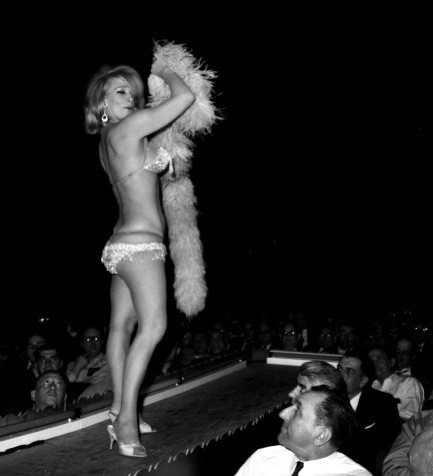
Confidential magazine, more so than other mid-century tabloids, could be counted on to report upon Hollywood’s interracial romances. Generally, the editors took no definitive stance on the divisive issue, but by placing such stories front and center were clearly pandering to their mostly conservative readership’s prejudices. In this issue from March 1956, it’s Billy Eckstine and Denise Darcel who are put under hot lights. Eckstine was a popular crooner sometimes referred to as the “black Sinatra”, the “sepia Sinatra” or even the “bronze balladeer”; Darcel was a French-born actress. When they met he was separated from a wife he would later divorce and was enjoying the NYC party circuit; she was an émigré from France circa 1947, newly divorced, and trying to establish a film career. What broke them up? Even Confidential doesn’t know for sure, but career pressure is a likely culprit. Eckstine lost a movie contract when word got out that he was 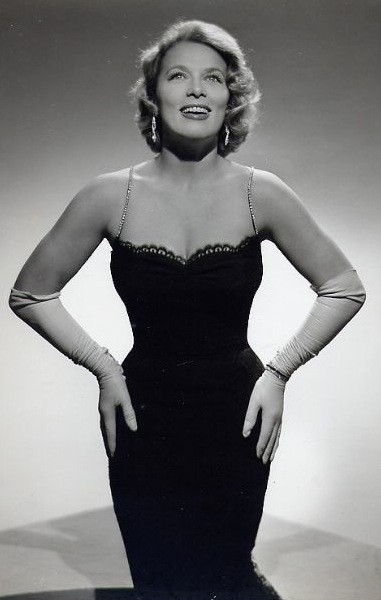 spending time with Darcel. It was a significant blow, because leading movie roles for African-Americans—rare today—were pretty much non-existent back then. Eckstine had already carved out a pan-racial popularity in music, but was denied a chance to do the same in cinema. He wouldn’t appear in a movie as an actor until 1975’s Let’s Do It Again. His music career survived, however, and he remained a hitmaker for another ten years. spending time with Darcel. It was a significant blow, because leading movie roles for African-Americans—rare today—were pretty much non-existent back then. Eckstine had already carved out a pan-racial popularity in music, but was denied a chance to do the same in cinema. He wouldn’t appear in a movie as an actor until 1975’s Let’s Do It Again. His music career survived, however, and he remained a hitmaker for another ten years. As for Darcel, she made some Hollywood films, but never broke big. On a few French websites we learned that her career was possibly damaged by Howard Hughes after she refused his advances, but we can’t confirm that in a language we’re actually fluent in, so don’t quote us. We do know that at age forty she went on to a career in burlesque, which you see below. Asked why she had made the move into erotic dance, she replied, "Because that's where the money is." However, that period didn't last long—three years, more or less. In any case, Eckstine and Darcel certainly look happy on the cover of Confidential. The photo is from the party where they met. Asked that night about Eckstine by a reporter, Darcel said, “Billy is sooo wonderful!”

|
 |

The headlines that mattered yesteryear.
1933—The Gestapo Is Formed
The Geheime Staatspolizei, aka Gestapo, the official secret police force of Nazi Germany, is established. It begins under the administration of SS leader Heinrich Himmler in his position as Chief of German Police, but by 1939 is administered by the Reichssicherheitshauptamt, or Reich Main Security Office, and is a feared entity in every corner of Germany and beyond. 1937—Guernica Is Bombed
In Spain during the Spanish Civil War, the Basque town of Guernica is bombed by the German Luftwaffe, resulting in widespread destruction and casualties. The Basque government reports 1,654 people killed, while later research suggests far fewer deaths, but regardless, Guernica is viewed as an example of terror bombing and other countries learn that Nazi Germany is committed to that tactic. The bombing also becomes inspiration for Pablo Picasso, resulting in a protest painting that is not only his most famous work, but one the most important pieces of art ever produced. 1939—Batman Debuts
In Detective Comics #27, DC Comics publishes its second major superhero, Batman, who becomes one of the most popular comic book characters of all time, and then a popular camp television series starring Adam West, and lastly a multi-million dollar movie franchise starring Michael Keaton, then George Clooney, and finally Christian Bale. 1953—Crick and Watson Publish DNA Results
British scientists James D Watson and Francis Crick publish an article detailing their discovery of the existence and structure of deoxyribonucleic acid, or DNA, in Nature magazine. Their findings answer one of the oldest and most fundamental questions of biology, that of how living things reproduce themselves. 1967—First Space Program Casualty Occurs
Soviet cosmonaut Vladimir Komarov dies in Soyuz 1 when, during re-entry into Earth's atmosphere after more than ten successful orbits, the capsule's main parachute fails to deploy properly, and the backup chute becomes entangled in the first. The capsule's descent is slowed, but it still hits the ground at about 90 mph, at which point it bursts into flames. Komarov is the first human to die during a space mission.
|

|
|
It's easy. We have an uploader that makes it a snap. Use it to submit your art, text, header, and subhead. Your post can be funny, serious, or anything in between, as long as it's vintage pulp. You'll get a byline and experience the fleeting pride of free authorship. We'll edit your post for typos, but the rest is up to you. Click here to give us your best shot.
|
|