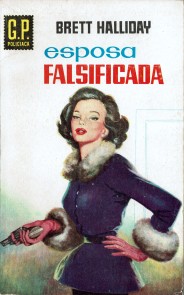
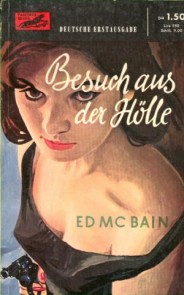
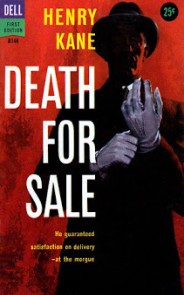
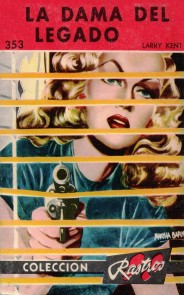
The girl next door has a mentally unbalanced doppelganger. 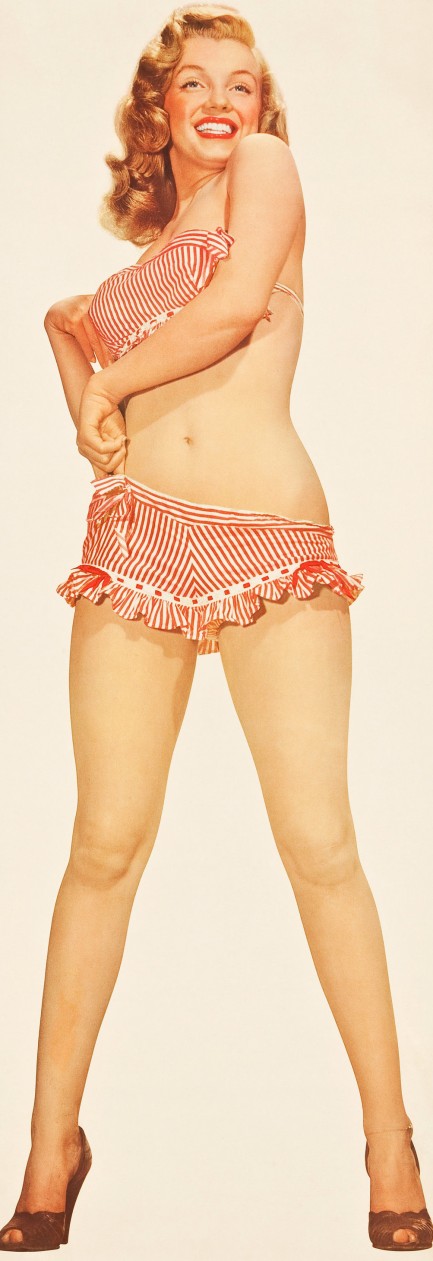 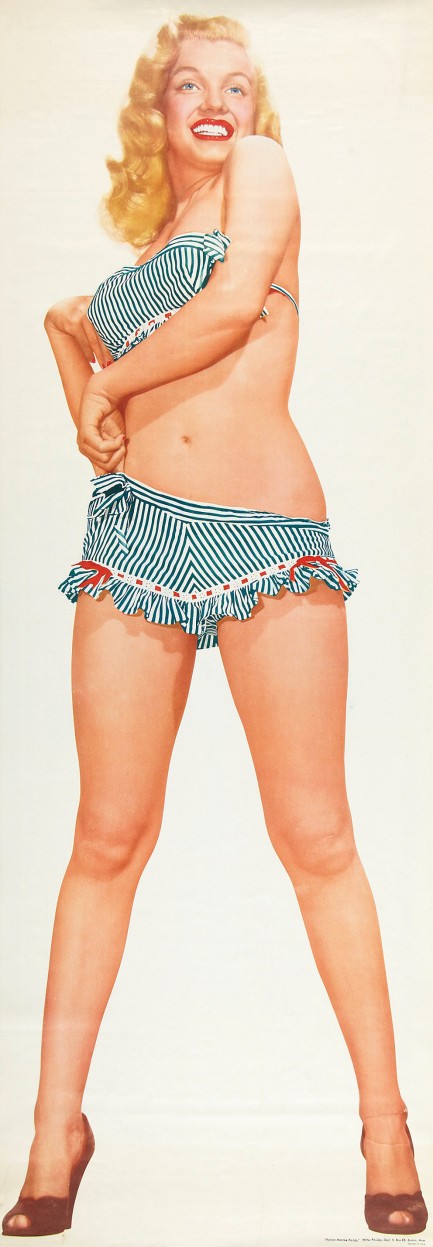
These rare Marilyn Monroe pin-up posters, which are life-sized and were advertised in magazines as something to hang on a bedroom or closet door, appeared in 1953. Two different companies made these. At least we assume so, because they have different street addresses printed on them where the curious could write for info. On the platinum poster it's Pin-Ups, Dept. K, Box 86, Boston, Mass. That pretty much guarantees only single men could buy them. “Honey, what's this letter you've stamped that's addressed to Pin-Ups?” The other address works better for the partnered up: Life-Size, Dept. X, Redstone, New Hampshire. “Honey, what is this life-size place you're sending a letter to? Life-size what?” Okay, maybe that one doesn't work either.
Monroe started her career as a girl-next-door type, but had become a star, gone platinum, and gotten her famed poodle hair-do by 1953. The two pin-up companies—assuming they were separate—both somehow had the identical negative from earlier in Monroe's career. One was content to print her as she was, but the folks in Boston decided on a platinum makeover. It was a canny move, except the re-do is different enough in an almost subliminal way to make her look like a psychopath who's smiling because she's about to devour a human kidney. Maybe not the best thing to have staring from your closet door after midnight. At least she's wearing blue. It's well known to be the sanest color. It's possible one company was responsible for both of these pieces, and it simply had two addresses at some point during 1953, but we're sticking with the two printer theory. What isn't a theory is that Monroe is a consummate work of art. Even when she's terrifying. We have an absolute pile of Monroe material in the website, and if you click her keywords below you'll be set upon a path that could keep you busy for a large part of your day. But focusing only on sheer pin-up awesomeness, even though the above examples are great, we prefer the one at this link. If it's not her best it's close.
 He's been eaten down to the bones. I don't know about you but this is by far the worst case of frostbite I've ever seen. 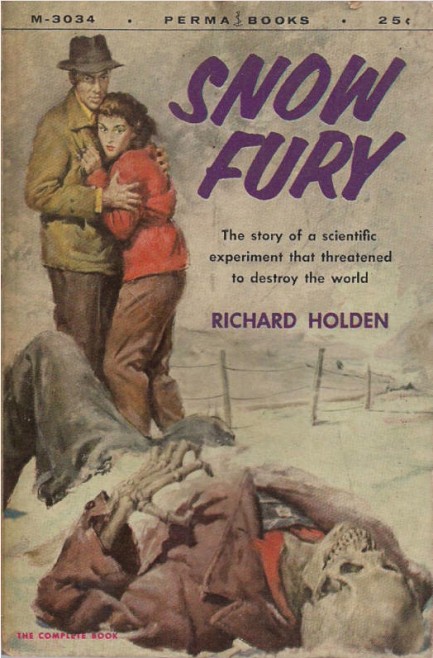
We imagine Boston born author James Holden sitting around one bitterly cold night, probably just a little tipsy from drinking warm brandy, staring out at a December snowstorm, thinking to himself that if anyone's out there in such terrible weather they're risking frostbite. And then his eyes grow wide and he says aloud, “What if the frost... takes more... than just a bite? Yes! Writer's block cured!” And some months later he finishes Snow Fury, in which the snow eats people entirely. Yep. How could snow eat people? Might have something to do with a scientific experiment run amok. And just to push the entire concept to full fruition Holden named the main character David Storm. Well, at least the cover is brilliant, and for that you can thank James Meese. This Perma edition is from 1956 and the book originally appeared in hardback in 1955.
 After two long years of unsolved killings National Star Chronicle points the accusatory finger at—nobody. 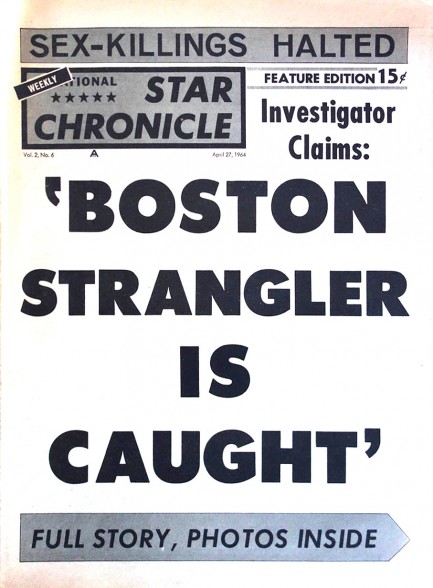
This edition of National Star Chronicle appeared today in 1964, and as you can see it blares the claim that the Boston Strangler had been caught. Eleven women in the Boston area had been slain during the early 1960s, with the victims ranging in age between nineteen and eighty-five, nearly all of whom were sexually assaulted or raped before bring killed. Boston police felt they were drawing close to a break in their marathon investigation, but the confessed killer Albert DeSalvo was not apprehended until the autumn of 1964. He was actually arrested for a different set of crimes known as the Green Man rapes, but he eventually claimed, while a patient at the Bridgewater State Hospital in southern Massachusetts, to have committed the Boston Strangler rape/killings. The admission came in April 1965. 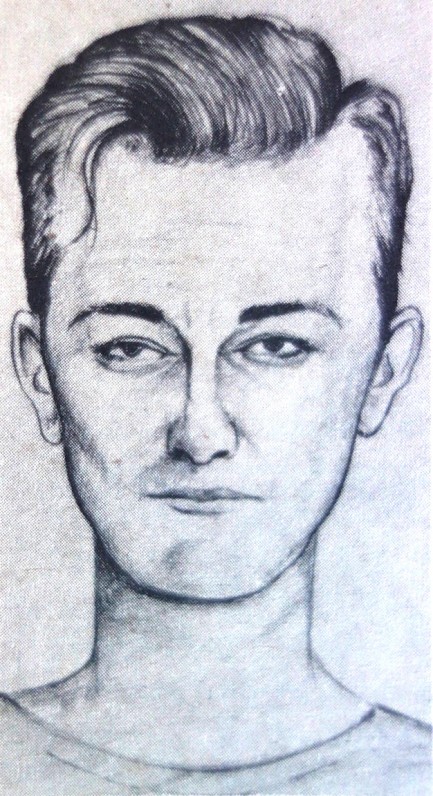 In addition to the eleven killings police had tentatively linked, DeSalvo confessed to two more killings, bringing the unofficial total of his victims to thirteen. So Chronicle jumped the gun on their headline by a year, but we've all learned by now never to trust low rent tabloids, right? In addition to the eleven killings police had tentatively linked, DeSalvo confessed to two more killings, bringing the unofficial total of his victims to thirteen. So Chronicle jumped the gun on their headline by a year, but we've all learned by now never to trust low rent tabloids, right?
At the time this Chronicle hit newsstands Boston police in fact still had dozens of suspects. The police sketch does resemble DeSalvo somewhat, who you see in his mugshot at bottom. Of course, the sketch also resembles other suspects in the case. In fact, it even resembles big brained Tany Kominski in the above post. The police didn't immediately consider all the strangulations to be the work of one person. The age range of the victims, as well as some variations in the method of dispatch, had slowed them in seeing a connection. Later, after DeSalvo confessed, many observers doubted the real killer had been caught. In 2013 DNA testing definitively tied DeSalvo to the last victim in the murder chronology, 19-year-old Mary Sullivan, but public doubt over who killed the others continues to this day. Of course, the public is always doubtful. Meanwhile the prosecutors are certain they got the right guy. Of course, prosecutors are always certain. One thing's beyond doubt—National Star Chronicle didn't help clarify matters. 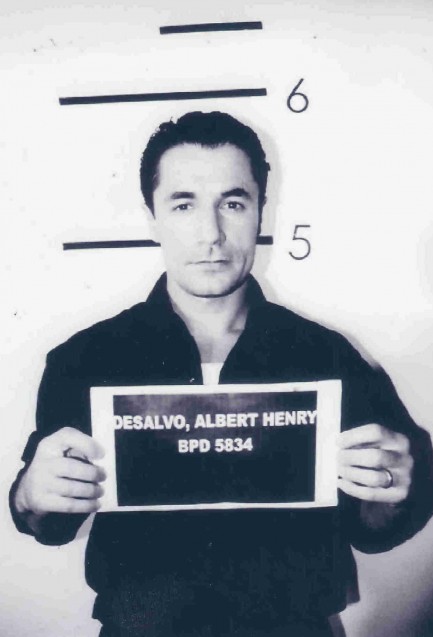
 Better killing through chemistry. 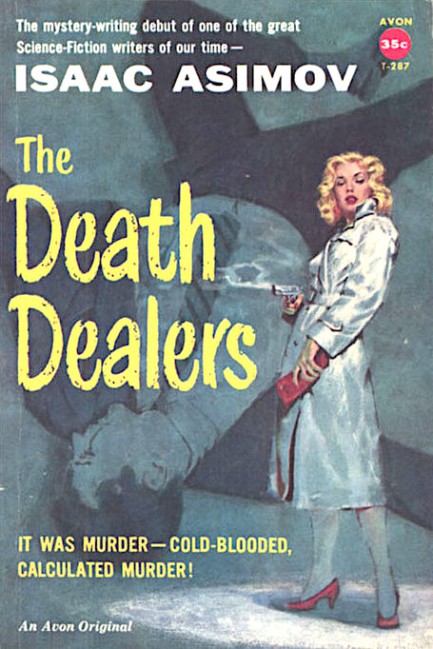
Above is a 1958 Avon edition of The Death Dealers, sci-fi writer Isaac Asimov's first foray into the mystery genre. When a chemistry professor's best student dies of an apparent lab accident the professor ponders taking over the protege's cutting edge research as a way to impress peers—and perhaps earn a long denied tenure. But he's deduced there's a murderer loose and is worried the police might deduce it too, and consider the valuable research a perfect motive. While Asimov lays out the killing and resulting dilemma in a methodical way, and the world of chemists on a college campus is one he knew well as a professor of biochemistry at Boston University, the linear nature of the plot and emotional coolness of the characters don't allow the mystery to truly grip the reader. Yet the book is very readable—the details of life on campus, the politics, the maneuvering for that elusive tenure all help to make up for the other deficiencies. Add to that the backdrop of advanced chemistry, the detailed but not overwrought scientific descriptions of experiments and processes, the fact that most of the characters are geniuses in their field, and the end result is something that works reasonably well. But there are so many mystery masterpieces out there we can only feel good recommending The Death Dealers to voracious readers in the genre. Or to Asimov fans. Neither group will be disappointed. All others, no guarantees. 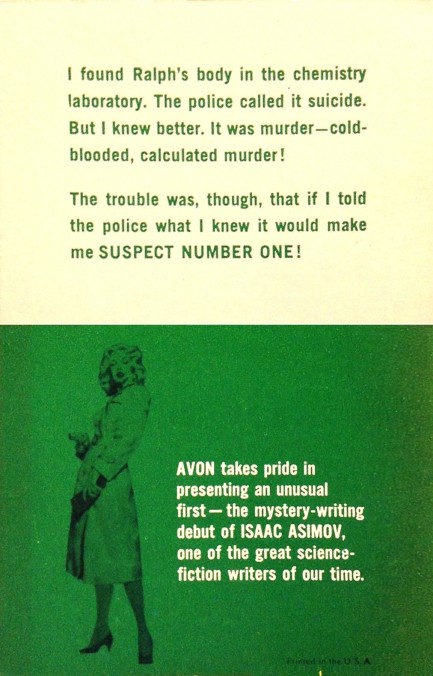
 Private Affairs joins the wild mix of 1960s tabloids. 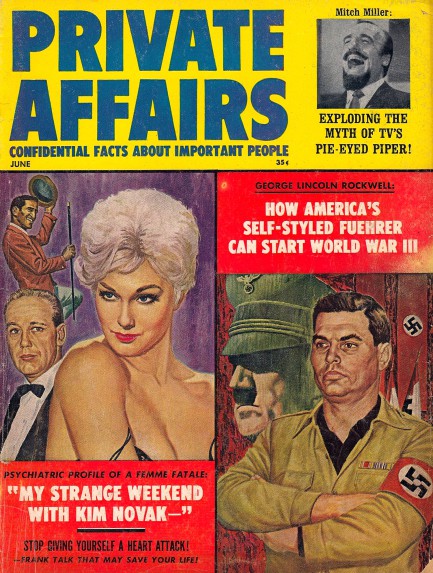
This issue of the New York based tabloid Private Affairs appeared in June 1962, and features cover stars Kim Novak and American Nazi Party leader George Lincoln Rockwell rendered by an uncredited artist. Inside the issue Affairs rehashes Novak’s various relationships, recounting how mafia goons threatened to kill Sammy Davis Jr. if he didn’t stop meeting Novak across the color line, how she accepted an expensive sports car as a gift from Ramfis Trujillo even though his hands were “bathed in the blood of executed political prisoners,” and how she shot down a smitten Charles Boyer by asking him in bewilderment, “How could you have thought I loved you?” The overarching concern is Novak’s longstanding unmarried status, wedlock of course being the default state for any normal woman. Novak was only twenty-nine at the time—but that was spinster age by tabloid standards. She eventually did wed when she was thirty-two, and it’s a wonder she made it down the aisle without the aid of a wheelchair. Private Affairs moves on to Norman Lincoln Rockwell, who was making waves with racist rhetoric and a bold guarantee to win the White House by 1972. The question Private Affairs editors ask is whether Rockwell should be taken seriously. They answer by offering an anecdote about how German president Paul von Hindenburg scoffed at a fledgling Adolf Hitler by calling him a “silly little housepainter.” Ten years later, they note, there were 30,000,000 dead. “How far will America let the hate mongers go? Will an unsound branch on the tree of American democracy fall off or will it poison the organism?” they ask. It’s worth noting that while Rockwell’s anti-Jewish rhetoric clearly annoys the editors, they don’t offer any support for the African Americans he was likewise excoriating. But in the end, Rockwell was shot dead by a fellow Nazi. Whether he could have risen to political office is a matter of historical debate. Private Affairs moves next to related subject matter by claiming that the 1942 Cocoanut Grove fire that killed nearly five-hundred people in a Boston nightclub was set by Nazi saboteurs, and furthermore that the FBI covered that fact up. We wrote about the fire a few years ago, and you may remember that witnesses said the conflagration began with a busboy changing a light bulb. Private Affairs claims the bulb was a specially designed Nazi device that had a fuse inside instead of a normal tungsten filament. This fuse could be set for various ignition times, and a delayed setting allowed the saboteur got away. How the editors puzzled this out remains unclear, and there’s no explanation how a busboy randomly asked to change a burnt out light chose or was handed a deadly device rather than a typical bulb, but maybe those points aren’t important. Tabloids often fail to answer their own questions—the important thing is to stir up trouble.
Elsewhere in the issue we get Lana Turner, who Affairs claims let her daughter take a murder rap for her; comedian Dick Gregory, who is accused of stealing jokes; and Ingrid Bergman, who is shown with her later-to-be-famous daughter Isabella Rossellini. We also meet Nai Bonet, a famed Vietnamese bellydancer who within a couple of years would parlay her fame into a film and music career. Private Affairs is not a well known tabloid today—it probably arrived on the scene just a bit too late to carve out a readership when newsstand shelves were already packed with established imprints such as Confidential, Uncensored, Top Secret, Inside Story, Hush-Hush, et al. This particular issue—designated Vol 1, No. 3—is the only copy of the magazine we’ve ever seen. We suspect the brand was defunct within the first year. Many scans below, and more rare tabloids coming soon. 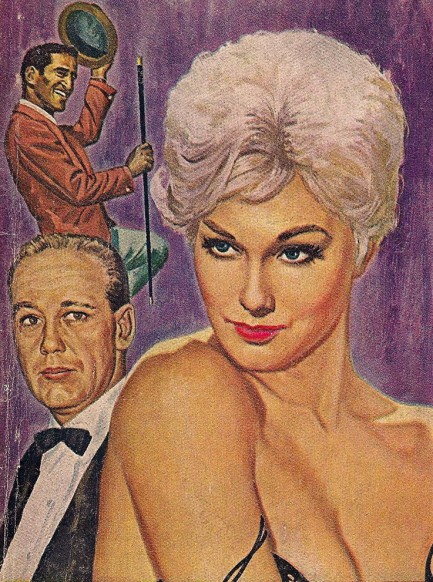 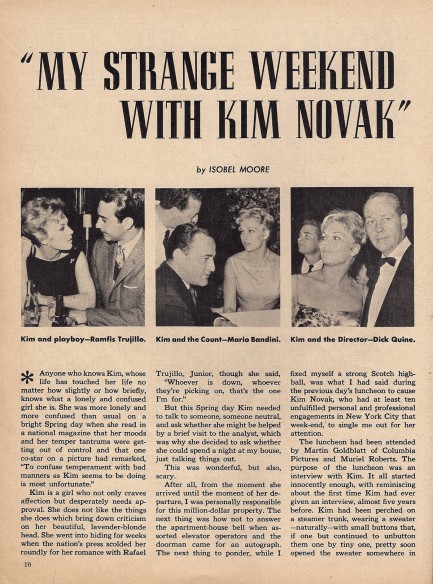 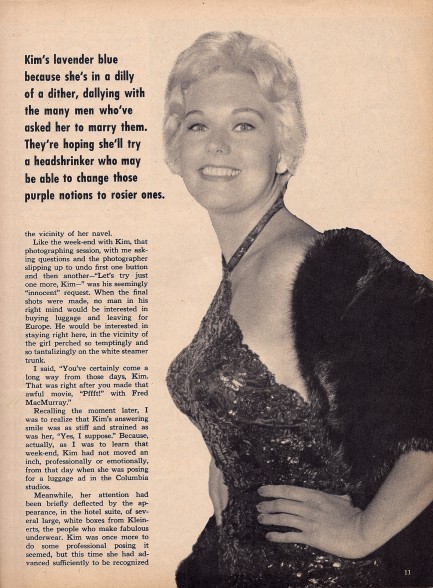 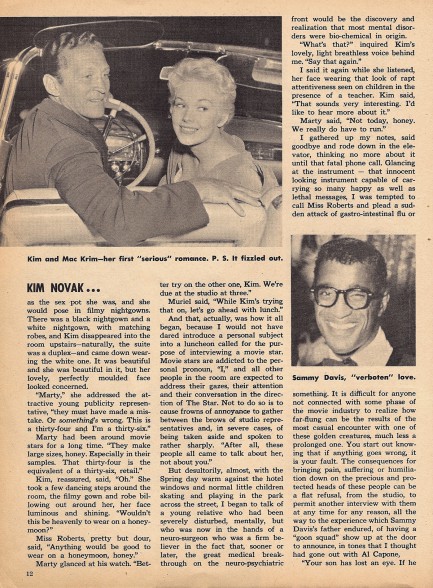 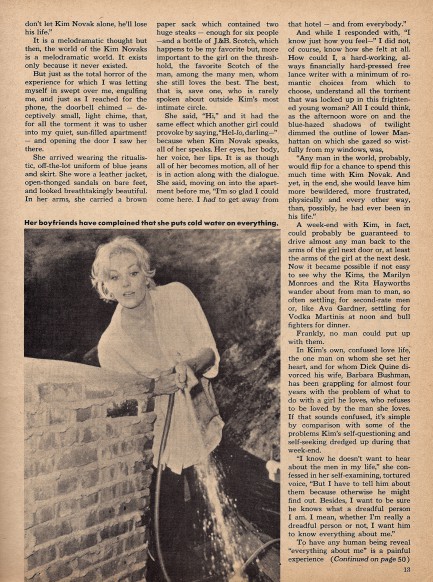 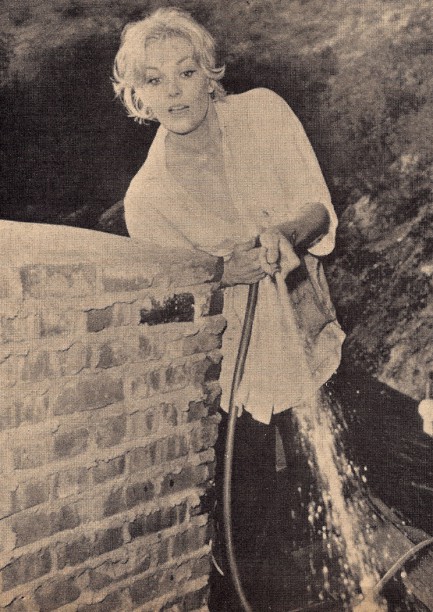 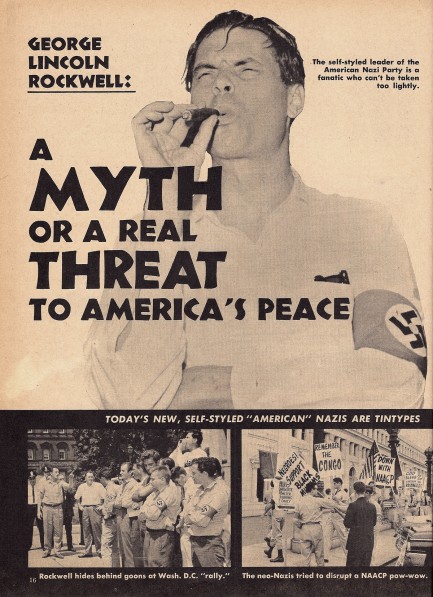 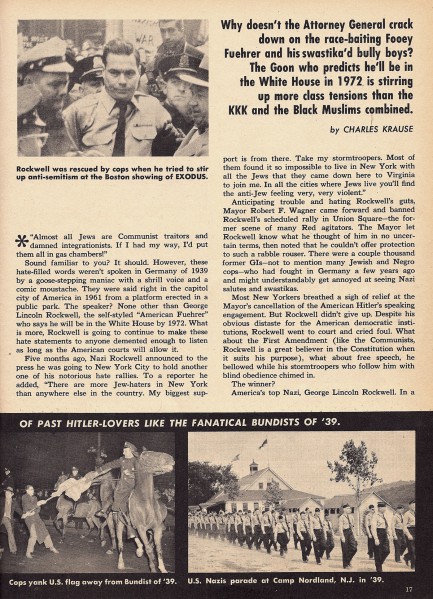 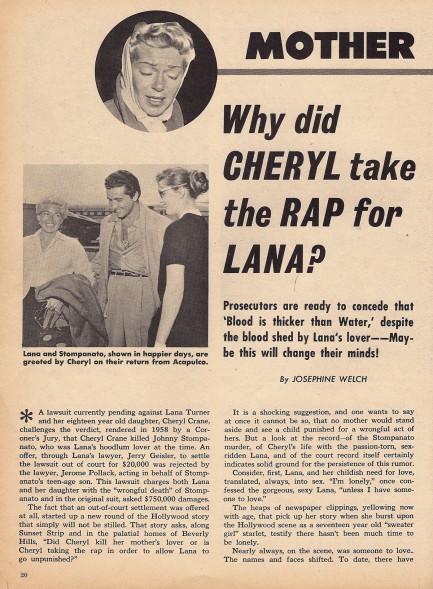 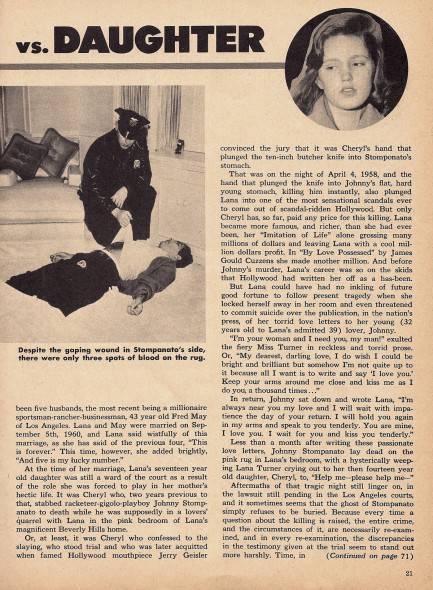 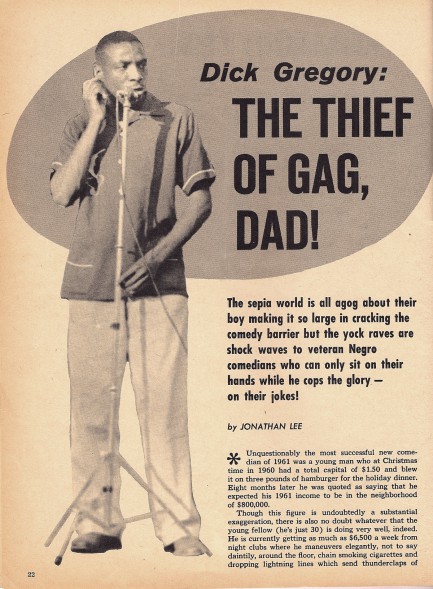 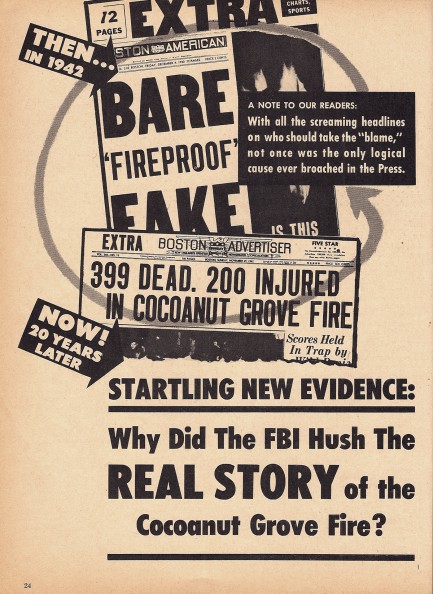 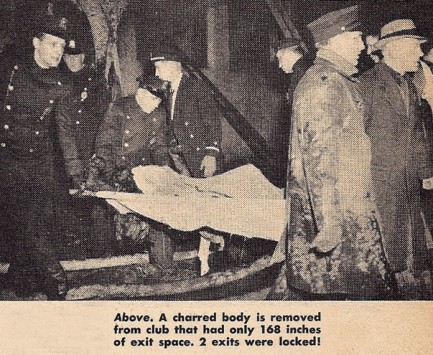 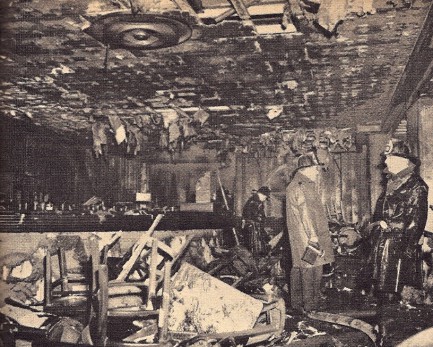 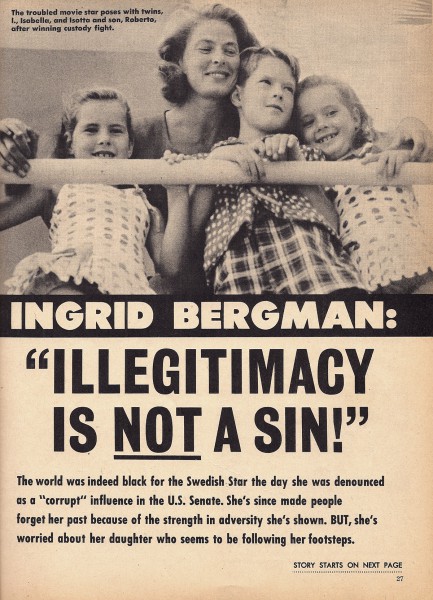  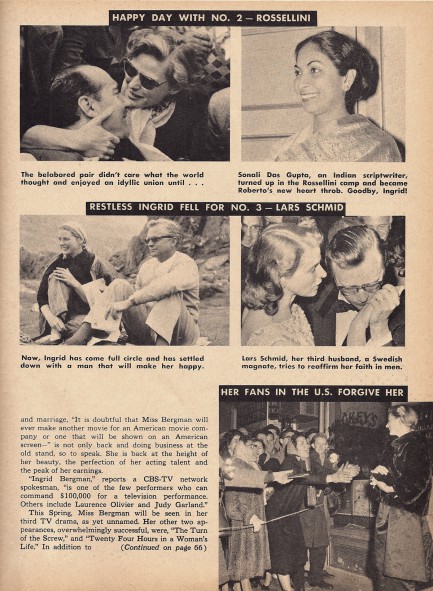 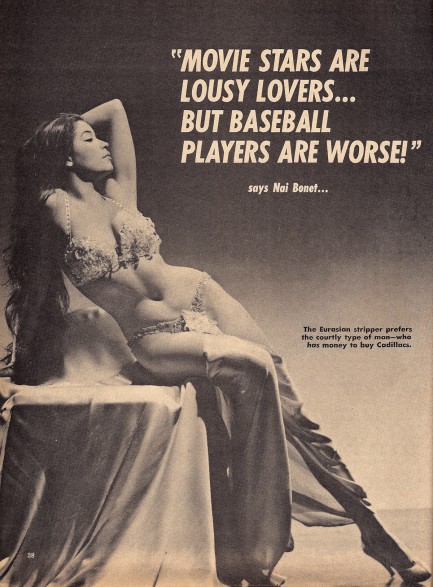 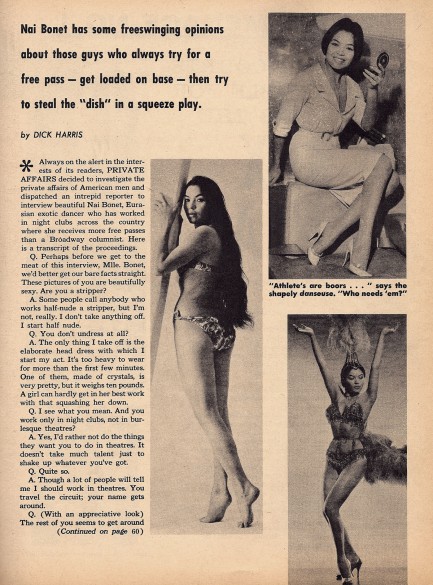 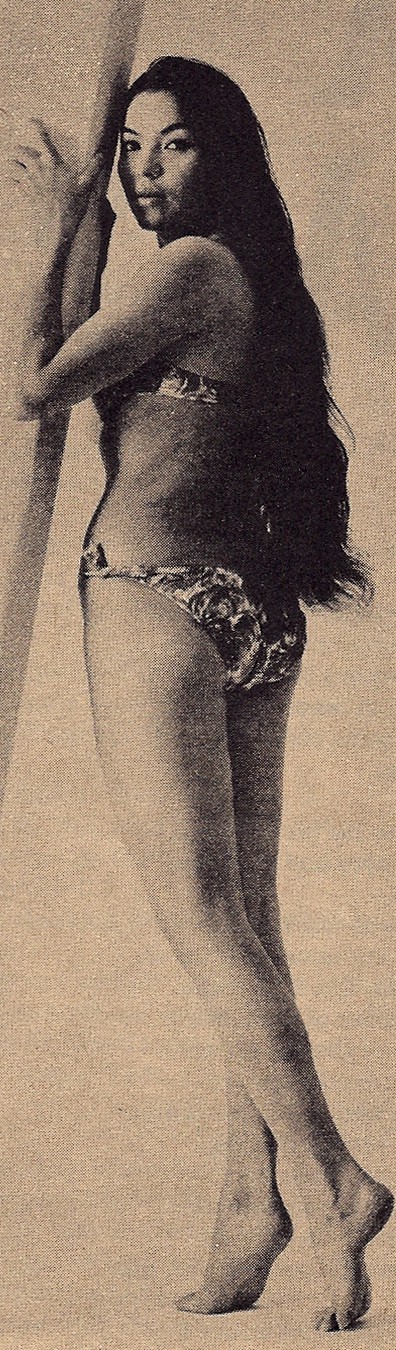 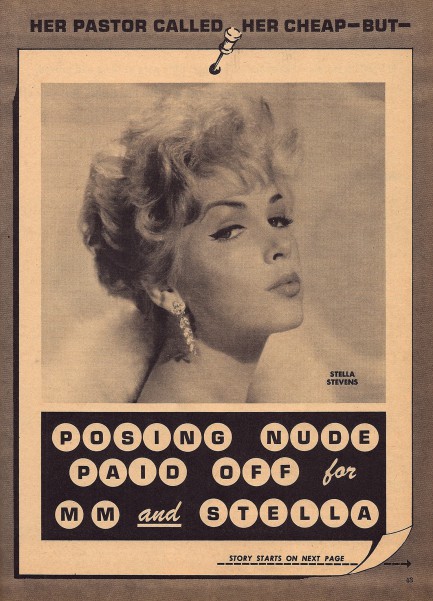 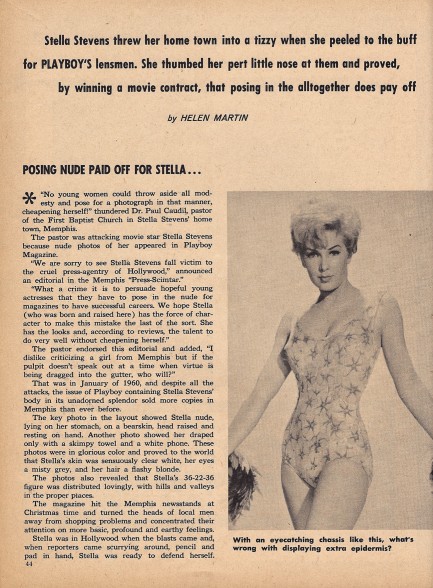 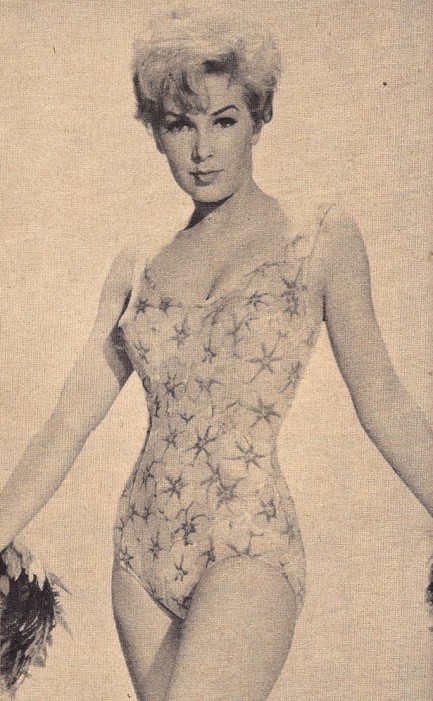 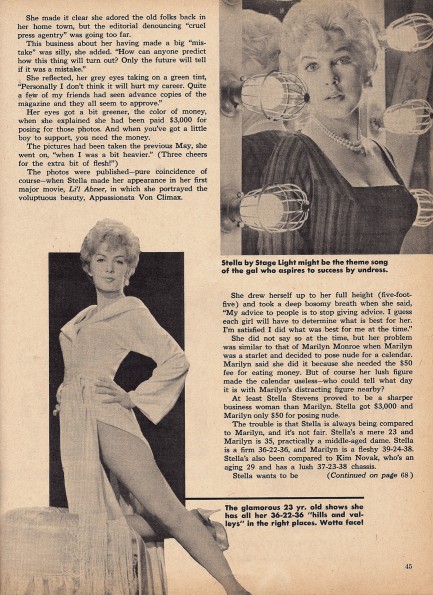 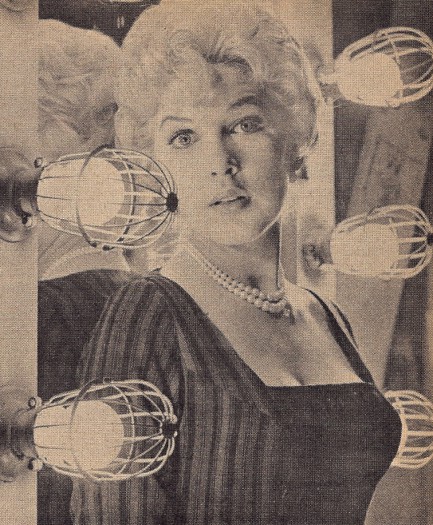
 How it started nobody can remember for sure. How it ended nobody can ever forget. 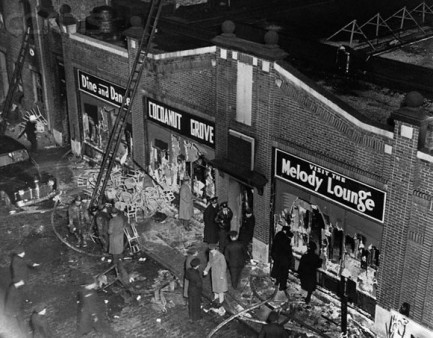
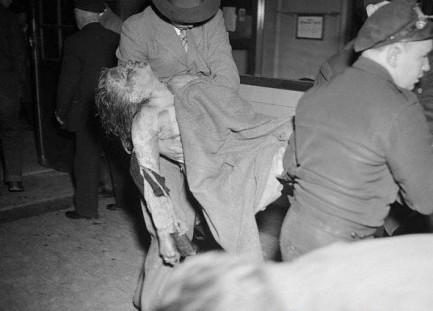
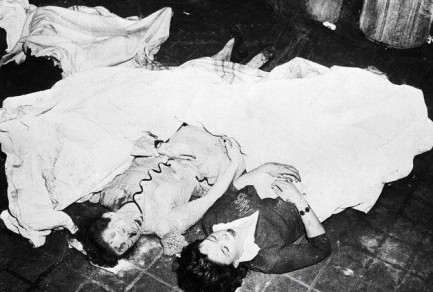
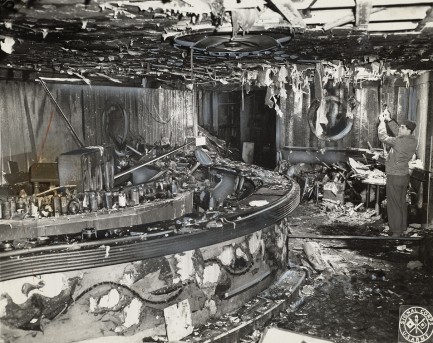
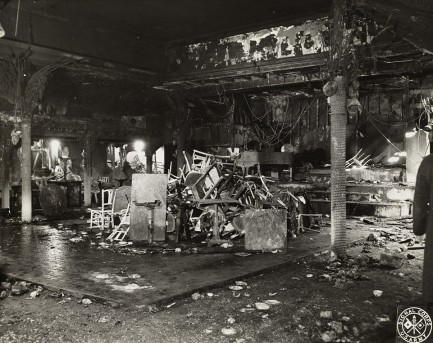
Above is a photo of the aftermath of the Cocoanut Grove fire of 1942. Its appearance belies the scope of the disaster that took place there. The Cocoanut Grove had been founded as an illegal speakeasy and, after the 1933 repeal of Prohibition, became Boston’s trendiest nightspot. It consisted of several properties that had been consolidated into one, and was a labyrinth of tropical-themed bars, lounges, and dining rooms, complete with a famous “rolling roof” that allowed patrons to dance under the stars during warm summer nights. The club’s cobbled together construction meant there were many points of egress, but owner Barnet “Barney” Welansky was preoccupied with the possibility of people using these to dash without paying their checks, and had hidden some exits behind curtains, locked others, boarded up a plate glass window, and bricked over an emergency exit.
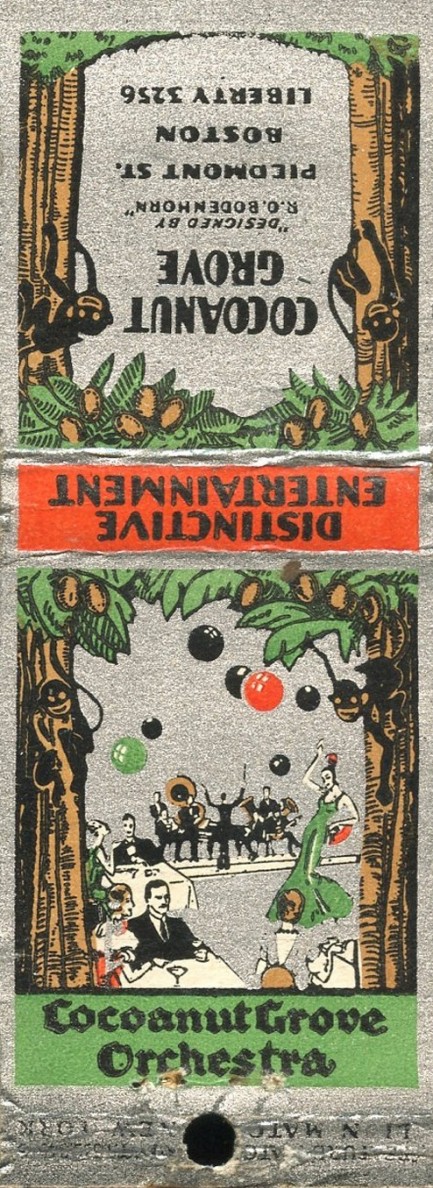 About 10:15 p.m. one frigid November night a fire started for the most banal of reasons. A soldier in the Melody Lounge, which was in the basement, had either loosened or removed a light bulb in an artificial palm tree to create the privacy he desired in order to make out with his date. A busboy was ordered to replace or tighten it. He climbed onto a chair and lit a match so he could see, very likely using one from a matchbook like the one at right. Moments later the canopy of artificial palm fronds overhead caught fire. Whether it was the match or the light bulb that started the blaze nobody ever figured out for sure, though the busboy unambiguously blamed himself and the match. About 10:15 p.m. one frigid November night a fire started for the most banal of reasons. A soldier in the Melody Lounge, which was in the basement, had either loosened or removed a light bulb in an artificial palm tree to create the privacy he desired in order to make out with his date. A busboy was ordered to replace or tighten it. He climbed onto a chair and lit a match so he could see, very likely using one from a matchbook like the one at right. Moments later the canopy of artificial palm fronds overhead caught fire. Whether it was the match or the light bulb that started the blaze nobody ever figured out for sure, though the busboy unambiguously blamed himself and the match.
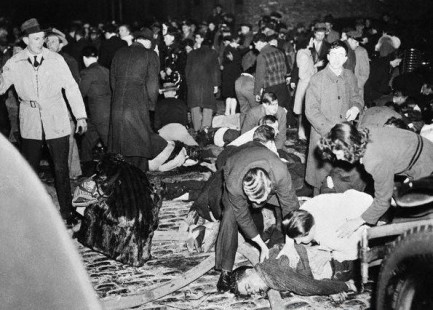
But in any case, flames blossomed through the paper and rattan decorations. Waiters tried to douse them but they quickly became what witnesses described as a fireball. This fireball raced up a staircase to the lounges and bars on the ground floor and men and women ran upstairs with their hair ablaze. The flames burst into the main level and triggered a deadly crush at the revolving door entrance, which was immediately rendered useless as patrons tried to escape by pushing in opposite directions. Another crush formed at a set of double doors that opened inward from the street. In the panic, the patrons couldn’t organize themselves enough to step back so the exit could be opened. As people struggled, passed out, and piled up before the doors, the flames consumed everything. Many people escaped. They ran through the kitchen, or squeezed through barred windows. The house band’s bass player, Jack Lesberg, who later went on to perform with Louis Armstrong and Sarah Vaughan, among others, smashed his way out using his stand-up bass. Five survivors barricaded themselves in a walk-in freezer. In all, about half the occupants escaped, but in the end the fire killed 492, which was thirty-two more people than were legally allowed to inhabit the building. Some patrons were so quickly overcome by fumes that they died sitting at their tables. Firemen described charred corpses with glasses in their hands. Barnet Welansky went to jail for multiple counts of manslaughter, but was pardoned after only four years by Massachusetts Governor Maurice J. Tobin, who had been the mayor of Boston at the time of the fire. Helps to know people, and helps even more to drink with them. The Cocoanut Grove fire—or inferno might be a better word—was today in 1942.
 Are you ready for some football? 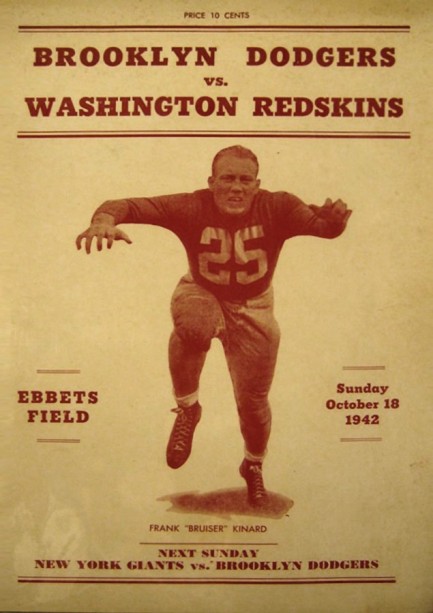
Did you know there was a football team called the Brooklyn Dodgers? This nice little piece of Americana reminds us of that fact. It’s the cover of a program for an NFL game between the Dodgers and the Washington Redskins, played at Ebbets Field today in 1942. The Brooklyn Dodgers football team existed from 1930 to 1944, at which point it became the Brooklyn Tigers for one season, then the next year merged with the Boston Yanks. This move came about due to a decline in the on-field product caused by wartime shortages of players. But before being folded into another franchise and effectively disappearing, the Dodgers helped bring the NFL into the mass media era when its October 22, 1939 game against the Philadelphia Eagles was broadcast on television. That was the first NFL broadcast ever. Another historical note: the unusual Dodgers nickname derives from the fact that through the late 1800s and early 1900s, there were so many trolley lines running through Brooklyn that people from that borough were called “trolley dodgers.” Naturally, this is also the reason the All-America Football Conference team called the Brooklyn Dodgers, and the baseball Brooklyn Dodgers, both adopted the nickname. Of course, baseball’s Dodgers were the first to do so, by decades. Lastly, on the cover is a photo of Frank Kinard, who played for the Dodgers/Tigers and, just to make the whole name thing even more convoluted, played for the New York Yankees of the All-America Football Conference. He was inducted into the Pro Football Hall of Fame in 1971. You can learn plenty more about the Brooklyn Dodgers at the website luckyshow.org.
 The Goddess of Fire goes to Hollywood. 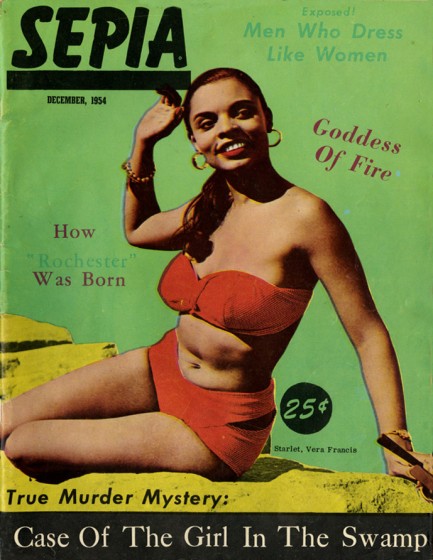
Some treasures are more valuable than others, and for us this issue of the African-American tabloid Sepia published this month in 1954 is one of the better jewels we’ve unearthed. The word “sepia” was used back then as a supposedly hip alternative to "negro," and you may have noticed it in some of the mid-century tabloid pages we’ve posted. The cover star, actress Vera Francis, is referred to as the Goddess of Fire because of her popular calypso act. Francis had become famous first as a Boston model, then made the leap to Hollywood actress, scoring a bit role in 1953’s The President’s Lady (though she's not cited in its IMDB entry, we noticed). She later scored a larger role opposite Johnny Weissmuller in 1955’s Devil Goddess. The Sepia interview discusses her decision to focus on her singing career because film work—which by the way, she reveals paid $125 a day—was very difficult to come by. In the most circumspect fashion, the profile does not hint at the embedded racism of Hollywood that severely limited roles for black women. That isn’t a surprise. The power and allure of Hollywood was such that few would dare to point out its shortcomings—at least if they hoped to work again. Besides the stunning cover (which we’d definitely consider framing if we had a hi-rez canvas print of it) we have four more pages of Vera Francis, plus a centerfold featuring model Maria Piñeda, and as a bonus we even uncovered a promo photo from Devil Goddess. All below. 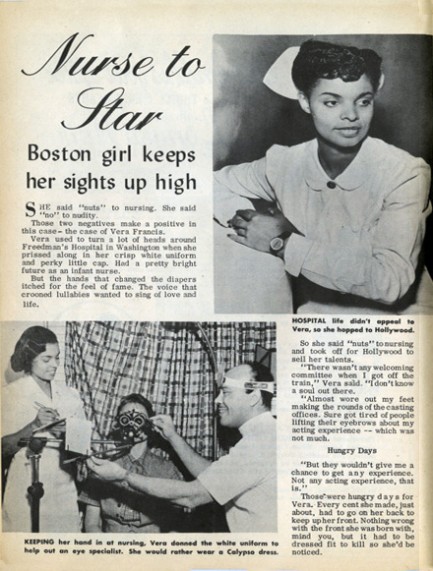 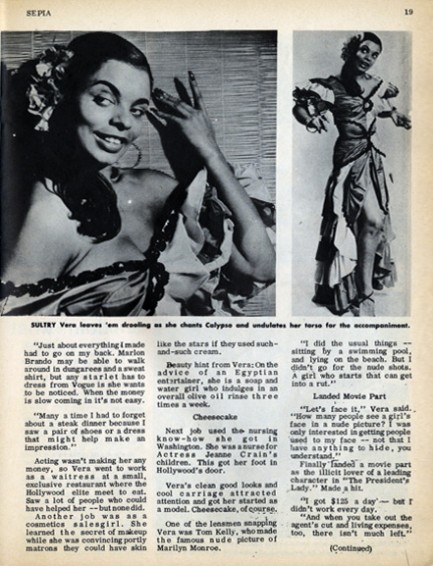 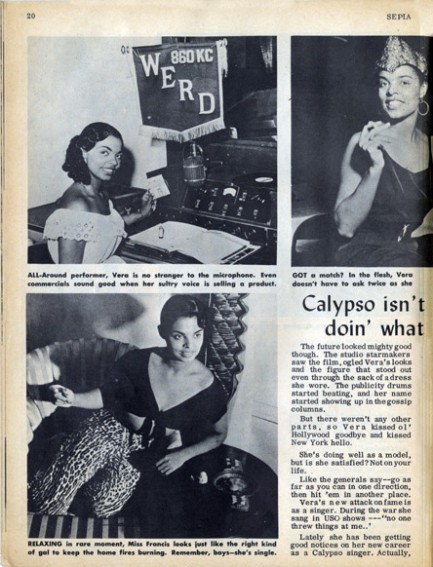 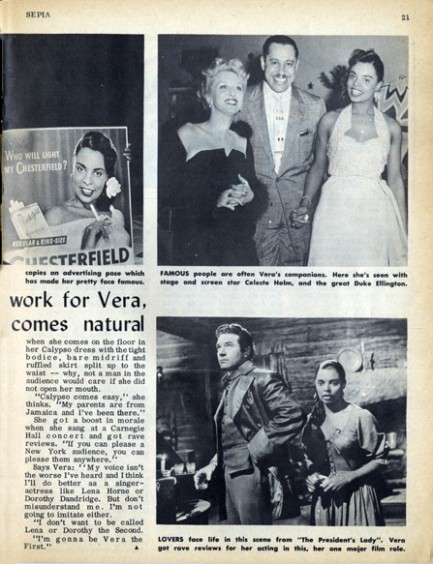 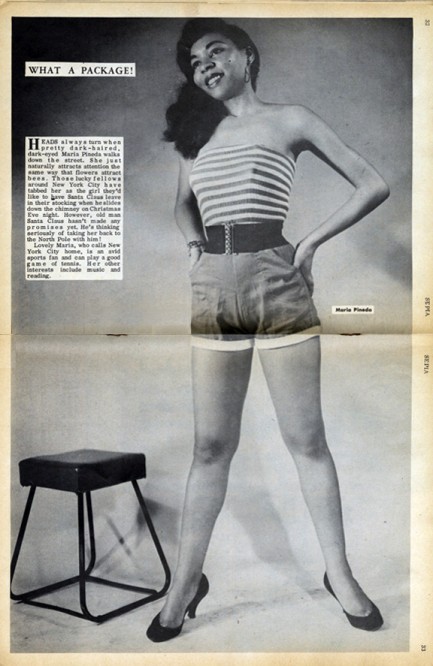 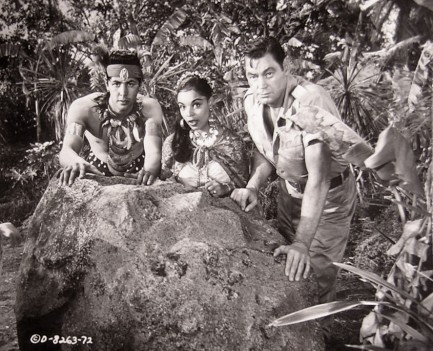
 Elusive Whitey Bulger captured in California. 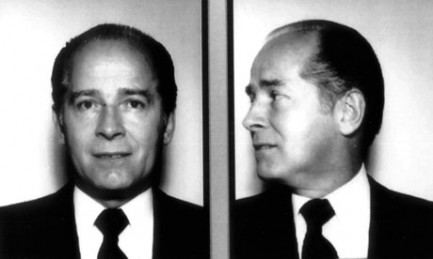
No, Whitey Bulger isn’t a thing, but a person. James “Whitey” Bulger, a notorious gangster who had been on the FBI’s 10 Most Wanted List for sixteen years and was the template for Jack Nicholson’s character in Martin Scorsese’s The Departed, was captured last night in Southern California. Bulger had once been leader of an Irish organized crime syndicate called the Winter Hill Gang, and worked for twenty years as an FBI informant in Boston. But he was dropped from the Feds’ roster in the early 1990s and dropped out of sight himself in 1995 when his FBI handler John Connolly, Jr. tipped him off that an indictment was coming down. Bulger was arrested yesterday at a Santa Monica apartment complex and now will face a full slate of serious charges—including murder, conspiracy, money laundering, narcotics distribution, and extortion. Though the FBI has traditionally worked with criminals to help secure evidence against other lawbreakers, the agency’s relationship with Whitey Bulger was sharply criticized once it became public. At the time, the FBI was determined to cripple the Italian Mafia in Boston, and saw a partnership with Bulger and his Winter Hill Gang associate Stephen “The Rifleman” Flemmi as an acceptable bargain. But the relationship quickly became messy as the agency turned a blind 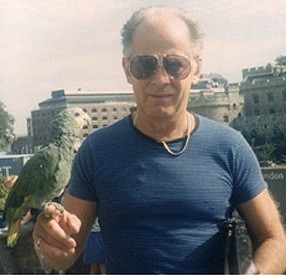 eye to Bulger and Flemmi’s ongoing crimes. Flemmi himself testified in court in 1998 that the FBI gave him a free pass on numerous murders and attempted murders. He described it as having a “license to kill.” eye to Bulger and Flemmi’s ongoing crimes. Flemmi himself testified in court in 1998 that the FBI gave him a free pass on numerous murders and attempted murders. He described it as having a “license to kill.” At one point, who was operating who came into serious doubt, as John Connolly—at Whitey Bulger’s behest—passed along a case of wine and an envelope of cash to John Morris, Connolly’s supervisor in the FBI. Morris later copped to accepting thousands in bribes from Bulger and Flemmi. And in the most bizarre twist, the already wealthy Bulger somehow won $1.9 million in the Massachusetts lottery but went on the run before he was able to claim his prize, leading to the sight of his sister marching into U.S. Appeals Court in an attempt to win rights to the cash. Safe to say that as convoluted a story as Scorsese filmed in The Departed, the truth was infinitely more complex. Whether that truth will ever come out is in doubt. Bulger, eighty-one years old, is certain to die in prison.
 But I didn’t steal the money, I swear—it was a bailout. 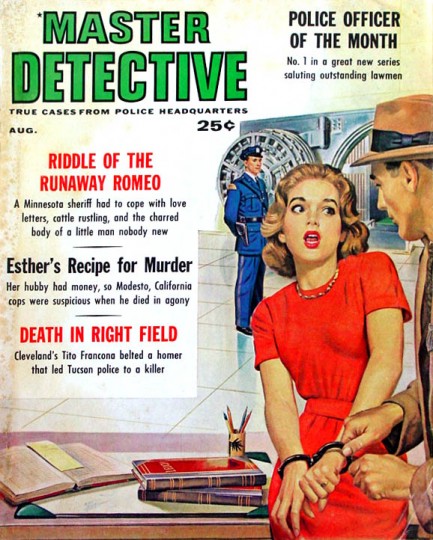
Above is an August 1962 Master Detective with great cover art of a lady in red being taken into custody, and clearly this isn’t a Wall Street bank she works at, because at those taxpayers’ money is free for the taking. Since it’s getting toward the best part of baseball season over in the U.S., the blurb that intrigued us the most on this cover was the final one, telling us that Tito Francona—father of current Boston Red Sox manager Terry Francona—was somehow involved in solving a murder. We’re told that he “belted a homer that led Tucson police to a killer”, and we were expecting the story to be some kind of convoluted mystery. But no—the blurb is meant literally. Francona hit a home run during a Cleveland Indians spring training game in Tucson and the ball actually landed next to a body that was hidden in brush beyond the right field wall. The body belonged to a fugitive who was wanted for the murder of his unfaithful wife’s lover. He had chosen that unlikely spot to commit suicide by shooting himself. Case solved. So Francona didn’t exactly enter stage right and help unravel a Da Vinci Code style puzzle, but the story is still an interesting historical footnote. Baseball is the type of sport where players and fans tend to believe in curses, so maybe a purification ceremony where the body was found would help the Indians finally win a World Series. It’s been sixty-two years and counting.

|
 |

The headlines that mattered yesteryear.
1933—The Gestapo Is Formed
The Geheime Staatspolizei, aka Gestapo, the official secret police force of Nazi Germany, is established. It begins under the administration of SS leader Heinrich Himmler in his position as Chief of German Police, but by 1939 is administered by the Reichssicherheitshauptamt, or Reich Main Security Office, and is a feared entity in every corner of Germany and beyond. 1937—Guernica Is Bombed
In Spain during the Spanish Civil War, the Basque town of Guernica is bombed by the German Luftwaffe, resulting in widespread destruction and casualties. The Basque government reports 1,654 people killed, while later research suggests far fewer deaths, but regardless, Guernica is viewed as an example of terror bombing and other countries learn that Nazi Germany is committed to that tactic. The bombing also becomes inspiration for Pablo Picasso, resulting in a protest painting that is not only his most famous work, but one the most important pieces of art ever produced. 1939—Batman Debuts
In Detective Comics #27, DC Comics publishes its second major superhero, Batman, who becomes one of the most popular comic book characters of all time, and then a popular camp television series starring Adam West, and lastly a multi-million dollar movie franchise starring Michael Keaton, then George Clooney, and finally Christian Bale. 1953—Crick and Watson Publish DNA Results
British scientists James D Watson and Francis Crick publish an article detailing their discovery of the existence and structure of deoxyribonucleic acid, or DNA, in Nature magazine. Their findings answer one of the oldest and most fundamental questions of biology, that of how living things reproduce themselves. 1967—First Space Program Casualty Occurs
Soviet cosmonaut Vladimir Komarov dies in Soyuz 1 when, during re-entry into Earth's atmosphere after more than ten successful orbits, the capsule's main parachute fails to deploy properly, and the backup chute becomes entangled in the first. The capsule's descent is slowed, but it still hits the ground at about 90 mph, at which point it bursts into flames. Komarov is the first human to die during a space mission.
|

|
|
It's easy. We have an uploader that makes it a snap. Use it to submit your art, text, header, and subhead. Your post can be funny, serious, or anything in between, as long as it's vintage pulp. You'll get a byline and experience the fleeting pride of free authorship. We'll edit your post for typos, but the rest is up to you. Click here to give us your best shot.
|
|