British adventurers get high in South Asia. 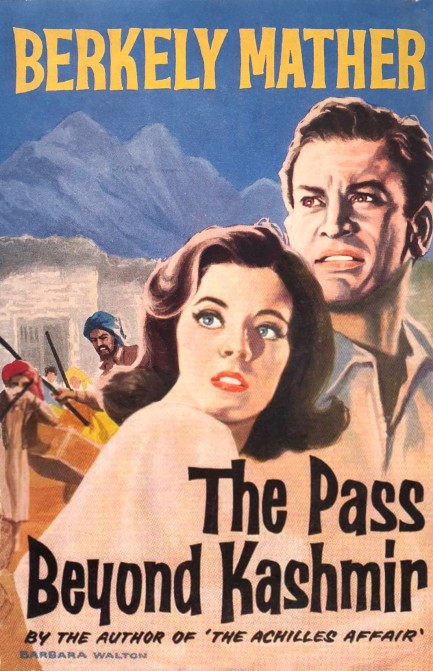
The cover you see above for Berkely Mather's, aka John Evan Weston-Davies', 1960 adventure The Pass Beyond Kashmir is one of the more pleasing we've come across. It's by Barbara Walton, a preeminent dust sleeve illustrator from the 1950s until around 2000. We've featured her a few times, such as here, here, and here, and this effort maintains her incredibly high standard. The scene depicted makes one think there's a major romantic subplot in the novel, but the love interest is in the book for maybe twenty pages. It isn't Walton's fault that the art gave us expectations that weren't met. It happens with covers sometimes. No romantic adventure here.
The story actually revolves around a sardonic and extremely determined ex-intelligence operative named Idwal Rees who gets caught up in a search for missing documents in the Himalayas that might reveal the location of an oil discovery. The action takes the form of a quest from Bombay-Mumbai into the high mountains, with new difficulties encountered in each stop by he and partner Smedley, servant Safaraz, and reluctant informer Poison. Each obstacle is followed by desperate problem solving, and hairsbreadth escapes. The aforementioned sort-of love interest, a nurse named Claire Culverton, is mainly a source of consternation for Rees and a focus for his chauvinism.
The set-up and framework are fine, but we felt that the book got bogged down with too much local color. Obviously, authors wish to impart that they've at a minimum done their homework, and at a maximum lived some version of what they're writing about, but there's also such a thing as narrative flow. We get it—Mather was really in India and Pakistan. He even served in the army there. But in our opinion he needed another pass from an editor to make for a better book. Still, as it resolved, it was decent, though anyone of Indian, Pakistani, or Chinese descent—or of good conscience—will bristle at the treatment meted out by Rees and other Brits. But you know that going in, right?
 Sneaky Chinese security ministry hatches scheme to infiltrate U.S. with costumed spies. 
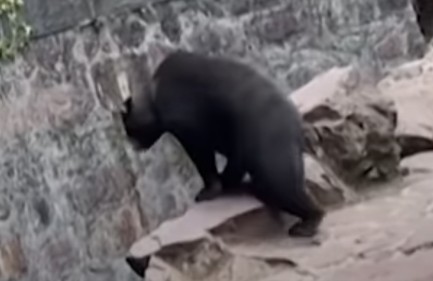
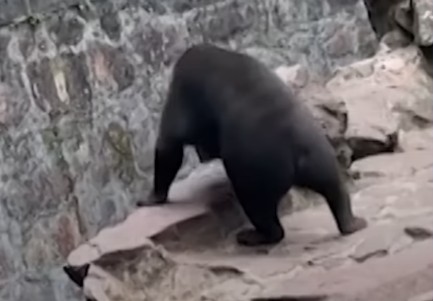
We resisted this for a few days, but in the end we caved because we had a late night, which oh so often leads to an early morning, which in turn means we have a little more time than usual before our work days begin. Therefore: an image went viral over the weekend of a sun bear in a zoo in Hangzhou, China that many online commenters seem convinced was a human in costume. The image was a frame from a video. Chinese authorities dealt with the wave of outrage far too logically, we think. They could have simply said, “What would be the fucking point of that?” Instead they noted that, as the daytime high temperature was near 100 Fahrenheit when the video was made, a human in a thick fur costume, “would not last more than a few minutes before collapsing.” Uh huh.
But what if the costume were refrigerated? What if, in fact, the fake bear was a field test by the Ministry of State Security for a new scheme in which U.S. national parks would be infiltrated by spies in refrigerated sun bear costumes, who would gather crucial intel from Yellowstone, Grand Teton, and other wilderness areas where the most important Americans are well known to congregate? Obviously, sun bears are not native to North America, but the type of fur needed to make grizzly costumes is scarce due to global supply chain issues. Anyway, the bears are merely a precursor to more advanced costumes in the form of pot-bellied pigs. Once those pig costumes are perfected, they'll be used to infiltrate Congress, and they'll fit right in. Some will probably even get committee assignments.
On the other hand, in this, the year of our impatience 2023, one could watch the posted videos to their conclusions and see that the phony sun bear is actually a real bear (named Angela). But we do have to give the online virus vectors credit. Breaking down a video to single frames is the most efficient way to fool people. It's how the cops who attacked Rodney King avoided jail (well, that and racism): “Ladies and gentlemen of the jury, in motion Mr. King indeed seems to be helpless, but look! This freeze frame shows his raised arm, clearly an attempt to attack the police!” For those of you who have better things to do with your time than watch a sun bear video, below you see a few frames from seconds later in the same sequence. That's all bear is, folks.
 It's not comfortable, but it's reliable. 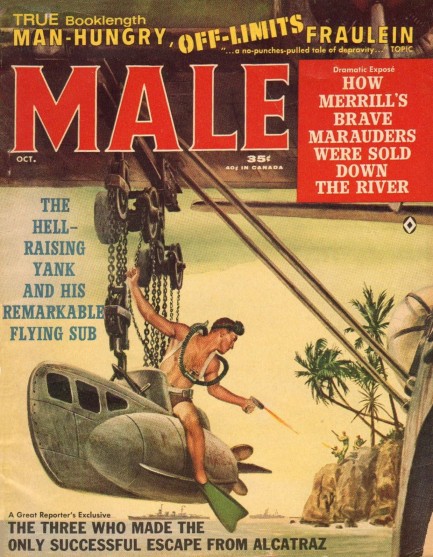
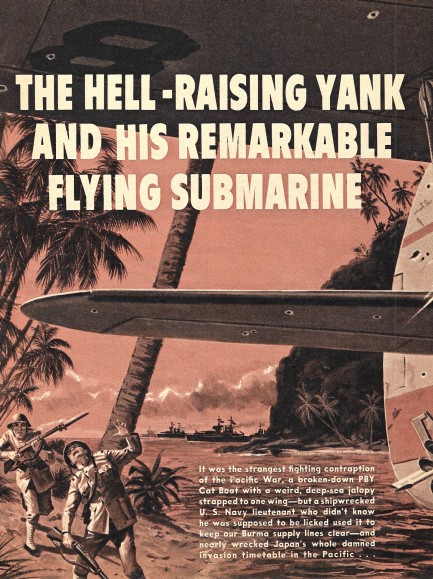
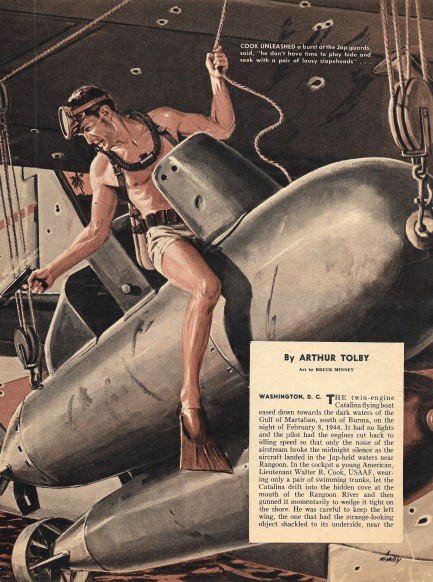
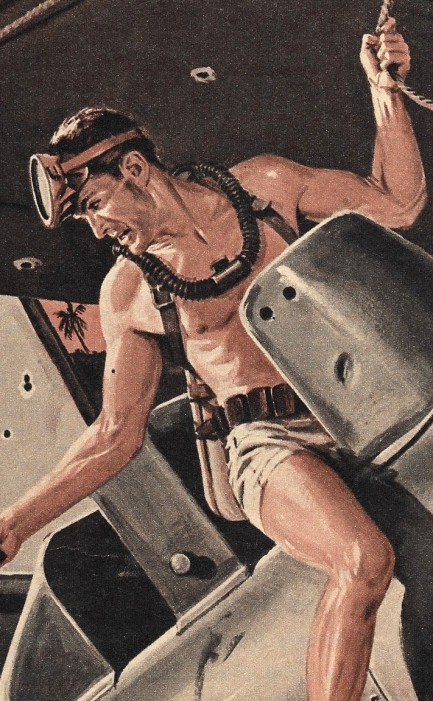
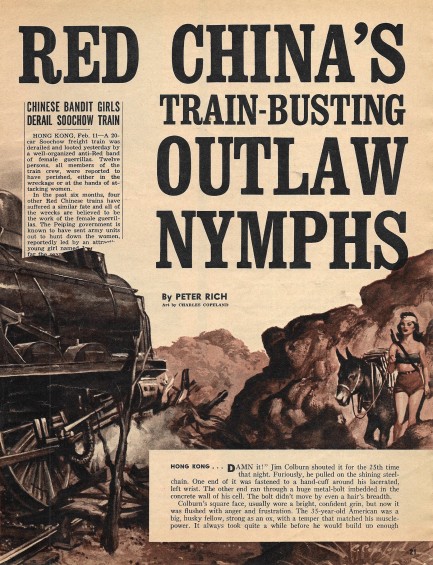
We're back to men's adventure mags today with an issue of Male from this month in 1962, with cover art by Mort Kunstler illustrating the tale, “The Hell-Raising Yank and His Remarkable Flying Sub.” We gave the story a read and it tells of Walter R. Cook, a U.S. soldier stranded in Burma who, with the aid of a local beauty (of course), finds and refurbishes an abandoned Catalina seaplane, which has attached to it a two man submarine. The sub was a type used during World War II that the operators rode like horses while breathing through scuba gear. Cook uses it to disrupt Japanese supply lines.
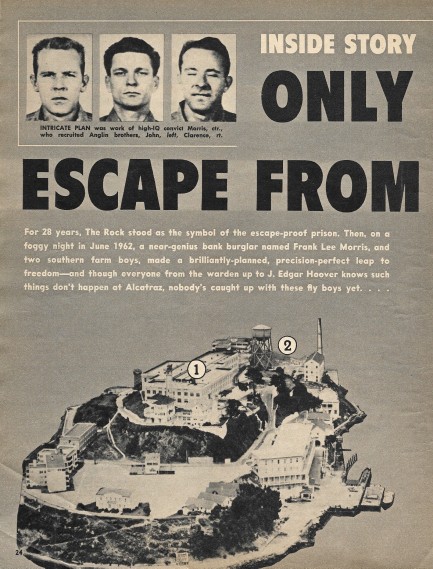
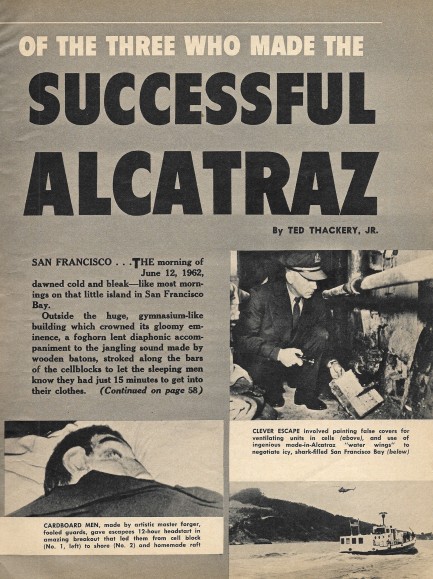
The story is a standard sort for an adventure magazine, but educational, since we'd never heard of rideable submarines. The illustration makes clear exactly what form it took. The magazine also offers stories set in China and New Zealand, and contains a detailed piece on an escape from Alcatraz, the very escape that inspired the Clint Eastwood film Escape from Alcatraz, involving the inmate Frank Morris, who may or may not have actually succeeded. The art throughout the issue is from the usual suspects—Charles Copeland, Samson Pollen, and Bruce Minney—and is tops as always. We have seventeen scans below.
 Hong Kong sexploitation epic isn't very good, but give it credit for ripping the scab off a historical wound. 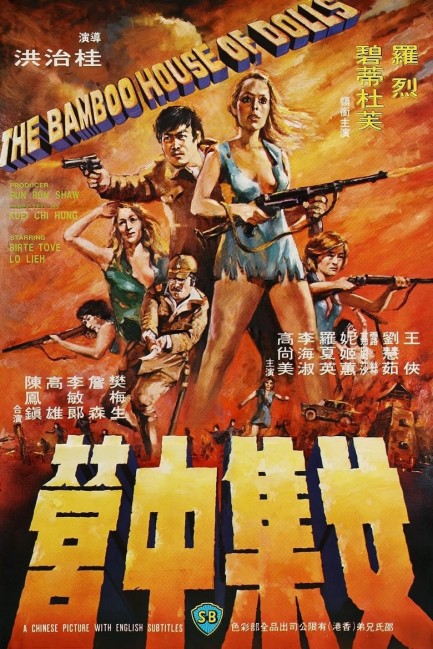
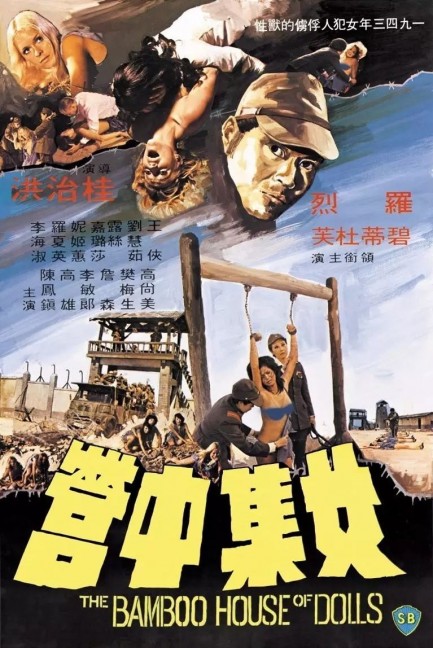
Above is a poster for the sexploitation flick Nu ji zhong ying, known in English as The Bamboo House of Dolls, and to get right to the heart of the matter, this one must have set Sino-Japanese relations back a few years. The film stars Danish actress Birte Tove as a nurse in Hong Kong who during World War II gets corralled along with her co-workers into Japanese Women's Concentration Camp 13, there to undergo various indignities before finally deciding that escape is her only option. You know the drill. Tove is the marquee attraction, but the film is largely cast with Hong Kong actresses such as Lee Hye-Sook, Hseih Wang, and others, which means that while the movie resembles entries in the women-in-prison sub-genre—with the scheming wardeness, lesbian sex, group showers, and half-cocked escapees made into examples of what not to do while in a tropical women's prison—the obvious historical context of Japan actually sexually abusing Chinese women during the war gives it an underlying grimness that's hard to ignore.
We suspect that if this were made today it would spark an international crisis, insults traded by high ranking officials on Twitter, and possibly diplomats kicked out of China and Japan, but 1970s filmmakers did not shy away from uncomfortable subject matter—and this is about as uncomfortable as it gets. That isn't the problem, though. Well, that isn't the problem for us. The objective problem is the movie is just bad. Legendary Hong Kong producers the Shaw Brothers (and by legendary we mean Run Run Shaw would be knighted in 1977) wanted to copy Jack Hill's women-in-prison movies The Big Bird Cage and The Big Doll House, but possibly overlooked the fact that setting such films in imaginary Central American hellholes as Hill did was worlds away from making the Japanese the villains in a historically laden sexual abuse epic. But what do we know? Run Run got knighted, not us. In any case, Tove's escape plan runs into some snags, but we won't reveal what those are, just in case you're in the mood for politically explosive titillation. Our advice? Give it a pass. Nu ji zhong ying premiered in Hong Kong today in 1973. 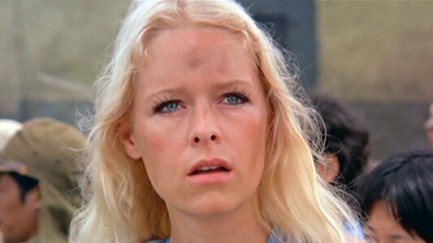 I get the feeling there's history here. Since I'm from Denmark, maybe I can I just leave? I get the feeling there's history here. Since I'm from Denmark, maybe I can I just leave?
 Calcutta is heavy on looks but light on substance. 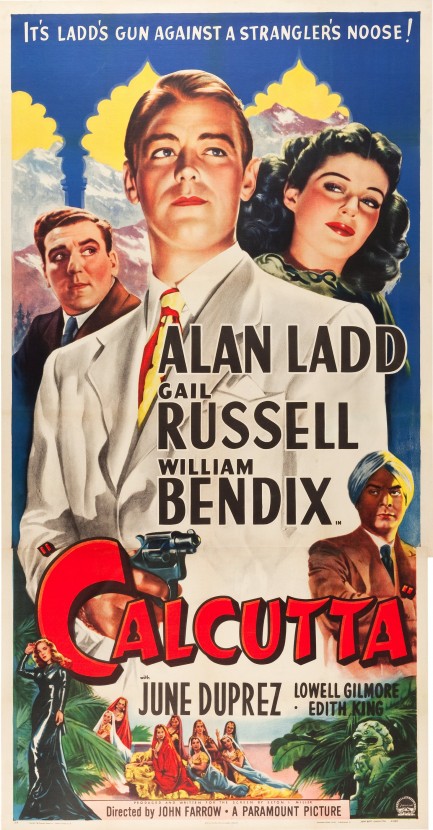
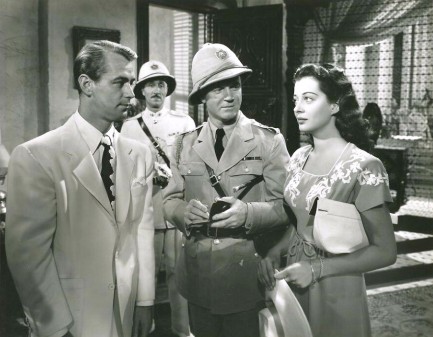
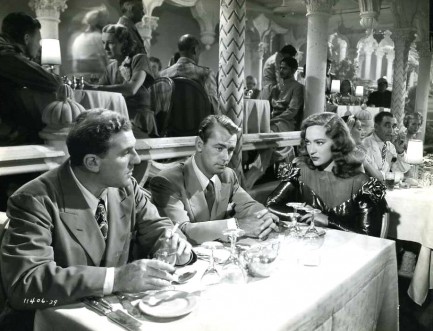
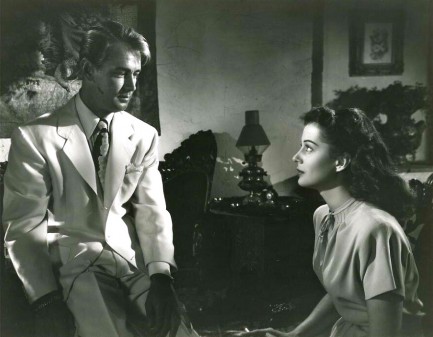
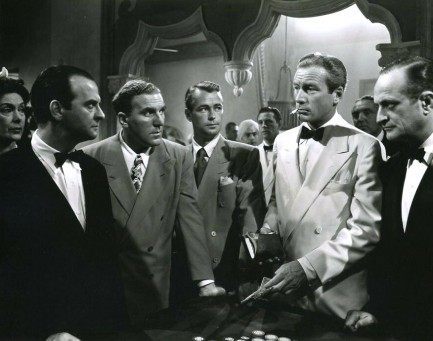
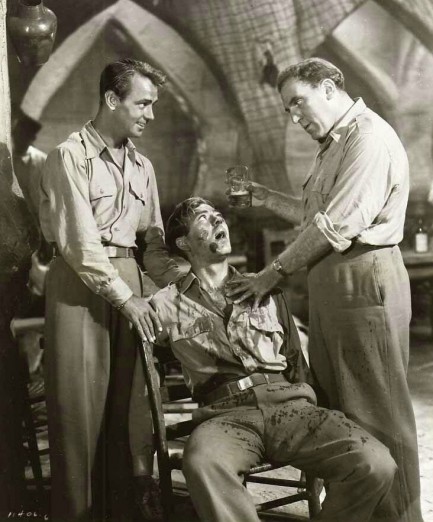
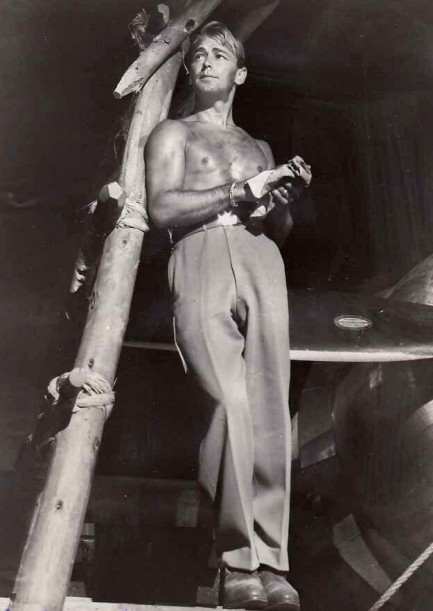
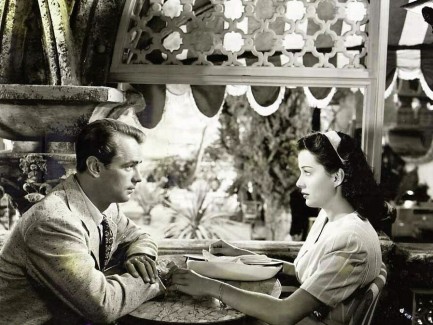
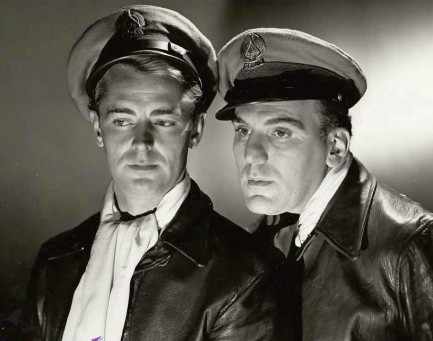
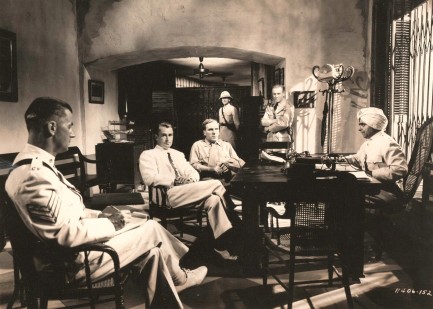
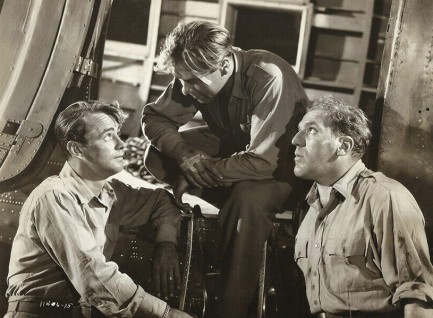
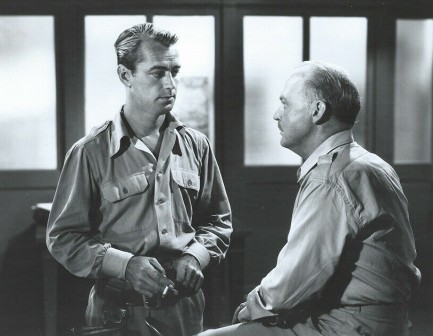
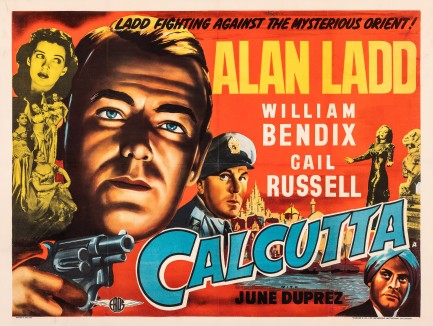
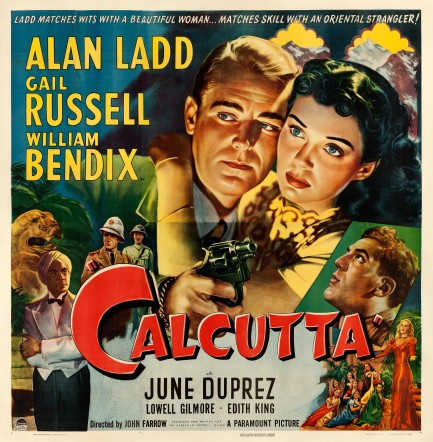
We'll tell you right out that Calcutta came very close to being an excellent movie, but doesn't quite get over the hump. It deals with a trio of pilots flying cargo between India and China on fictional China International Airways. The trio, Alan Ladd, William Bendix, and John Whitney, stumble upon a highly profitable international smuggling ring and quickly find that the villains play for keeps. Along with the fliers, the film has Gail Russell as Whitney's girlfriend, and June Duprez as a slinky nightclub singer. While the exotic setting marks the film as an adventure, it also fits the brief as a film noir, particularly in Ladd's cynical and icy protagonist.
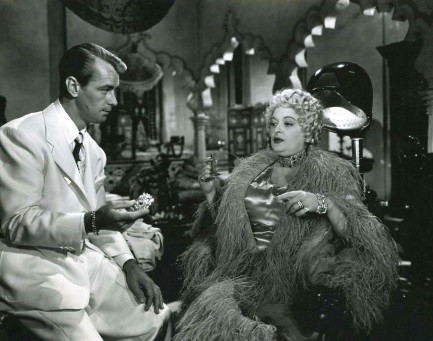
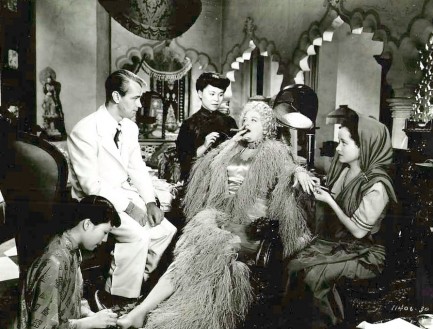
As we said, the movie isn't as good as it should be, but there are some positives. Foremost among them is Edith King as a wealthy jewel merchant. She smokes a fat cigar, the masculine affectation an unspoken but clear hint of her possible lesbianism, and with a sort of jocular grandiosity simply nails her part. Another big plus is the fact that the miniature work (used in airport scenes), elaborate sets and props, and costumed extras all make for a convincing Indian illusion—definitely needed when a movie is filmed entirely in California and Arizona (Yuma City and Tucson sometimes served as stand-ins for exotic Asian cities, for example Damascus in Humphrey Bogart's Sirocco).
On the negative side, Calcutta has two narrative problems: the head villain is immediately guessable; and Russell is asked to take on more than she can handle as an actress, particularly as the movie nears its climax. Another problem for some viewers, but not all, is that the movie has the usual issues of white-centered stories set in Asia (or Africa). However, within the fictional milieu the characters themselves seem pretty much color and culture blind, which isn't always the case with old films. Even so, the phalanxes of loyal Indian servants, and the dismissiveness with which they're treated—though that treatment is historically accurate—probably won't sit well with a portion of viewers.
Here's what to focus on: Alan Ladd. He's a great screen presence, a solid actor in the tight-lipped way you often see in period crime films, and the filmmakers were even smart enough to keep him shirtless and oiled for one scene. We swear we heard eight-decade-old sighs on the wind, or maybe that was the Pulp Intl. girlfriends. They'd never seen Ladd before, but immediately became interested in his other films. We were forced to tell them he was a shrimpy 5' 6” and they were a bit bummed. But he had it—and that's what counted. His it makes all his films watchable, but doesn't quite make this one a high ranker. Calcutta had its official world premiere in London today in 1946.
 When someone says they're playing the role of their life they usually mean it figuratively. 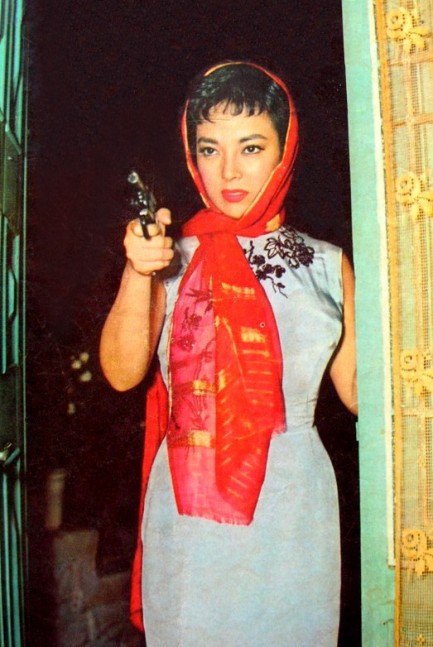
This nice photo shows actress and singer Li Xianglan, aka Li Hsiang-lan, and based on her name you'd guess she's Chinese, but she was actually Japanese and her real name was Yoshiko Yamaguchi. Early in her career the Manchukuo Film Association noted that she had grown up in Manchuria and was fluent in Mandarin, so they decided to hide her Japanese origin, which made it possible for her to star in Japanese films posing as Chinese. The purpose was to make films promoting certain Japanese ideologies, disseminated onscreen by someone the Chinese public saw as one of their own. In other words, at a time when Japan had invaded and occupied part of China, she starred in propaganda films. The ruse wasn't perfect. People Xianglan worked with figured out she was Japanese, but the Chinese public didn't know until 1946, when she was arrested after the Second Sino-Japanese War as a collaborator. She avoided execution only by revealing her Japanese identity to the Chinese court. It's a long and interesting story, but we won't get into it here. We'll note, though, that her tale didn't end there. She became a journalist in the 1950s using the name Yoshiko Otaka, and was elected to the Japanese parliament in 1974, where she served eighteen years. Quite an autobiography. The photo above was made to promote her 1957 film Shénmì měirén, aka Lady of Mystery. Indeed.
 Sexplay goes south in a big way for cock cage gamesters. 
Everything—truly everything—is going digital. We're thrilled to inform you that they finally upgraded the cock cage. We're surprised we missed this tech bombshell when it happened a while back, but finding out late is better than never. Longtime readers will know right away why we had to write about this, because they'll remember the Pulp Intl. cock cages. For newer visitors, back when we bothered putting ads on our website, for a few months we accepted the filthy but spendable lucre of a manufacturer of cock cages. They're metal devices designed to keep your junk trunked, and the idea is to prevent erections, bdsm style, for purposes of denial or punishment. Fun, right?
Now it seems there's a digital version, remotely controlled, compatible with the internet of things. The device, seen above, is called the Cellmate. It's from China-based manufacturer Qiui, and basically you slide this puppy on, lock it, and give someone else the code—and the power over whether to unleash your kraken. This is a quantum leap in sexual discomfort. Back during the analog cock cage days you'd whine to your master or mistress in person to set your peehole free. Now you text them. Maybe send them a frowny emoticon. And somewhere, near or far, they tap a code into their phone and it's sweet release for you.
Except some cheeky hacker found a security flaw and kept an unknown number of unlucky willies locked up against their will. What can you say? Hackers gonna hack, right? And they weren't content just to harass and terrify. They also demanded bitcoin ransoms, and sent messages to the effect of, “Your cock is mine now.” We don't know how many dismayed consumers lost their digital innocence through this scam, nor how many—if any—paid the ransom, but we would. Fuck yeah we would. We'd pay plenty. But we're happy to say it could never happen. The only people who keep our cocks locked up are the Pulp Intl. girlfriends. 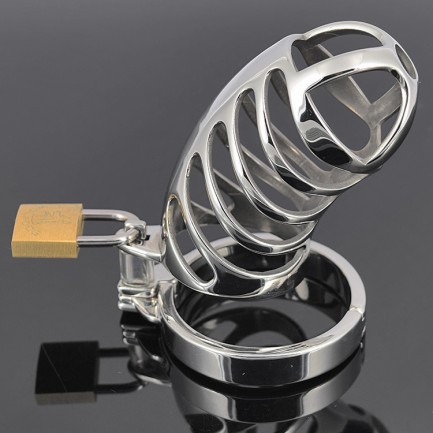 Analog cock cage with cheap dime store lock. Analog cock cage with cheap dime store lock.
 Digital cock cage with encrypted security. Which would you choose? Digital cock cage with encrypted security. Which would you choose?
 China figures out how to kiloton of people. 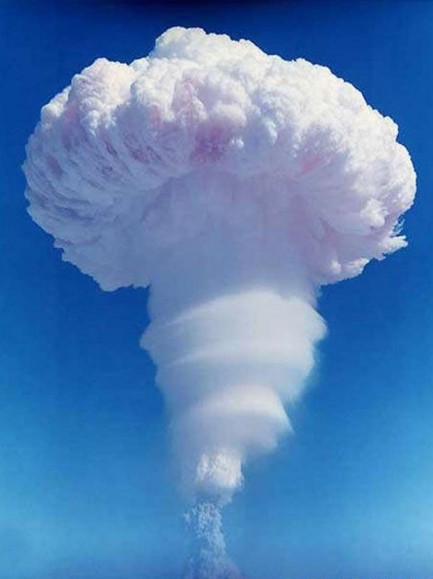
This photo shows the first Chinese nuclear device, detonated today at Lop Nur in 1964. The U.S., Russia, France, and England were already members of the worst club ever devised—the nuclear club, the one aliens will write into the galactic history books as proof of humanity's inferior intelligence. China's tower mounted bomb was about the size of the U.S. bomb dropped on Hiroshima, a mere balloon pop. For the sake of comparison, the most powerful nuke ever detonated exploded with the power of 57 million tons of TNT, more than 1,500 times the destructive power of the Hiroshima and Nagasaki bombs combined. Put another way, it was ten times more powerful than all the munitions expended during World War II. Put still a third way, its shockwave circled the entire Earth three times. China very well might build a bomb like that too one day. Just to be like the cool kids. See another image of the above test here.
 It's all skin no wit as tabloid stumbles along on its last legs. 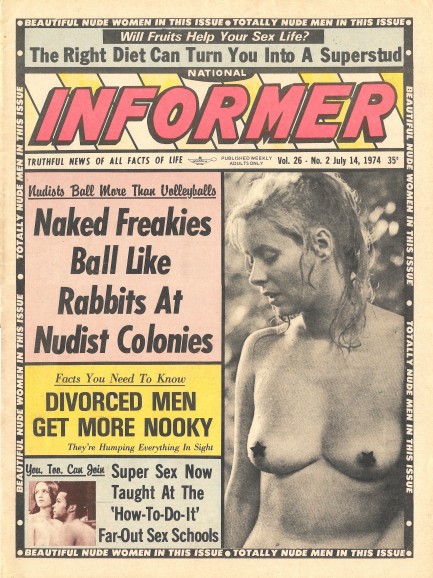
It's July 14, 1974 and it's getting late in the game for National Informer. This issue shows that the magazine is exhausted of ideas and inspiration, and is bereft of all but the crassest humor. We suspect staff reductions. As magazines decline in circulation they lose pages and bleed staff. This issue is a full eight pages shorter than two years earlier. We aren't sure how much longer Informer lasted, but by this point the writing seems to be on the wall.
One mainstay, though, is resident seer Mark Travis, who offers his thoughts about the far future, predicting that Greenland will become the next frontier by 2050 due to underground volcanoes turning it into a tropical paradise, and Brazil will become a world power by 2075, ranking only after the U.S., China, and the U.S.S.R., thanks to cheap labor and the vast resources of the Amazon.
This guess is not far wide of the mark. The current president of Brazil is selling off the Amazon. But Travis's prediction is undermined by the fact that the U.S.S.R. no longer exists. Future visions tend to be notoriously select, but a non-U.S.S.R. future should be glaringly readable even within swirling clairvoyant mists. Well, no seer is perfect. Maybe Travis will do better in the next issue. You'll find out, because we have more to come. 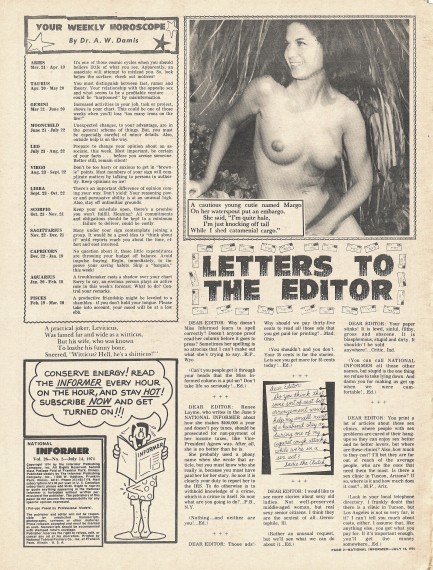    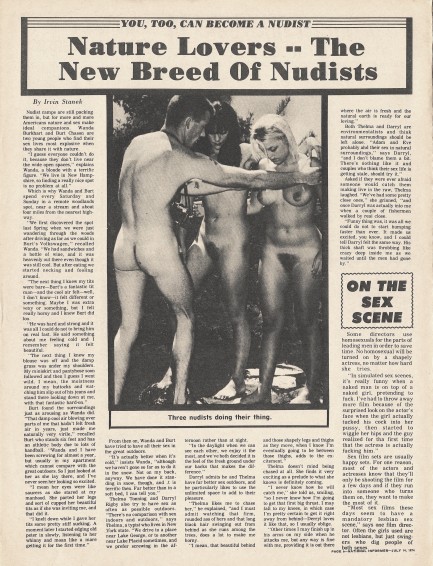 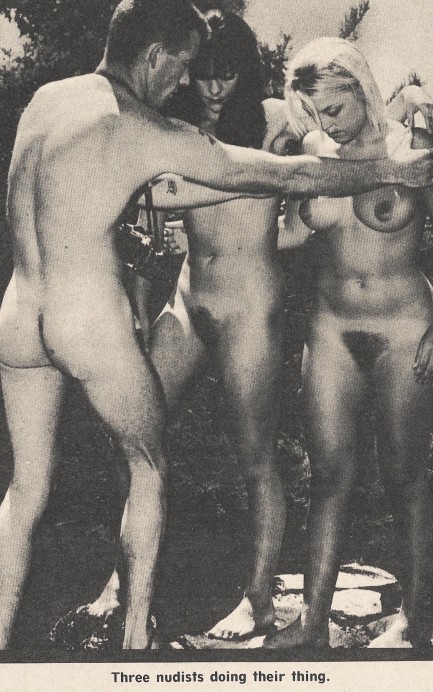    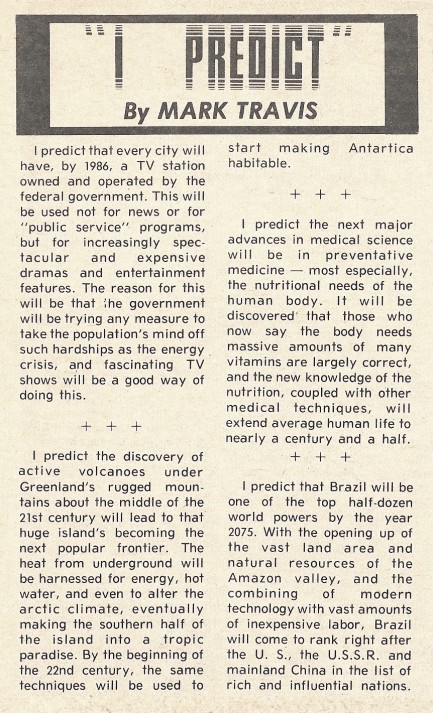  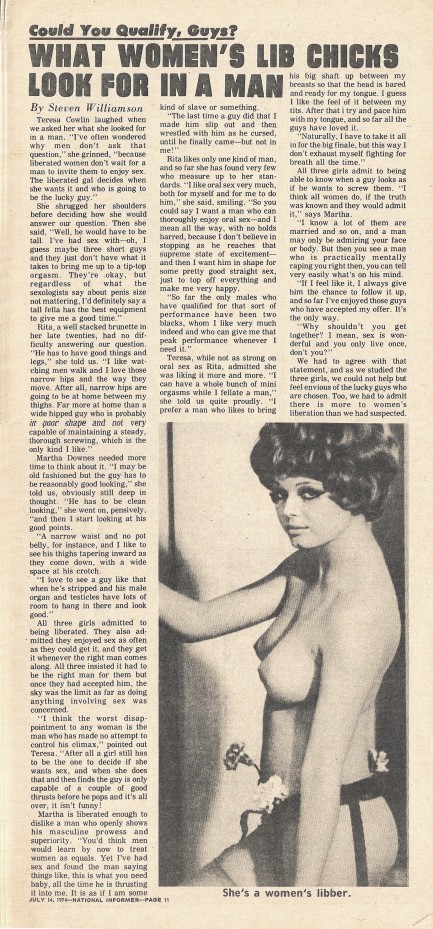   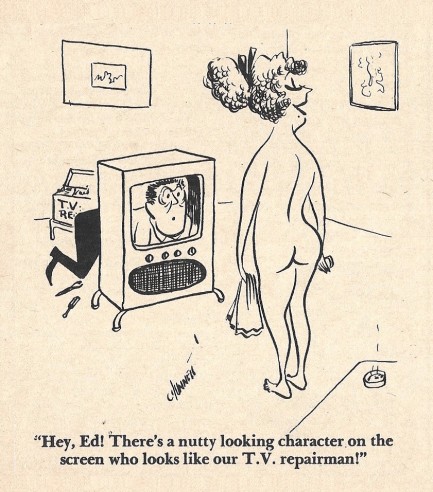
 Forget it, Jake. It's Tinseltown. 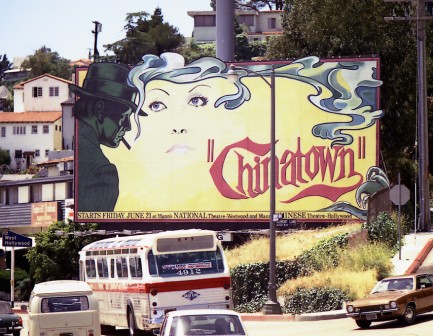
We were poking around the architecture forum skyscraperpage.com and ran across this interesting photo of a billboard advertising the film Chinatown. This was located in Los Angeles at the intersection of Sunset Boulevard and Marmont Lane, and as you can see it touts the opening of the film today in 1974. We lived on the west side of L.A. for four years, and used to pass this spot occasionally. Marmont Lane winds to the right toward the famed Chateau Marmont Hotel, where luminaries such as Howard Hughes, Natalie Wood, Elizabeth Taylor, and James Dean once made the scene, and a couple met their ends, including Helmut Newton and John Belushi.
We knew the intersection was one of the city's most important billboard spots and wondered what else had been advertised there. So we had a look.  We expected to find an assortment of examples, but it turns out the locale was so coveted a relative few companies monopolized it. The first was the Sahara Hotel in Las Vegas, which erected a sign there in 1957, complete with a rotating showgirl and an illuminated marquee listing the headlining acts. We expected to find an assortment of examples, but it turns out the locale was so coveted a relative few companies monopolized it. The first was the Sahara Hotel in Las Vegas, which erected a sign there in 1957, complete with a rotating showgirl and an illuminated marquee listing the headlining acts.
The sheer novelty of the sign helped establish the heavily trafficked intersection as one of L.A.'s go-to spots for promotion, and the sign itself became a landmark. In fact, in 1961 Jayne Mansfield unveiled a Rocky and Bullwinkle statue across the street that was inspired by the Sahara showgirl. It was commissioned by Jay Ward, producer of the television series Rocky and His Friends, for the opening of his office complex.
After the Sahara moved on in 1966 the location was divided into two-tiered advertising. For almost three decades the iconic Marlboro Man towered above the intersection on the higher billboard, first on a horse, and later sans mount. During the time Chinatown was advertised Mr. Marlboro was standing vigil above. The lower location hosted ads for Stroh's and numerous other products, but was a particularly popular home for movie billboards. We found shots of billboards for Looking for Mr. Goodbar, Black Sunday, and other popular films of the 1970s.
Tens of thousands of billboards dot the Los Angeles landscape, especially around Hollywood. An uptick of political billboards has some Angelenos considering whether these objects are more akin to visual pollution. They're already illegal in entire U.S. states, including Hawaii and Maine. We always thought they further cluttered an already chaotic landscape, but we imagine they will survive in Los Angeles longer than almost anywhere else in the U.S. Tinseltown is a place where you don't get people's attention unless you scream for it. Nothing screams better than a well placed billboard. 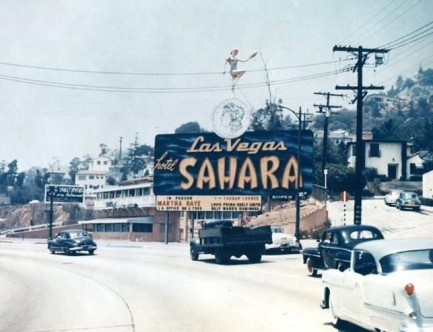 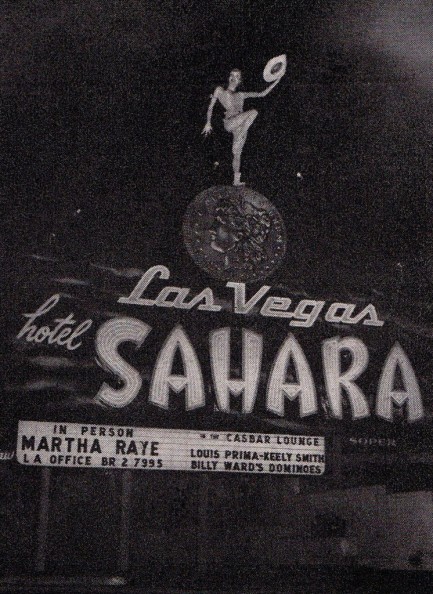 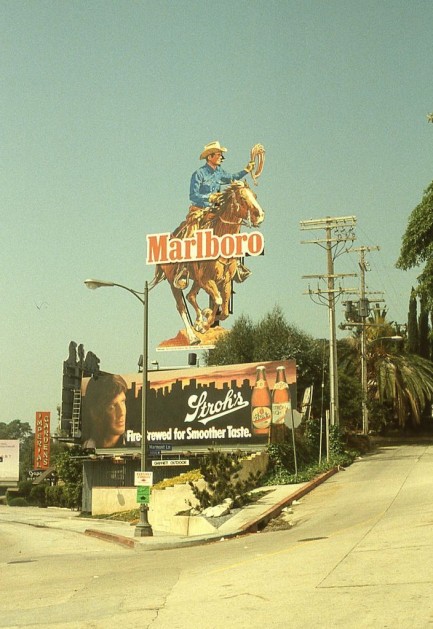

|
 |

The headlines that mattered yesteryear.
1945—Mussolini Is Arrested
Italian dictator Benito Mussolini, his mistress Clara Petacci, and fifteen supporters are arrested by Italian partisans in Dongo, Italy while attempting to escape the region in the wake of the collapse of Mussolini's fascist government. The next day, Mussolini and his mistress are both executed, along with most of the members of their group. Their bodies are then trucked to Milan where they are hung upside down on meathooks from the roof of a gas station, then spat upon and stoned until they are unrecognizable. 1933—The Gestapo Is Formed
The Geheime Staatspolizei, aka Gestapo, the official secret police force of Nazi Germany, is established. It begins under the administration of SS leader Heinrich Himmler in his position as Chief of German Police, but by 1939 is administered by the Reichssicherheitshauptamt, or Reich Main Security Office, and is a feared entity in every corner of Germany and beyond. 1937—Guernica Is Bombed
In Spain during the Spanish Civil War, the Basque town of Guernica is bombed by the German Luftwaffe, resulting in widespread destruction and casualties. The Basque government reports 1,654 people killed, while later research suggests far fewer deaths, but regardless, Guernica is viewed as an example of terror bombing and other countries learn that Nazi Germany is committed to that tactic. The bombing also becomes inspiration for Pablo Picasso, resulting in a protest painting that is not only his most famous work, but one the most important pieces of art ever produced. 1939—Batman Debuts
In Detective Comics #27, DC Comics publishes its second major superhero, Batman, who becomes one of the most popular comic book characters of all time, and then a popular camp television series starring Adam West, and lastly a multi-million dollar movie franchise starring Michael Keaton, then George Clooney, and finally Christian Bale. 1953—Crick and Watson Publish DNA Results
British scientists James D Watson and Francis Crick publish an article detailing their discovery of the existence and structure of deoxyribonucleic acid, or DNA, in Nature magazine. Their findings answer one of the oldest and most fundamental questions of biology, that of how living things reproduce themselves.
|

|
|
It's easy. We have an uploader that makes it a snap. Use it to submit your art, text, header, and subhead. Your post can be funny, serious, or anything in between, as long as it's vintage pulp. You'll get a byline and experience the fleeting pride of free authorship. We'll edit your post for typos, but the rest is up to you. Click here to give us your best shot.

|
|